Benefits of Bridging Assets Across Chains
 by
by 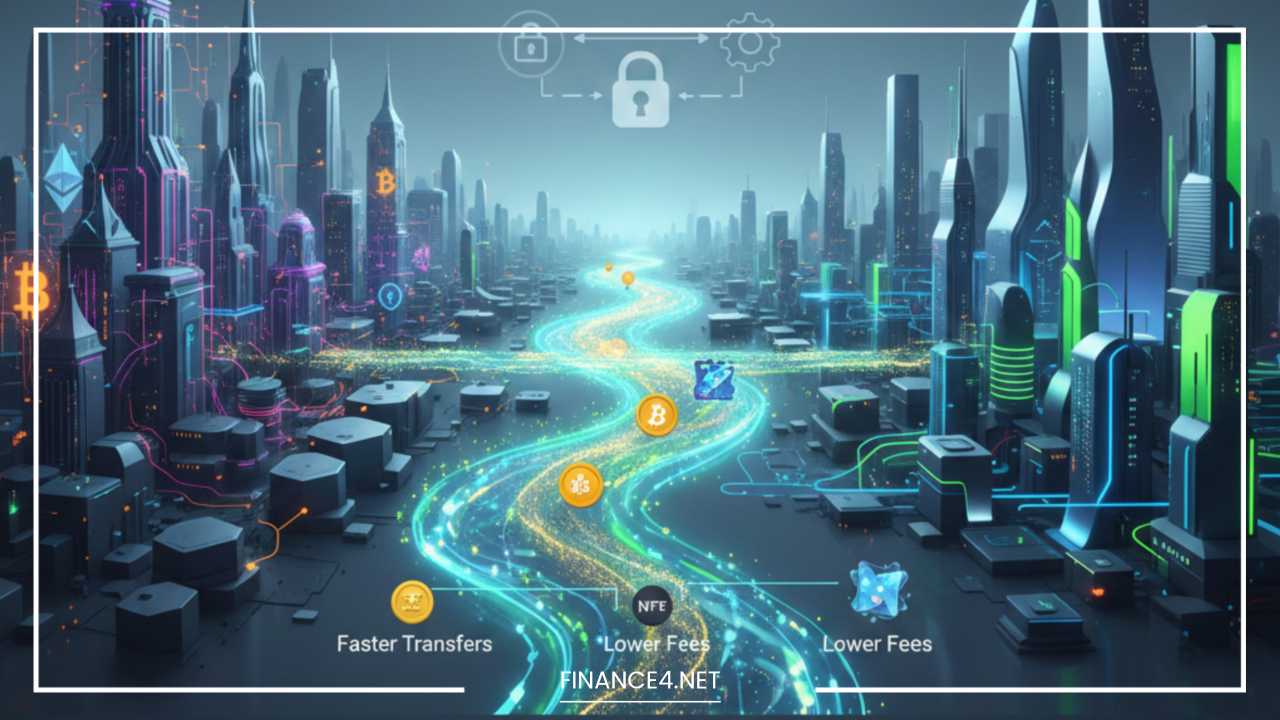
Benefits of Bridging Assets Across Chains: Faster, Cheaper & Flexible Transfers
The digital asset landscape in 2026 has matured into a complex, multi-layered environment. The early dominance of single-chain ecosystems has given way to a world where thousands of blockchains, from Layer 1 powerhouses like Ethereum and Solana to modular Layer 2s and application-specific “AppChains,” coexist. While this diversity drives innovation, it creates a fundamental problem: fragmentation.
Without a way for these networks to communicate, liquidity remains trapped, users are siloed, and developers are forced to build in isolation. Cross-chain asset bridging has emerged as the essential infrastructure—the “connective tissue” of Web3—that solves these challenges. By enabling the seamless movement of value across disparate ledgers, bridges provide the speed, cost-efficiency, and flexibility required for a truly global decentralized economy.
The Rise of Multi-Chain Ecosystems
The evolution of blockchain technology mirrors the history of the early internet. Just as local area networks eventually needed the TCP/IP protocol to form the global World Wide Web, blockchains have reached a point where isolated operations are no longer sufficient.
The Shift from Single to Multi-Chain
In the previous decade, the industry debated whether one “monolithic” chain would eventually host all global activity. However, the sheer demand for block space led to high fees and congestion, proving that a single network cannot scale to meet every global use case. This led to the explosion of the multi-chain ecosystem:
-
Layer 1s (L1s): Alternative base layers specializing in different trade-offs of the “Blockchain Scalability Trilemma” (Security, Scalability, and Decentralization).
-
Layer 2s (L2s) and Rollups: Chains that sit on top of L1s (primarily Ethereum) to process transactions faster and cheaper while inheriting the base layer’s security.
-
Modular Blockchains: Networks that outsource specific functions (like data availability or execution) to different layers.
The Problem of Fragmentation
This explosion of choice created a “walled garden” effect. A user’s capital on Arbitrum was not natively accessible for a DeFi protocol on Avalanche. This liquidity fragmentation meant that market depth was shallow across multiple platforms rather than concentrated in one efficient market.
Asset bridging emerged as the solution to dismantle these walls. Bridging is the process of porting the value and utility of a digital asset from a “source” chain to a “destination” chain. It is the backbone of blockchain interoperability, allowing for a unified user experience across the entire Web3 stack.
What Does Bridging Assets Across Chains Mean?
Technically, tokens do not “move” between blockchains. Because each blockchain is a closed ledger, an asset that exists on Ethereum cannot physically leave its native database to enter Solana’s. Instead, bridges facilitate a synchronized “state change” across both networks.
How Asset Bridging Works
Most bridges function using a set of smart contracts on both the source and destination chains, coordinated by an off-chain messaging layer. The mechanism generally follows one of four primary models:
- Lock-and-Mint (The Wrapped Asset Model):The most common approach for cross-chain transfers. A user sends their native asset (e.g., BTC) to a bridge contract on the source chain, where it is locked in escrow. The bridge then sends a message to the destination chain, which mints an equivalent amount of a “wrapped” asset (e.g., WBTC). When the user wants to return, the wrapped asset is burned, and the original is unlocked.
- Burn-and-Mint:Often used by token issuers for their native assets across multiple chains (like USDC). Instead of locking funds in escrow, the bridge burns the native token on the source chain and mints a native version on the destination chain. This eliminates the risk of an escrow “honeypot” being hacked.
- Liquidity-Based Bridges (Atomic Swaps):These bridges maintain pre-funded “liquidity pools” on both sides. If you want to move 100 USDT from Chain A to Chain B, you deposit into the pool on Chain A, and the bridge sends you 100 USDT from its existing pool on Chain B. This is often the fastest method but is limited by the amount of liquidity available in the pools.
- Cross-Chain Messaging:More advanced protocols (like LayerZero or Chainlink CCIP) don’t just move assets; they move “intent” or “data.” This allows a smart contract on one chain to call a function on another, enabling “cross-chain native” assets that don’t need wrapping at all.
Bridges vs. Centralized Exchanges (CEXs)
While you can move funds between chains by depositing to an exchange like Binance and withdrawing to a different network, this process is custodial. You lose control of your private keys. Decentralized bridges allow for non-custodial transfers where the user maintains ownership of their assets throughout the entire journey.
Why Cross-Chain Interoperability Matters
Interoperability is not just a technical luxury; it is an economic necessity. Without it, the blockchain world remains a series of “silos,” leading to several systemic inefficiencies:
-
Capital Inefficiency: Users may have idle capital on one chain while high-yield opportunities exist on another. Bridging allows capital to flow to where it is most productive.
-
Developer Friction: Developers currently have to choose a “home” chain. Interoperability allows them to build apps that leverage Ethereum’s security, Solana’s speed, and Arweave’s storage simultaneously.
-
User UX Hurdles: For mass adoption, a user shouldn’t need to know which “chain” they are on. Bridging (and its successor, Chain Abstraction) aims to make the underlying network invisible to the end user.
Key Benefits of Bridging Assets Across Chains
The implementation of robust bridging technology offers four primary pillars of value: speed, cost-efficiency, liquidity access, and flexibility.
1 Faster Asset Transfers Across Networks
In 2026, the speed of value transfer is a competitive advantage. Traditional bank transfers can still take 3-5 business days to settle across borders. Even early blockchain transfers were subject to long “finality” times on Layer 1 networks.
Modern bridges, especially those utilizing optimistic or zero-knowledge (ZK) proofs, have slashed these times to minutes or even seconds. This speed enables:
-
Arbitrage: Traders can instantly move funds between decentralized exchanges (DEXs) on different chains to capture price differences.
-
Liquidity Management: Large institutions can shift their capital reserves across different networks in real-time to respond to market volatility.
-
DeFi Emergencies: If a user’s position on a lending protocol is nearing liquidation, they can bridge collateral from another chain instantly to save their position.
2 Lower Transaction Fees and Cost Efficiency
High gas fees have historically been the “retail killer” of blockchain. During peak demand, an Ethereum transaction could cost upwards of $100. Bridging allows users to migrate their activity to high-throughput, low-cost environments.
By bridging assets to a Layer 2 (like Arbitrum, Base, or ZK-Rollups), users can perform hundreds of transactions for the cost of a single transaction on the mainnet.
-
Retail Accessibility: Small-scale investors can participate in yield farming or NFT minting without their profits being eaten by gas fees.
-
Batching and Compression: Many bridges utilize data compression to minimize the cost of the “message” sent between chains, passing those savings on to the user.
3 Improved Liquidity Access Across Chains
Liquidity is the lifeblood of any financial system. In a fragmented ecosystem, a DEX on a new chain might have very “thin” liquidity, leading to high slippage for traders.
Bridges act as a “liquidity funnel.” They allow protocols to tap into the massive liquidity pools of established chains like Ethereum.
-
Unified Markets: Bridging enables “omni-chain” liquidity, where a protocol can have a single “virtual” liquidity pool that draws from ten different blockchains simultaneously.
-
Capital Depth: For institutional players, deep liquidity is a requirement for entry. Bridges ensure that large trades don’t “move the market” by providing access to the global supply of an asset.
4 Greater Flexibility for Users and Developers
Bridging restores the “Freedom of Choice” to the decentralized world. Users are no longer “locked in” to an ecosystem because their assets are there.
-
For Users: You can hold your long-term savings on a high-security chain but bridge a small amount to a gaming-specific chain for entertainment, then bridge the winnings back to your secure vault.
-
For Developers: They can build “cross-chain native” dApps. For example, a lending protocol could accept collateral on Chain A and issue a loan on Chain B. This composability allows for financial products that were previously impossible.
5 Enhanced User Experience and Accessibility
The “UX Gap” has been a major hurdle for Web3. In the past, bridging required technical knowledge of RPC endpoints, bridge URLs, and “gas” for two different chains.
In 2026, we are seeing the rise of Bridge Aggregators and Wallet-Native Bridging.
-
One-Click Swaps: Modern wallets allow you to “Swap ETH on Ethereum for USDC on Polygon” in a single click, handling the bridge in the background.
-
Gas Abstraction: Some bridges now allow you to pay the fee in the asset you are bridging, removing the need to hold the native gas token of the destination chain before you arrive.
Bridging Assets vs. Centralized Exchanges
When a user needs to move assets between chains, the two main options are a Decentralized Bridge or a Centralized Exchange (CEX).
| Feature | Decentralized Bridge | Centralized Exchange (CEX) |
| Custody | Non-Custodial (You own keys) | Custodial (Exchange owns keys) |
| Privacy | Pseudonymous (On-chain) | Mandatory KYC/AML |
| Trust Model | Trust in Code/Smart Contracts | Trust in Institution/Legal System |
| Speed | 1–15 Minutes (Varies) | Instant (Internal) / 10-60m (Withdraw) |
| Asset Variety | Thousands of niche tokens | Limited to listed assets |
| Transparency | Fully auditable on-chain | “Black box” internal ledgers |
When to use a Bridge: If you value self-custody, privacy, and access to the full breadth of the DeFi ecosystem.
When to use an Exchange: If you are moving massive amounts of fiat currency or prefer a familiar, customer-support-backed interface.
Use Cases Enabled by Cross-Chain Asset Bridging
Bridging is not just about moving “money”; it’s about moving “utility.”
Decentralized Finance (DeFi)
The most mature use case. Yield Arbitrage allows users to move assets to whichever chain currently has the highest demand for borrowing. Cross-chain lending allows you to use your Bitcoin (as WBTC) on Ethereum to take a loan in a stablecoin on a Layer 2.
NFTs and Gaming
Imagine a world where a skin you earned in a game on an Avalanche subnet can be bridged to an Ethereum-based marketplace to be sold for ETH. This “Cross-chain Provenance” ensures that digital ownership is not tied to a single software provider.
DAO Treasury Management
DAOs (Decentralized Autonomous Organizations) often hold millions in assets. Bridging allows a DAO to diversify its treasury across multiple chains to minimize the risk of a single network failing or being compromised.
Institutional Capital and RWAs
Real-World Assets (RWAs) like tokenized real estate or government bonds are moving on-chain. Institutions use bridges to move these assets from private, permissioned chains (where they are issued) to public liquidity layers (where they are traded).
Security Considerations and Risks of Asset Bridging
It is critical to acknowledge that bridges are complex and have been the target of some of the largest hacks in crypto history. Because bridges hold high concentrations of capital in “escrow” contracts, they are high-value targets for attackers.
Key Risks
-
Smart Contract Bugs: If the bridge code has a flaw, an attacker could “fake” a deposit on the source chain to trigger a mint on the destination chain.
-
Validator Collusion: If a bridge is secured by a small “Multisig” of 5-9 people, and a hacker steals the keys to a majority of those wallets, they can drain the bridge.
-
Finality Issues: If a source chain experiences a “reorg” (a reversal of blocks) after the bridge has already minted tokens on the destination chain, the bridge could become insolvent.
The Evolution of Security in 2026
The industry has responded with more robust architectures:
-
ZK-Bridges: Use Zero-Knowledge proofs to mathematically prove a transaction happened on the source chain without relying on a middleman.
-
Optimistic Bridges: Use a “challenge period” where watchers can prove a transaction is fraudulent before it is finalized.
-
Immutable Audits: Continuous, real-time auditing and bug bounty programs are now industry standards.
Best Practices for Bridging Assets Safely
To benefit from bridging while protecting your capital, follow these “Safe Bridging” rules:
-
Use Industry-Standard Bridges: Stick to bridges with high Total Value Locked (TVL) and long histories of uptime (e.g., official chain bridges like the Arbitrum Bridge or established protocols like Stargate).
-
Verify the UI: Always double-check the URL. Phishing sites often mimic bridge interfaces to steal wallet approvals.
-
The “Test Transaction” Rule: Never bridge your entire portfolio at once. Always send a small “test” amount first to ensure the path is clear and the funds arrive.
-
Manage Approvals: When a bridge asks for “Infinite Approval” to spend your tokens, it’s often to save gas on future transactions. However, this is a security risk. Use tools like Revoke.cash to clear approvals after you are done.
-
Monitor the Network: Check if either the source or destination chain is undergoing maintenance or experiencing congestion before you initiate a bridge.
The Future of Cross-Chain Asset Bridging
The ultimate goal of the industry is Chain Abstraction. In this future, the concept of “bridging” will disappear from the user’s view.
The Rise of “Intents”
Instead of selecting a bridge, a user will simply express an intent: “I want to buy this NFT for 500 USDC.” The underlying software will look at the user’s wallets across five different chains, find the 500 USDC, bridge it to the correct chain, and execute the purchase—all in one transaction.
Institutional and Enterprise Trends
As global regulations clarify, we will see “Regulated Bridges” that incorporate KYC/AML checks directly into the smart contract. This will allow traditional banks to use bridging to move tokenized assets across international borders in seconds rather than days.
Final Thoughts: Why Asset Bridging Is Essential for Web3 Growth
Asset bridging is more than just a convenience; it is the infrastructure of the decentralized future. By enabling faster, cheaper, and more flexible transfers, bridges have transformed a collection of isolated blockchains into a unified, global financial system.
Fragmentation was the growing pain of the early multi-chain era. Bridging is the cure. As security models continue to harden and user interfaces become more intuitive, the barriers to moving value will continue to fall. For the user, this means more opportunity, lower costs, and the freedom to navigate the digital economy without borders.