Cross-Chain Bridging vs. Centralized Exchanges
 by
by 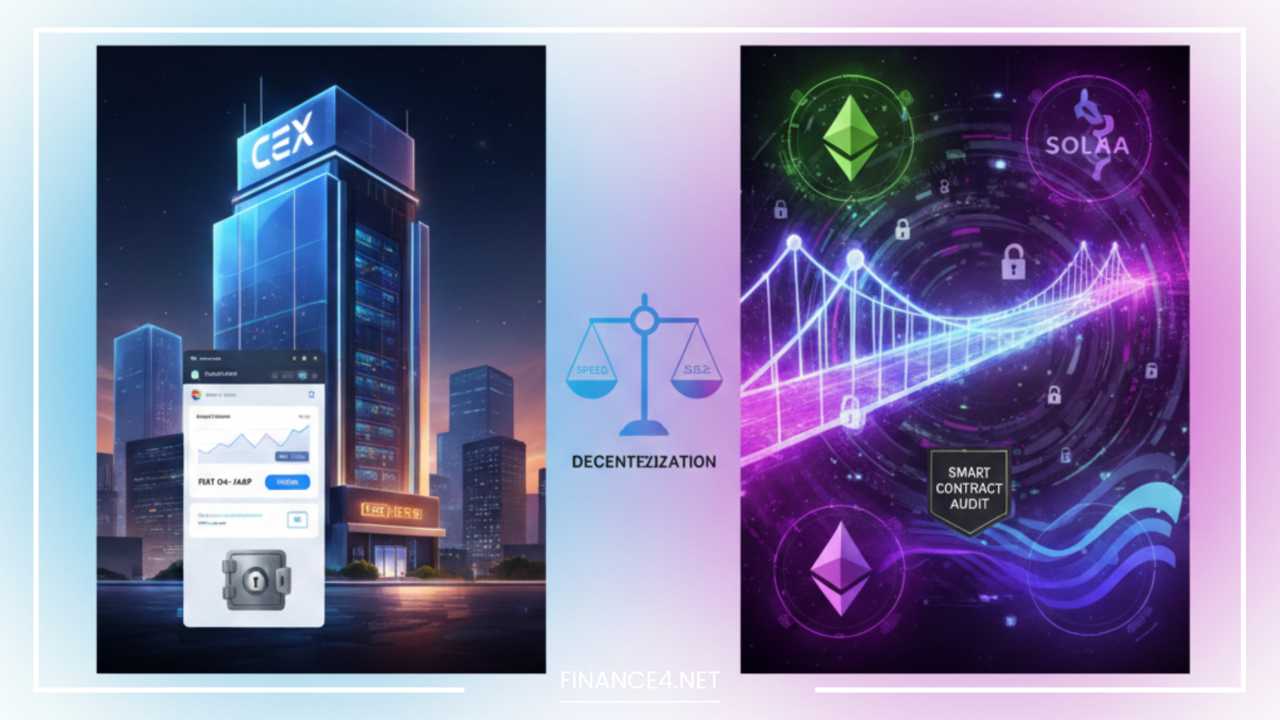
Cross-Chain Bridging vs. Centralized Exchanges: Key Differences Explained
The rapid evolution of the cryptocurrency landscape has transitioned from a niche experiment into a multi-trillion-dollar ecosystem. As the industry matured, it moved beyond Bitcoin to include a diverse array of Layer 1 and Layer 2 blockchains, such as Ethereum, Solana, Binance Smart Chain, and Avalanche. This proliferation of networks has created a “multi-chain” reality where value is fragmented across different ecosystems. For users, the ability to move value from one blockchain to another is no longer just a luxury—it is a fundamental requirement for participating in Decentralized Finance (DeFi), NFT marketplaces, and gaming.
To navigate this fragmented landscape, users primarily rely on two distinct mechanisms: Centralized Exchanges (CEXs) and Cross-Chain Bridges. While both achieve the end goal of moving value across ecosystems, they operate on fundamentally different philosophies, architectures, and risk profiles. Understanding these differences is crucial for any investor looking to optimize their security, costs, and efficiency in the digital asset space. This article provides a comprehensive comparison between these two pillars of crypto interoperability, helping you decide which tool is right for your specific needs.
Understanding Centralized Exchanges (CEXs)
Definition and Overview
A Centralized Exchange (CEX) is a platform that acts as an intermediary between buyers and sellers of cryptocurrencies. Much like a traditional stock exchange, a CEX is owned and operated by a private company. These platforms provide a centralized marketplace where users can trade fiat currency (like USD or EUR) for cryptocurrency, or swap one digital asset for another. Examples of industry leaders include Binance, Coinbase, Kraken, and OKX. These entities function as the primary gateways for the general public to enter the crypto market, offering a bridge between traditional finance (TradFi) and the world of digital assets.
How CEXs Work
At the heart of a CEX is the order book. When you place a trade, the exchange’s internal engine matches your “buy” order with someone else’s “sell” order. The most critical aspect of a CEX is its custodial nature. When you deposit funds into a CEX, you are effectively transferring ownership of your private keys to the exchange. The platform keeps a ledger of how much crypto you “own” on their books, but the actual assets are stored in “cold” and “hot” wallets controlled by the company.
Because the exchange holds a massive pool of assets across dozens of different blockchains, “moving” assets across chains is often as simple as a database update. For instance, if you deposit Bitcoin (BTC) and want to withdraw it as an ERC-20 token on Ethereum, the exchange simply deducts the BTC from your balance and sends you the equivalent asset from their own Ethereum liquidity reserves. You are not actually “bridging” anything in a technical sense; you are simply asking a third party to swap an asset on one ledger for an asset on another.
Advantages of CEXs
-
Liquidity and Speed: CEXs boast the highest trading volumes in the industry. Trades happen almost instantaneously within the exchange’s internal engine because they do not require immediate on-chain confirmation or the mining of blocks.
-
User-Friendly Experience: For beginners, CEXs offer a familiar interface similar to online banking. They handle the technical complexities of blockchain addresses, gas fees, and network selection behind the scenes, reducing the “fat finger” risk for new users.
-
Fiat Onramps: CEXs are the primary gateways for moving traditional money into the crypto world via bank transfers, credit cards, or wire transfers.
-
Customer Support and Recovery: Unlike decentralized protocols, CEXs have human support teams. If you lose your password or encounter a technical glitch, there is a process to recover your account—a safety net that does not exist in the world of private keys.
-
Regulatory Oversight: Many major CEXs operate under strict licenses in various jurisdictions, providing a layer of legal recourse and institutional trust.
Disadvantages of CEXs
-
Custodial Risk: The famous mantra “not your keys, not your coins” applies here. If an exchange is hacked, becomes insolvent, or experiences mismanagement (as seen with the collapse of FTX), users may lose their entire investment.
-
KYC Requirements: To comply with global Anti-Money Laundering (AML) regulations, CEXs require “Know Your Customer” (KYC) documentation. This involves sharing personal IDs, addresses, and sometimes biometric data, which compromises user privacy.
-
Centralization and Control: CEXs can freeze accounts, limit withdrawals, or delist assets at their discretion. This centralized control contradicts the permissionless and censorship-resistant ethos that many believe is the core value of blockchain.
-
Withdrawal Limits: Users are often limited in how much they can withdraw per day based on their verification level, which can be a hindrance for high-net-worth individuals.
Understanding Cross-Chain Bridges
Definition and Overview
A cross-chain bridge is a decentralized application (dApp) or protocol that allows the transfer of data or tokens between two independent blockchains. Unlike a CEX, which relies on a company, a bridge relies on smart contracts and cryptographic proofs. Bridges allow for the movement of assets across chains that have different protocols, rules, and consensus mechanisms. Notable examples include the Polygon Bridge, Avalanche Bridge, Wormhole, and Arbitrum Bridge.
How Cross-Chain Bridges Work
Bridges generally use several technical mechanisms to ensure the value on the destination chain matches the value on the source chain:
-
Lock-and-Mint: This is the most common method. You send your native tokens (e.g., Ethereum) to a smart contract on the source chain, where they are locked. Once the bridge confirms the transaction, it “mints” an equivalent “wrapped” version of that token (e.g., Wrapped ETH or WETH) on the destination chain (e.g., Solana).
-
Burn-and-Mint: To move assets back, the user “burns” the wrapped tokens on the destination chain. This cryptographic proof of destruction triggers the smart contract on the source chain to “unlock” the original native assets and send them back to the user’s wallet.
-
Liquidity Pools: Some bridges do not use wrapped assets. Instead, they maintain large reserves (liquidity pools) of native assets on multiple chains. A user might deposit USDC on Ethereum into a pool, and the bridge will release native USDC from its pool on the Avalanche network.
Advantages of Cross-Chain Bridges
-
Decentralization and Privacy: Bridges allow users to move assets without creating an account or providing identity documents. You interact directly with the protocol using your own non-custodial wallet (like MetaMask or Phantom).
-
Interoperability: Bridges are the “highways” of the Web3 world, allowing assets to move freely into DeFi protocols, yield farms, and NFT markets that CEXs may not support.
-
Asset Sovereignty: Users maintain control of their private keys throughout the process. The assets are never in the hands of a human intermediary; they are governed by code.
-
Innovation Access: Bridges allow users to access brand-new blockchains and Layer 2 solutions immediately after launch, often long before CEXs decide to support them.
Disadvantages of Cross-Chain Bridges
-
Smart Contract Risk: This is the greatest threat. If the code governing the bridge has a bug, hackers can drain the locked collateral. This renders the “wrapped” tokens on the other chain worthless since there is nothing left to “unlock.”
-
Complexity and Technical Debt: Using a bridge requires a higher level of technical knowledge. Users must manage gas fees on two different networks, understand “wrapped” asset risks, and ensure they are on the correct RPC (Remote Procedure Call) settings.
-
Latency and Waiting Times: Bridging can take anywhere from a few minutes to several days (in the case of some optimistic rollups) to ensure finality and security.
-
High Fees: Depending on the congestion of the source chain (especially Ethereum), gas fees for interacting with complex bridge smart contracts can be very expensive.
Key Differences Between Cross-Chain Bridges and CEXs
Centralization vs. Decentralization
The core difference lies in the governance model. A CEX is a permissioned environment. A company decides which tokens you can trade, which countries can access the platform, and when the platform undergoes maintenance. A bridge is typically permissionless. It is a public utility on the blockchain. No central authority can stop a transaction once it is initiated, and the service is available 24/7 as long as the underlying blockchains are running.
Custodial vs. Non-Custodial
In a CEX, you are a customer. The exchange is the custodian. In a bridging scenario, the process is non-custodial. You are interacting with an automated protocol. While the protocol might fail due to a bug, you are not vulnerable to the human greed, political pressure, or mismanagement of an exchange executive team.
Security Models
-
CEX Security: Focuses on cybersecurity and institutional safety. This includes cold storage of assets, multi-signature wallets for employees, insurance funds, and robust firewalls. The risk here is a centralized point of failure.
-
Bridge Security: Focuses on code integrity and game theory. Security is maintained through audits of smart contracts and decentralized validator sets. The risk here is an “exploit”—a hacker finding a logical flaw in the code that the auditors missed. Bridges have been the target of some of the largest hacks in history (e.g., the $600 million Ronin Bridge hack).
Speed and Liquidity
CEXs are almost always faster for trading. Because the “trade” is just a row changing in a private database, it happens at the speed of the internet. Bridges are beholden to the speed of the underlying blockchains. If you are bridging from a slow chain, you must wait for a certain number of block confirmations to ensure the transaction cannot be reversed. Furthermore, bridges can suffer from “slippage” if the liquidity on the destination chain is too thin for the size of your transfer.
User Experience (UX)
CEXs offer a unified “one-stop-shop” experience. You can buy, sell, stake, and lend in one dashboard. Bridges require the user to be their own “IT department.” You must manage multiple wallet extensions, ensure you have the right native tokens (ETH, SOL, MATIC) to pay for gas on both sides, and troubleshoot your own transactions if they get “stuck.”
Fees and Costs
-
CEX Fees: These are usually transparent. You pay a percentage-based trading fee (e.g., 0.1%) and a flat withdrawal fee to cover the network cost of sending the crypto to your wallet.
-
Bridge Fees: These are multi-layered. You pay a gas fee to trigger the contract on the source chain, a protocol fee to the bridge provider, and sometimes a gas fee to “claim” the asset on the destination chain. During periods of high Ethereum traffic, bridging a small amount (like $100) could cost $50 in gas, making it inefficient for small users.
Asset Availability and Listing
CEXs are selective and slow. They perform due diligence before listing a token to ensure it isn’t a scam or a security. Bridges are neutral. If a developer creates a liquidity pool on a bridge for a new, obscure token, it becomes “bridgable” immediately. This makes bridges the preferred choice for early adopters and “degen” traders looking for the next big thing before it hits the mainstream exchanges.
Deep Dive into Use Cases: When to Use Which?
The decision between a bridge and an exchange should be dictated by your specific objective.
Use Case 1: The Fiat Gateway
If you have $5,000 in a traditional bank account and want to buy Bitcoin or Ethereum, you must use a CEX. Bridges do not connect to the traditional banking system. CEXs like Coinbase or Kraken are the essential “onramps” that convert your government-issued currency into digital assets.
Use Case 2: DeFi and Yield Farming
If you own ETH on the Ethereum mainnet but want to use a lending protocol on the Polygon network to earn higher interest, you should use a bridge. A CEX would require you to deposit your ETH, wait for confirmations, and then withdraw it to a different network—all while paying withdrawal fees and potentially dealing with KYC. A bridge allows you to move the asset directly while keeping it in your own wallet, ready to be deposited into a dApp immediately.
Use Case 3: High-Frequency Trading
If you are a day trader looking to profit from 1% price movements throughout the day, a CEX is the only viable option. The instant execution and low internal fees allow you to enter and exit positions without being eaten alive by on-chain gas fees or waiting for block times.
Use Case 4: Privacy and Censorship Resistance
If you live in a region with restrictive financial laws or simply value your financial privacy, bridges are superior. Because bridges are non-custodial and often permissionless, they do not require you to link your identity to your transactions. While the blockchain is public, the link between your real name and your wallet address is much harder to establish than it is with a regulated CEX account.
Use Case 5: Airdrop Participation
New blockchain protocols often reward early users with “airdrops” (free tokens). These rewards are almost always distributed to users who interacted with the protocol’s on-chain tools, such as their official bridges or decentralized exchanges. If you keep your assets on a CEX, the exchange receives the airdrop, and they may or may not pass that value on to you. To ensure you qualify for these incentives, using a bridge is the standard practice.
Risks and Security Considerations
Navigating the crypto world requires a “zero-trust” mindset. Both CEXs and bridges have unique failure points that can lead to a total loss of funds.
The Risks of Centralization
The primary risk of a CEX is insolvency. In a traditional bank, your deposits are often insured by the government (like the FDIC in the US). In crypto, there is no such safety net. If an exchange lends out user funds to a hedge fund that goes bust, the exchange may not have enough money to honor your withdrawal. We saw this play out in 2022 with several major platforms. Additionally, CEXs are vulnerable to government intervention. If a government decides to freeze the assets of a specific group, the CEX must comply.
The Risks of Interoperability
Bridges are arguably the most targeted infrastructure in the crypto space because they represent a “honeypot.” A bridge might hold billions of dollars in locked collateral in a single smart contract. This makes them a prime target for elite hacking groups.
-
Validator Attacks: Some bridges are “multisig” bridges, meaning a small group of people (validators) must sign off on a transfer. If a hacker gains control of a majority of those keys, they can authorize a transfer of all the locked funds to their own wallet.
-
Oracle Failure: Bridges need to know the price and state of different chains. If the “oracle” (the data feed) providing this information is manipulated, the bridge can be tricked into releasing more funds than it should.
Best Practices for Risk Mitigation
To protect yourself, consider the following strategies:
-
The “Bridge and Move” Strategy: Do not leave assets sitting in a “wrapped” state or inside a bridge contract longer than necessary. Once you bridge to a new chain, move those assets into a secure cold wallet.
-
Avoid “The Honeypot”: Use bridges that have a long track record of security and multiple third-party audits. While no bridge is unhackable, those that have survived several years of operation are generally more battle-tested.
-
Tiered Storage: Keep only a small “working capital” amount on CEXs for active trading. Store the bulk of your long-term investments in a non-custodial hardware wallet.
-
Check the “Wrapped” Asset Liquidity: Before bridging a large amount of a niche token, ensure there is enough liquidity on the destination chain to actually trade that token back into something stable like USDC.
The Future Outlook: Convergence and Abstraction
The debate between bridging and CEXs may soon become a relic of the past as the technology moves toward Chain Abstraction.
The “Invisible” Bridge
New protocols like Chainlink CCIP, LayerZero, and Cosmos IBC are working on making the bridging process invisible to the user. In the next few years, you might open a DeFi app, click “Buy,” and the app will automatically bridge the necessary funds from whatever chain you happen to have money on. The user won’t have to worry about RPC settings or gas tokens; the complexity will be abstracted away by the software.
The Evolution of the CEX
Centralized exchanges are not standing still. They are increasingly launching their own “Web3 Wallets” that integrate directly with their exchange interface. This allows users to move funds from their custodial exchange account to a non-custodial bridge with a single click. We are seeing a “hybridization” where CEXs act as the user interface for the decentralized world.
Regulatory Pressure
As the industry matures, regulators are looking closely at bridges. There is a possibility that “front-end” websites for bridges may be required to implement KYC or block certain jurisdictions. This could push the “true” decentralized bridging into the realm of more technical, command-line interfaces, while the average user continues to use regulated, “safe” gateways.
Security Innovation
The industry is moving away from simple “lock-and-mint” bridges toward Zero-Knowledge (ZK) Bridges. These use complex mathematics (ZK-proofs) to prove that a transaction happened on one chain without needing to trust a group of validators. This could potentially eliminate the “validator collusion” risk that has plagued bridges in the past.
Final Thoughts
The decision between using a cross-chain bridge or a centralized exchange ultimately comes down to a trade-off between convenience and control.
Centralized Exchanges are the “airports” of the crypto world. They provide the most straightforward path to enter or exit the ecosystem, offer high-speed trading, and provide a layer of professional management. They are the best choice for beginners, high-volume traders, and those who need to convert fiat to crypto. However, they require you to trust a corporation with your financial sovereignty.
Cross-Chain Bridges are the “interstate highways” that connect the various sovereign states of the blockchain world. They offer the freedom to explore the furthest reaches of Web3, maintain your privacy, and keep you in total control of your digital property. They are the best choice for DeFi users, NFT collectors, and those who prioritize decentralization. However, they require a higher level of technical skill and expose you to the risks of experimental code.
As the multi-chain ecosystem continues to grow, most successful participants will find that they need both. By using a CEX for what it does best (liquidity and fiat) and bridges for what they do best (interoperability and sovereignty), you can build a robust and flexible strategy for the digital age. In the world of crypto, knowledge is the only true form of security. Whether you are clicking “Trade” on a CEX or “Bridge” on a dApp, understanding the underlying machinery is the first step toward financial freedom.
The landscape is changing every day, but the principles remain the same: verify the code, trust the math, and never risk more than you can afford to lose. The bridge to the future of finance is still being built, and you now have the map to navigate it.