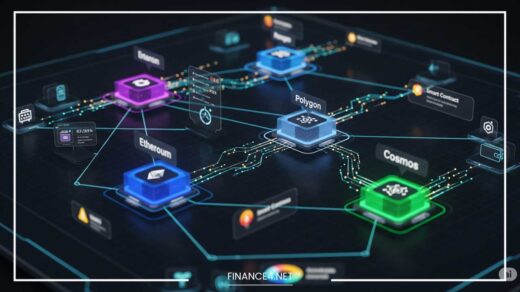
Leading Cross-Chain Bridging Technology
 by
by 
Leading Cross-Chain Bridging Technology
The blockchain revolution promised a decentralized, transparent, and globally accessible financial and data infrastructure. Yet, as the ecosystem has matured, it has evolved into a vast, fragmented landscape of hundreds of independent networks—each with its own protocol, community, assets, and rules. Ethereum, Solana, Binance Smart Chain, Avalanche, and numerous Layer-2 solutions like Polygon and Arbitrum exist largely as isolated silos. This is the challenge of blockchain fragmentation. Limited liquidity, restricted application reach, and poor user experience are all direct consequences.
This is where the concept of cross-chain bridging becomes not just a feature, but an existential necessity. Cross-chain bridges are the connective tissue of the crypto world, allowing assets, data, and information to flow securely and efficiently between these disparate chains. They are the conduits that solve the critical problem of interoperability, unlocking the full, collective potential of the blockchain universe.
Why does leading technology in this space matter? Because bridges have also emerged as the single largest security vulnerability in the entire Web3 domain. Billions of dollars have been lost in bridge exploits, making the technology that facilitates this crucial connectivity a prime target. Therefore, the leading cross-chain bridging technology is defined by a delicate balance: the seamless efficiency to unify liquidity with the robust security to withstand sophisticated attacks. The future of decentralized finance (DeFi) and the wider blockchain economy hinges on the success of these technological lynchpins.
Understanding Cross-Chain Technology
Defining the Connective Tissue
A cross-chain bridge is a decentralized application (dApp) or protocol that facilitates the transfer of assets or data between two otherwise incompatible blockchain networks. Without a bridge, a token like Ethereum’s native Ether (ETH) cannot natively exist or be used on the Solana network, and vice-versa.
In essence, a bridge creates a mechanism to acknowledge and verify the state of an asset on one chain and represent an equivalent value on a different chain. It is a cryptographic communication protocol that allows two distinct consensus mechanisms to communicate in a verifiable, trust-minimized way.
Cross-Chain vs. Single-Chain Solutions
Single-chain solutions, such as the Ethereum Virtual Machine (EVM), are powerful but inherently limited to their own network. An Ethereum dApp can only interact with Ethereum assets and users. This creates “walled gardens” of liquidity and functionality.
Cross-chain solutions dismantle these walls. They enable:
-
Liquidity Access: A Bitcoin holder can use their BTC as collateral on an Ethereum-based DeFi protocol by bridging a wrapped version of their asset.
-
Asset Transfers: Users can move tokens like stablecoins to the chain with the lowest gas fees or the fastest transaction speed for a specific activity.
-
DeFi Opportunities: Developers can build dApps that utilize the unique strengths of multiple chains—for example, using the robust security of Ethereum’s settlement layer while leveraging the speed and low cost of an L2 or a separate L1 like Avalanche for transactions.
Examples of networks that critically rely on bridging include: Ethereum (the main layer for high-value settlement), Binance Smart Chain (BSC) (known for fast, low-cost EVM execution), Solana (a high-throughput alternative), Polygon (a leading Ethereum Layer-2), and Avalanche (a highly scalable L1). Bridging is the key to creating a truly unified, interconnected Web3.
How Cross-Chain Bridges Work
The underlying mechanics of a cross-chain bridge are complex, but they follow a core principle of “locking and minting” or “burning and releasing” to maintain a 1:1 value peg between the asset on the source chain and its representation on the destination chain.
Technical Overview
At a high level, a cross-chain asset transfer follows three key steps:
-
Lock/Burn on Source Chain: A user sends their native asset (e.g., ETH) to a specific smart contract on the source chain (e.g., Ethereum). This action locks the asset in the contract’s escrow or burns it (removes it from circulation).
-
Verification: An off-chain component, often called a Relayer or Oracle, detects and verifies the locking/burning event on the source chain. Validators (a decentralized set of independent nodes) confirm the validity of this event across the chains. Security mechanisms like multi-signature (multi-sig) schemes or more advanced threshold signatures are used here to ensure a quorum of parties verifies the event before the transfer proceeds.
-
Mint/Release on Destination Chain: Once the event is cryptographically verified, the smart contract on the destination chain (e.g., Polygon) mints an equivalent, non-native asset (e.g., wrapped ETH or wETH) and sends it to the user’s address. If the process is reversed, the wrapped token is burned on the destination chain, and the original, native asset is released from the escrow contract on the source chain.
Types of Bridges
Bridges can be primarily categorized based on their underlying trust model:
-
Centralized Bridges (Custodial): These rely on a single, trusted entity or a small group of entities (like a centralized exchange or a specific project team) to custody the locked assets and attest to the transactions. They are fast and cheap, but they introduce a single point of failure—users must trust the custodian not to steal the funds or be hacked.
-
Decentralized Bridges (Trustless): These use cryptography, decentralized validator networks, and smart contracts to manage assets and verify events. They are more secure because they minimize the need for trust in a single human or organization, but they can be slower and more complex.
-
Federated Bridges: These represent a middle ground, relying on a pre-selected set of trustworthy, known validators (a “federation”) to sign off on cross-chain transactions using a multi-sig wallet. They offer a balance of speed and security but still depend on the trustworthiness of the federation members.
Challenges in Bridging
Despite their vital role, bridges face significant technical hurdles:
-
Security Risks: The concentration of assets in bridge contracts makes them “honeypots” for hackers, as securing a transfer across two different consensus models is exponentially more complex than securing a single-chain contract.
-
Speed and Cost: The verification and finality time on the source chain can cause significant delays (often 10–30 minutes) and the transaction fees (gas) on the source chain (like Ethereum Mainnet) can be prohibitively expensive.
-
Complexity: Different chains have different standards and finality models, making the development of truly generic, secure bridges a monumental task.
Leading Cross-Chain Bridges and Platforms
The competition to create the most secure, efficient, and interconnected bridge infrastructure is intense, leading to specialized and highly innovative platforms.
| Bridge/Platform | Primary Function/Architecture | Key Chains Supported | Unique Selling Point |
| Polygon Bridge (PoS) | Lock-and-Mint, Dual Consensus | Ethereum $\leftrightarrow$ Polygon | Low-fee, fast transactions between L1 and popular L2/sidechain. |
| Avalanche Bridge (AB) | Secured by Intel SGX Enclaves (Trusted Execution Environment) | Ethereum $\leftrightarrow$ Avalanche | High speed, high throughput, and lower costs than Ethereum L1. |
| Wormhole (Portal Bridge) | Decentralized Guardian Network (Relayer/Validator) | Ethereum, Solana, BSC, Polygon, Terra (Classic), etc. (15+ chains) | One of the most multi-chain solutions, supporting non-EVM chains like Solana. |
| LayerZero (OFTs/OApps) | Ultra-Light Node (ULN) + Relayer/Oracle Separation | Ethereum, Solana, Polygon, Avalanche, Arbitrum, etc. | “Omnichain” approach. Separates the Relayer and Oracle for enhanced security; focuses on native asset transfer and cross-chain messaging. |
| Synapse Protocol | Automated Market Maker (AMM) + Cross-Chain Messaging | Ethereum, Arbitrum, Polygon, Avalanche, BSC, Fantom, etc. | Focus on deep, unified liquidity pools for instant, capital-efficient swaps. |
| Hop Protocol | Liquidity Bonders + Rollup-Specific Architecture | Ethereum L1 $\leftrightarrow$ L2s (Arbitrum, Optimism, Polygon) | Specialized for fast, low-cost asset transfers between Ethereum Rollups. |
Polygon Bridge and Avalanche Bridge
These represent successful chain-to-chain bridges that were initially deployed to solve the congestion problem of Ethereum by enabling asset migration to their respective, more scalable ecosystems. The Polygon PoS Bridge is heavily utilized due to Polygon’s position as a leading Ethereum Layer-2. The Avalanche Bridge (AB) has achieved high security and speed by utilizing a trust-minimized model often secured by a committee operating within a Trusted Execution Environment (TEE), offering significant efficiency gains over its predecessor.
Wormhole and LayerZero: The Next-Gen Messaging Protocols
Platforms like Wormhole (which powers the Portal Bridge) and LayerZero are moving beyond simple asset transfer to focus on generic cross-chain messaging. This means a smart contract on one chain can securely call a function on a smart contract on another chain.
-
Wormhole uses a decentralized validator set called Guardians to sign and verify messages.
-
LayerZero employs a unique model where the Oracle (which sends the transaction proof) and the Relayer (which transmits the transaction payload) are separate, independent entities. For an attack to succeed, both the Oracle and the Relayer would need to be compromised and collude, a security architecture known as Trust-Minimized Interoperability. LayerZero’s Omnichain Fungible Tokens (OFTs) and Omnichain Applications (OApps) are designed to be truly native across all supported chains, eliminating the wrapped token complexity for users.
These innovative approaches are defining the future of interoperability, shifting from mere asset transport to full cross-chain composability.
Security Challenges and Solutions
The history of cross-chain bridging is unfortunately marked by some of the largest exploits in crypto history, with billions stolen across various bridges. This highlights that for this technology to truly lead, security must be paramount.
Common Vulnerabilities
-
Smart Contract Bugs: The code that locks, mints, burns, and verifies the assets is highly complex and multi-chain. A single, small logic flaw in a mintWrappedToken() function, for instance, can be exploited to mint infinite, unbacked tokens on the destination chain. This was a contributing factor in the notorious Wormhole exploit.
-
Private Key/Validator Compromise: For bridges that rely on a multi-sig or federated validator set, compromising a majority of the private keys allows an attacker to approve malicious transactions and drain the locked funds. The 2022 Ronin Bridge exploit was a devastating example of this, where five of the nine validator keys were compromised.
-
Oracle Manipulation: The Oracle is the component that reports the event from the source chain to the destination chain. If this data can be manipulated, the destination chain may be tricked into releasing or minting assets based on a false event.
How Leading Bridges Mitigate Risks
Leading bridges adopt a defense-in-depth strategy to secure the vast amounts of capital they hold:
-
Rigorous Audits and Bug Bounties: Continuous, thorough security audits by multiple independent firms are standard practice. Extensive bug bounty programs incentivize white-hat hackers to find and report vulnerabilities before malicious actors do.
-
Decentralized Validators and Multi-Sig Wallets: Moving away from a small, centralized set of custodians is a crucial step. Increasing the number of independent, geographically distributed validators and setting a high quorum threshold (e.g., requiring 7 out of 10 signatures) makes collusion or key compromise exponentially harder.
-
Independent Risk Management: Some next-generation protocols, like Chainlink’s Cross-Chain Interoperability Protocol (CCIP), have introduced a separate, independent Risk Management Network that constantly monitors the bridge and can automatically pause the protocol if a malicious event or unusual capital outflow is detected, acting as a crucial safety circuit breaker.
-
Zero-Knowledge Proofs (ZKPs): Emerging bridge designs are exploring the use of ZKPs to verify the state of the source chain on the destination chain without needing to trust any intermediary. This cryptographic approach offers a path toward truly trustless, minimal-risk bridging.
-
Insurance and Capital Allocation: Some bridges offer insurance against smart contract failure, and leading platforms often limit the total value of assets that can be locked (Total Value Locked or TVL) to manage the overall risk exposure.
Use Cases of Cross-Chain Bridging
The importance of bridging extends far beyond simply moving a token; it is the enabler for the most critical and complex use cases in the decentralized world.
Decentralized Finance (DeFi)
Bridging is the engine of multi-chain DeFi:
-
Liquidity Pooling and Yield Farming: Users can bridge their assets to a chain offering the highest returns. For example, moving stablecoins from Ethereum to a fast L1 like Fantom or an L2 like Arbitrum to access a higher-yield farm or liquidity pool. This arbitrage of yield is only possible through efficient cross-chain transfers.
-
Cross-Chain Collateral: An asset locked on one chain can be used as verifiable collateral for a loan taken out on another chain, creating truly interconnected debt markets.
-
Arbitrage and Price Discovery: Bridges enable rapid movement of capital between decentralized exchanges (DEXs) on different chains, helping to ensure asset prices remain consistent across the entire ecosystem.
NFTs and Digital Assets
The boom in Non-Fungible Tokens (NFTs) has also been impacted by interoperability:
-
Transferring NFTs Across Chains: An artist minting an NFT on a high-fee chain (like Ethereum) might bridge it to a lower-fee chain (like Polygon) to enable cheaper trading and accessibility for a broader collector base. The ownership record is locked on the source chain, and a verifiable, wrapped version is issued on the destination chain.
-
Gaming/Metaverse: As metaverse platforms often launch on different chains (e.g., in-game tokens on one chain, land NFTs on another), bridges allow players to utilize their digital assets across these different virtual worlds seamlessly.
Enterprise and Interoperability
Beyond consumer use, bridging is essential for institutional and business adoption:
-
Supply Chain and Payments: Enterprises can use different blockchains optimized for different tasks—one for high-security supply chain tracking and another for rapid, low-cost cross-border payments. A bridge allows the data and assets to move between these specialized networks without friction.
-
CBDC Compatibility: If central bank digital currencies (CBDCs) are adopted, cross-chain technology will be necessary for them to interoperate with private, permissioned, and public blockchain networks, ensuring a path for traditional finance to engage with the decentralized world.
The Future of Cross-Chain Bridging
The current generation of “lock-and-mint” bridges is an evolutionary step, but the industry is moving towards a more native, seamless, and mathematically secure model of interoperability.
Key Trends
-
Omnichain and Interoperable Smart Contracts: The focus is shifting from simply moving tokens to generic messaging. Protocols like LayerZero and Axelar are creating a future where a developer can build an application that is “omnichain” by default, allowing it to exist and function natively across dozens of chains without requiring the user to manually bridge.
-
Zero-Knowledge Proofs (ZK-Bridges): This is the next frontier of security. ZK-bridges would use cryptographic proofs to guarantee that an event occurred on the source chain without needing to rely on a validator set or multi-sig wallet. This is the path to achieving a truly trustless bridge.
-
Layer-2 Adoption: The rise of Layer-2 scaling solutions (Rollups like Arbitrum, Optimism, zkSync) has led to the development of specialized bridges like Hop Protocol, which optimize for fast, cheap transfers between L2s and the main L1. As the L2 ecosystem matures, these purpose-built bridges will become the main highways for intra-ecosystem liquidity.
-
Standardization and Universal Messaging: The industry is moving towards a common set of standards, much like how the ERC-20 token standard unified asset creation on Ethereum. Universal standards for cross-chain communication will simplify development, enhance security through shared scrutiny, and improve the overall user experience.
Role in Mainstream Adoption
For blockchain technology to reach mainstream adoption, the multi-chain complexity must be abstracted away from the end-user. The user should not have to worry about whether their asset is on Ethereum, Polygon, or Arbitrum; they should simply interact with the application.
Leading cross-chain bridging technology is the invisible infrastructure that enables this. By becoming faster, cheaper, and fundamentally more secure, bridges will foster a connected, scalable, and resilient ecosystem capable of supporting the global economy. Predictions suggest a future where liquidity is unified, capital is perfectly efficient, and the underlying blockchain is merely a technical detail, not a user constraint.
Final Thoughts
Cross-chain bridging technology is the defining infrastructure of the modern blockchain landscape. It is the necessary answer to the fragmentation problem, serving as the essential conduit for liquidity, data, and composability across hundreds of disparate networks.
We have moved from simple, sometimes risky, lock-and-mint solutions to sophisticated, trust-minimized architectures utilizing decentralized validators, independent risk monitoring, and the promise of Zero-Knowledge proofs. Leading platforms like LayerZero, Wormhole, Polygon Bridge, and Avalanche Bridge are not just moving tokens; they are pioneering the secure, multi-chain future of Web3.
While the enormous value locked in bridge contracts will continue to make them a primary security target, the industry’s continuous innovation in cryptography and decentralized design is creating more resilient solutions. The era of isolated blockchains is rapidly ending. We are entering an “Omnichain” world where interoperability is the norm, unlocking a new wave of capital efficiency, application design, and mainstream utility. Users and developers are encouraged to engage with these cross-chain solutions, prioritizing platforms with robust security audits, transparent governance, and a proven track record to responsibly navigate the increasingly interconnected world of decentralized technology.