Most Popular Crypto Indexes
 by
by 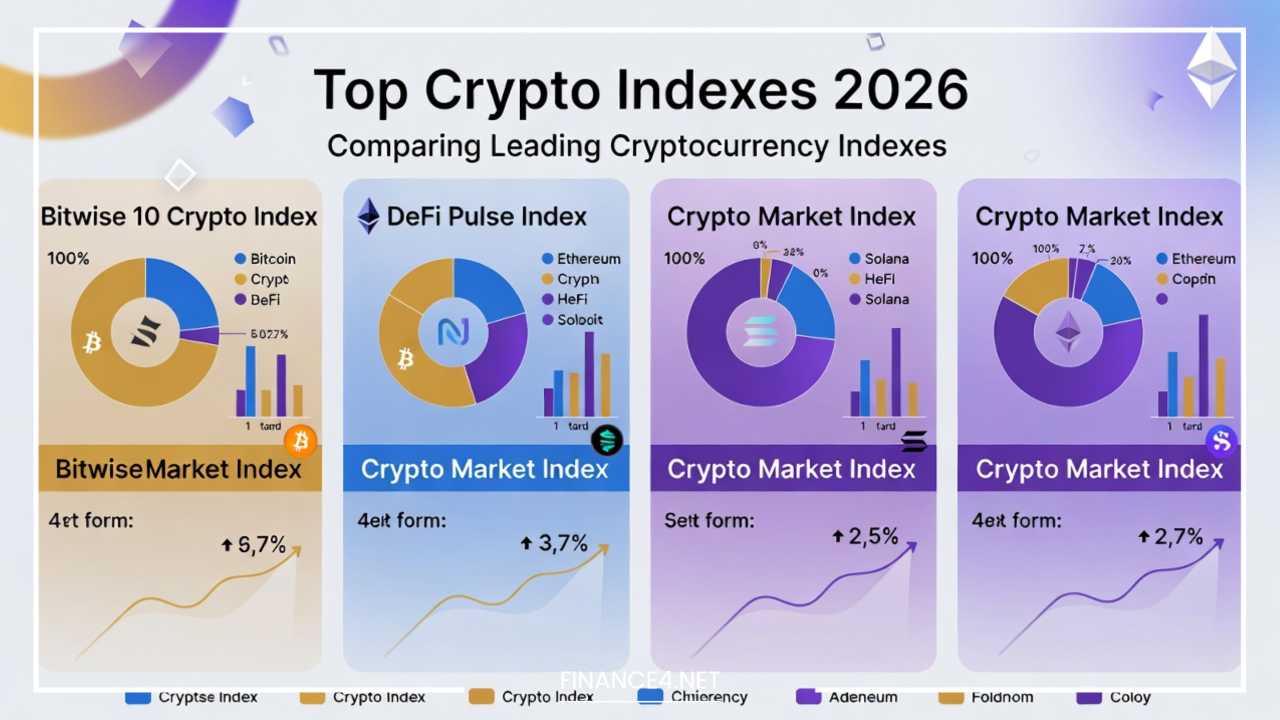
Most Popular Crypto Indexes – Top Digital Asset Indexes for 2026
The digital asset landscape in 2026 is no longer the fragmented, speculative “Wild West” it once was. As the market matures, the sheer volume of tokens—ranging from institutional-grade Layer-1s and decentralized physical infrastructure (DePIN) to hyper-niche AI agents—has made manual portfolio management an nearly impossible task for the average investor. In this environment, the crypto index has emerged as the definitive tool for modern wealth management.
Much like the S&P 500 revolutionized equity investing in the 20th century by allowing participants to own a slice of the entire American economy, crypto indexes in 2026 allow investors to capture the “beta” of the digital revolution. These instruments provide a structured, transparent, and disciplined approach to an asset class that, while more stable than in its infancy, still moves at a velocity that defies traditional manual trading.
This comprehensive guide explores the evolution of these financial instruments, the sophisticated methodologies driving them today, and a definitive list of the most popular crypto indexes dominating the market this year. Whether you are a retail “HODLer” seeking broad exposure or an institutional allocator navigating the complexities of “Real World Asset” (RWA) tokenization, understanding these benchmarks is the cornerstone of a 2026 investment strategy.
What Are Crypto Indexes?
A crypto index is a financial instrument designed to track the price performance of a specific “basket” or group of digital assets. Rather than requiring an investor to manage individual wallets for Bitcoin, Ethereum, Solana, and dozens of smaller utility tokens, an index provides a single entry point.
The Mechanics of Construction
In 2026, the methodology behind an index is its “North Star.” Most reputable indexes use a rules-based, algorithmic approach to determine inclusion. The criteria generally revolve around three pillars:
-
Market Capitalization: This remains the gold standard. Assets are weighted based on their total circulating market value, ensuring the index reflects the giants of the industry.
-
Liquidity and “Investability”: A token might have a high market cap on paper, but if it cannot be traded in high volumes without moving the price (slippage), it is excluded. In 2026, indexes strictly filter for assets with deep order books across regulated exchanges.
-
Governance and Security: For institutional-grade indexes, assets must often pass a “due diligence” check. This includes verifying that the smart contracts are audited and that the project isn’t under active investigation by major regulatory bodies like the SEC or ESMA.
Traditional vs. Crypto Indexes
While they share DNA with the Dow Jones or the FTSE 100, crypto indexes operate on a much faster “reconstitution” schedule. In traditional finance, an index might update its components once or twice a year. In the digital asset world of 2026, monthly or quarterly rebalancing is the norm.
This agility is necessary because the “Top 10” tokens can shift rapidly as new technological paradigms—such as Modular Blockchains or AI-Compute networks—gain traction. Furthermore, many 2026 indexes are natively on-chain. This means the index itself is a smart contract that programmatically holds the underlying assets, providing a level of real-time transparency and “proof of reserves” that traditional finance is still struggling to match.
Why Are Crypto Indexes Important?
As the total crypto market cap hovers at record highs in 2026, the importance of indexes has shifted from a convenience to a necessity for risk management and institutional entry.
Diversification: The Only “Free Lunch”
The primary draw of a crypto index is instant diversification. Even in 2026, individual protocols are susceptible to “idiosyncratic risk”—a specific hack, a failed upgrade, or a sudden loss of developer interest. By spreading capital across 10, 20, or 50 assets, an investor mitigates the impact of any single failure. If one DeFi protocol in a 10-asset index suffers a liquidity drain, the other nine assets act as a structural buffer.
Overcoming “Analysis Paralysis”
The complexity of the market has scaled exponentially. To pick a “winner” in 2026, an investor needs to understand Zero-Knowledge Proofs, Liquid Staking Derivatives (LSDs), and Cross-Chain Interoperability. Most people simply don’t have the time. Indexes remove the need for expert-level technical knowledge, allowing investors to bet on the growth of the industry rather than the success of a single project.
The Bridge to Institutional Adoption
Indexes have been the “trojan horse” for institutional capital. Large-scale hedge funds, family offices, and even some sovereign wealth funds have mandates that prohibit “stock picking” in volatile emerging markets. However, they are permitted to invest in regulated, benchmarked products.
The existence of indexes like the Nasdaq Crypto Index (NCI) has provided a familiar “wrapper” for TradFi. These products come with professional auditing, tax reporting, and institutional-grade custody (e.g., via Fidelity or BNY Mellon), making crypto “palatable” for the world’s largest pools of capital.
Types of Crypto Indexes
The 2026 market offers a diverse menu of index types, categorized by their specific investment thesis.
1. Market Cap-Based Indexes
These are the most popular and act as the “Blue Chips.” They track the largest assets by valuation.
-
Purpose: To capture the overall growth of the crypto market.
-
Example: The Bitwise 10 Crypto Index, which focuses on the “Mega-Caps.”
2. Sector-Specific Indexes
As the industry has “unbundled,” sector indexes allow for targeted bets.
-
DeFi Indexes: Tracking decentralized exchanges and lending protocols.
-
Layer-2 Indexes: Focusing on the scaling solutions (like Arbitrum, Optimism, and ZK-Sync) that handle the bulk of Ethereum’s transactions.
-
AI & DePIN Indexes: A massive trend in 2026, tracking protocols that provide decentralized computing power or storage for Artificial Intelligence.
3. Thematic and “Values-Based” Indexes
Reflecting broader global trends, these indexes group coins by specific themes.
-
Green Crypto Indexes: These exclude Proof-of-Work (PoW) coins due to energy concerns, focusing instead on Proof-of-Stake (PoS) and carbon-neutral chains.
-
Governance Indexes: Focusing on “DAO” tokens where the holders have voting rights over protocol treasuries.
4. Active vs. Passive Indexes
-
Passive: These strictly follow a mathematical formula (e.g., “Top 10 by market cap”). They have lower fees and are highly predictable.
-
Active: In 2026, these are often AI-managed. A machine-learning model analyzes on-chain data and social sentiment to “overweight” assets it predicts will outperform in the next 30 days.
5. Volatility and Risk-Weighted Indexes
These are designed for the “conservative” crypto investor. They use complex formulas to give more weight to stable, less volatile assets and less weight to high-risk, “high-beta” tokens. The goal is a smoother ride during market turbulence.
Most Popular Crypto Indexes in 2026
The following are the industry leaders that have defined the market in 2026.
1. Bitwise 10 Crypto Index (BITW)
The “S&P 500 of Crypto.” This remains the most widely cited and held index for general exposure.
-
What it tracks: The 10 largest digital assets, representing nearly 80% of the total market capitalization.
-
Methodology: Market-cap weighted, rebalanced monthly. It excludes stablecoins and assets with “significant security or custody hurdles.”
-
2026 Performance: It has served as a stable benchmark during the 2025-2026 “consolidation phase,” offering a steady return driven largely by Bitcoin and Ethereum’s institutional demand.
-
Fees: Roughly 2.5% for the fund version, though “tokenized” versions are cheaper.
2. DeFi Pulse Index (DPI)
The gold standard for the decentralized finance sector.
-
What it tracks: A basket of the most influential DeFi protocols (e.g., Uniswap, Aave, Lido, MakerDAO).
-
Methodology: Uses a unique “liquidity-weighted” cap to ensure that a single token doesn’t distort the index just because its price spiked on low volume.
-
2026 Context: DPI has seen a massive influx of capital this year as “Real World Assets” (RWA) began moving onto these platforms, turning DeFi from a “crypto-native toy” into global financial infrastructure.
3. Coinbase Index / Coinbase 50 (COIN50)
A newer but dominant player, the Coinbase 50 tracks the top 50 assets listed on the exchange.
-
What it tracks: A broader slice of the market, including mid-cap “growth” tokens.
-
Significance: Because it is integrated directly into the Coinbase app, it is the most popular index for retail investors. It offers a “one-click” diversified portfolio.
-
Fees: Low, often integrated into the platform’s trading fee structure.
4. Crypto Carbon Index (The “Green” Choice)
As ESG mandates became law in several jurisdictions by 2026, this index surged in popularity.
-
What it tracks: High-performance blockchains with a minimal carbon footprint (Solana, Ethereum post-merge, Polkadot, etc.).
-
Exclusions: It famously excludes Bitcoin, making it the preferred choice for eco-conscious institutional funds and European pension schemes.
5. VanEck Digital Assets Index
A TradFi powerhouse’s foray into the space.
-
Focus: It tracks the “Digital Transformation,” meaning it includes both crypto assets and the stocks of companies building the infrastructure (like miners and exchange operators).
-
Benefit: Provides a “hybrid” exposure that links the performance of tokens with the cash-flow-producing companies in the sector.
How Crypto Indexes Are Impacting the Market
The dominance of indexes in 2026 has fundamentally altered market dynamics.
1. Reducing Entry Barriers and Promoting Inclusivity
In the early 2020s, crypto was a “gatekept” industry requiring technical prowess. In 2026, the index has democratized access. A worker in an emerging economy can buy a “Top 20” index token with as little as $5, gaining the same professional diversification as a billionaire. This has driven unprecedented financial inclusivity.
2. The “Index Effect” on Volatility
When a massive amount of capital is tied up in indexes, it changes how individual coins behave. When an index rebalances, it creates massive buying or selling pressure on the underlying assets. Interestingly, this has led to lower overall volatility for the “Blue Chips” (as they are consistently bought by index funds) but higher volatility for “un-indexed” tokens, which lack this steady capital floor.
3. Portfolio Stabilization
For the long-term investor, indexes have proven to be the most “survivable” strategy. Data from 2024–2026 shows that while “meme-coin” traders often lost their principal, index investors captured the steady 20-30% year-over-year growth of the broader ecosystem.
Future Trends and Predictions (2026 and Beyond)
The evolution of crypto indexes is far from over. Several emerging trends are set to redefine the landscape by the end of the decade.
AI-Driven Dynamic Weighting
The “Static Index” is becoming a relic. Future indexes will use on-chain AI agents to adjust weights in real-time based on “Liveness” data (how many people are actually using the dApp) rather than just market price. This will help indexes avoid “Zombies”—assets that have a high market cap but no actual users.
Tokenization of Everything (The Multi-Asset Index)
By 2028, we expect to see indexes that combine crypto, tokenized real estate, and tokenized US Treasuries into a single “Global Wealth Token.” This will allow an investor to hold a truly global, diversified portfolio in a single crypto wallet.
The Role of CBDCs
As Central Bank Digital Currencies (CBDCs) become integrated into global trade, they will likely become the “collateral” or the “base pair” for indexes. This will make moving in and out of a crypto index as fast and cheap as sending a text message, further blurring the line between traditional and digital finance.
NFT and Meta-Indexes
While the “Profile Picture” craze died out, the tokenization of intellectual property (IP) did not. 2026 has seen the rise of “IP Indexes” that track the value of tokenized music royalties, film rights, and gaming assets.
How to Invest in Crypto Indexes: A Step-by-Step Guide
If you are ready to move away from individual coin-picking and toward an index strategy, follow these steps:
-
Determine Your Venue:
-
Exchange-Based: Use Binance, Coinbase, or Kraken for “Bundles.” These are easiest to use but are “custodial” (you don’t own the keys).
-
On-Chain (DeFi): Use a platform like Index Coop or Phuture. You will need a wallet (like MetaMask or Phantom) and will buy a token that represents the index.
-
Traditional Brokerage: Buy an ETF or Trust (like BITW) through your standard stock trading app.
-
-
Select Your Index Type: Do you want the whole market (Bitwise 10) or a specific bet (DeFi Pulse)?
-
Check the Methodology: Read how the index rebalances. Does it happen monthly? Does it exclude “meme coins”? Make sure the rules align with your risk tolerance.
-
Review the Fees: * Expense Ratios: The yearly fee for managing the index.
-
Gas Fees: If buying on-chain, consider the network cost (Solana and Layer-2s are significantly cheaper than Ethereum Mainnet).
-
-
Set Up a “DCA” (Dollar-Cost Averaging): Most index platforms allow you to automatically buy a set amount every week or month. This is the most effective way to build wealth in a volatile market.
Challenges and Risks of Crypto Indexes
Despite their benefits, indexes are not “risk-free” magic boxes.
-
Regulatory Headwinds: A sudden change in how a “Top 10” token is regulated can force an index to sell at a massive loss. The “regulatory risk” of an index is the sum of the risks of all its components.
-
The Correlation Problem: In a true “Black Swan” event (like a global financial crisis), crypto correlations often spike to 1.0. This means the entire index will drop together; diversification within the crypto space will not protect you from a total market drawdown.
-
Liquidity Bottlenecks: For larger indexes, rebalancing can be difficult if the underlying tokens don’t have enough liquidity. This can lead to the index price “de-pegging” slightly from the value of the actual coins it holds.
-
Smart Contract Risk: For on-chain indexes, the smart contract itself could have a bug. Even if the coins inside are safe, if the “wrapper” is hacked, your funds could be lost.
Final Thoughts
As we navigate through 2026, the crypto index has solidified its place as the “bedrock” of the digital asset economy. It represents the transition of cryptocurrency from a speculative hobby into a legitimate, institutional-grade asset class.
The top indexes of 2026—Bitwise 10, NCI, and DPI—have proven that a “slow and steady” approach, rooted in diversification and rules-based logic, consistently outperforms the “hit-or-miss” nature of individual token trading. The future of the market lies in automated, intelligent, and transparent baskets of value.
For the investor who values their time as much as their capital, the move toward indexes is not just a trend—it is a logical evolution. As the industry continues to integrate with AI and global finance, those who own the “index” will own the future of the internet of value.