How to Build a Cross-Chain DApp
 by
by 
How to Build a Cross-Chain DApp: Navigating the Interoperable Future
The blockchain landscape, once dominated by a single monolithic chain, has exploded into a vibrant, multi-chain universe.
While this diversity fosters innovation and caters to specific needs (like high throughput for gaming or low fees for payments), it also creates fragmentation.
Users, assets, and data are locked within their native networks, limiting the potential of decentralized applications (DApps).
Enter the cross-chain DApp. These applications are designed to interact with, or operate across, multiple blockchain networks, breaking down silos and unlocking new possibilities for liquidity, user reach, functionality, and efficiency.
Building such an application is significantly more complex than developing for a single chain, requiring a deep understanding of different consensus mechanisms, virtual machines, communication protocols, and, critically, security models.
This article delves into the intricacies of building cross-chain DApps, exploring the necessity, architectural patterns, technical challenges, security considerations, and the various tools and protocols available to developers venturing into this interoperable frontier.
The Case for Cross-Chain: Why Break the Chains?
Before diving into the ‘how’, it’s crucial to understand the ‘why’. The motivations behind building a cross-chain DApp are compelling:
- Increased Liquidity and User Base: Assets and users are scattered across chains. A cross-chain DeFi protocol can access liquidity pools on Ethereum, Binance Smart Chain (BSC), Polygon, and others simultaneously, offering better trading prices and higher yields. Similarly, an NFT marketplace can allow users to trade assets regardless of which chain they were minted on, dramatically expanding market reach.
- Leveraging Unique Chain Features: Different blockchains are optimized for different purposes. Solana offers high speed and low transaction costs, ideal for gaming or high-frequency trading. Ethereum boasts robust security and a mature DeFi ecosystem. Avalanche provides rapid finality. A cross-chain DApp can leverage the strengths of each chain – perhaps using Solana for fast interactions and Ethereum for secure storage or complex smart contract logic.
- Improved Scalability and Performance: By distributing operations across multiple networks, a DApp can potentially achieve greater scalability than being limited to the transaction throughput of a single chain. Offloading specific functions to faster, cheaper chains can improve overall performance and reduce user costs.
- Enhanced User Experience: For users, interacting with multiple chains via a single DApp interface is far more convenient than managing separate wallets, bridges, and applications for each network. Abstraction layers can hide the underlying chain complexities.
- Future-Proofing: The blockchain landscape is constantly evolving. Building with interoperability in mind makes a DApp more resilient to changes in the dominance or technical capabilities of any single network. It positions the DApp to integrate with future chains as they emerge.
Understanding Cross-Chain Architecture: The Interoperability Challenge
At its core, the challenge of cross-chain communication lies in the fundamental isolation of different blockchain networks.
Each chain maintains its own state, secured by its own consensus mechanism (Proof-of-Work, Proof-of-Stake, etc.), governed by its own rules, and executed by its own virtual machine (like the EVM on Ethereum-compatible chains, or different VMs on Solana, Cosmos, Polkadot).
There is no inherent way for a smart contract on one chain to directly read the state or call a function on another chain.
Therefore, building a cross-chain DApp necessitates a mechanism to facilitate secure and reliable communication between these disparate environments. This communication layer is the heart of any cross-chain architecture.
A cross-chain DApp typically involves these components:
- Smart Contracts: Deployed on one or more chains, containing the DApp’s core logic. These contracts need to be aware of or interact with the cross-chain communication layer.
- Frontend Interface: The user interface, often a web or mobile application, which interacts with the smart contracts and guides the user through cross-chain operations. It needs to handle wallet connections across multiple networks and potentially abstract away network switching.
- Backend/Middleware: Services that might listen for events on one chain, initiate transactions on another, relay messages, or manage data synchronization.
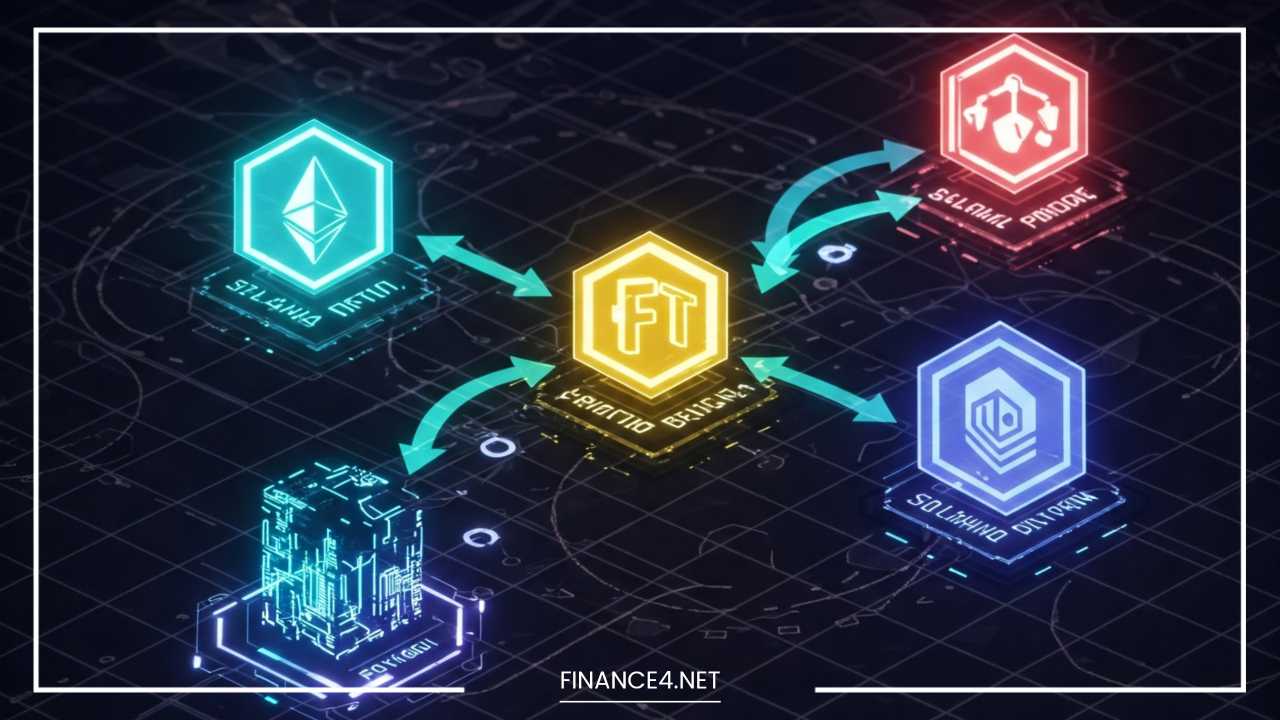
- Cross-Chain Communication Layer: This is the critical piece. It’s the protocol or infrastructure responsible for sending messages, transferring assets, or synchronizing data between chains securely.
Key Cross-Chain Communication Methods and Patterns
Choosing the right communication method is paramount, influencing the DApp’s security, performance, complexity, and trust assumptions. Here are the primary patterns:
-
Bridging:
- Concept: Bridges are protocols or systems designed specifically to transfer assets or data between two (or sometimes more) specific blockchains. They typically involve locking assets on one chain and minting equivalent “wrapped” assets on another, or verifying events on one chain to trigger actions on another.
- Types:
- Centralized (Custodian) Bridges: Rely on a trusted third party (a company or entity) to hold assets on the source chain and issue equivalent assets on the destination chain. Pros: Simple, fast. Cons: High trust requirement, single point of failure, security risk if the custodian is compromised or malicious. Less common in truly decentralized DApps due to the trust assumption.
- Federated/Multi-sig Bridges: A group of trusted validators or guardians collectively manage the bridge. Transfers require a majority of the group to sign off. Pros: Decentralized compared to a single custodian, potentially faster than fully trustless methods. Cons: Requires trust in the validator set, still susceptible to collusion if a majority is compromised.
- Decentralized (Trustless) Bridges: These bridges aim to minimize trust in external parties by using cryptographic proofs and economic incentives.
- Validator Sets: A network of independent validators runs nodes on both chains, verifies events, and signs off on transfers. Security relies on the integrity and decentralization of the validator set. Often use staking and slashing mechanisms to incentivize honest behavior.
- Relayers and Light Clients: A more advanced approach involves lightweight clients (light clients) that verify the state of a remote chain without downloading the full blockchain. Relayers observe events on one chain and submit them to the light client contract on the other chain for verification. This is the foundation of protocols like Cosmos IBC. Pros: High security (cryptographically verified), minimizes trust assumptions. Cons: Complex to implement, can be costly (gas fees for verification), potentially slower.
- Functionality: Bridges can be asset-specific (transferring only a particular token) or general-purpose (allowing transfer of various tokens and potentially data/messages).
- Challenges: Security is the paramount concern. Bridges have been the target of some of the largest hacks in the crypto space due to vulnerabilities in smart contracts, key management, or validator collusion. Latency and transaction costs can also be issues.
-
Interoperability Protocols/Networks:
- Concept: These are more ambitious frameworks or networks designed to provide a generalized, secure way for chains to communicate arbitrary messages, not just asset transfers. They often abstract away the complexities of dealing directly with different chain specifics.
- Examples:
- Cosmos IBC (Inter-Blockchain Communication): A protocol for sovereign blockchains built with the Cosmos SDK to connect and pass messages trustlessly using light clients. Focuses on sovereign chains opting into communication.
- Polkadot XCMP (Cross-Chain Message Passing): Enables parachains within the Polkadot ecosystem to send messages to each other via the central Relay Chain. Relies on the shared security of the Relay Chain.
- LayerZero: Aims to provide a lightweight, configurable messaging layer. It uses separate entities, an Oracle (e.g., Chainlink) and a Relayer, to transmit block headers and transaction proofs between chains. Security relies on the Oracle and Relayer being independent.
- Chainlink CCIP (Cross-Chain Interoperability Protocol): Leverages Chainlink’s decentralized oracle network to enable secure cross-chain message and token transfers. Uses a network of “Approved Risk Management” nodes to monitor potential issues.
- Axelar: A network connecting various blockchains, allowing developers to build cross-chain applications. It uses a proof-of-stake validator set to relay and verify messages and transactions across connected chains.
- How they Work: Generally involve listening for events on a source chain, passing the message/data through their network (which handles verification and security checks), and then delivering the message or triggering a transaction on the destination chain.
- Pros: Designed for general message passing, potentially higher security guarantees (depending on the protocol’s design and decentralization), can simplify developer experience by providing SDKs and abstractions.
- Cons: Rely on the security and liveness of the protocol’s own network and validators, can introduce additional latency and cost, requires integration with the specific protocol.
-
Wrapped Assets:
- Concept: Creating a representation of an asset from one chain on another chain. The original asset is typically locked in a smart contract or held by a custodian, and an equivalent “wrapped” token is minted on the destination chain. (e.g., wBTC on Ethereum is BTC locked on the Bitcoin blockchain and represented as an ERC-20 token).
- Limitations: While useful for bringing liquidity to other chains, this is not a general cross-chain communication method. It only addresses asset transfer and still relies on the underlying bridging mechanism (often custodial or federated for assets like BTC, or decentralized via liquidity pools and burning/minting for others).
-
Atomic Swaps:
- Concept: Allows users to trade cryptocurrencies from different blockchains directly with each other without needing a trusted third party. Uses Hash Time-Locked Contracts (HTLCs) to ensure that either both sides of the trade complete, or neither does.
- Pros: Trustless for asset exchange.
- Cons: Limited to direct swaps between two users, requires both parties to be online and participate simultaneously, not suitable for general message passing or complex DApp logic across chains.
Designing Your Cross-Chain DApp
Building a cross-chain DApp starts with careful design, considering the use case and the technical implications of operating across multiple networks.
-
Define the Cross-Chain Functionality:
- What specific interactions need to happen across chains? (e.g., transfer asset A from Chain X to Chain Y, call function Z on Chain Y based on an event on Chain X, synchronize state between contracts on different chains).
- Which chains are involved? This impacts the available interoperability solutions.
- What are the security requirements for each cross-chain operation? (e.g., is it transferring high-value assets or just sending a notification?).
-
Choose the Interoperability Strategy:
- Based on your defined functionality, security needs, technical expertise, and risk tolerance, select the appropriate cross-chain communication method (bridge, protocol, or a combination).
- Consider the trade-offs: security vs. speed, cost vs. trustlessness, complexity vs. ease of integration. Using a well-established interoperability protocol like LayerZero or Chainlink CCIP might simplify development but introduces reliance on that protocol’s security model. Building your own bridge or using a less-proven solution carries higher development and security risks.
-
Architect the Smart Contracts:
- How will contracts on different chains interact? Will they hold state that needs to be synchronized? Will they trigger actions on other chains?
- Design contracts to interface with the chosen interoperability layer (e.g., importing SDKs or libraries provided by Axelar, LayerZero, etc.).
- Implement mechanisms to handle potential delays, failures, and duplicate messages inherent in asynchronous cross-chain communication. Error handling and message reconciliation are crucial.
-
Manage Data Across Chains:
- How will the DApp access data that resides on different chains?
- Consider indexing solutions (like The Graph, which can index multiple chains) to query data efficiently.
- Determine if and how state needs to be synchronized between contracts on different chains. This is often the most complex aspect and might require a dedicated middleware layer.
-
Design the User Experience:
- Abstract away the complexity of multiple chains for the user as much as possible.
- Integrate wallets that support multiple networks (e.g., MetaMask, WalletConnect).
- Clearly communicate the status of cross-chain transactions (pending, confirmed on source, processing by communication layer, confirmed on destination). Due to the asynchronous nature, these transactions take significantly longer than single-chain transactions.
- Handle network switching smoothly if the user needs to interact directly with different chains.
Implementation Steps and Technologies
Building the DApp involves developing the smart contracts, frontend, and potentially backend/middleware to tie everything together using the chosen cross-chain communication layer.
-
Smart Contract Development:
- Write smart contracts in the appropriate language for each target chain (e.g., Solidity for EVM chains, Rust for Solana/Polkadot).
- Integrate the SDK or libraries provided by the chosen interoperability protocol. This typically involves inheriting from base contracts or using specific interfaces to send and receive messages.
- Implement logic to handle incoming messages from other chains, verify their authenticity (often handled by the protocol’s library), and trigger corresponding actions.
- Develop robust error handling and fallback mechanisms for cross-chain calls that might fail or be delayed.
- Thorougly test smart contracts in simulated cross-chain environments.
-
Frontend Development:
- Use a framework like React, Vue, or Angular.
- Integrate multi-chain wallet connectors (e.g., WalletConnect 2.0, which supports multiple chains).
- Implement logic to detect the user’s current network and guide them through switching networks if necessary.
- Display relevant information from multiple chains (e.g., asset balances, transaction history).
- Handle asynchronous cross-chain transactions in the UI, showing progress indicators and clear status updates.
-
Backend/Middleware Development:
- Depending on the architecture, you might need backend services to:
- Listen for and index events on different chains.
- Run a relayer for a specific protocol (if not using a public relayer service).
- Manage and synchronize off-chain data related to cross-chain operations.
- Provide APIs for the frontend to interact with multiple chains or the interoperability layer.
- Choose appropriate languages and frameworks (Node.js, Python, Go).
- Depending on the architecture, you might need backend services to:
-
Tools and Frameworks:
- Development Environments: Hardhat or Foundry for EVM contract development and testing.
- Interoperability Protocol SDKs: Use the specific SDKs provided by protocols like LayerZero, Axelar, Chainlink, etc., to interact with their networks.
- Indexing Tools: The Graph can be used to build subgraphs that index data from multiple chains, making querying easier.
- Cross-Chain Wallets & Connectors: WalletConnect, RainbowKit, Web3Modal.
- Block Explorers: Etherscan, Polygonscan, etc., for debugging transactions on individual chains. Cross-chain explorers (if available for the chosen protocol) can help track messages.
Challenges and Considerations: The Hard Truths
Building cross-chain DApps is challenging, and it’s crucial to be aware of the complexities:
-
Complexity and Development Time: Developing for multiple chains and integrating with interoperability protocols is significantly more complex and time-consuming than single-chain development. Developers need expertise across different chain environments and protocol specifics.
-
Security Vulnerabilities: This is the most significant challenge. Each layer of the cross-chain stack is a potential attack vector:
- Smart Contract Risks: Bugs in your DApp’s smart contracts or the smart contracts of the interoperability protocol itself.
- Bridge/Protocol Risks: Exploits in the bridge mechanism, compromise of validator sets or relayers, oracle manipulation. A vulnerability in the cross-chain communication layer can have cascading effects across all connected chains.
- Frontend Risks: Phishing attacks, malicious code injection.
- Asynchronous Risks: Handling potential race conditions, duplicate messages, or message loss due to the non-instantaneous nature of cross-chain communication.
-
Cost: Cross-chain operations typically involve transactions on multiple chains, incurring gas fees on each. The interoperability layer itself may also charge fees. This can make frequent, low-value cross-chain interactions expensive.
-
Latency and Asynchronicity: Unlike single-chain transactions, cross-chain operations are asynchronous. A transaction initiated on one chain needs to be confirmed, processed by the interoperability layer, and then executed on the destination chain. This can take anywhere from seconds to minutes or even longer, impacting user experience and requiring careful handling in the DApp’s logic.
-
User Experience: Managing multiple networks, understanding cross-chain transaction flows, and dealing with potential delays or failures can be confusing for users. A clear and intuitive UI is essential.
-
Upgradability and Maintenance: Deploying and maintaining smart contracts on multiple chains, and ensuring compatibility with evolving interoperability protocols, adds significant operational overhead.
-
Regulatory Landscape: The regulatory environment for blockchain and cross-chain technology is still evolving and varies by jurisdiction. Compliance needs to be a key consideration.
Security Deep Dive: Mitigating the Risks
Given the high stakes, security must be the top priority.
- Choose Reputable Protocols: Opt for well-audited and established interoperability protocols with strong security track records and decentralized designs. Understand their security models and trust assumptions.
- Thoroughly Audit Smart Contracts: Engage reputable blockchain security firms to audit your DApp’s smart contracts before deployment, especially those interacting with the cross-chain layer.
- Implement Robust Monitoring: Set up monitoring systems to detect suspicious activity related to cross-chain transactions or the interoperability protocol.
- Handle Errors and Timeouts Gracefully: Design your smart contracts and middleware to correctly handle failed cross-chain messages, timeouts, and potential duplicate deliveries. Implement mechanisms for manual intervention if necessary (though this adds a centralized element).
- Educate Users: Clearly inform users about the risks and process of cross-chain operations.
- Limit Exposure: In critical applications (like large-scale asset bridges), consider implementing circuit breakers or rate limits to mitigate the impact of a potential exploit.
- Stay Updated: The cross-chain space is rapidly evolving. Stay informed about new attack vectors and security best practices.
Future Trends in Cross-Chain Development
The field of cross-chain interoperability is still in its nascent stages and is undergoing rapid innovation:
- Increased standardization.
- More robust and secure protocols.
- Abstraction complexity for developers and users.
- Native cross-chain features at the protocol level.
- Focus on Interchain Security: Concepts like shared security models (as seen in Polkadot) or interchain security (in Cosmos) aim to provide stronger security guarantees for cross-chain interactions within their ecosystems.
Final Thoughts: Building the Interoperable Future
Building a cross-chain DApp is a complex undertaking, requiring a deep technical understanding and a cautious approach to security.
It involves navigating disparate blockchain environments and integrating with specialized interoperability layers, each with its own trade-offs and risks.
However, the potential rewards are significant. Cross-chain DApps have the power to unlock trapped liquidity, expand user bases, leverage the unique strengths of different networks, and ultimately contribute to a more connected and powerful decentralized ecosystem.
As the blockchain space matures, cross-chain capabilities will become increasingly essential for DApps aiming for broad adoption and functionality.
By understanding the core concepts, architectural patterns, available technologies, and, most importantly, the inherent security challenges, developers can begin to build the decentralized applications of the interoperable future.
It’s a journey filled with technical hurdles, but one that promises to break down the silos and usher in a new era of blockchain connectivity.