Top Cross-Chain Aggregator for Tokens
 by
by 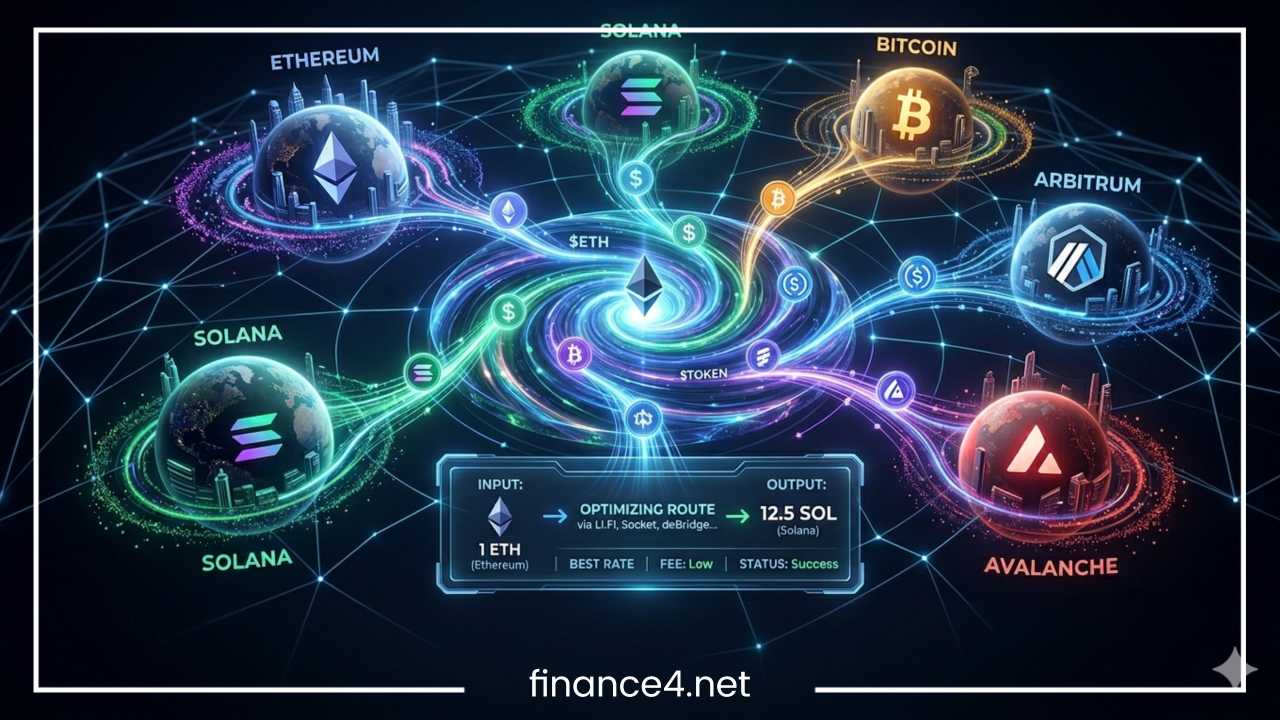
Top Cross-Chain Aggregator for Tokens: The Definitive Multi-Chain Swap Guide
The decentralized finance landscape has evolved from a single dominant blockchain network into a vibrant, multi-chain ecosystem. In the early days of decentralized applications, Ethereum hosted nearly all meaningful capital, liquidity, and transactional activity. Today, market participants routinely interact with a vast array of alternative Layer-1 networks and Layer-2 scaling solutions. Blockchains such as Solana, BNB Chain, and Avalanche operate alongside highly successful Ethereum Layer-2 networks like Arbitrum, Base, and Optimism. While this explosion of networks has drastically lowered transaction costs and introduced unique technological innovations, it has also created a highly fragmented financial landscape.
Liquidity is no longer unified. Instead, it is scattered across hundreds of isolated protocols spread across distinct, non-communicative blockchains. When a user holds capital on Ethereum but spots an attractive yield farming opportunity on Base, or wants to purchase a native token available exclusively on Solana, they face a complex web of logistical hurdles. Moving assets across these disparate networks historically required interacting with centralized exchanges as intermediaries or navigating dangerous, highly technical standalone bridges. Each manual step exposes the user to operational friction, high transaction costs, slippage, and security risks.
This friction has fueled the rise of the cross-chain aggregator, an advanced layer of decentralized finance infrastructure. A cross-chain token aggregator acts as a unified portal, programmatically abstracting away the underlying complexities of moving and swapping digital assets between separate blockchains. By bundling together decentralized exchanges and cross-chain bridge protocols, these platforms offer users optimized multi-chain liquidity, minimal slippage, and unmatched capital efficiency. This comprehensive article explores how cross-chain token aggregators function, breaks down the core benefits and inherent risks of using them, evaluates the premier platforms available in the market today, and provides a clear framework for selecting the right solution for your decentralized finance workflows.
Understanding the Cross-Chain Aggregator Landscape
To appreciate the value proposition of a cross-chain aggregator, it is essential to distinguish it from other foundational pieces of decentralized financial infrastructure. The broader crypto ecosystem frequently uses the terms decentralized exchange aggregator, token bridge, and cross-chain aggregator interchangeably, yet they serve distinctly different roles within a user’s transactional journey.
A standard decentralized exchange aggregator operates entirely within the boundaries of a single blockchain network. When a trader seeks to swap Ether for wrapped Bitcoin on Ethereum, a decentralized exchange aggregator scans all automated market makers and order books on Ethereum—such as Uniswap, SushiSwap, and Curve—to find the most efficient route. It breaks the order into smaller pieces if necessary, ensuring the user experiences the lowest possible price impact. However, a traditional decentralized exchange aggregator is completely blind to assets and liquidity pools residing outside its host network; it cannot facilitate a swap that originates on Ethereum and terminates on Solana.
A token bridge protocol, by contrast, is a specialized transport mechanism designed explicitly to move data or value from one blockchain to another. Traditional bridges operate by accepting a specific token on a source chain, locking or burning it, and then generating an equivalent representation of that token on the destination chain through a minting or liquidity release mechanism. While a bridge solves the problem of cross-chain mobility, it rarely optimizes for token exchange. If a user wants to turn Ether on Ethereum into native Solana tokens via a pure bridge, they must first convert their Ether into a bridgeable asset, execute the bridge transaction, manually claim the bridged asset on the destination chain, and then perform a separate swap on a destination-chain decentralized exchange.
A cross-chain aggregator sits at the apex of these two technologies, seamlessly combining their capabilities into a single, cohesive user experience. It functions as both a multi-chain decentralized exchange aggregator and a token bridge aggregator simultaneously. When a user initiates a cross-chain swap, the aggregator analyzes the available decentralized exchange liquidity on the source chain, selects the optimal asset to send across the network, routes that asset through the most efficient token bridge protocol, and then executes a final swap via decentralized exchanges on the destination chain.
From the end-user perspective, this entire sequence of smart contract interactions, multi-network transactions, and gas payments is compressed into a single click. A user can trade Ether on Ethereum and receive native USD Coin on Polygon or Solana within a few minutes, completely insulated from the underlying mechanics of route optimization, smart routing, and manual bridge navigation. The platform automatically calculates the gas requirements for all involved networks, incorporates them into the final quote, and delivers a unified, frictionless transaction.
How Cross-Chain Aggregators Work Beneath the Surface
The seamless user experience provided by a cross-chain token aggregator relies on an intricate, highly coordinated stack of technologies working behind the scenes. This infrastructure must balance data communication, capital allocation, and algorithm-driven computation across completely isolated state machines. The architecture can be broken down into four foundational components: liquidity aggregation, cross-chain messaging, smart routing algorithms, and bridge infrastructure.
Liquidity Aggregation
Liquidity aggregation is the process of synthesizing capital depth from hundreds of individual pools. Cross-chain aggregators do not typically maintain their own massive, proprietary pools of tokens for every conceivable pair across all chains. Instead, they integrate programmatically with local decentralized exchanges on every supported network.
By utilizing customized smart contracts and application programming interfaces, the aggregator queries real-time order books, concentrated liquidity positions, and automated market maker equations. When an aggregation engine processes a trade request, it treats the entire decentralized finance landscape as a singular, unified pool of capital. This allows the system to tap into billions of dollars in liquidity, ensuring that even large institutional-sized transactions can be processed with minimal price distortion.
Cross-Chain Messaging
The fundamental challenge of any multi-chain transaction is state verification: proving to Blockchain B that a specific event occurred on Blockchain A. Cross-chain aggregators rely heavily on arbitrary data messaging protocols to pass instructions and confirmations across networks.
This communication layer is sustained by an architecture of relayers, validators, and decentralized oracles. Relayers actively monitor the source chain for specific smart contract events, such as a user depositing tokens into an aggregator’s vault. Once an event is detected, the relayer packages the cryptographic proof and transmits it to the destination chain.
Before the destination chain accepts this data, a validation mechanism must confirm its legitimacy. Depending on the architecture, this validation might rely on a decentralized network of multi-signature oracles, cryptographic light clients that verify state proofs directly on-chain, or optimistic verification windows where network participants can challenge fraudulent data. Once verified, the destination smart contract executes the final leg of the trade.
Smart Routing Algorithms
The core intellectual property of a cross-chain aggregator resides within its smart routing algorithm. Finding the optimal path for an asset transfer is an incredibly complex computational problem, particularly when factoring in volatile token prices, varying block times, shifting liquidity depths, and fluctuating network gas fees.
The routing algorithm acts as a real-time pathfinding engine. When a user requests a quote, the algorithm calculates thousands of potential permutations instantaneously. It evaluates whether it is cheaper and faster to swap Token A to Token B locally on the source chain before bridging, or whether it should bridge Token A directly and perform the swap entirely on the destination chain.
Furthermore, advanced routing algorithms support multi-hop and split-path execution. For instance, if a user wants to move a large volume of tokens, the algorithm might split the transaction, sending forty percent through one bridge protocol and sixty percent through another, while simultaneously breaking up the accompanying decentralized exchange swaps to eliminate slippage. The algorithm continuously balances three primary variables: execution speed, total transaction cost including gas, and the ultimate payout rate delivered to the user.
Bridge Infrastructure and Intent Architecture
The bridge infrastructure utilized by aggregators generally falls into three operational models. The first is the classic lock-and-mint or burn-and-mint framework, where assets are cryptographically secured on one network while synthetic equivalents are generated on another. The second model relies on cross-chain liquidity pools, where the aggregator or its underlying bridge protocols maintain balanced reserves of identical native assets on multiple networks, allowing users to deposit an asset on Chain A and withdraw it from a pool on Chain B.
The third and most advanced framework is intent-based routing. In an intent-based architecture, the user does not specify the exact technical path or bridge protocol their transaction must use. Instead, they simply state their desired outcome, or “intent”—for example, “I want to exchange 10 Ether on Ethereum for its maximum value in Solana tokens on Solana.”
This intent is broadcasted to an open network of competitive third-party entities known as solvers, market makers, or fillers. These solvers compete against one another to fulfill the user’s intent immediately using their own private capital reserves. The winning solver provides the user with the requested assets on the destination chain almost instantly, and in return, claims the user’s original assets on the source chain along with a small premium. Intent-based routing shifts the burden of execution risk, bridge waiting times, and gas optimization away from the retail user and onto highly sophisticated professional market makers, radically accelerating transaction speeds and reducing failures.
Benefits of Navigating DeFi with Cross-Chain Aggregators
Utilizing a cross-chain aggregator rather than navigating individual bridges and decentralized exchanges manually provides market participants with substantial structural advantages. These platforms have quickly shifted from a luxury convenience tool to mandatory infrastructure for efficient capital management.
Optimized Token Pricing and Minimal Slippage
The primary economic incentive for employing an aggregator is the optimization of execution prices. Because cryptocurrency markets are highly fragmented, a token may trade at slightly different values across different decentralized exchanges and networks simultaneously. A manual trader lacks the tooling to scan these inefficiencies in real time.
Cross-chain aggregators continuously benchmark prices across the entire ecosystem. By splitting trades across multiple liquidity sources and selecting the absolute cheapest cross-chain corridors, they systematically deliver more tokens to the destination wallet than a user could achieve on their own. This reduction in slippage is particularly profitable for high-volume traders and institutional entities where even a basis point of price improvement translates into significant capital retention.
Eradication of Transaction Complexity
Executing a manual cross-chain transfer is an error-prone, multi-step process that intimidates even seasoned decentralized finance veterans. It requires a user to maintain multiple browser extension wallets, connect to various fragmented web applications, manually configure custom network settings, hold separate native gas tokens for every single blockchain involved, and sign a succession of individual smart contract approvals. A single mistake, such as sending a wrapped token to an incompatible address, can result in the permanent, irreversible loss of capital.
Aggregators eliminate this operational complexity entirely. They consolidate the entire workflow into a clean, singular interface. The underlying protocol handles the multi-stage execution, manages token approvals, and abstracts away gas token requirements. Many modern aggregators feature gas abstraction or gas payment conversion, allowing users to pay for all cross-chain transaction and network fees using the primary asset they are swapping, completely eliminating the need to hold small amounts of native tokens like AVAX, MATIC, or SOL just to cover gas on destination networks.
Enhanced Capital Efficiency and Ecosystem Accessibility
For yield farmers, arbitrageurs, and active Web3 participants, capital efficiency is paramount. Opportunities in decentralized finance—such as a mispriced liquidity pool, a high-yielding lending market, or a time-sensitive non-fungible token mint—often open and close within incredibly tight windows.
If capital is locked in an inefficient, slow bridging process, the user misses the opportunity entirely. Cross-chain aggregators provide the velocity required to move capital fluidly across the Web3 landscape. Traders can rapidly redeploy assets to whichever blockchain currently offers the highest returns or lowest risks, maximizing the compounding potential of their portfolios. This friction-free mobility breaks down the walled gardens of individual layer-1 networks, fostering a truly interconnected and global digital asset economy.
Risks, Vulnerabilities, and Challenges
Despite their compelling advantages, cross-chain aggregators are not completely without risk. Operating at the frontier of blockchain interoperability introduces unique technical, structural, and systemic vulnerabilities that users must thoroughly understand before committing substantial capital.
Smart Contract Exploits and Systemic Bridge Risks
The most significant threat to any cross-chain transaction is security failure within the underlying smart contracts. Cross-chain infrastructure represents one of the most heavily targeted vectors for malicious actors in the digital asset space. Bridges are inherently attractive targets because they act as centralized honeypots, locking up massive volumes of collateral on one chain to back assets on another.
When a user interacts with a cross-chain aggregator, they are exposed to a compounded security surface. The user is trusting not only the security of the aggregator’s own routing smart contracts but also the integrity of every individual bridge protocol, cross-chain messaging protocol, and decentralized exchange liquidity pool that the aggregator selects to fulfill the route. If an underlying bridge protocol utilized by an aggregator suffers a critical exploit or validation vulnerability mid-transaction, the user’s funds could be permanently frozen, drained, or lost in transit.
Liquidity Fragmentation on Secondary Networks
While aggregators excel at routing through deep pools of capital, they remain fundamentally constrained by the organic liquidity available in the market. Smaller, newer, or highly specialized blockchain networks often suffer from thin liquidity depth.
If a trader attempts to move a substantial volume of tokens to an emerging Layer-2 or a nascent Layer-1 through an aggregator, the aggregator may still struggle to find an efficient path. In such instances, the algorithm may be forced to route the trade through illiquid automated market makers, resulting in high slippage or exorbitant price impacts. Aggregators generally warn users via their user interface when liquidity is insufficient, but executing large trades on long-tail assets always carries heightened pricing risks.
Miner Extractable Value, Front-Running, and Network Congestion
Cross-chain transactions typically take longer to achieve finality than pure local transactions because they must wait for consensus on multiple distinct networks. This extended exposure window makes cross-chain swaps susceptible to Miner Extractable Value and front-running attacks.
Malicious searchers run automated bots to scan public mempools for pending cross-chain transactions. When they identify a large swap routed through an aggregator, they can execute transactions immediately before and after the user’s trade—a maneuver known as a sandwich attack—effectively stealing value by manipulating the token price. Furthermore, unexpected network congestion on either the source chain, the destination chain, or the intermediary messaging layer can cause transactions to stall. A stalled transaction can leave a user’s capital trapped in a half-executed state for hours, exposing them to adverse market movements while they wait for network fees to normalize or for validators to clear the backlog.
Top Cross-Chain Aggregators for Tokens
To assist market participants in navigating this landscape, we examine the premier cross-chain token aggregators currently dominating the industry. Each platform approaches the challenge of interoperability through a unique architectural lens, optimizing for distinct user profiles, developer integrations, or security paradigms.
LI.FI
LI.FI is an institutional-grade cross-chain liquidity aggregation protocol that acts as a middleware solution for the broader Web3 ecosystem. Rather than operating strictly as a consumer-facing retail website, LI.FI focuses heavily on providing a robust Software Development Kit and Application Programming Interface that other developers can integrate directly into their own wallets, decentralized applications, and portfolio trackers.
-
Supported Chains: LI.FI features a highly modular architecture that aggregates dozens of individual cross-chain bridges, intent-based systems, and hundreds of localized decentralized exchanges. It provides comprehensive coverage across virtually all major Ethereum Virtual Machine compatible environments—including Ethereum, Arbitrum, Optimism, Base, Polygon, Avalanche, and BNB Chain—while maintaining deep non-EVM connectivity to networks like Solana.
-
Key Features: It focuses on developer toolkit infrastructure, token bridge aggregation, dynamic multi-hop routing, and intent-based routing structures through external partners.
-
Security Model: The protocol implements an advanced, dynamic risk-management framework. It continuously monitors the economic health and security status of its connected bridges, automatically disabling routes through protocols exhibiting unusual activity or vulnerabilities.
-
Fees: LI.FI passes through the underlying gas and bridge fees directly to the user, adding a highly competitive and customizable integrator fee for platforms utilizing its API.
-
Best For: Developers, institutional setups, and advanced DeFi users who require robust SDK/API solutions.
-
Pros & Cons: It offers industry-leading structural redundancy and comprehensive asset path coverage. However, its consumer interface can feel dense or slightly complex for a complete beginner.
Socket
Socket is a prominent interoperability protocol designed to deliver complete chain abstraction to decentralized applications. Socket views the multi-chain universe not as a collection of separate paths, but as a single, unified execution environment, allowing developers to build applications where the user remains completely unaware of what chain their assets reside on.
-
Supported Chains: Socket’s architecture separates asset bridging from data messaging, allowing for maximum flexibility. Its flagship consumer-facing integration layer enables seamless token transfers across all major Layer-2 scaling solutions (Arbitrum, Base, Optimism) and primary Layer-1 environments.
-
Key Features: Focuses on complete modular chain abstraction, developer plug-and-play app integrations, app-specific customizable routing, and low-latency asset execution.
-
Security Model: Socket utilizes a modular security approach, letting applications choose their preferred validation mechanisms based on their risk tolerance. Its routing engine focuses heavily on gas optimization, constantly updating its smart contracts to minimize the computational overhead of cross-chain execution.
-
Fees: Transparent and tightly optimized fees, bundled neatly into a single asset quote presented during transaction signing.
-
Best For: Mobile wallets, decentralized app developers, and users prioritizing native app ecosystem integrations.
-
Pros & Cons: Excellent developer tools and incredibly fast asset propagation across Layer-2 networks. The main drawback is a slightly narrower layout for highly exotic non-EVM networks.
Rango Exchange
Rango Exchange stands out as one of the most comprehensive multi-chain DEX and bridge aggregators in existence regarding total blockchain network coverage. Designed as a powerful, feature-rich terminal for decentralized finance power users, Rango specializes in bridging the gap between radically different blockchain architectures.
-
Supported Chains: Where many aggregators restrict their operations primarily to the EVM universe, Rango Exchange supports a massive list of heterogeneous networks. It connects EVM chains, Cosmos ecosystem app-chains, Bitcoin, Litecoin, Solana, TRON, Near, and Starknet.
-
Key Features: Multi-wallet connection compatibility, cross-ecosystem routing algorithms, advanced multi-hop pathfinding, and non-EVM swap focus.
-
Security Model: Rango aggregates decentralized, non-custodial protocols, ensuring users always retain ownership of their private keys throughout the transaction lifecycle.
-
Fees: Base bridge fees and standard network gas fees, alongside a minor service fee built directly into the swap rates.
-
Best For: Cross-ecosystem power users, multi-chain asset traders, and legacy UTXO (Bitcoin/Litecoin) holders.
-
Pros & Cons: Unmatched support for non-EVM, Cosmos, and legacy networks. On the downside, the visual interface can be complex, and certain non-EVM routes may take longer due to slower baseline block confirmation times.
Jumper Exchange
Jumper Exchange is a flagship consumer-facing front-end built directly on top of the LI.FI aggregation engine. Created specifically to provide a beautiful, simple, and ultra-reliable gateway for retail crypto participants, Jumper serves as a unified interface for all cross-chain swapping needs.
-
Supported Chains: Inheriting the extensive backend infrastructure of LI.FI, Jumper Exchange supports dozens of chains, bridges, and decentralized exchanges spanning the major EVM environments and Solana.
-
Key Features: Beginner-friendly user interface, transparent routing optimization tabs, immediate multi-option execution path comparisons, and gas fallback mechanisms.
-
Security Model: Jumper benefits completely from LI.FI’s institutional-grade security monitoring and smart contract auditing standards. The platform prioritizes user safety by clearly labeling routes based on speed and cost.
-
Fees: Clear breakdowns of bridge fees, destination gas costs, and execution paths before a user signs the transaction, with no added hidden retail markups.
-
Best For: Mainstream retail traders, everyday DeFi users, and beginners exploring multi-chain swaps.
-
Pros & Cons: Extremely intuitive layout and clean, seamless execution with deep backend liquidity. However, it lacks advanced algorithmic fine-tuning parameters for custom scripting.
THORChain
THORChain represents a fundamentally different architectural philosophy compared to the other aggregators on this list. While most aggregators function as software layers that orchestrate third-party bridges, THORChain is an independent, decentralized Layer-1 blockchain designed specifically to facilitate native, trustless asset swaps without relying on wrapped tokens or centralized custodians.
-
Supported Chains: THORChain uses a unique continuous liquidity pool model supporting major native Layer-1 assets including Bitcoin, Ethereum, Solana, BNB Chain, Avalanche, and Litecoin.
-
Key Features: Native cross-chain asset swaps, complete elimination of wrapped or synthetic asset risks, decentralized structural liquidity, and the RUNE settlement system.
-
Security Model: THORChain’s security is maintained by a decentralized network of anonymous node operators who must bond massive quantities of RUNE capital to secure the network. The protocol uses advanced threshold signature schemes to secure its multi-signature vaults.
-
Fees: Paid in the native assets being swapped; includes a slip-based dynamic fee to prevent pool manipulation and flat outbound network destination fees.
-
Best For: Decentralized purists, high-volume native asset holders, and long-term investors moving large amounts between Bitcoin and Ethereum.
-
Pros & Cons: True decentralized native asset swaps without intermediate wrapper smart contracts. The downside is that it doesn’t support long-tail meme tokens or minor Layer-2 scaling tokens.
Across Protocol
Across Protocol is a premier, intent-based cross-chain bridging network that specializes in ultra-fast, capital-efficient token transfers. Rather than acting as a wide-ranging aggregator of other platforms, Across operates as a highly optimized foundational protocol that other aggregators frequently route through due to its superior speed and pricing structure.
-
Supported Chains: Across focuses intensely on the core asset corridors connecting Ethereum mainnet to major Layer-2 networks like Arbitrum, Optimism, Base, Polygon, Linea, and ZKsync.
-
Key Features: Intent-based solver design, exceptionally fast confirmation speeds, minimal capital overhead, and low slippage optimization.
-
Security Model: The platform relies on UMA’s battle-tested optimistic oracle framework to resolve disputes and validate transactions. Independent solvers take on the immediate execution risk, insulating the user.
-
Fees: Highly optimized, minimalist gas fees and a small premium paid directly to competitive solvers.
-
Best For: High-velocity Layer-2 traders and users looking for the lowest fee paths for standard stablecoins and wrapped assets.
-
Pros & Cons: Exceptionally fast (often resolving under 15 seconds) and highly cost-efficient. However, its asset lists are confined primarily to blue-chip tokens and major Layer-2 channels.
deBridge
deBridge is a high-performance cross-chain interoperability and liquidity transfer infrastructure layer designed to facilitate instantaneous value and data transfers between diverse blockchain networks. It has gained massive adoption for its highly efficient connections between the EVM world and non-EVM ecosystems like Solana.
-
Supported Chains: deep high-velocity pipelines connecting Ethereum, Solana, Arbitrum, Base, Optimism, Linea, and BNB Chain.
-
Key Features: Institutional-grade messaging framework, peer-to-peer liquidity networks (DLN), guaranteed zero-slippage routes, and cross-chain execution intent engines.
-
Security Model: The protocol’s security is anchored by a decentralized network of independent validators who cryptographically sign every cross-chain transaction. Its intent-based architecture completely eliminates intermediate systemic smart contract locks.
-
Fees: Minimal and clearly separated into execution costs and filler premiums, offering explicit guaranteed pricing.
-
Best For: Solana-to-EVM power users, high-frequency arbitrageurs, and institutional transaction size execution.
-
Pros & Cons: Zero-slippage guarantee on intent routes and incredible speed between Solana and Layer-2 environments. For illiquid token paths, finding an available solver matching your price intent can sometimes take longer than standard AMMs.
| Platform | Chains Supported | Fees | Speed | Best For | Security Model |
| LI.FI | EVM (Ethereum, L2s) & Solana | Bridge costs + dynamic integrator fee | Variable (dependent on route) | Developers and advanced dApps | Multi-bridge redundancy and active risk monitoring |
| Socket | Broad EVM and major Ethereum L2s | Optimized gas fee + direct bridge cost | Fast (highly optimized for L2s) | App developers seeking chain abstraction | Modular validation frameworks per dApp |
| Rango Exchange | EVM, Cosmos, Solana, Bitcoin, Tron | Base bridge fees + minor service fee | Variable (can be slow for non-EVM) | Multi-ecosystem power users | Aggregated decentralized non-custodial smart contracts |
| Jumper Exchange | Extensive EVM & Solana ecosystem | Transparent bridge costs; no added retail fees | Fast to moderate (user optimized) | Mainstream retail traders and beginners | Inherited LI.FI audit stack and risk curation |
| THORChain | Native L1s (Bitcoin, Ethereum, Solana) | Slip-based fee + native outbound network fees | Moderate (dependent on L1 block times) | Decentralized purists and large native swaps | Node operator collateral bonding and TSS vaults |
| Across Protocol | Ethereum and premier Layer-2 networks | Ultra-low gas + minimal solver premium | Exceptionally fast (often < 30 seconds) | High-velocity Layer-2 asset transfers | UMA Optimistic Oracle and batch settlement |
| deBridge | EVM chains and deep Solana integration | Zero slippage quotes + minor filler premium | Instantaneous peer-to-peer execution | Solana-to-EVM traders and large volume orders | Decentralized validator signatures and intent matching |
Key Features to Look for in a Cross-Chain Aggregator
When choosing a cross-chain aggregator for your daily token swaps, you should not simply pick a platform at random. Different trading scenarios demand different prioritization of features. Evaluate any protocol against the following core criteria before executing a transaction:
-
Supported Blockchains: Verify that the aggregator natively supports both your precise source network and your target destination network. If you frequently trade outside the standard EVM universe, prioritize platforms like Rango Exchange or deBridge.
-
Security Audits and Track Record: Investigate whether the aggregator’s smart contracts have undergone rigorous, multi-firm security audits. Look for platforms that publish their audit reports transparently and maintain an unblemished historical record free from catastrophic exploits.
-
Liquidity Depth and Routing Intelligence: A superior aggregator should connect to a wide array of localized decentralized exchanges and bridges. Deeper liquidity access guarantees that your larger transactions will not suffer from excessive slippage or negative price impacts.
-
Transaction Speed and Finality: Depending on the underlying architecture, a cross-chain swap can take anywhere from a few seconds to over an hour. Intent-based systems generally offer the fastest settlement times, whereas native Layer-1 swaps are bound by slower blockchain consensus speeds.
-
Wallet Compatibility: Ensure the aggregator seamlessly interfaces with your preferred cryptocurrency wallets. If you are executing a cross-chain swap between two entirely different network architectures, the platform must be capable of connecting to multiple wallet extensions simultaneously.
-
User Interface Clarity: Multi-chain transactions are structurally complex. A well-designed user interface should explicitly break down every stage of the transaction, displaying the exact route, the expected time to completion, the breakdown of fees, and clear warnings regarding slippage risks.
-
Slippage Protection and Price Guarantees: Look for protocols that offer robust slippage settings and front-running protection. Intent-based aggregators that guarantee zero-slippage execution provide a significant safety advantage for volatile digital assets.
Future of Cross-Chain Aggregation
The cross-chain aggregation landscape is moving toward a future defined by complete architectural invisibility. This paradigm shift is being driven by two monumental technological trends: chain abstraction and intent-driven design.
In the future, the fragmented nature of individual blockchain networks will be completely hidden from the end-user. The current industry design, which requires individuals to manually select bridges, hold distinct gas tokens, and consciously jump between networks, will be replaced by a unified, invisible Web3 user experience. Powered by advanced account abstraction wallets and intent-based routing networks, users will simply interact with an application’s interface. Whether the underlying financial action takes place on Solana, Arbitrum, or Ethereum will be irrelevant to the consumer; the cross-chain aggregation layer will handle the routing, gas conversion, and settlement instantaneously and autonomously in the background.
Simultaneously, the widespread adoption of artificial intelligence and machine learning routing engines will enable aggregators to predict network congestion, gas spikes, and liquidity shifts before they occur. Solvers and automated market makers will compete in highly sophisticated, hyper-efficient digital marketplaces to deliver the absolute best execution prices across thousands of modular rollups. As these technologies mature, cross-chain aggregators will cease to be standalone destinations where users go to swap tokens; instead, they will transform into the foundational, invisible vascular system powering the entire global decentralized financial network.
Final Thoughts
Cross-chain aggregators represent a critical evolutionary step for the decentralized finance ecosystem. By weaving together the disparate liquidity pools of decentralized exchanges and the transport pipelines of token bridges, these platforms rescue market participants from the manual friction, high costs, and operational risks of multi-chain navigation.
Platforms like Jumper Exchange provide a perfect, user-friendly entry point for daily retail swaps, while infrastructure giants like LI.FI and Socket empower developers to build deeply integrated multi-chain applications. For traders moving assets outside the standard EVM sandbox, Rango Exchange offers unmatched network coverage, while deBridge delivers zero-slippage intent fulfillment. Finally, decentralized purists handling large native asset transfers can continue to rely on the robust, wrapped-token-free architecture of THORChain.
As you navigate this multi-chain landscape, always prioritize security and capital preservation. Before executing any substantial cross-chain swap, double-check your recipient addresses, verify the liquidity depth to avoid excessive slippage, and choose an aggregator whose architecture aligns with your specific speed, fee, and risk tolerances. Cross-chain aggregators have successfully laid the groundwork for a truly unified Web3 financial ecosystem, providing the essential infrastructure required to trade any token, on any chain, at any time.
Frequently Asked Questions
What is the best cross-chain aggregator for low fees?
The best cross-chain aggregator for low fees depends heavily on the networks you are using, but Across Protocol consistently offers some of the lowest fees for moving standard assets between Ethereum and major Layer-2 networks. Because Across utilizes an intent-based architecture with competitive third-party solvers, it drastically minimizes gas overhead and protocol costs. For broader token swaps spanning non-EVM chains, platforms like deBridge or Jumper Exchange (powered by LI.FI) offer highly optimized routes that benchmark dozens of liquidity pools to ensure you get the lowest total transaction cost.
Which is the safest cross-chain bridge aggregator to use?
No cross-chain platform is entirely without risk, but the safest cross-chain bridge aggregators prioritize multi-bridge redundancy, rigorous smart contract audits, and real-time security tracking. Platforms like LI.FI and its consumer interface, Jumper Exchange, feature active risk-monitoring frameworks that automatically disable specific bridging routes if unusual activity or vulnerabilities are detected. If you want to eliminate the security risks associated with wrapped or synthetic assets entirely, THORChain is considered highly secure for large-scale transfers because it executes trustless, native asset swaps directly on underlying Layer-1 blockchains.
How do I swap tokens across different blockchains without wrapped assets?
To swap tokens across completely different blockchains without using wrapped or synthetic assets, you should use a decentralized native asset liquidity protocol like THORChain. Unlike traditional bridges that lock collateral on one chain to mint a synthetic equivalent on another, THORChain utilizes continuous liquidity pools paired against its native token, RUNE. This allows you to trade native Bitcoin directly for native Ether or native Solana safely and trustlessly, ensuring you retain true asset ownership without intermediate smart contract counterparty risks.
Can I do a cross-chain swap from Ethereum to Solana with zero slippage?
Yes, you can achieve guaranteed zero slippage on cross-chain swaps between Ethereum and Solana by using intent-based aggregation networks like deBridge (via its DLN network). Traditional automated market makers can suffer from high price impacts during volatile periods, but intent-based systems operate on a peer-to-peer liquidity matching model. The exact token price quoted to you at the beginning of the transaction is locked in and guaranteed at settlement by a private filler, shifting the risk of market volatility completely away from you.
Why do some multi-chain DEX swaps take so long to complete?
Multi-chain DEX swaps take longer than single-chain trades because they rely on cross-chain messaging layers and validators to verify state changes across separate, isolated blockchains. A single transaction must achieve finality on the source chain, get verified by relayers or oracles, and then execute a final swap on the destination chain. If you are routing through slower legacy Layer-1 networks like Bitcoin, or if there is unexpected network congestion on an Ethereum Layer-2, your capital can temporarily experience longer confirmation times while waiting for validators to clear the backlog.