Top Bridging Aggregator for Real-Time Quotes
 by
by 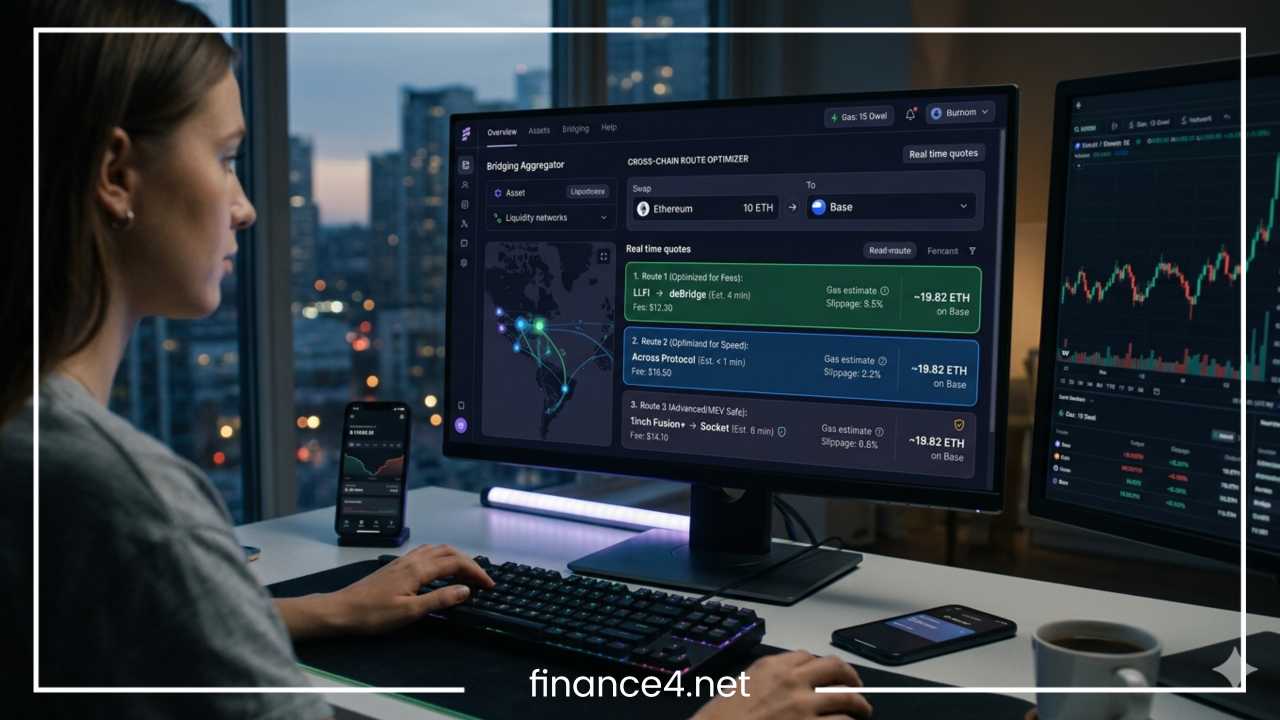
Top Bridging Aggregators for Real-Time Quotes & Low Fees
The expansion of the decentralized web has led to an explosion in cross-chain activity. Instead of a single dominant network, the blockchain landscape has evolved into an interconnected ecosystem of Layer 1 mainnets, optimistic rollups, zero-knowledge execution layers, and application-specific chains. While this multi-chain architecture offers unparalleled scalability and diversity, it has simultaneously created fragmented blockchain liquidity. Assets are isolated across distinct cryptographic environments, forcing users to constantly navigate technical boundaries to participate in different decentralized finance ecosystems.
In the early days of multi-chain expansion, moving assets between networks meant relying exclusively on native or canonical bridges. For example, transferring capital from Ethereum to Base, Arbitrum to Optimism, or moving USDC to Solana required interacting with separate web applications, each featuring its own user interface, liquidity depth, and pricing assumptions. Users quickly realized that navigating these direct infrastructure options manually resulted in significant overpayment. Direct bridges often suffer from shallow liquidity pools, high fixed fees, unoptimized smart contracts, and prolonged settlement delays, leading to capital inefficiency.
To solve this friction, bridging aggregators have emerged as a critical layer of the Web3 infrastructure. Similar to how travel booking search engines scan multiple airlines to find the most cost-effective and direct flight, bridge aggregators continuously evaluate the entire interoperability market to construct optimal cross-chain pathways. Bridging is no longer just about moving assets from point A to point B — it is about getting the best route, lowest fees, and fastest execution quality. In a mature market where slippage and execution speed directly impact profitability, relying on an aggregator is no longer an optional strategy for power users; it is a fundamental requirement for efficient capital preservation.
What Is a Bridging Aggregator?
To understand the value proposition of a bridging aggregator, it is essential to distinguish it from other fundamental primitives in decentralized financial architecture. A native crypto bridge is a piece of dedicated infrastructure designed to pass messages and burn, mint, or lock assets across two or more specific blockchains. A decentralized exchange aggregator, on the other hand, sources liquidity from multiple automated market makers within a single blockchain network to optimize token swaps.
A bridge aggregator combines these concepts on a multi-chain scale. It does not own or maintain the underlying cross-chain communication channels. Instead, it sits above them, integrating dozens of distinct bridges, liquidity networks, and messaging protocols into a single, cohesive user interface and application programming interface. In recent years, this has further evolved to include intent-based protocols, where users do not specify the explicit route but rather declare a desired end state, leaving competitive market actors to fulfill the transaction via specialized paths.
The core technology driving an aggregator relies on complex route aggregation and dynamic liquidity sourcing. When a user initiates a cross-chain swap, the aggregator’s real-time quote engines dissect the trade parameters. The engine analyzes token availability, pool depth, and historical execution performance across every integrated route. It calculates cross-chain swaps by evaluating whether it is more efficient to swap tokens on the source chain before bridging, transfer the native asset directly, or execute a post-bridge swap on the destination network.
This continuous optimization is engineered to achieve dramatic slippage reduction and meticulous gas optimization. By distributing large orders across multiple routes or identifying specific bridges with temporary liquidity imbalances, aggregators mitigate the price impact that typically plagues massive transfers. Furthermore, modern aggregation frameworks leverage specialized solvers and relayers. These are independent, incentivized off-chain actors who compete to fulfill user requests. Solvers pre-fund transactions on the destination chain or batch user actions, effectively absorbing volatile gas overhead and passing the structural cost savings back to the end user. Ultimately, these aggregators compare multiple infrastructure channels simultaneously, optimizing every cross-chain transfer for the lowest fees, the fastest speed, and the best available liquidity route.
Key Factors That Matter in a Bridge Aggregator
Selecting the best bridge aggregators requires a comprehensive understanding of the structural variables that dictate cross-chain efficiency. The architecture of a multi-chain platform must balance several competing priorities to deliver superior execution quality.
Real-Time Quotes
An aggregator’s value is deeply tied to the accuracy and responsiveness of its real-time bridge quotes. The digital asset landscape is highly volatile, meaning that liquidity depth and gas fee volatility shift on a second-by-second basis. A top-tier aggregator utilizes highly optimized indexing infrastructure to pull on-chain data instantly. This allows for dynamic route calculation, ensuring that the quotes presented to the user reflect actual network conditions. Because network congestion can alter the cost of a transaction within moments, these systems implement precise quote expiration timers, protecting users from signing stale transactions that could lead to unexpected slippage or reverted states.
Fees
Evaluating the true expense of a cross-chain transaction requires breaking down multiple layers of cost. First are the bridge fees, which are the structural tolls levied by the underlying cross-chain protocols for liquidity utilization. Second are the gas costs required to execute smart contracts on both the source and destination networks. Third are relayer fees, which compensate the off-chain infrastructure that broadcasts and verifies the cross-chain messages. Finally, users must account for slippage and hidden spreads, which represent the difference between the quoted price and the actual execution price. Superior aggregators clearly unbundle these expenses, exposing hidden costs and allowing users to make informed financial decisions.
Speed & Finality
Cross-chain performance varies heavily based on the underlying architecture used to settle transactions. Canonical bridges are highly secure but notoriously slow, sometimes requiring hours or even days to settle due to challenge periods on optimistic rollups. Liquidity networks offer faster turnarounds by maintaining pre-funded asset pools across multiple chains, allowing users to trade local assets quickly. Intent-based systems represent the fastest paradigm, where competitive relayers take on the finality risk themselves, instantly paying out the user on the destination chain in exchange for a future claim on the source assets.
Chain Coverage
The utility of a low-fee crypto bridge aggregator is inherently bounded by its connectivity. Comprehensive coverage requires deep integrations across divergent technological stacks. This includes Ethereum Virtual Machine rollups and layer-2 networks, Solana’s high-throughput architecture, Cosmos interoperability zones through Inter-Blockchain Communication protocols, and native Bitcoin integrations. An aggregator capable of bridging between non-EVM and EVM environments seamlessly reduces the structural friction of managing independent browser extensions and address formats.
Security
Security remains an existential concern within the interoperability sector. Because bridges hold vast pools of locked capital, they are frequent targets for exploits. A robust aggregator evaluates the underlying security profiles of the routes it offers. This involves verifying third-party smart contract audits, assessing the validator assumptions of each bridge, and understanding whether a network relies on multi-signature consensus, decentralized proof-of-stake networks, or optimistic verification systems. Aggregators often provide users with security filters, allowing them to intentionally exclude high-risk or unaudited pathways from their search results.
MEV Protection
Maximal Extractable Value poses a constant threat during cross-chain transactions, where the delay between chains leaves trades vulnerable to exploitation. Advanced aggregators integrate robust MEV protection mechanisms. By routing transactions through intent settlement systems and localized batch auctions, they eliminate public mempool visibility. Solvers compete privately to execute the order, eliminating the risk of front-running, sandwich attacks, and malicious block reorganization. This ensures that the real-time quote displayed on the user’s screen closely matches the final settlement value.
Top Bridging Aggregators
To navigate this landscape effectively, users must familiarize themselves with the leading aggregation platforms that define modern cross-chain infrastructure. Each platform targets distinct niches, balancing network coverage, developer integrations, and execution models differently.
LI.FI
LI.FI is widely regarded as one of the premier meta-aggregators in the decentralized ecosystem. It serves as a comprehensive middleware solution, abstracting the complexities of multi-chain swaps by linking decentralized exchange aggregators directly with cross-chain data and bridge protocols.
-
Supported Chains: LI.FI boasts expansive coverage, supporting over 30 distinct blockchain networks, including all prominent EVM chains, layer-2 rollups, and major non-EVM environments like Solana.
-
Fee Model: The platform charges a negligible infrastructure fee or takes a micro-percentage of the transaction volume, while dynamically querying integrated bridges to find routes that minimize gas overhead and liquidity spreads.
-
Speed: Depending on whether a user prioritizes speed or cost, LI.FI can route transactions through lightning-fast liquidity networks or highly secure, slower canonical paths, with average times ranging from 2 to 15 minutes.
-
Best Use Case: Excellent for multi-chain power users who require diverse network access, as well as developers building applications that demand embedded cross-chain functionality.
-
Pros: Deep meta-aggregation across both bridges and DEXs; highly customizable developer APIs; robust security filtering tools.
-
Cons: The interface can feel overly complex for absolute beginners; multi-hop routes can occasionally compound smart contract risk.
Across
Across takes a structurally distinct approach by operating as an intent-based bridging network optimized for speed and cost efficiency. It relies on an optimistic framework where decentralized relayers immediately fulfill user intents on the destination chain, backed by a unified liquidity pool on Ethereum mainnet.
-
Supported Chains: Primarily focused on the Ethereum ecosystem, providing deep, high-efficiency connections between Ethereum mainnet and leading Layer 2 networks such as Arbitrum, Optimism, Base, Linea, and Polygon.
-
Fee Model: Across features an incredibly low fee structure due to its single-sided liquidity paradigm and optimized relayer competition, which minimizes the computational gas consumed on-chain.
-
Speed: Settlement is near-instantaneous for the end user, often wrapping up in less than a minute, as relayers are incentivized to beat competitors by releasing funds instantly.
-
Best Use Case: Highly recommended for dedicated ETH ecosystem users who frequently cycle capital between Layer 2 networks.
-
Pros: Industry-leading transaction speeds; exceptionally low relayer fees; minimal gas overhead.
-
Cons: Limited native support for non-EVM ecosystems like Solana or Cosmos; narrower total chain count compared to broad meta-aggregators.
1inch
1inch made its name as the definitive decentralized exchange aggregator, but it has drastically expanded its footprint into cross-chain liquidity via its innovative Fusion and Fusion+ architectures.
-
Supported Chains: Extensive support across major EVM-compliant blockchains, including Ethereum, BNB Chain, Arbitrum, Optimism, Base, Avalanche, and Fantom.
-
Fee Model: Utilizing its unique Dutch auction model, 1inch allows users to submit orders where the price dynamically adjusts over time. Solvers compete to fill the order, often absorbing gas fees entirely, creating a gasless swap experience for the end user.
-
Speed: Execution speeds are highly dependent on market maker participation and the parameters of the Dutch auction, generally finalizing within a few minutes.
-
Best Use Case: Advanced decentralized finance participants executing large-volume swaps who require absolute protection against front-running and MEV.
-
Pros: Advanced split routing capabilities; native, built-in MEV protection; gasless order creation for users.
-
Cons: Can experience longer settlement wait times if auction parameters are set too aggressively; lack of native non-EVM cross-chain bridges.
Jupiter
Jupiter stands as the uncontested titan of liquidity aggregation within the Solana ecosystem. While initially built to master single-chain Solana swaps, Jupiter has aggressively moved into the cross-chain space to bring external liquidity directly into its ecosystem.
-
Supported Chains: Solana-centric, with deep, specialized cross-chain pipelines linking Solana to Ethereum, Arbitrum, Optimism, Base, and other major EVM entry points.
-
Fee Model: Jupiter leverages Solana’s inherent structural advantages to offer ultra-low transactional fees. It does not levy protocol surcharges on basic routing, extracting value instead through premium feature sets.
-
Speed: Cross-chain operations entering or exiting Solana via Jupiter settle almost instantly once the source chain confirms, often outperforming traditional EVM networks.
-
Best Use Case: Indispensable for active Solana ecosystem participants, meme coin traders, and high-frequency cross-chain swappers.
-
Pros: Exceptionally clean and fast user interface; unmatched liquidity depth for Solana assets; dynamic route splitting.
-
Cons: Heavily optimized for Solana, making it less useful for a user looking to swap exclusively between two distinct EVM chains.
Socket
Socket represents an infrastructure-first protocol that powers some of the most widely used consumer-facing cross-chain applications, including its flagship consumer showcase portal, Bungee.
-
Supported Chains: Comprehensive coverage across dozens of ecosystems, focusing heavily on bridging the gaps between diverse EVM networks, layer-2 solutions, and expanding app-chains.
-
Fee Model: Socket focuses on meta-routing optimization, analyzing fee components dynamically to offer users the choice between the absolute cheapest route or the fastest route.
-
Speed: Highly modular; speed scales based on the underlying bridge selected by Socket’s meta-router, from quick liquidity networks to standard settlement times.
-
Best Use Case: Developers seeking to embed white-label cross-chain experiences into their decentralized applications or wallets, and retail users seeking highly granular routing control via Bungee.
-
Pros: Extremely modular and flexible architecture; deep wallet infrastructure integration; precise breakdown of route components.
-
Cons: Infrastructure-heavy focus means user-facing documentation can be highly technical; reliance on multiple third-party bridges requires ongoing contract auditing.
Relay
Relay is built with a singular, unwavering focus: stripping away the complexity of cross-chain swaps to create a highly optimized, lightning-fast retail bridging experience.
-
Supported Chains: Supports a highly curated list of liquidity-rich EVM networks and layer-2 networks, including Ethereum, Arbitrum, Optimism, Base, Polygon, and Avalanche.
-
Fee Model: Optimized specifically for small-to-medium transaction values, ensuring that fixed smart contract costs do not eat a disproportionate share of user capital.
-
Speed: Near-instant execution due to its specialized relaying framework, which bypasses heavy multi-hop calculations to prioritize direct liquidity matching.
-
Best Use Case: Crypto beginners and casual retail users looking to move smaller tranches of capital quickly without dealing with advanced slip settings or complex routing paths.
-
Pros: Intuitive, streamlined user UX; tailored perfectly for small transaction optimization; high operational reliability.
-
Cons: Lacks the advanced, multi-hop route configuration tools desired by institutional traders; restricted ecosystem coverage compared to comprehensive meta-aggregators.
Alternative Protocols to Consider
While the primary aggregators dominate market share, several secondary platforms provide compelling specialized features. deBridge has surged in prominence by utilizing a highly performant validation layer that enables ultra-fast, intent-based cross-chain transfers with negligible slippage. Rango Exchange stands out for its exceptional cross-chain swap aggregator design that spans entirely different cryptographic architectures, linking Bitcoin native networks, Cosmos Tendermint chains, Solana, and EVM environments through a single routing macro-engine.
CowSwap leverages its specialized Coincidence of Wants mechanism to match trades off-chain, eliminating gas fees and slippage when two users hold offsetting token desires, extending this architecture safely into multi-chain applications. Squid Router, built atop the Axelar network, uses programmable cross-chain logic to enable single-click swaps across any chain using native liquidity pools, eliminating the intermediate steps typical of legacy systems.
Comparison Analysis
To help users determine which system aligns with their immediate needs, the following matrix contrasts the market-leading cross-chain platforms based on structural features, coverage depth, and core performance metrics.
| Aggregator | Chains Supported | Quote Quality | Avg Fees | Speed | Best For |
| LI.FI | 30+ (EVM & Non-EVM) | Excellent | Low | Fast | Multi-chain liquidity sourcing |
| Across | EVM & Major Layer 2s | Excellent | Very Low | Very Fast | High-speed ETH and L2 bridging |
| 1inch | Extensive EVM | Excellent | Low | Fast | MEV-safe, large-volume swaps |
| Jupiter | Solana & Major EVM | Excellent | Ultra-low | Instant | Solana ecosystem integration |
| Socket | Multi-chain Ecosystem | Strong | Low | Fast | Wallet integrations and developers |
| Relay | Curated EVM & L2s | Strong | Low | Very Fast | Retail users and small transfers |
| deBridge | EVM & Solana | Excellent | Very Low | Near-Instant | High-performance intent swaps |
| Rango | 50+ (Cosmos, BTC, EVM) | Strong | Moderate | Variable | Complex non-EVM interoperability |
How Aggregators Reduce Fees
The mechanism by which bridge aggregators consistently outperform direct, manual bridging options comes down to programmatic efficiency and structural market design. Left to their own devices, a standard user will typically select a well-known bridge, navigate to its portal, and execute a direct transaction. This approach subjects the user to whatever localized pricing inefficiencies exist within that specific protocol’s smart contract environment.
Aggregators systematically dismantle this overhead through several advanced engineering strategies:
-
Route Splitting: For substantial order sizes, an aggregator can dissect a single transaction into smaller fragments, routing them across three or four separate liquidity pathways concurrently. This parallel processing prevents any single liquidity pool from experiencing an extreme price impact, preserving the underlying token exchange rate.
-
Solver Competition and Request-for-Quote Systems: Modern aggregation frameworks utilize an open-market ecosystem where independent solvers compete to fulfill user trades. Instead of the user paying arbitrary, fixed platform rates, solvers view the transaction parameters and bid against each other to offer the lowest fee and best execution path. This capitalistic race to the bottom naturally compresses margins, shifting economic surplus from the service providers directly to the user.
-
Intent Settlement & Batch Execution: Instead of executing a sequence of sequential smart contract calls on public chains, users sign an off-chain intent statement. Relayers group hundreds of these individual intents together into unified cryptographic batches. By executing multiple user actions within a single block transaction, the foundational gas cost is distributed across a massive pool of participants, significantly reducing the individual network transaction fee.
-
Liquidity Optimization: Aggregators continuously track localized inefficiencies, such as fee discounts offered by newly launched bridges seeking market share or protocols experiencing liquidity imbalances that favor one-way routing. By systematically capitalizing on these temporary market features, aggregators regularly construct pathways that are mathematically cheaper than any single direct bridge option available on the open market.
Risks & Limitations
Despite their profound structural advantages, interacting with bridging aggregators introduces specific trade-offs and risks that any diligent market participant must carefully consider. Security in Web3 is additive; every layer of software stacked on top of a base protocol introduces additional vectors for potential systemic failure.
The most prominent risk stems from smart contract vulnerabilities. Because an aggregator interacts with multiple third-party bridges, decentralized exchange routers, and localized smart contracts, its total attack surface is inherently larger than that of a single isolated protocol. If an underlying bridge integrated by an aggregator suffers an exploit or a coding vulnerability, users routed through that channel could face capital loss or stuck funds.
Furthermore, multi-hop transactions can lead to failed transactions under volatile market conditions. If a user attempts a complex cross-chain swap involving a pre-swap, a bridge, and a post-swap, an unexpected slippage spike on the intermediate network can cause the final leg of the transaction to fail. This results in an incomplete state where the user is left holding an unintended intermediate token on an unintended destination chain, requiring manual intervention and additional gas expenses to resolve.
Finally, dependency on centralized relayers and off-chain solvers remains a structural point of concern. While solver competition lowers costs, a sudden network liveness issue or synchronized off-chain infrastructure failure can cause delayed settlements. During periods of extreme market-wide liquidation, solvers may withdraw liquidity to protect their own capital, leading to sudden shortages and temporary counterparty risk while funds remain locked within the bridging pipeline.
Future Trends in Bridge Aggregation
The cross-chain landscape is rapidly transitioning toward a state of complete backend abstraction. The ultimate objective of the interoperability sector is to make the underlying blockchain infrastructure invisible to the end user, transforming a highly fragmented multi-chain environment into a fluid, unified operating system.
Central to this evolution is the paradigm of chain abstraction powered by pervasive intent-based bridging. In this future state, a user interacting with a decentralized application will not need to know which network hosts the smart contracts or where their collateral currently resides. They will simply click a button to execute an action, and underlying cross-chain accounts will handle the structural movement of data and value instantly. Solver networks will handle the heavy lifting, using predictive AI-powered routing algorithms to anticipate liquidity demands before they even manifest on-chain.
Furthermore, the rise of unified liquidity layers and native gasless user experiences will eliminate the requirement for users to maintain separate gas token balances across dozens of distinct networks. Gas sponsorship models will allow users to settle all network fees using the native asset being transferred, or abstract fees entirely through platform-level subsidization. Ultimately, users may eventually stop choosing bridges manually as routing becomes fully abstracted. The concept of an independent “bridge” will fade into the background of internet history, replaced by a seamless, automated execution layer that silently handles cross-chain optimization on behalf of global consumer applications.
Final Thoughts
The multi-chain landscape demands sophisticated tools capable of navigating fragmented liquidity and highly volatile execution costs. Using a manual, single-channel bridge is no longer an efficient approach to asset management; it exposes users to unnecessary slippage, unoptimized gas overhead, and significant MEV vulnerabilities. Embracing a top-tier bridging aggregator solves these operational inefficiencies by providing real-time quotes, robust fee minimization, and comprehensive network security filters through a single interaction point.
For individuals seeking maximum coverage across diverse cryptographic ecosystems, LI.FI offers unparalleled meta-aggregation depth. Users operating strictly within the Ethereum rollup ecosystem will find the speed and structural affordability of Across unmatched, while Solana participants can rely safely on Jupiter’s dominant localized execution engine. For institutional-grade transactions requiring strict MEV insulation, 1inch’s advanced solver infrastructure remains a primary choice. Ultimately, the best bridge aggregator is the one that consistently delivers the best execution quality — not simply the most chains. By matching your specific transactional profile with the appropriate aggregation architecture, you ensure that your cross-chain capital remains secure, efficient, and highly performant.
Frequently Asked Questions
Which crypto bridge aggregator has the lowest fees for Layer 2 rollups?
Across and deBridge consistently offer some of the lowest fees for moving assets between Ethereum and Layer 2 rollups like Arbitrum, Optimism, and Base. Across minimizes costs by utilizing a single-sided liquidity pool model on Ethereum mainnet, which vastly reduces the smart contract gas consumed on-chain. Additionally, intent-based platforms use competitive off-chain relayer networks that bid down transaction margins, passing those structural fee savings directly to the user.
How do I find real-time bridge quotes for cross-chain swaps?
The most reliable way to find real-time bridge quotes is to use meta-aggregators like LI.FI or Socket (Bungee). These platforms run live indexing infrastructure that queries dozens of underlying bridges and decentralized exchanges simultaneously. Because liquidity depth and gas fee volatility change on a second-by-second basis, these platforms provide dynamic route calculations alongside a quote expiration timer to protect you from unexpected on-chain slippage.
What is the fastest crypto bridge to transfer USDC to Solana?
Jupiter is the fastest and most efficient aggregator for routing cross-chain transfers into the Solana ecosystem. By leveraging Solana’s high-throughput architecture and combining it with dedicated cross-chain pipelines, transfers exiting EVM networks and entering Solana via Jupiter execute almost instantly once the source chain confirms, regularly outperforming traditional EVM-to-EVM routes.
Is intent-based bridging safer than using a canonical bridge?
Intent-based bridging and canonical bridges use entirely different security models. Canonical bridges are highly secure but slow, as they rely on hardcoded base-layer settlement and challenge periods. Intent-based bridging relies on private solvers or relayers who take on the finality risk themselves, paying you out instantly on the destination chain. While intent-based systems are much faster and heavily reduce front-running risks via MEV protection, they still carry underlying smart contract risks associated with the aggregator’s framework.
How can I protect my cross-chain swaps from MEV and front-running?
To protect your transactions from malicious front-running and sandwich attacks, you should use aggregators that feature built-in MEV protection, such as 1inch (via its Fusion architecture) or CowSwap. These platforms protect users by routing trades through private batch auctions and off-chain intent settlement systems. This keeps your transactions out of public mempools where MEV bots operate, ensuring your final execution price matches your real-time quote.
Why did my bridge aggregator transaction fail or get stuck?
Cross-chain transactions usually get stuck or fail due to unexpected slippage spikes, sudden gas fee volatility, or temporary liquidity shortages on the destination network. If you are executing a multi-hop route (e.g., swapping tokens, bridging, and then swapping again), an error in the final leg will cause the transaction to halt. In these cases, your funds are rarely lost; instead, you will typically find the intermediate token waiting safely in your wallet on the destination chain, requiring a small manual transaction to complete.