How to Monitor Bridging Aggregator for Front-Running
 by
by 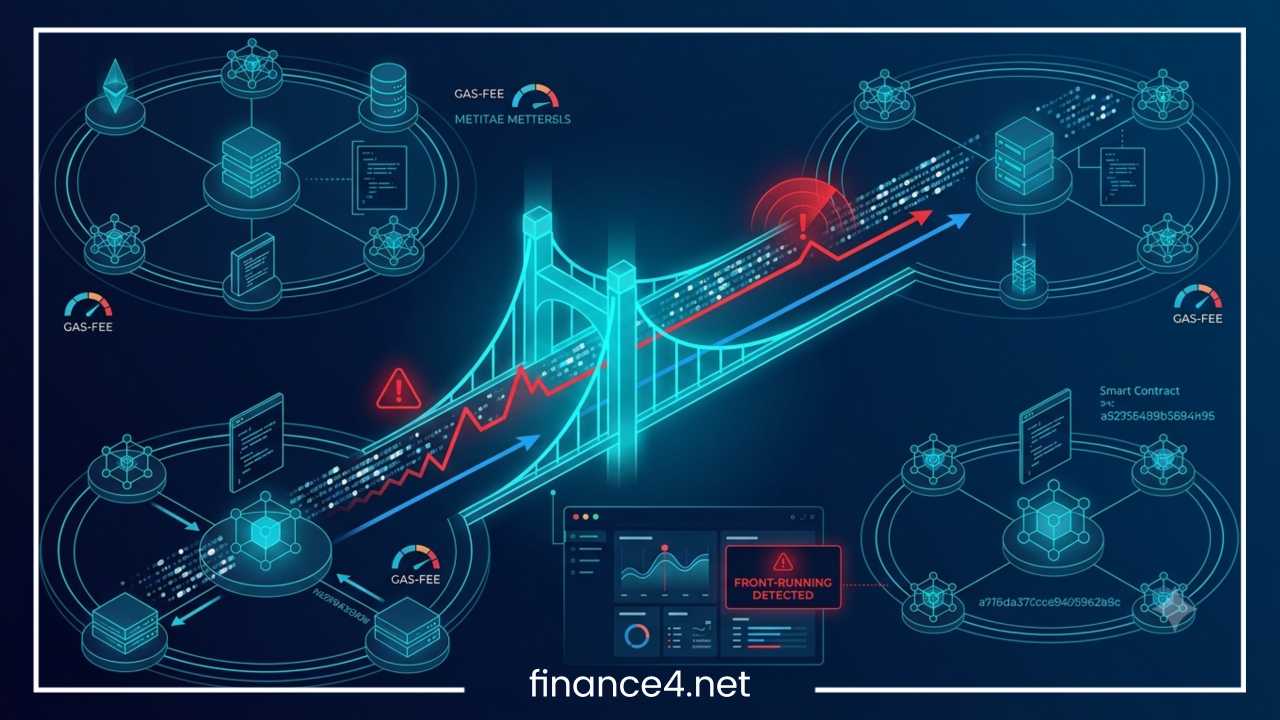
How to Monitor Bridging Aggregator for Front-Running
Why Front-Running Matters in Bridging Aggregators
Bridging aggregators serve as vital infrastructure in the modern multi-chain web3 landscape. By routing funds across diverse blockchain networks, these protocol suites combine liquidity pools, cross-chain messaging formats, and decentralized exchange (DEX) routes to provide users with optimal trade execution. Instead of manually inspecting individual liquidity pools, users rely on aggregators to discover the most efficient path for swapping and moving assets from a source network to a destination network.
However, the architectural complexity of moving assets across distinct ledgers introduces significant surface area for Maximum Extractable Value (MEV) exploitation. Cross-chain transactions inherently require time to settle, rely on asynchronous messaging layers, and frequently interact with public mempools across multiple execution environments. This extended lifecycle creates unique opportunities for malicious actors to observe incoming volume and execute manipulative ordering strategies.
Traditional transaction monitoring focuses on single-chain execution parameters, such as tracking gas fees and mempool state on one isolated EVM or non-EVM chain. Monitoring a cross-chain bridging aggregator requires a holistic approach. Analysts must trace pending state changes on the source chain, relaying infrastructure activities across intermediate message layers, and settlement behavior on the target network.
To safeguard protocol integrity and prevent systematic value extraction, security researchers, bridge developers, and institutional traders must understand how to monitor bridging aggregator for front-running. This guide establishes a comprehensive framework for detecting suspicious transaction ordering, identifying route manipulation, calculating abnormal execution loss, and deploying automated monitoring pipelines.
What Is Front-Running in a Bridging Aggregator?
Front-running occurs when a malicious actor leverages advanced knowledge of a pending transaction to place their own transaction ahead in the execution queue, extracting profit at the victim’s expense. In traditional financial systems, this practice is illegal and relies on insider information. In public blockchain environments, front-running is driven by automated bots reading pending transactions directly from public memory pools (mempools).
The lifecycle of a cross-chain bridge aggregator transaction involves several distinct phases:
-
User Initiation: The user approves and signs an aggregator trade on the source chain.
-
Aggregator Routing: The aggregator smart contract routes local tokens through a source-chain DEX to obtain an intermediate wrapped or bridge-compatible asset.
-
Bridge Message Dispatch: The source contract locks or burns the asset and dispatches a cross-chain payload via a messaging protocol or relayer network.
-
Validation and Settlement: Relayers or validators verify the source event and submit an execution proof to the destination network.
-
Destination Execution: The destination bridge contract mints or unlocks assets, potentially passing them through a local DEX to deliver the final target token to the recipient.
At each phase, transaction ordering can be exploited. Attackers continuously monitor public mempools on both source and target networks, looking for high-value user trades.
Vector Breakdown
-
Mempool Front-Running: A bot detects a pending swap on the source chain and submits a similar transaction with a higher priority fee (gas price) to ensure it executes first, artificially driving up the asset price before the user’s trade lands.
-
Back-Running: A bot submits a transaction immediately after a large trade or liquidity event, capitalizing on the temporary price skew or rebalancing liquidity across pools before external arbitrageurs can adjust.
-
Sandwich Attacks: The attacker combines front-running and back-running. They place a buy order directly ahead of the target transaction to elevate the execution price, allow the target transaction to execute at a worse price, and immediately execute a sell order to capture the price differential.
-
Route Manipulation: An attacker manipulates local DEX pool ratios or oracle inputs immediately before an aggregator evaluates execution paths, forcing the aggregator to choose a sub-optimal route that benefits the attacker’s capital.
-
Cross-Chain MEV: An attacker observes an unconfirmed bridge payload on the source chain or within a relayer network and front-runs the target-chain execution step, taking advantage of known incoming liquidity before the target-chain settlement transaction finalizes.
Cross-chain monitoring is significantly more complex than tracking single-chain swaps due to asynchronous block times, distributed consensus models, and disjointed mempool visibility between the source network, relayer layer, and target chain.
How Bridging Aggregators Create Front-Running Opportunities
Bridging aggregators optimize cross-chain swaps by splitting transactions across multiple protocols, but their operational design inherently exposes state changes to front-running bots.
Mempool Exposure and Route Selection
When a user submits an aggregator transaction, the transaction payload containing target tokens, minimum output limits, and chosen routes sits in the public mempool of the source chain. Searchers parse this data instantly, checking if the trade will cause significant price impact in underlying DEX pools. If an aggregator selects a route through a shallow liquidity pool, a searcher can front-run the swap on that local pool before the bridge call is finalized.
Large Swaps and Slippage Settings
To ensure cross-chain execution succeeds despite price fluctuations during long bridging windows, users and UI interfaces often configure high slippage tolerances (e.g., 1% to 3%). Front-running bots target trades with wide slippage limits because they guarantee a large margin for forced price movement without triggering a transaction revert.
Delayed Cross-Chain Settlement
Unlike single-chain atomic swaps, cross-chain bridging involves latencies ranging from several seconds to tens of minutes. This prolonged interval exposes the trade lifecycle to market shifts. If a searcher can predict the exact parameters of the destination transaction while the source transaction is still confirming, they have ample time to position capital on the target chain.
Liquidity and Oracle Discrepancies
Price differences between source and target asset pools create structural arbitrage opportunities. When a bridging aggregator relies on on-chain price oracles or local pool ratios to calculate cross-chain conversion rates, temporary oracle lags or manipulated pool states can be exploited. Bots front-run aggregator calls by pushing pool balances away from equilibrium just prior to transaction execution.
Relayers, Validators, and Intent Solvers
Modern bridging aggregators rely on intent-based frameworks and third-party solvers. In an intent system, users sign an off-chain message specifying their desired outcome, and solvers compete to fulfill the order on the destination chain. If solver auctions or message-relaying networks lack privacy protections, malicious actors can front-run public solver fulfillments or censor relayers to execute trades ahead of legitimate solvers.
What You Need to Monitor
A comprehensive front-running monitoring system for cross-chain aggregators requires tracking signals across three distinct layers: on-chain transaction data, broader market dynamics, and internal aggregator metrics.
On-Chain Signals
-
Pending Transactions: Tracking unresolved transactions targeting aggregator router contracts within source and target mempools.
-
Transaction Timestamps and Block Numbers: Measuring the exact sequence and timing of transaction inclusions relative to other network activity.
-
Gas Prices and Priority Fees: Tracking sudden spikes in priority fees or legacy gas prices attached to transactions calling the same contract logic.
-
Nonce Patterns: Identifying automated address sequences and high-frequency bot interactions with relevant liquidity pools.
-
Transaction Ordering within Blocks: Verifying whether a specific address consistently achieves inclusion directly prior to target aggregator transactions within a block.
-
Contract Calls and Event Logs: Decoding input parameters for smart contract calls (e.g., swap, process route, fulfill intent).
-
Token Transfers and Bridge Messages: Monitoring cross-chain event emissions (e.g., deposit, message sent, tokens locked) across source contracts.
-
Destination-Chain Execution: Tracing recipient addresses and target contract events (e.g., unlock, message executed) to confirm transaction land timing.
Market Signals
-
Asset Prices Around Execution: Recording spot prices across primary trading pairs immediately before and after transaction land times.
-
Liquidity Pool Depth: Monitoring dynamic shifts in automated market maker (AMM) reserves before and after execution.
-
Realized vs. Expected Slippage: Calculating the delta between expected token output and final settled balance.
-
Unusual Volume Spikes: Detecting sudden localized trade volume surges targeting specific route pairs.
-
Cross-Chain Price Discrepancies: Tracking price divergence between equivalent wrapped or canonical assets across participating chains.
Aggregator Signals
-
Selected Route Paths: Comparing the expected execution route generated at quote time against the actual executed path on-chain.
-
Quoted vs. Executed Amounts: Assessing systemic discrepancies between quote API data and on-chain event logs.
-
Bridge Provider and Sub-Router Health: Monitoring performance and transaction success rates across individual bridge protocols used by the aggregator.
-
Fee Structure Changes: Tracking variations in relayer fees, bridge protocol fees, and dynamic gas overhead.
-
Failed and Reverted Transactions: Cataloging transaction reverts caused by exceeded slippage limits or stale route parameters, which frequently signal failed sandwich attacks.
Step-by-Step: How to Monitor Bridging Aggregator for Front-Running
Monitoring a cross-chain bridging aggregator requires a structured technical workflow to capture, decode, correlate, and analyze multi-chain data streams.
Step 1: Identify the Aggregator and Its Smart Contracts
Begin by constructing a comprehensive registry of all smart contracts associated with the bridging aggregator across all supported blockchain networks.
-
Routers and Proxies: Identify the primary entry-point contracts that take user approvals and initiate trades.
-
Bridge Adapters: Catalog the wrapper contracts that format and forward calls to individual underlying bridges.
-
Relayer and Fulfiller Addresses: Document official addresses responsible for signing or relaying cross-chain execution proofs.
-
Liquidity and Settlement Pools: Map source-chain and destination-chain pools touched during cross-chain asset movement.
Constructing an address directory ensures that filtering mechanisms catch both direct aggregator calls and indirect adapter interactions.
Step 2: Monitor the Source-Chain Mempool
To detect front-running as it happens, establish direct WebSocket connections to high-performance RPC nodes or mempool streaming services on the source chain.
-
Filter the incoming transaction pool using the smart contract addresses mapped in Step 1.
-
Capture pending calls before they are included in a block.
-
Isolate transactions targeting aggregator endpoints that involve substantial capital volumes or wide slippage parameters.
Mempool streaming provides the earliest indication that a target transaction is visible to MEV searchers.
Step 3: Capture Transaction Parameters
Parse incoming pending payload inputs using the aggregator smart contract ABIs (Application Binary Interfaces). Extract and record the following parameters for each transaction:
-
Sender Address: The address initiating the trade.
-
Destination Recipient: The final target wallet designated to receive assets.
-
Input Token and Amount: The asset and balance being bridged.
-
Minimum Output Amount: The minimum balance the user accepts, which defines the maximum allowable slippage.
-
Deadline / Expiration: Timestamp limits governing transaction validity.
-
Route Topology: The explicit list of DEX pools and bridging protocols selected by the aggregator routing engine.
-
Gas Settings: Max fee per gas, priority fee per gas, and total gas limit.
Step 4: Analyze Transaction Ordering
Once a block is produced containing the monitored transaction, inspect the exact position of all transactions within that block.
-
Preceding Transactions: Check if another transaction interacted with the same liquidity pool or aggregator route directly before the target transaction within the same block.
-
Priority Fee Delta: Compare the priority fee of the target transaction with the transaction placed directly before it. Front-runners typically pay marginally higher priority fees to win inclusion right ahead of the victim.
-
Succeeding Transactions: Inspect the transaction landed immediately after the victim’s trade to check for a corresponding sell order (completing a sandwich attack).
Step 5: Compare Quoted and Executed Prices
Calculate the actual execution efficiency of the trade to quantify value loss.
Execution Loss equals Expected Output Amount minus Actual Executed Output Amount.
Determine if the execution loss approaches the user’s maximum defined slippage threshold. If a transaction consistently lands at or near the absolute worst possible slippage limit, it indicates systematic sandwiching or front-running rather than standard market drift.
Step 6: Track Destination-Chain Execution
Extend monitoring to the target network to complete the cross-chain context.
-
Extract the cross-chain transaction hash, nonce, or message identifier emitted in the source chain logs.
-
Monitor target-chain block space for the corresponding execution transaction submitted by the bridge relayer, solver, or destination contract.
-
Verify if destination-chain DEX swaps performed upon asset arrival experienced front-running or sandwiching prior to final settlement in the user’s target wallet.
Step 7: Identify Repeated Suspicious Patterns
Systematic MEV extraction relies on automated bot clusters. Collect transaction history to identify recurring operational signatures:
-
Wallet Clusters: Group addresses that consistently interact with the same pools directly before high-value aggregator trades.
-
Smart Contract Proxies: Detect custom front-running smart contracts designed to perform rapid buy-swap-sell sequences across multiple liquidity venues.
-
Route Exploitation Trends: Identify specific bridge adapters or secondary DEX pools that suffer high rates of execution loss relative to other pathways offered by the aggregator.
Key Metrics for Detecting Potential Front-Running
When constructing detection heuristics, use observable parameters to score transaction risk.
| Metric | Primary Data Source | Detection Threshold / Trigger | Operational Sign |
| Gas Premium Delta | Mempool / Block Data | Priority fee > 20% above block base median | Bidding for front position |
| Block Inclusion Position | Block Explorer / Node | Directly preceding target transaction slot | Immediate front-run placement |
| Slippage Saturation | On-Chain Event Logs | Executed output within 0.1% of minimum output | Maximized sandwich extraction |
| Pre-Trade Price Impact | DEX Pool State Logs | Asset price moves > 0.5% in same block | Artificial price escalation |
| Address Recurrence Index | Historical Indexer | Address appears multiple times in pre-trade slots | Bot net operational pattern |
| Route Divergence | Aggregator API vs. Log | Executed path differs from quoted path | Path/pool manipulation |
| Cross-Chain Latency Delta | Cross-Chain Indexer | Extended time lag between source burn and target mint | Window of exposure |
| Failed Transaction Ratio | Contract Event Logs | High rate of slippage exceeded reverts | Failed searcher attempts |
Tools and Data Sources for Monitoring
Building a cross-chain monitoring infrastructure requires combining RPC connectivity, indexing pipelines, and specialized analytics software.
Ingestion and Node Access
Direct, low-latency access to execution layers is essential for capture.
-
Enterprise RPC Providers: Services like Alchemy, QuickNode, or Infura provide WebSocket streams for pending transactions and new block headers across major chains.
-
Dedicated Nodes: Running client instances (such as Geth, Reth, or Besu) grants access to raw mempool state without third-party rate limits or filtering.
Event Indexing and Storage
Cross-chain analysis requires structured storage to cross-reference transactions spanning multiple networks.
-
Custom Indexers: Frameworks like Envio, Goldsky, or custom indexing daemons parse raw logs, decode ABI payloads, and populate relational databases.
-
Time-Series Databases: Platforms like ClickHouse or TimescaleDB store high-throughput block and event data, allowing for performant multi-table join operations across transaction histories.
Specialized MEV Frameworks
Analyzing block space dynamics benefits from specialized toolsets.
-
MEV Inspection Frameworks: Open-source tools designed to parse blocks and quantify MEV extraction, including sandwich attacks and arbitrage trades.
-
On-Chain Analytics Platforms: Platforms useful for querying historical bridge adapter performance, calculating average slippage, and mapping recurring bot addresses.
How to Build an Automated Front-Running Detection System
An automated detection pipeline captures raw blockchain feeds, evaluates suspicious ordering patterns, assigns a risk score, and dispatches real-time alerts.
1. Ingestion Pipeline
Set up data stream collectors for all supported networks. Maintain active WebSocket subscriptions for pending transactions and new heads. Route these payloads into a distributed message broker (such as Apache Kafka or RabbitMQ) to handle high event throughput safely.
2. Transaction Parsing Engine
Filter incoming transactions for those interacting with known aggregator router addresses. Decode the call data to extract input tokens, output tokens, target amounts, and minimum acceptable output parameters.
3. State Evaluation and Matching
When a block is confirmed:
-
Fetch all transactions within the block that touch the aggregator’s routes or underlying liquidity pools.
-
Group transactions by contract address, token pair, and block index.
-
Identify sequences where an address trades asset A for asset B in the slot directly before the target transaction, the target aggregator transaction executes, and the same address trades asset B back for asset A in the slot directly after.
4. Multi-Signal Risk Scoring
Assign a cumulative Risk Score (0 to 100) to flagged transaction clusters based on weighted parameters:
-
Transaction Ordering Anomaly (30 pts): Direct placement immediately surrounding the target transaction.
-
Priority Fee Spike (20 pts): Preceding transaction paid a priority fee significantly higher than the block median to secure position.
-
Slippage Maximization (25 pts): The victim transaction suffered execution loss within 0.05% of its absolute worst allowable slippage.
-
Known MEV Address Recurrence (15 pts): The preceding address is listed in an index of known MEV searcher contracts.
-
Route Discrepancy (10 pts): The trade executed through an altered, illiquid route path.
5. Alerting and Evidence Archiving
If the combined Risk Score exceeds a designated threshold (e.g., 75 points), the system triggers an alert to security teams via webhooks or notification engines. Simultaneously, write the complete transaction bundle metadata, block headers, and execution traces to persistent storage for forensic verification.
How to Distinguish Front-Running From Normal Market Activity
A common challenge in cross-chain transaction monitoring is avoiding false positives. Sudden price movements, natural market volatility, and legitimate arbitrage can mirror front-running patterns.
| Feature | Front-Running / Sandwich | Legitimate Volatility / Arbitrage |
| Block Ordering | Strict pre-trade buy and post-trade sell | Random block indexes |
| Address Lifecycle | Custom bot contracts / repeated usage | Diverse, organic addresses |
| Trade Net Inventory | Zero net position post-block | Net asset acquisition or holding |
| Gas Strategy | Precision priority fee bidding | Standard network gas price |
| Slippage Impact | Drives output to minimum limit | Variable, partial slippage impact |
Common Sources of False Positives
-
High Organic Volatility: A sudden external market event (e.g., a major news release) can trigger concurrent buying across multiple pools, driving up execution loss naturally without malicious intent.
-
Legitimate Arbitrage: Arbitrage bots continuously equalize price differences across exchanges. An arbitrageur balancing a pool directly after a large bridge trade executes valid back-running, which restores pool balance rather than exploiting a user’s slippage.
-
Bridge Relayer Latency: High network congestion on the destination chain can delay execution, causing the transaction to land in a significantly altered market environment that looks like slippage exploitation.
To accurately classify an incident as front-running, look for the combination of tight block ordering correlation, priority gas bidding, net-zero inventory strategy, and systematic wallet recurrence.
Best Practices to Reduce Front-Running Risk
While monitoring provides visibility, implement preventive strategies at both the protocol and user levels to minimize front-running vulnerability.
Protocol and Aggregator Protections
-
Private Transaction Routing: Integrate with private RPC endpoints to bypass the public mempool entirely on source chains.
-
Intent-Based Architecture: Shift from traditional public transaction routing to intent frameworks where solvers execute trades against private RFQ (Request for Quote) order books under strict execution SLAs.
-
Dynamic Slippage Algorithms: Replace static user-defined slippage controls with dynamic pricing algorithms that calculate realistic slippage based on real-time pool depth.
-
Commit-Reveal Schemes: Implement commit-reveal mechanisms or encrypted mempools for large cross-chain orders to obscure transaction parameters until block inclusion is locked.
-
MEV-Aware Routing Engines: Design routing algorithms to split large orders across multiple liquidity venues, keeping single-pool price impact below profitable thresholds for searchers.
User and Integrator Best Practices
-
Tighten Slippage Controls: Avoid default high-slippage tolerances when bridging large amounts.
-
Split Large Volume Transactions: Divide large cross-chain trades into smaller, staggered batches to reduce mempool visibility and minimize individual trade impact.
-
Utilize MEV-Protected Gateways: Configure wallets to route transactions through MEV-shielded RPC nodes that offer front-running protection and return captured back-running value to the user.
Front-Running Monitoring Checklist
Use this operational checklist to audit and maintain an active bridging aggregator monitoring framework:
| Status | Monitoring Action | Key Objective |
| Pending | Contract Registry Mapping | Maintain up-to-date catalog of routers, adapters, and relayers across all chains |
| Pending | Source Mempool Streaming | Ingest real-time pending transactions via WebSocket RPC connections |
| Pending | Call Input Parsing | Extract transaction variables including target amounts and minimum outputs |
| Pending | Block Order Verification | Trace adjacent transaction slots to flag surrounding trades |
| Pending | Execution Loss Tracking | Compare quoted API rates against final settled amounts on-chain |
| Pending | Cross-Chain Lifecycle Correlation | Match source burn events with target execution logs to measure timing |
| Pending | Bot Address Indexing | Catalog recurring searcher wallets and custom front-running smart contracts |
| Pending | Risk Score Calculation | Apply multi-factor weighting to separate MEV attacks from organic trades |
| Pending | Automated Incident Alerting | Trigger alerts via webhooks when composite risk score crosses threshold |
| Pending | Forensic Data Storage | Archive raw block headers, transaction traces, and logs for audit trails |
Final Thoughts
Monitoring a bridging aggregator for front-running requires a specialized approach beyond basic single-chain transaction tracking. Because cross-chain transactions rely on distributed state changes, public mempool visibility, and intermediate relaying steps, they present unique opportunities for MEV extraction and sandwich attacks.
Effective front-running detection relies on evaluating multiple correlated signals: mempool visibility, priority gas bidding, precise in-block positioning, execution loss metrics, and cross-chain land timing. By combining real-time node feeds, automated parsing engines, dynamic risk scoring, and structured indexing, protocol developers and security teams can detect front-running behavior, protect user capital, and refine cross-chain routing systems against malicious extraction.
Frequently Asked Questions (FAQ)
What is cross-chain front-running on a bridging aggregator?
Cross-chain front-running occurs when an automated Maximal Extractable Value (MEV) bot detects a pending transaction on a bridge aggregator and executes a trade ahead of it to extract value. Because bridging aggregators route trades through decentralized exchange (DEX) liquidity pools on both source and target chains, searchers can place orders in the mempool to manipulate asset prices before the user’s bridge swap finalizes.
How do MEV bots detect bridging aggregator transactions in the mempool?
MEV bots continuously scan public memory pools (mempools) on source and destination networks using high-speed RPC nodes and WebSocket connections. They decode transaction payload data targeting bridge router smart contracts—such as token pair types, transaction volume, route paths, and maximum slippage tolerance—to calculate whether driving up local pool prices prior to execution will yield a profit.
Why are bridge aggregators more vulnerable to sandwich attacks than single-chain DEXs?
Bridge aggregators combine cross-chain messaging delays, dynamic route selections, and token swaps across multiple networks. Because cross-chain settlement takes longer than a single-chain atomic swap, users frequently set wider slippage tolerances (e.g., 1% to 3%) to prevent transaction reverts. This wider slippage window gives sandwich attack bots a significantly larger margin to manipulate buying and selling prices without failing execution.
What is the difference between mempool front-running and cross-chain MEV back-running?
Mempool front-running happens on the source chain when a bot bids a higher priority gas fee to get its order processed directly before the victim’s trade, forcing the victim to buy at an inflated price. Cross-chain MEV back-running occurs on the target chain when a searcher detects an incoming bridge message payload and places an order immediately after the bridge settlement executes, capturing arbitrage opportunities or rebalancing liquidity left behind by the incoming trade.
How do you calculate transaction execution loss from front-running on a bridge?
Transaction execution loss is calculated by subtracting the actual output token amount delivered to the target wallet from the estimated quote amount provided by the aggregator API at transaction initiation:
Execution Loss = Quoted Output Amount − Actual Received AmountIf the execution loss consistently equals or sits directly at the user’s maximum slippage threshold, it strongly indicates that an MEV searcher sandwiched the transaction.
Can bridge aggregators prevent front-running using private RPCs and Flashbots?
Yes, routing source-chain transactions through private RPC endpoints (such as Flashbots Protect or MEV-Blocker) bypasses the public mempool entirely. This keeps incoming bridge transactions invisible to front-running bots until the block is mined, preventing searchers from placing pre-execution orders.
What are the main signs that a bridge transaction was front-run?
The most reliable indicators include:
-
Block Inclusion Position: A trade from a known bot contract landing at the block slot directly preceding the bridge transaction.
-
Gas Price Spikes: An unusually high priority fee (
maxPriorityFeePerGas) attached to the preceding transaction. -
Maximized Slippage: Final token output landing exactly at the minimum allowed slippage bound (
minAmountOut). -
Instant Reversal: A corresponding sell transaction occurring in the block slot directly following the target trade.
How do intent-based bridging solvers help reduce front-running risks?
Intent-based architectures replace public transaction routing with private off-chain solver auctions. Instead of placing a trade in a public mempool, users sign an off-chain intent specifying their desired minimum output. Professional solvers compete off-chain to fulfill the order using their own capital, taking on the execution and slippage risk themselves while guaranteeing the user receives their exact quoted output.