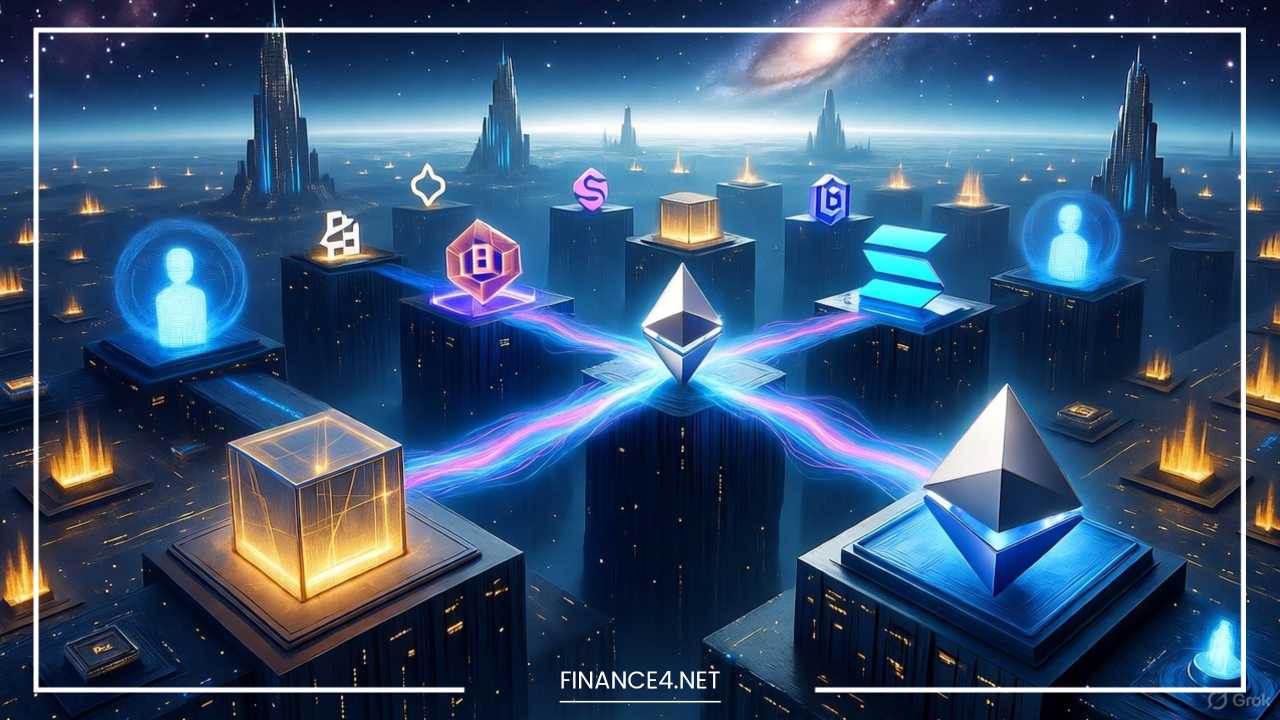
Benefits of Cross-Chain Governance Tokens
 by
by 
The Dawn of Interoperable Democracy: Unpacking the Benefits of Cross-Chain Governance Tokens
The blockchain landscape, once a collection of isolated digital islands, is rapidly evolving into an interconnected ocean of possibilities.
As decentralized applications (dApps) and protocols proliferate across various networks, the need for seamless interaction and unified control becomes paramount.
This is where cross-chain governance tokens emerge as a transformative force, promising to usher in an era of truly interoperable democracy within the decentralized world.
Traditional Governance Models: A Limiting Framework
Historically, blockchain governance has been confined to single-chain ecosystems. Token holders on specific networks could vote on proposals and influence the evolution of that particular protocol.
While this model was effective in its early stages, it has become increasingly inadequate as blockchain technology expands into a multi-chain world.
In this new ecosystem, assets, users, and dApps are no longer limited to a single blockchain, which has led to fragmented liquidity, siloed communities, and complicated user experiences.
Cross-chain governance tokens break down these barriers. These tokens empower users to have a say in the governance of protocols and applications that span multiple blockchain networks.
By holding and using cross-chain governance tokens, users can propose, debate, and vote on decisions that impact a range of decentralized systems, whether they operate on Ethereum, Polkadot, Cosmos, or other platforms.
The Evolution to Cross-Chain Governance Tokens
Cross-chain governance tokens represent much more than just a stake in a single protocol. They embody the democratization of decentralized decision-making, with the power to influence the future of ecosystems that operate across different chains.
As decentralized applications evolve and extend their reach, cross-chain governance offers a way to ensure that governance remains inclusive, efficient, and representative of the broader community of users and stakeholders.
These tokens provide a way for decentralized projects to foster a deeper level of interconnectivity and collaboration.
Rather than remaining isolated within the boundaries of one blockchain, they allow governance to span multiple networks, creating a more cohesive ecosystem.
This interconnectedness enhances the decentralized nature of blockchain governance and paves the way for a truly interoperable digital world.
Enhancing Decentralized Decision-Making
One of the most significant advantages of cross-chain governance tokens is their ability to enhance decentralized decision-making.
In single-chain governance, the voting power is restricted to users of that specific network, which can skew decisions to favor the interests of one community over others.
This creates an inherent problem in a multi-chain world where different blockchain communities, such as Ethereum and Binance Smart Chain (BSC), may have divergent interests and needs.
By using cross-chain governance tokens, voting power is distributed across a broader base of stakeholders. Token holders from various connected chains can participate in governance decisions, ensuring that the needs and concerns of all stakeholders are taken into account.
This broader inclusivity results in decisions that reflect the interests of a larger, more diverse community.
Example: A DeFi Protocol Spanning Multiple Chains
Imagine a decentralized finance (DeFi) protocol that operates across both Ethereum and a high-throughput Layer-2 solution.
With governance tokens confined to individual chains, decisions made on Ethereum might not align with the needs of users on the Layer-2 network.
This could result in friction, inefficiency, and a lack of adoption. A cross-chain governance token, however, would enable holders from both chains to vote on critical decisions like protocol upgrades, fee structures, or integration with new platforms.
This ensures that all users, regardless of their preferred blockchain, can contribute to the governance process. By aligning the interests of multiple networks, cross-chain governance tokens provide a more unified and democratic approach to protocol evolution.
Improving Interoperability and Connectivity
The second key benefit of cross-chain governance tokens is their ability to improve interoperability and connectivity across different blockchain ecosystems.
Today, blockchain networks operate in relative isolation from one another, with limited ability to communicate or exchange data.
This isolation creates barriers for decentralized applications and protocols that aim to serve users across multiple chains.
Cross-chain governance tokens serve as a tool for bridging this gap. By allowing governance decisions to span multiple chains, they enable the integration of cross-chain functionalities such as asset bridges, smart contract interoperability, and standardized data formats.
These governance decisions can directly address issues such as cross-chain asset transfers, enabling a seamless and secure exchange of information and value across networks.
Case Study: A Cross-Chain Bridge DAO
Consider a decentralized autonomous organization (DAO) that governs a cross-chain bridge connecting several major blockchains.
If the governance were confined to a single chain, decisions made on that chain might not be effectively communicated or enforced on the other connected blockchains. This could lead to inconsistencies, vulnerabilities, and a fragmented user experience.
Cross-chain governance tokens solve this issue by providing a unified governance framework that spans all connected chains.
Token holders can vote on proposals to upgrade the bridge, adjust fees for cross-chain transfers, or add new supported chains.
These decisions are executed consistently across all the participating networks, ensuring a more stable and secure cross-chain infrastructure.
The ability to coordinate governance across chains is vital for maintaining the integrity of cross-chain protocols and for ensuring that interoperability becomes a reliable feature of the blockchain ecosystem.
Strengthening Security and Resilience
Another crucial advantage of cross-chain governance tokens is their potential to enhance security and resilience across decentralized protocols.
Cross-chain interactions inherently introduce new security complexities, but cross-chain governance can play a key role in addressing these risks by decentralizing control and decision-making.
In a single-chain governance model, a security vulnerability or attack targeting that chain could potentially compromise the entire protocol.
However, in a cross-chain governance model, token holders distributed across various chains can collectively vote on security upgrades or emergency actions that affect all chains simultaneously.
This distributed decision-making process reduces the risk of a single point of failure and strengthens the overall security posture of the ecosystem.
Multi-Signature Security Approvals
One potential method for improving security within cross-chain governance is the use of multi-signature approvals for critical actions.
For example, a proposed security patch could require the approval of token holders across several chains before being implemented.
This ensures that no single entity or group can unilaterally enact security measures, reducing the risk of malicious attacks or errors.
By enabling coordinated decision-making across multiple chains, cross-chain governance ensures that security issues are addressed in a timely and effective manner, thereby increasing the resilience of the entire ecosystem.
Increased Efficiency and Reduced Costs
Governance in a multi-chain environment can be complex and costly. Maintaining separate governance processes for each chain requires additional infrastructure, transaction fees, and administrative overhead.
Cross-chain governance tokens help to streamline this process by providing a unified platform for governance across multiple networks.
Cost-Effective Decision Making
Rather than conducting separate votes and proposals for each chain, a single cross-chain governance vote can impact all relevant networks simultaneously.
This reduces the need for multiple governance systems, saving on transaction fees and administrative costs. The reduced complexity also allows for faster decision-making and more efficient implementation of protocol upgrades.
For example, a DeFi platform with tokens across Ethereum, Binance Smart Chain (BSC), and Polygon could face the challenge of managing separate governance votes for each chain.
Cross-chain governance tokens solve this by allowing a unified governance process where a single vote impacts all chains simultaneously, accelerating protocol changes and minimizing overhead.
Expanded Utility and Value Accrual
Cross-chain governance tokens have the potential to expand their utility and value by influencing a wider range of applications across multiple chains. In a single-chain governance model, token holders’ influence is limited to that network.
However, with cross-chain governance, token holders can participate in the governance of various ecosystems, such as DeFi protocols, NFT marketplaces, supply chain systems, and decentralized social networks.
Multi-Ecosystem Influence
A cross-chain governance token gives its holder more power and influence across an interconnected network of blockchains and protocols.
This expands the token’s utility, as it can be used to vote on a wide array of governance decisions.
Additionally, by holding cross-chain governance tokens, users gain access to a broader set of protocols, increasing the potential for value accrual.
Cross-chain governance tokens can also incorporate revenue-sharing or fee-distribution models. Token holders might receive a portion of the revenue generated across all integrated networks, offering a direct economic incentive for participation.
This model provides both utility and economic rewards, making cross-chain governance tokens even more attractive to stakeholders.
Combating Centralization in Governance
Centralization remains a persistent issue in blockchain governance. While governance tokens inherently promote decentralization compared to traditional centralized systems, single-chain governance still allows for centralization within specific ecosystems.
Large token holders or influential groups can dominate governance outcomes, skewing decisions in their favor.
Cross-chain governance mitigates this problem by distributing power across multiple chains and a more diverse base of token holders. Token holders must coordinate their influence across different chains, each with its own user base and token distribution.
This reduces the likelihood of any single entity or group gaining disproportionate control over governance decisions, promoting a more balanced and decentralized decision-making process.
Real-World Applications and Projects
Several projects are already exploring and implementing cross-chain governance models, providing early examples of the benefits in action.
Protocols focused on cross-chain interoperability, such as decentralized bridges or multi-chain DeFi platforms, are prime candidates for cross-chain governance tokens.
These projects recognize the need for a unified governance model to address the complexities of multi-chain systems and ensure that they operate securely and efficiently.
Polkadot and Cosmos: Frameworks for Cross-Chain Governance
Polkadot and Cosmos are two blockchain ecosystems designed with interoperability in mind. These platforms aim to connect disparate blockchains, allowing them to communicate and share data.
By leveraging cross-chain governance tokens, these ecosystems are well-positioned to create a more interconnected and democratic blockchain landscape.
The Road Ahead: Challenges and Opportunities
The adoption of cross-chain governance tokens is still in its early stages, and several challenges remain.
Designing secure and effective voting mechanisms, addressing technical complexities, and ensuring cost-effective participation are key hurdles that need
to be overcome. Additionally, ensuring that cross-chain governance is accessible to users across multiple blockchains is crucial for achieving true decentralization.
Despite these challenges, the ongoing development of cross-chain communication protocols, zero-knowledge proofs, and decentralized identity solutions is making cross-chain governance more feasible.
As these technologies mature, the vision of an interoperable, democratic blockchain ecosystem will continue to move closer to reality.
Final Thoughts: A More Integrated, Democratic Future
Cross-chain governance tokens are a vital step in the evolution of decentralized governance. By enabling token holders to participate in the governance of protocols and applications across multiple blockchain networks, these tokens unlock a host of benefits, including enhanced decision-making, improved interoperability, greater security, increased efficiency, expanded utility, and stronger resistance to centralization.
As the blockchain ecosystem continues to grow and interconnect, cross-chain governance will play an increasingly important role in shaping a more integrated, democratic, and resilient decentralized world. The age of interoperable democracy is upon us—driven by the power of cross-chain governance tokens.