Top Cross-Chain Stablecoin Solutions
 by
by 
Top Cross-Chain Stablecoin Solutions
The cryptocurrency landscape is rapidly evolving, but the need for price stability remains a constant, crucial factor. This is where stablecoins come in. Stablecoins are digital assets designed to maintain a stable value relative to a fiat currency, most commonly the US Dollar, providing a crucial bridge between the volatility of the crypto world and the reliability of traditional finance. They serve as the primary medium of exchange, unit of account, and store of value across the entire decentralized finance (DeFi) ecosystem.
However, the rapid proliferation of blockchain networks—including Ethereum, Solana, Avalanche, and numerous Layer 2 rollups—has led to a fragmented environment. A stablecoin native to one chain (like Ethereum) cannot be used directly on another (like Solana) without an intermediary step. This lack of seamless interaction, or interoperability, is a severe limitation.
The growing demand for cross-chain stablecoin solutions directly addresses this fragmentation. These solutions allow stable value to flow freely and securely between disparate blockchain ecosystems. By enabling stablecoins to move across networks, the market is aggressively moving toward multichain liquidity, unlocking unprecedented capital efficiency and composability. This article will deep-dive into the mechanisms, key players, and future trends shaping the world of interconnected stable assets.
Why Cross-Chain Functionality Matters for Stablecoins
The initial phase of stablecoins was characterized by traditional limitations of single-chain issuance. A stablecoin issued only on Ethereum, for instance, forces users to stay within the Ethereum ecosystem, significantly restricting its utility as the overall DeFi landscape expanded.
The rise of multichain ecosystems created an urgent need for fluid asset transfer. Without dedicated cross-chain support, the ecosystem faces several major challenges:
-
Liquidity Fragmentation: Stablecoin liquidity is siloed across dozens of chains, making it harder for large traders or protocols to access deep, reliable pools on any single network.
-
High Fees and Slower Transactions: Moving capital between chains often required expensive, time-consuming transfers through centralized exchanges or complex, less secure early-stage bridges.
-
Reduced Composability: DeFi protocols on one chain cannot easily interact with or leverage capital locked on another, stifling innovation that relies on combining financial primitives.
The benefits of true cross-chain stablecoins fundamentally resolve these issues:
-
Improved Capital Efficiency: Capital can be rapidly and cheaply deployed to the network offering the highest yield or the most advantageous trading opportunity.
-
Better User Experience: Users can maintain a single stablecoin asset and move it between networks with near-instant speed and minimal friction.
-
Deeper Liquidity: Cross-chain mechanisms unify liquidity, making the stablecoin more robust and resistant to depegging events across all supported networks.
-
Enhanced Composability: Complex multi-chain DeFi strategies, such as lending on Chain A and using the resulting collateral on Chain B, become possible.
How Cross-Chain Stablecoin Transfers Work
Moving a stablecoin from Chain A to Chain B requires specialized infrastructure to verify the state change on one network and replicate the asset on the other. Several mechanisms are currently in play:
1. Bridges (Lock-and-Mint / Burn-and-Mint Models)
-
Lock-and-Mint: The most common early bridge model. The user sends a stablecoin (e.g., USDC) to a smart contract on the source chain (Chain A), which locks the asset. The bridge then mints a new, wrapped version of the token (e.g., “wrapped USDC”) on the destination chain (Chain B). The wrapped token is only redeemable for the original asset by burning the wrapped version on Chain B and releasing the locked asset on Chain A.
-
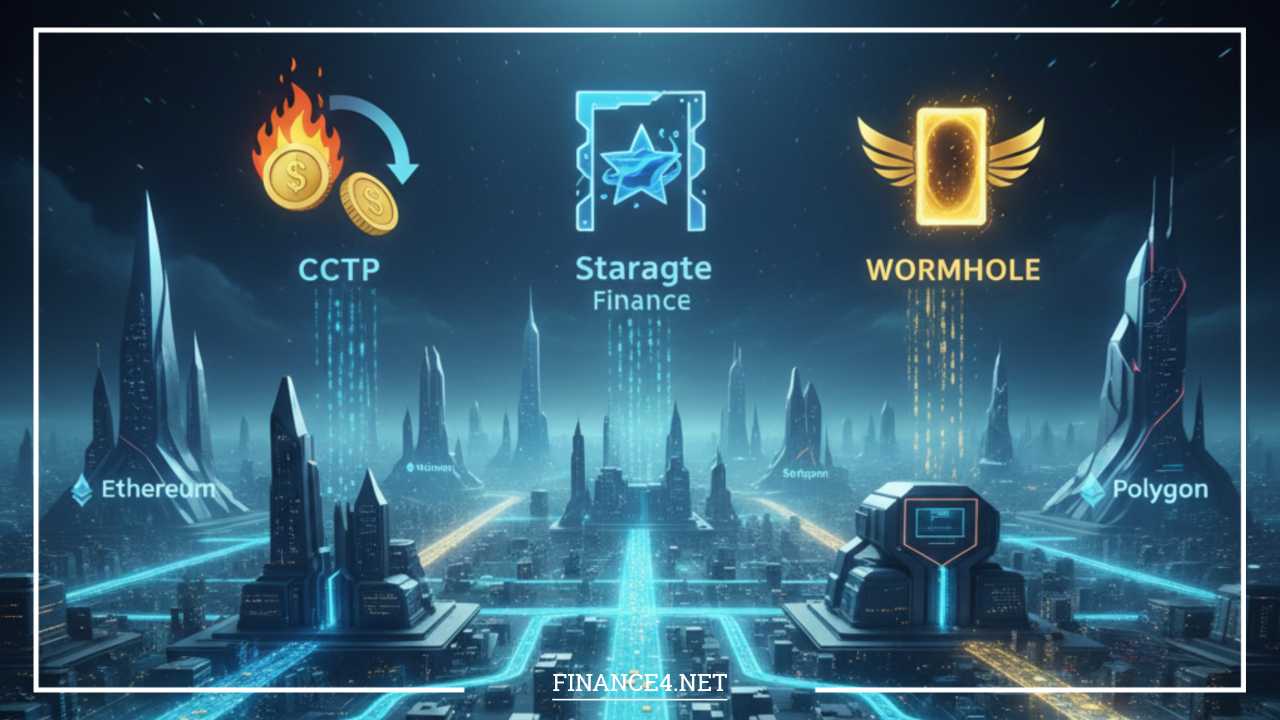
Burn-and-Mint (Canonical/Native): This superior model, utilized by providers like Circle’s CCTP, works by burning the native stablecoin on the source chain and instructing the issuer to mint an equivalent amount of the native stablecoin on the destination chain. This ensures the asset on the destination chain is the genuine, issuer-backed token, unifying liquidity.
2. Cross-Chain Messaging Protocols
Protocols like Axelar, Wormhole, and LayerZero focus on General Message Passing (GMP) rather than just asset transfer. When a stablecoin is transferred, the protocol sends a secure message from the source chain to the destination chain. This message contains instructions (e.g., “Burn 100 USDC on Chain A and mint 100 USDC for this address on Chain B”). These protocols are critical as the security of the asset transfer is tied to the security of the message passing layer.
3. Native Multichain Stablecoins
These are stablecoins where the issuer deploys an identical, independent smart contract on multiple blockchains, actively supporting and maintaining the peg across all of them (e.g., USDT). While they offer wide adoption, moving between their native deployments on different chains still requires a bridge or messaging protocol unless done through a centralized exchange.
Security Considerations
The complexity of cross-chain transfers introduces significant security challenges:
-
Bridge Hacks: Vulnerabilities in the smart contract logic or the security of the custodians/validators managing the lock-and-mint mechanism have led to some of the largest exploits in DeFi history.
-
Oracle Risks: Bridges often rely on off-chain relayers (oracles/validators) to attest to the state of the source chain. A compromised oracle can lead to the fraudulent minting of tokens.
Key Criteria for Evaluating Cross-Chain Stablecoin Solutions
Choosing a reliable cross-chain stablecoin solution requires a rigorous evaluation across multiple vectors:
1. Security Architecture & Audit History
The foundation of any cross-chain solution is its security. This includes reviewing the mechanism’s decentralization (is it secured by a multi-sig, a decentralized Proof-of-Stake validator set, or a trusted third-party oracle?), the frequency of external code audits, and its track record of resilience against attacks.
2. Peg Stability Mechanisms
This is the core risk of any stablecoin. The evaluation must consider the asset’s backing model:
-
Fiat-Backed (Centralized): USDC, USDT, backed by dollar reserves, but carries custodial and regulatory risk.
-
Crypto Collateralized (Decentralized): DAI, backed by over-collateralized crypto assets, introducing liquidation risk.
-
Algorithmic/Hybrid: FRAX, partially backed by collateral and stabilized by an algorithm, carrying complexity risk.
3. Supported Networks
The utility of a cross-chain stablecoin is directly tied to its reach. The solution should support the networks where liquidity and opportunity are most relevant (e.g., Ethereum, Polygon, Arbitrum, Optimism, Solana, Avalanche).
4. Speed and Cost of Transfers
For users and applications, quick settlement and low transaction costs are paramount. Solutions utilizing native burn-and-mint or efficient liquidity routing layers often outperform older, slower lock-and-mint bridges.
5. Liquidity Depth and Adoption
A stablecoin is only useful if it is liquid. The solution must demonstrate significant market capitalization and deep liquidity pools across its supported chains to ensure low-slippage swaps and reliable transfers.
6. Regulatory Compliance
For institutional adoption, the stablecoin’s compliance posture is critical. Fiat-backed stablecoins often adhere to strict audit and reporting requirements, a key differentiator in attracting enterprise users.
Top Cross-Chain Stablecoin Solutions
This core section breaks down the leading stablecoins and their specific approaches to achieving cross-chain fluidity.
1. USDC (Circle)
| Overview | Key Features | Pros & Cons | Ideal Use Cases |
| Fiat-Backed, Regulated: Issued by Circle, backed 1:1 by USD-denominated assets. The second-largest stablecoin by market cap, emphasizing compliance and transparency. |
Native Multichain Issuance: Circle issues native USDC on multiple Layer 1s and Layer 2s (e.g., Ethereum, Solana, Avalanche, Base).
Cross-Chain Transfer Protocol (CCTP): The proprietary burn-and-mint mechanism for secure, trust-minimized transfer between native deployments. |
Pros: High regulatory compliance, strong institutional trust, CCTP ensures native USDC on the destination chain, unifying liquidity.
Cons: Centralized control by Circle; asset can be frozen on-chain if required by law. |
Institutional settlement, treasury management, regulated DeFi environments, and fast, secure transfers using CCTP. |
The introduction of the Cross-Chain Transfer Protocol (CCTP) is USDC’s main competitive advantage in the cross-chain race. CCTP eliminates the need for risk-prone liquidity pools and wrapped tokens. A user wishing to move USDC from Ethereum to Avalanche initiates a transaction that burns the USDC on Ethereum. Circle’s Attestation Service verifies this burn, and an equivalent amount of native, Circle-issued USDC is then minted on Avalanche. This teleportation ensures every USDC token is always the canonical, fully redeemable asset, drastically reducing fragmentation and security risk associated with wrapped assets.
2. USDT (Tether)
| Overview | Key Features | Pros & Cons | Ideal Use Cases |
| Fiat-Backed, Market Leader: The largest and most adopted stablecoin by market capitalization and daily trading volume. |
Widest Multichain Adoption: Available natively on a vast number of blockchains (e.g., Ethereum, Tron, Omni, Solana, BNB Chain, etc.).
Bridged Liquidity: While native on many, its movement across other chains often relies on third-party bridges like Wormhole or Polygon Bridge. |
Pros: Unmatched liquidity footprint, deeply integrated into virtually all centralized and decentralized exchanges, often lower transaction fees on non-Ethereum chains.
Cons: Long-standing transparency concerns regarding reserve composition and auditing; often relies on more centralized bridge infrastructure for cross-chain movement. |
High-volume trading, cross-border payments, arbitrage opportunities, and accessing deep liquidity across fringe markets. |
Tether’s cross-chain strategy is defined by sheer volume and expansive native deployment. By being the first-mover and maintaining the largest market cap, Tether has become a cornerstone of liquidity on almost every major network. While it doesn’t have a single, unified “teleportation” mechanism like CCTP, its ubiquity means users often rely on fast, deep liquidity pools on DeFi bridges or the centralized infrastructure of major exchanges to move USDT between its native chains.
3. DAI (MakerDAO)
| Overview | Key Features | Pros & Cons | Ideal Use Cases |
| Decentralized, Crypto-Collateralized: Issued by the Maker Protocol, backed by a mix of crypto assets (ETH, USDC, tokenized Real World Assets, etc.). | Highly Bridged: Not issued natively across dozens of L1s/L2s, but is frequently bridged using protocols like Wormhole, Arbitrum Bridge, and Optimism Bridge, resulting in various wrapped/bridged DAI versions. |
Pros: The most decentralized and censorship-resistant blue-chip stablecoin; stability is governed by a community of token holders.
Cons: Bridge reliance creates fragmented wrapped versions (e.g., dai on Optimism, DAI.e on Avalanche), introducing security and liquidity risks from third-party bridges. |
Decentralized lending/borrowing, users prioritizing censorship resistance, and use in decentralized autonomous organizations (DAOs). |
DAI is a prime example of a stablecoin that achieves cross-chain functionality primarily through third-party bridging. Because DAI is a decentralized, over-collateralized asset, its security rests entirely on its smart contracts and collateral ratio. When DAI is bridged, the security of the bridged asset relies on the security of the bridge itself. This leads to liquidity fragmentation where native DAI remains on Ethereum, and various wrapped versions exist elsewhere, requiring users to track which bridge’s risk profile they are taking on.
4. FRAX (Frax Protocol)
| Overview | Key Features | Pros & Cons | Ideal Use Cases |
| Fractional-Algorithmic Hybrid: Partially backed by collateral (USDC/crypto) and partially stabilized algorithmically through its governance token (FXS). |
Fraxferry (Older): A bespoke bridge solution.
Frax v3 & Canonical Assets: A shift toward native issuance and use of decentralized message-passing (like Chainlink CCIP) to maintain a single, canonical FRAX asset across all chains, unifying liquidity. |
Pros: Innovative hybrid model; pushing for a truly canonical, burn-and-mint approach for decentralized assets; strong integration into Ethereum L2s.
Cons: Algorithmic component adds complexity and risk compared to fully fiat-backed assets; historical vulnerability to extreme market conditions. |
Next-generation DeFi protocols, experimentation with stablecoin mechanics, and advanced yield strategies. |
Frax is an innovator in the space, constantly evolving its mechanisms. Its current focus is on creating a canonical, multichain version of FRAX that mirrors the benefits of Circle’s CCTP but for a decentralized asset. By leveraging secure, generalized message-passing protocols, Frax aims to ensure that FRAX tokens are burned on one chain and minted as native FRAX on the destination chain, eliminating the need for fragmented, wrapped tokens.
5. LUSD (Liquity)
| Overview | Key Features | Pros & Cons | Ideal Use Cases |
| Decentralized, ETH-Collateralized: Backed purely by over-collateralized ETH, with a unique liquidation mechanism based on a Stability Pool. | Strictly Bridged: LUSD is predominantly an Ethereum-centric asset. Its presence on other chains is almost entirely through standard third-party bridging, similar to DAI, which results in various wrapped LUSD assets. |
Pros: Fully decentralized and censorship-resistant; 100% backed by ETH (no reliance on centralized collateral); very low collateral ratio requirement.
Cons: Minimal native multichain support; relies entirely on the security and liquidity of third-party bridges for cross-chain utility; less liquidity than DAI. |
Hardcore DeFi users, those seeking maximum decentralization, and strategies focused on ETH collateralization. |
LUSD is a decentralized alternative that has chosen a path of minimal complexity, focusing on core protocol stability on Ethereum. Its cross-chain adoption is a function of market demand and bridge availability, rather than an active issuance strategy by the protocol.
6. Emerging Cross-Chain Initiatives
-
USDD (Tron Ecosystem): While controversial due to its algorithmic nature, USDD has seen significant cross-chain adoption, mainly bridged via protocols like Multichain to chains like BNB Chain and Avalanche, driven by the size of the Tron ecosystem.
-
Chainlink CCIP Integration: The most significant trend is the increasing use of general messaging protocols. Stablecoin issuers (including those managing RWA-backed tokens) are beginning to use Chainlink’s Cross-Chain Interoperability Protocol (CCIP) to create their own secure, Programmable Token Transfers. This allows an RWA stablecoin, for example, to be transferred across chains while simultaneously executing a compliance check on the destination chain, creating a robust, unified asset.
Infrastructure Players Enabling Cross-Chain Stablecoins
The stability of a cross-chain stablecoin is only as strong as the infrastructure that moves it. These protocols are the middleware that facilitates secure, seamless movement:
1. Axelar
Axelar is a decentralized network that connects blockchains using a Proof-of-Stake consensus mechanism run by a robust set of validators. It offers General Message Passing (GMP), allowing smart contracts on one chain to call functions on another. This is crucial for cross-chain stablecoins because it enables the burn-and-mint logic to be securely verified by a decentralized validator set, offering a higher degree of security than many earlier bridges. Axelar’s Interchain Token Service (ITS) allows assets to be tokenized once and then deployed across numerous connected blockchains instantly.
2. Wormhole
Wormhole is a generic message passing protocol that offers rapid, widely integrated token transfers. It is secured by a set of Guardians, a limited group of entities that observe and attest to events on the connected chains. Wormhole has massive adoption, particularly connecting non-EVM chains like Solana to the EVM ecosystem. Despite a historical exploit, its security has been reinforced, and its speed and broad integration make it a key facilitator for bridged stablecoins like USDT and DAI.
3. LayerZero
LayerZero is an omnichain interoperability protocol that focuses on ultra-light node technology. It uses a separate Oracle (often Chainlink) and Relayer to securely transmit messages. The core innovation is the decoupling of verification and delivery, making the process highly efficient. A transaction is only deemed valid if the Oracle and the Relayer, which are independent entities, agree on the transmitted data. This dual-verification model makes it a popular choice for stablecoin transfers and building unified liquidity applications like Stargate.
4. Chainlink CCIP
Chainlink’s Cross-Chain Interoperability Protocol (CCIP) is emerging as a security-first standard for cross-chain token movement. It leverages Chainlink’s existing, battle-tested Decentralized Oracle Network (DON) infrastructure, which has secured trillions of dollars in value, to provide a defense-in-depth security model. This standard is particularly appealing to stablecoin issuers (especially for tokenized Real-World Assets) because it offers features like Programmable Token Transfer (transferring assets and executing logic simultaneously) and a separate Risk Management Network that can halt suspicious transfers, ensuring the highest level of security and compliance.
Risks & Challenges in Cross-Chain Stablecoins
Despite the clear benefits, the move toward cross-chain stability is fraught with specific risks:
-
Bridge Exploits and Smart Contract Vulnerabilities: Bridges remain the single most significant point of failure in the multichain ecosystem. Hacks like the Ronin and Harmony bridge exploits demonstrate that a single vulnerability in the lock-and-mint contract or the security of the multi-sig keys can lead to the loss of hundreds of millions of dollars.
-
Depegging Risks: A cross-chain transfer gone wrong, or a systemic failure on the native chain, can lead to the depegging of the wrapped stablecoin on the destination chain. For example, if the bridge token is compromised, the wrapped tokens may become worthless, while the native asset remains pegged, leading to liquidity fragmentation and a crisis of confidence.
-
Liquidity Fragmentation When Bridges Fail: When a bridge is halted (due to a hack or operational issues), the wrapped asset on the destination chain is effectively cut off from its native collateral, leading to the risk of de-liquidation and a lack of redemption ability.
-
Regulatory Uncertainties (especially USDC/USDT): Fiat-backed stablecoins operate under a constant shadow of potential regulation. New regulatory frameworks, such as those governing reserve requirements or permissible use cases, could impact their multichain operations and compliance obligations globally.
-
Centralization vs. Decentralization Tradeoffs: Highly secure solutions like USDC’s CCTP and CCIP are efficient but involve a degree of central authority (Circle/Chainlink DON). Fully decentralized solutions (like DAI via a simple bridge) are more censorship-resistant but often carry greater technical risk from the bridge itself.
Future Trends in Cross-Chain Stablecoin Adoption
The current landscape is merely the transition phase; the future of cross-chain stablecoins is set to be more seamless, secure, and integrated:
-
Native Multichain Stablecoin Issuance: The CCTP model will become the default for centralized stablecoins, eliminating wrapped tokens and unifying liquidity into a single, canonical asset across all supported chains. Decentralized protocols like Frax will follow suit by adopting secure message-passing standards.
-
Emerging Interoperability Standards: Protocols like Chainlink CCIP will evolve into the foundational layer, providing a common, secure “rails” for not just stablecoins, but all tokenized assets, ensuring high security with a defense-in-depth approach.
-
Rollup-Centric Future (Ethereum L2s): As the bulk of activity migrates to Ethereum Layer 2s (Arbitrum, Optimism, zkSync, Starknet), interoperability between these L2s, and between L2s and L1, will become the primary focus for stablecoin movement, with tools like canonical bridges becoming highly optimized.
-
Institutional Adoption and RWA Integration: Traditional financial institutions will leverage cross-chain stablecoins to settle tokenized Real-World Assets (RWAs). CCIP’s ability to embed compliance and policy checks into the token transfer process is vital for institutional use cases that require Know Your Customer (KYC) or geographical restrictions on movement.
-
Potential Role of CBDCs: If Central Bank Digital Currencies (CBDCs) are launched, interoperability protocols will likely be used to facilitate atomic settlement and secure transfers between a nation’s CBDC and existing stablecoin ecosystems or other foreign CBDCs.
Final Thoughts
The evolution of stablecoins from single-chain tokens to fluid, cross-chain assets is arguably the most critical development for the scaling of the entire crypto industry. The era of siloed liquidity and fragmented user experience is quickly coming to an end, replaced by robust, security-focused solutions.
The market is converging around canonical issuance models (like CCTP) and trust-minimized message passing (like Chainlink CCIP, Axelar, and LayerZero). These infrastructures are not merely moving tokens; they are unifying liquidity and providing the atomic, secure financial rails required for complex, global decentralized applications.
The successful cross-chain solution of tomorrow will be one that manages the fundamental tradeoff between security and decentralization, ensuring that the asset remains perfectly pegged, easily transferable, and resilient to attack, ultimately delivering a seamless experience that makes the underlying blockchain irrelevant to the user.