Best Aggregator for Bridging Tokens with Metadata
 by
by 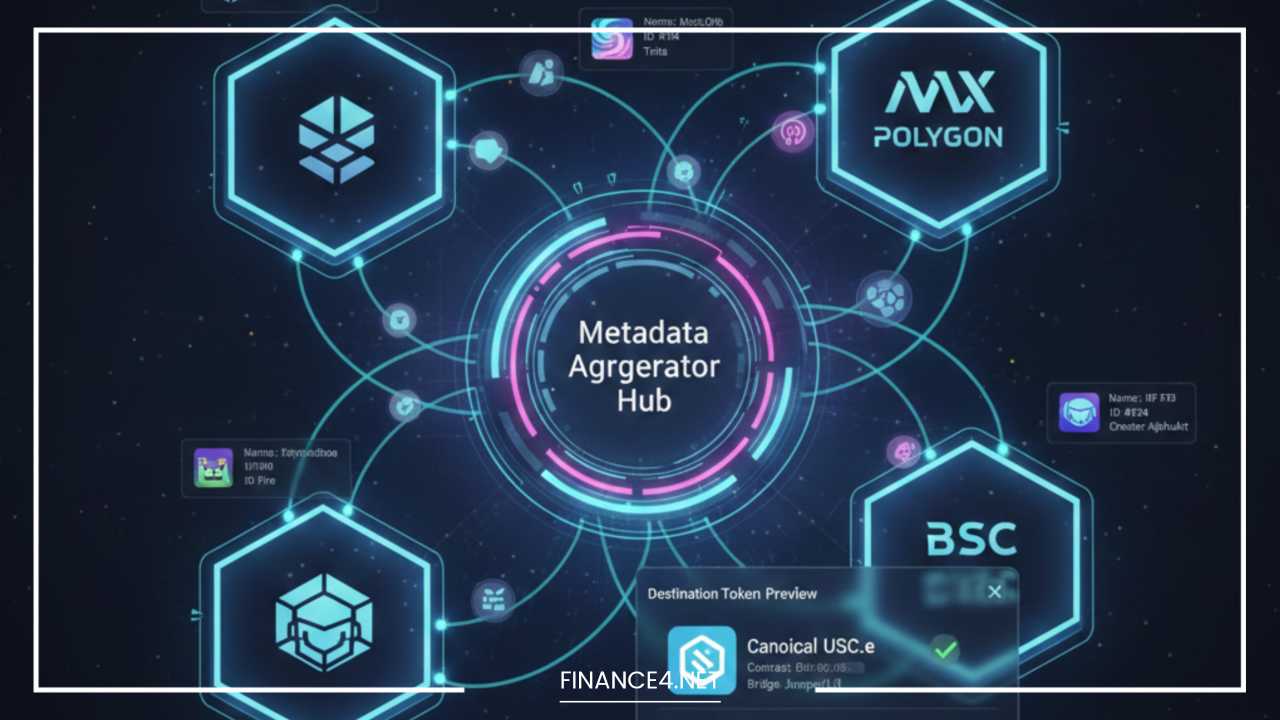
Best Aggregator for Bridging Tokens with Metadata
The expansion of the blockchain landscape has been characterized by a dramatic proliferation of Layer 1 and Layer 2 networks. While this growth has fostered innovation and specialized utility, it has simultaneously introduced a challenge of fragmentation. Assets, liquidity, and users are siloed across disparate chains, necessitating secure and efficient mechanisms to move tokens from one ecosystem to another. This requirement has propelled token bridging from a niche utility into a foundational pillar of Decentralized Finance (DeFi).
However, the simple transfer of a fungible token (like ETH or USDC) is only half the battle. As digital assets—especially Non-Fungible Tokens (NFTs) and increasingly complex fungible tokens—evolve, so too does the importance of their metadata. This article delves into the critical need for a new class of financial infrastructure: the best aggregator for bridging tokens with metadata. We will explore the technologies, challenges, and leading platforms that are defining this essential cross-chain standard.
Understanding Token Bridging
Token bridging is the decentralized process of enabling assets to be transferred, or represented, between two otherwise incompatible blockchain networks. It is the core technology that enables interoperability, allowing the crypto ecosystem to function as a unified financial market rather than a collection of isolated chains.
The Necessity of Interoperability
The need for bridging stems directly from the design philosophy of blockchains. Each chain—whether a general-purpose giant like Ethereum, a high-throughput network like Solana, or an Ethereum Layer 2 like Arbitrum—has its own set of rules, consensus mechanism, and smart contract environment. A native Ethereum ERC-20 token cannot exist or be spent on the Avalanche network without a specific protocol mediating the transfer.
Bridging allows users to:
-
Access greater liquidity: Move assets to a chain with deeper pools for a specific token or a better rate.
-
Chase higher yields: Transfer capital to DeFi protocols on a cheaper, faster chain offering better Annual Percentage Yields (APYs).
-
Utilize specialized dApps: Move a stablecoin from Ethereum to a chain that hosts a unique GameFi or NFT platform.
Common Bridging Mechanisms and Challenges
The most common bridging mechanism is the Lock and Mint / Burn and Mint model. In the “Lock and Mint” variant, the token on the source chain (e.g., Ethereum) is locked in a smart contract, and an equivalent wrapped or canonical token is minted on the destination chain (e.g., Polygon). This wrapped token represents a claim on the original asset.
Despite their necessity, bridges are a primary security vector in DeFi, notorious for being targets of massive exploits (e.g., the Wormhole and Ronin Bridge hacks). This risk, coupled with potentially high fees and slow transaction finality, underscores why users are increasingly turning to aggregators to find the safest and most efficient routes.
Token Metadata: What and Why
While the core functionality of a token is its value and its unique contract address, metadata provides the essential, human-readable context and specialized attributes that define its utility.
Defining Token Metadata
Metadata is simply “data about data.” In the context of a token, it refers to the supplementary information required to accurately identify, display, and interact with the asset.
For Fungible Tokens (e.g., ERC-20), metadata includes:
-
Token Name (e.g., ‘Wrapped Ether’)
-
Token Symbol (e.g., ‘WETH’)
-
Decimals (how the token amount is displayed)
-
Contract Address (the specific address on its native chain)
For Non-Fungible Tokens (e.g., ERC-721), the metadata is far more complex and critical:
-
Name and Description
-
Image URL or link (pointing to the art, often via IPFS or Arweave)
-
Attributes/Traits (e.g., ‘Background: Blue’, ‘Eyes: Laser’)
-
External Link (to the project’s website)
The Critical Role of Metadata in Cross-Chain DeFi
The seamless transfer of metadata is non-negotiable for a functioning cross-chain ecosystem.
-
Trust and Identity (Fungible Tokens): When a user bridges 1,000 USDC from Ethereum to Arbitrum, the resulting token is often called USDC.e (or similar). The metadata—the name, symbol, and the clear indication that it is a wrapped asset—prevents users from mistakenly thinking they hold the native asset. An aggregator must display this clearly to prevent asset confusion and loss of trust.
-
Functionality (NFTs): For an NFT, the metadata is the asset’s identity. If an NFT is bridged from Ethereum to Polygon, the aggregator and the underlying bridge must ensure that the new token on the destination chain correctly references the original contract and, crucially, the original trait data and image URI. A bridge failure to transmit accurate metadata can result in a “metadata mismatch,” rendering the NFT visually incorrect or unusable in marketplaces, essentially destroying its value.
This complexity—the need to ensure that the asset’s context is transferred alongside its value—is the primary design hurdle that aggregators must overcome.
What Is a Token Aggregator?
A token aggregator, often starting as a Decentralized Exchange (DEX) aggregator, is a platform designed to source and combine liquidity from multiple decentralized protocols to execute a single, optimal trade or service for the user. In the context of bridging, a Bridge Aggregator applies this same principle to cross-chain transfers.
How Bridge Aggregators Work
A bridge aggregator does not own the liquidity pools or the bridge smart contracts; instead, it acts as a smart routing layer. When a user requests to move 10 ETH from Ethereum to Polygon, the aggregator performs a dynamic, multi-factor analysis:
-
Route Discovery: It scans all integrated bridge protocols (e.g., Hop, Across, Stargate, Connext, Wormhole).
-
Metric Comparison: It compares the available routes based on:
-
Final Token Amount: Maximizing the yield after fees and slippage.
-
Total Fees: Summing gas fees on both chains plus bridge fees.
-
Time to Finality: Estimating the speed of the transaction.
-
-
Optimal Execution: It automatically selects and executes the transaction through the single best route or, in complex scenarios, splits the order across multiple bridges to minimize slippage and ensure timely execution.
The Crucial Layer: Aggregation and Metadata
The best aggregators go beyond basic routing and incorporate metadata validation into their comparison logic. For a user, seeing the simple token symbol is insufficient. The aggregator must pull the canonical metadata from the source chain, confirm how the target bridge protocol will represent the asset on the destination chain (e.g., is it a wrapped token? A canonical token?), and display the resulting asset’s full metadata to the user before they click “Confirm.” This process reduces the risk of users receiving a low-liquidity, unaudited, or incorrectly wrapped version of a token.
Key Features of the Best Aggregators
The ideal aggregator for bridging tokens with metadata must excel across six key vectors, balancing security, efficiency, and informational transparency.
1. Comprehensive Multi-Chain and Bridge Support
The value of an aggregator is directly proportional to the number of chains and underlying bridges it integrates. The best platforms support a wide range of chains—including major EVM-compatible chains (Ethereum, Arbitrum, Optimism, BSC, Avalanche, Polygon), and increasingly, non-EVM chains (Solana, Cosmos, etc.)—and aggregate from a diverse set of bridge types (liquidity network bridges, canonical bridges, and state-validation bridges). This ensures the broadest possible choice of optimized routes.
2. Sophisticated Metadata Integration and Validation
This is the non-negotiable feature for distinguishing a good aggregator from the best.
-
Canonical Token Mapping: The aggregator must maintain a definitive, audited database that maps a token’s contract address on one chain to its canonical representation on every other supported chain (e.g., mapping Ethereum $WETH$ to Polygon’s $WETH$).
-
NFT Metadata Preservation: For non-fungible assets, the aggregator must be protocol-agnostic, checking that the bridge technology is capable of transferring the token URI and attributes via a verifiable method (e.g., through a message passing layer like LayerZero or Wormhole) rather than simply minting a generic wrapper.
-
User Display and Transparency: The interface must clearly present the target token’s full metadata (name, symbol, logo) and the underlying bridge protocol being used. It must flag potential issues, such as low-liquidity wrapped assets or unverified token imports.
3. Security and Audit Transparency
Given that aggregators route users through bridges—the riskiest protocols in DeFi—the security of the aggregator itself is paramount.
-
Smart Contract Audits: Regular, public audits by reputable firms are mandatory for all core aggregator smart contracts.
-
Bridge Vetting: The platform should only integrate bridges that have demonstrated a strong security track record, undergone multiple audits, and ideally, have insurance or bug bounty programs.
-
Risk Display: The best aggregators incorporate a risk score or security profile for each bridge route, allowing users to choose between speed/cost and security.
4. User Experience (UX) and Speed
An intuitive, fast interface is key to simplifying cross-chain complexity.
-
Real-time Gas Estimation: Accurate, immediate display of the total cost (gas + fees) across all chains and bridges.
-
Transaction Speed Estimation: Reliable prediction of the time-to-finality for different routes, allowing the user to select based on urgency.
-
Single-Step Execution: Abstracting the complex multi-contract interactions into a single, seamless user action.
5. Liquidity and Slippage Management
For large transactions, the aggregator must dynamically manage liquidity. It does this by:
-
Order Splitting: Intelligently dividing a large bridge order across multiple underlying bridges or liquidity pools to minimize price impact (slippage).
-
Deep Liquidity Sourcing: Ensuring that the aggregated liquidity available for a specific token pair (e.g., $AVAX$ on Ethereum to $AVAX$ on Avalanche) is sufficient for the requested transfer size.
6. Analytics and Reporting
Advanced aggregators offer a data layer that empowers users to make informed decisions. This includes displaying historical performance data for each bridge, success rates, average transaction times, and a clear audit trail for the token’s origin and canonical status.
Popular Aggregators and Their Strengths
While the DeFi space is dynamic, certain aggregators have established a clear lead in integrating cross-chain functionality with robust metadata handling. The platforms below represent the cutting edge in this domain.
1. 1inch: The Liquidity & Smart Order Veteran
1inch began as a dominant DEX aggregator on Ethereum and has since expanded its aggregation technology to include cross-chain swaps and bridging services, now supporting numerous EVM chains.
-
Metadata Handling: 1inch excels in fungible token metadata by providing highly reliable canonical token mapping. Its smart contract logic includes a sophisticated registry that ensures the correct token symbol and decimal count are used when routing funds across its various integrated protocols. For users, the resulting token is clearly identified to mitigate ‘wrong token’ scams.
-
Core Strength: Its Smart Order Routing (SOR) algorithm is arguably the most powerful in DeFi, capable of splitting trades not just across DEXs, but also across bridge protocols to ensure maximum efficiency and minimal slippage. This makes it ideal for large-volume transfers where optimization is crucial.
-
Pros: Deepest aggregation logic; robust security track record; transparent fee structure.
-
Cons: Can be more gas-intensive on the Ethereum mainnet than pure bridge-focused protocols; its primary focus remains fungible tokens.
2. Matcha: The UX-Focused, Data-Rich Aggregator
Powered by the 0x Protocol, Matcha is renowned for its clean interface and dedication to transparency, making it a strong contender for users who prioritize clear visual data.
-
Metadata Handling: Matcha provides excellent token discovery and rich token display. By leveraging the 0x API, it ensures that all liquidity sources provide accurate and audited token information, including contract verification and clear logo display. This focus on front-end data integrity helps users instantly verify the token they are interacting with, a critical metadata function. While its initial focus was on DEX aggregation, its cross-chain swap feature (often powered by integrated bridges like Li.Fi) is fast and metadata-aware.
-
Core Strength: Simplicity and transparency. Matcha is known for not adding a protocol fee layer on top of the underlying bridge or DEX fees, and its routes are displayed with exceptional clarity, including the source of liquidity and the full path the token takes.
-
Pros: Extremely intuitive interface; strong data transparency; zero platform fee.
-
Cons: Often relies on third-party bridge integrators (like 0x’s own API), rather than direct bridge integration.
3. Jumper Exchange (Li.Fi): The Dedicated Bridge Aggregator
Jumper Exchange is the consumer-facing product of Li.Fi, a highly respected cross-chain aggregation protocol. This platform is built from the ground up to solve the aggregation problem specifically for cross-chain transfers, placing it directly at the intersection of bridging and metadata.
-
Metadata Handling: As a dedicated bridge aggregator, Jumper/Li.Fi has one of the most comprehensive canonical token registries. Their API is utilized by dozens of dApps to ensure they use the correct wrapped asset symbol, contract, and decimals across over 16 chains. They prioritize showing the user the end-to-end route from the source token to the destination token, including all intermediate steps. This level of route transparency is vital for metadata verification.
-
Core Strength: Breadth of Bridge Integration. Jumper aggregates over 13 bridges and 7 DEX aggregators, often finding complex, multi-hop routes (e.g., $A$ to $B$ via $Bridge X$, then $B$ to $C$ via $DEX Y$ on the new chain) to secure the best final price. This holistic approach to execution and price discovery is peerless.
-
Pros: Built specifically for cross-chain; massive integration depth; high degree of route and fee transparency.
-
Cons: Complex multi-hop routes, while cheaper, can occasionally introduce slightly higher smart contract risk by interacting with more protocols.
| Aggregator | Primary Focus | Core Metadata Strength | Bridge Vetting/Integration | Ideal For |
| 1inch | DEX & Bridge Aggregation | Canonical Token Mapping & Fungible Asset Security | Integrates major bridges and its own Fusion mode | Large, volume-sensitive traders needing optimal price |
| Matcha | DEX Aggregation & Cross-Chain Swaps | User Interface Display & Token Verification | Relies on 0x’s Aggregation API and integrated bridges | Users prioritizing transparency and a clean interface |
| Jumper/Li.Fi | Dedicated Bridge Aggregation | Comprehensive Canonical Token Registry & Route Transparency | Deep integration of 13+ Bridges and numerous DEXs | Users seeking the absolute best rate across complex, multi-chain routes |
How to Choose the Right Aggregator
Selecting the best platform requires a rigorous, multi-faceted approach, particularly when the value of the bridged asset depends on its metadata integrity.
Factors to Consider
-
Security and Community Trust: Has the aggregator been audited? Are the bridges it uses frequently exploited? Use tools like DefiSafety to verify the overall score of the aggregated protocols.
-
Chain and Token Coverage: Does it support both your source and destination chains? Does it support the specific token (e.g., a specific L1-native stablecoin) you need to bridge?
-
Metadata Accuracy: How clearly is the resulting token displayed? For NFTs, does the aggregator have a clear mechanism for ensuring trait preservation? If the resulting token is wrapped, is it labeled correctly (e.g., $USDC.e$ vs. $USDC$)?
-
Cost vs. Speed: Compare the gas fee estimates and the estimated time to finality. The cheapest route is often the slowest. Choose based on your urgency (e.g., time-sensitive arbitrage vs. long-term asset relocation).
Step-by-Step Selection Guide
-
Identify the Token and Chain Requirements: Determine the exact source token and the desired destination chain. Crucially, look up the canonical address/symbol of the token on the destination chain beforehand.
-
Check Metadata Preservation/Visibility: Enter the transaction details into two or three leading aggregators. Compare the output token’s name and symbol against your pre-verified canonical token. If the aggregator’s interface does not clearly show the final token’s full name or logo, it is a sign of poor metadata integration.
-
Compare Fees, Slippage, and Security: Analyze the full cost breakdown. Pay close attention to slippage on large transactions. Check which bridge the best rate is using and perform a quick check on that bridge’s recent security track record. The marginal cost saving must outweigh the marginal security risk.
-
Verify Reputation and Audit Reports: Search for recent news and bug bounty reports for the chosen aggregator. A platform that actively encourages white-hat hacking shows a stronger commitment to security.
Future of Token Aggregators and Metadata
The current generation of bridge aggregators is focused on fungible tokens, but the future of cross-chain DeFi will demand even more sophisticated handling of metadata, driven by three major trends.
1. AI-Powered Metadata Validation
As the number of tokens (and therefore the risk of scams/fakes) explodes, aggregators will leverage advanced data analytics and potentially AI to validate token provenance and metadata. This could involve real-time checks against a decentralized scoring system to flag tokens with similar names but differing contract addresses, or validating that an NFT’s metadata file has not been tampered with mid-bridge. This evolution transforms the aggregator into a Risk-Adjusted Router rather than just a price/speed optimizer.
2. Deeper NFT and Gaming Token Integration
The bridging of NFTs will become a standard, automated feature of aggregators. This will require specialized tools to ensure not just the transfer of the token, but the composability of its traits. For example, bridging a gaming asset must ensure that its in-game attributes (e.g., ‘Level 10 Sword’) are recognized and rendered correctly in the new chain’s environment. Aggregators will route NFTs based on which underlying bridge supports the most robust General Message Passing (GMP), which is necessary for transferring complex logic and attributes.
3. Canonicalization and Standardization
Efforts like the ERC-721 and ERC-1155 standards laid the groundwork for fungible and non-fungible tokens. The next standard will focus on Canonical Cross-Chain Metadata (CCCM). Aggregators will be the primary implementers of this standard, which will specify how metadata should be stored and transmitted across chains, ensuring that every wrapped asset is consistently named and reliably identified, regardless of the chain it lands on. This standardization will massively reduce the current risk of asset confusion.
Final Thoughts
The challenge of token bridging is no longer merely moving a number from $A$ to $B$. It is about transferring an asset’s identity and context—its metadata—securely and efficiently across disparate digital borders.
The best aggregator for bridging tokens with metadata is the one that transforms the complex task of cross-chain transfers into a transparent, single-click decision. This requires a platform with the deepest liquidity aggregation, the most rigorous security vetting of its underlying bridges, and, most importantly, a commitment to canonical token mapping and clear metadata presentation in its user interface.
Users must treat the aggregator’s interface as their primary source of truth. As DeFi continues its inevitable evolution into a multi-chain reality, the platforms that prioritize information transparency—showing not just the final price, but the full, verified identity of the token being received—will be the essential infrastructure that underpins the next era of growth in cross-chain DeFi. Choose wisely, prioritize security and metadata accuracy over minimal cost savings, and join the secure, interconnected future of digital finance.