Best Interoperability Protocols for Blockchains
 by
by 
Best Interoperability Protocols for Blockchains | Top Cross-Chain Solutions
The blockchain industry has transitioned from a single-chain experiment into a vast, multichain ecosystem. However, this growth has come at a cost: fragmentation. As of 2025, thousands of independent networks—ranging from Layer 1s like Ethereum, Solana, and Bitcoin to specialized Layer 2s and app-chains—operate as “walled gardens.” They possess their own consensus rules, assets, and data structures, but they cannot natively speak to one another.
This lack of connectivity has created liquidity silos and fragmented user experiences that hinder the mass adoption of decentralized finance (DeFi), Non-Fungible Tokens (NFTs), and enterprise blockchain applications. To realize the full potential of Web3, these isolated islands must be connected. This is where blockchain interoperability comes in.
In this comprehensive guide, we explore the best interoperability protocols for blockchains, analyzing the top cross-chain solutions that are defining the future of an interconnected digital economy.
Introduction to Blockchain Interoperability
Blockchain interoperability refers to the ability of different blockchain networks to communicate, exchange data, and move assets between each other without relying on a centralized intermediary. In the current landscape, blockchains are naturally fragmented because they are built on different “languages” (virtual machines) and consensus mechanisms.
What Blockchain Interoperability Means
At its core, interoperability allows a smart contract on Chain A to recognize that an event has occurred on Chain B. This is not a native feature of blockchains. Most blockchains are designed to be “closed systems” to maintain security and consensus integrity. Interoperability protocols act as the specialized translators and couriers that bridge these gaps.
Why Blockchains are Fragmented Today
The fragmentation we see today is a byproduct of the “Blockchain Scalability Trilemma.” Developers realized that no single chain could optimize for security, decentralization, and scalability simultaneously. This led to a surge in specialized networks:
-
Ethereum for security and decentralization.
-
Solana for high-speed execution.
-
Polygon and Base for low-cost transactions.
-
Monero and Zcash for privacy.
Because these networks use different cryptographic primitives and state-transition logic, they are fundamentally incompatible without an external layer.
Problems Caused by Isolated Blockchains
Isolated blockchains create several systemic issues that prevent Web3 from reaching the efficiency of Web2:
-
Liquidity Silos: Assets like USDC or ETH exist in separate pools across different chains. This leads to high slippage and poor capital efficiency for traders and liquidity providers.
-
UX Friction: A typical user must manage multiple wallets, navigate complex bridge interfaces, sign multiple transactions, and hold various gas tokens (e.g., SOL for Solana, ETH for Ethereum) just to perform a simple swap.
-
Scalability Limits: When a single chain becomes congested, users have no easy way to migrate their activity to a less congested chain without significant technical effort and risk.
Why Blockchain Interoperability Matters
The shift toward a multichain world is driven by the need for specialization. Interoperability is the “TCP/IP” moment for Web3—the standard that will allow the “Internet of Blockchains” to function as a single, unified web.
Cross-Chain Liquidity and Capital Efficiency
Without interoperability, capital is “trapped.” A user might have idle capital on Ethereum but see a lucrative yield opportunity on Avalanche. Interoperability protocols allow for cross-chain liquidity, enabling assets to move where they are most productive without the friction of centralized exchanges. This creates a unified global market rather than a series of localized ones.
Seamless User Experience
For Web3 to go mainstream, the “chain” should be invisible. Users shouldn’t need to know if their assets are on Polygon or Base; they should simply interact with an application. Interoperability protocols enable chain abstraction, where the technical complexities of switching networks, gas payments, and signing are handled in the background by the protocol.
Developer Flexibility and Innovation
Interoperability allows developers to build “omnichain” applications. A developer can host heavy computation on a high-throughput chain like Solana while tapping into the deep liquidity of Ethereum for settlements. This “plug-and-play” approach fosters a more creative and robust development environment where developers are no longer “locked in” to a single ecosystem’s limitations.
Enterprise and Institutional Adoption
Enterprises require private, permissioned chains for data privacy, yet they must also settle transactions on public ledgers for transparency and trust. Interoperability acts as the bridge between legacy financial systems and the decentralized world, allowing for secure, regulated cross-border settlements and asset tokenization.
Types of Blockchain Interoperability Solutions
To understand the current market, we must distinguish between the different architectural approaches to connecting chains.
1. Token Bridges
Bridges are the most common form of interoperability, primarily focusing on moving assets.
-
Lock-and-Mint: Tokens are locked in a smart contract on the source chain, and a “wrapped” version (e.g., wETH) is minted on the destination chain.
-
Burn-and-Mint: Tokens are destroyed on the source chain and a native version is minted on the destination. This is often seen as a more secure, permanent transfer method because it doesn’t leave a “honey pot” of locked assets on the source chain.
-
Risks: Bridges have historically been the weakest link in Web3 security, with over $2.5 billion lost to exploits due to smart contract bugs or compromised validator keys.
2. Cross-Chain Messaging Protocols (GMP)
General Message Passing (GMP) is an evolution of the bridge. Instead of just moving tokens, these protocols allow smart contracts on different chains to send any type of data or function call to one another.
-
Example: A user on Arbitrum can trigger a vote on a DAO located on Ethereum without ever leaving the Arbitrum interface. This enables true “cross-chain apps” rather than just “bridged assets.”
3. Layer 0 Protocols
Layer 0 protocols provide the underlying infrastructure for other blockchains (Layer 1s).
-
Architecture: They typically feature a central “hub” or “relay chain” that provides shared security to “spoke” chains (parachains or zones).
-
Difference: Unlike Layer 1s, Layer 0s do not host dApps directly; they provide the security and communication layer for the chains built on top of them.
4. Sidechains and App-Specific Chains
These are sovereign chains that connect to a main ecosystem. While they offer high performance and specific features (like gaming-optimized consensus), they often rely on the parent chain for finality or security, creating a trade-off between independence and risk.
Key Criteria for Evaluating Interoperability Protocols
When choosing a protocol, several factors determine its long-term viability:
-
Security Model: Does it rely on a small multisig (risky) or a large, decentralized validator set? Does it use “light clients” or Zero-Knowledge (ZK) proofs for verification?
-
Decentralization: Is the relaying of messages permissionless? Are the “Guardians” or “Validators” diverse and geographically distributed?
-
Scalability and Throughput: Can the protocol handle high transaction volume without significant latency?
-
Supported Blockchains: How many blockchains (EVM and non-EVM) does it support?
-
Developer Tooling and SDKs: Are there robust tools available for developers to integrate these features easily?
-
Adoption and Maturity: Is the protocol battle-tested, and does it have a thriving ecosystem of dApps?
Best Interoperability Protocols for Blockchains (Core Section)
The following protocols represent the gold standard of cross-chain technology in 2025.
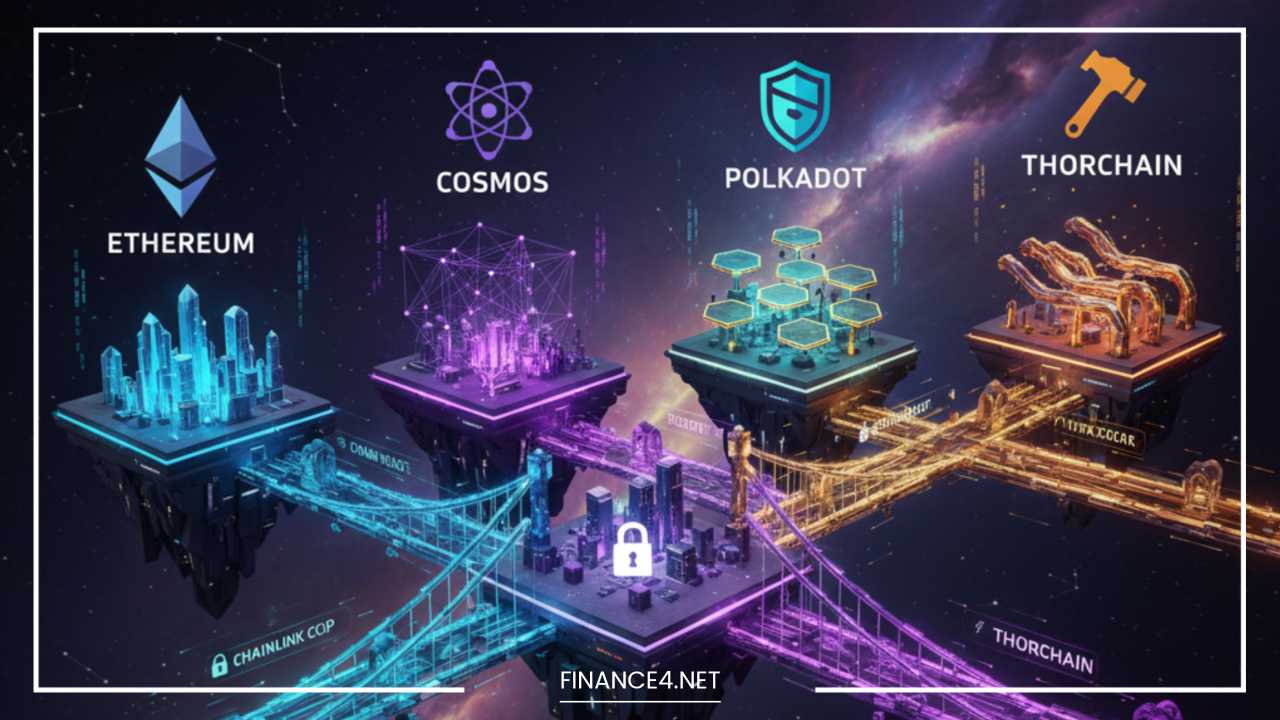
1. Polkadot (The Relay Chain & XCMP)
Polkadot is a Layer 0 protocol designed to unite an entire network of purpose-built blockchains.
-
Relay Chain and Parachains: The Relay Chain is the heart of Polkadot. It doesn’t support smart contracts; instead, it provides security and consensus to “Parachains”—specialized blockchains that plug into the Relay Chain slots.
-
XCMP (Cross-Chain Message Passing): This is Polkadot’s native messaging protocol. It allows parachains to send secure messages to each other without needing an external, third-party bridge. Because they share the same security umbrella, these messages are inherently trusted.
-
Shared Security Model: One of Polkadot’s biggest strengths is that the Relay Chain provides security for all connected parachains. Developers do not have to worry about recruiting their own validator set; they “lease” the security of the DOT token.
-
Use Cases: Projects like Astar, Moonbeam, and HydraDX leverage Polkadot to provide specialized services ranging from smart contracts to cross-chain DeFi.
2. Cosmos (The IBC Protocol)
Cosmos champions the “Internet of Blockchains” with a focus on sovereignty.
-
Cosmos Hub and Zones: The Cosmos ecosystem consists of many independent blockchains called “Zones” connected to “Hubs.”
-
IBC (Inter-Blockchain Communication): IBC is a standardized protocol that functions like the TCP/IP of blockchains. It allows independent Zones to connect and exchange data permissionlessly. IBC handles the transport, authentication, and ordering of data.
-
Sovereignty vs. Shared Security: Unlike Polkadot, Cosmos chains are traditionally sovereign. They have their own validator sets and tokens. However, the introduction of “Interchain Security” now allows smaller chains to “rent” security from the Cosmos Hub.
-
Real-World Examples: Major chains like Celestia, dYdX, and Injective are built using the Cosmos SDK and rely on IBC for connectivity.
3. Chainlink CCIP (Cross-Chain Interoperability Protocol)
Chainlink, the world’s leading oracle network, launched CCIP to provide a secure, universal standard for cross-chain communication.
-
Oracle-Based Interoperability: CCIP is built on Chainlink’s existing decentralized oracle networks, which have a track record of securing tens of billions in value.
-
Secure Message and Token Transfer: It provides a unified interface for both sending data and moving assets.
-
The Risk Management Network: This is CCIP’s standout feature. It is an independent set of nodes that monitor for suspicious activity, such as deep reorgs or anomalous bridge behavior. If it detects a threat, it can pause the protocol, providing a level of security that traditional bridges lack.
-
Enterprise Adoption: CCIP has gained massive traction with institutions like SWIFT and major global banks (e.g., J.P. Morgan, ANZ). It is the preferred choice for bridging traditional finance (TradFi) with decentralized finance (DeFi).
4. LayerZero
LayerZero is an Omnichain interoperability protocol designed for lightweight, low-cost messaging.
-
Ultra Light Nodes (ULN): Most bridges require running a “light node” on the destination chain, which is expensive. LayerZero avoids this by using two independent entities: an Oracle and a Relayer. The Oracle provides the block header, and the Relayer provides the proof. If both match, the message is delivered.
-
Omnichain Applications (OApps): LayerZero allows developers to build applications that exist natively on multiple chains simultaneously.
-
Security Considerations: While efficient, LayerZero relies on the independence of the Oracle and Relayer. Critics argue this introduces trust assumptions, but the protocol has seen massive adoption due to its ease of use and low costs.
5. Wormhole
Wormhole started as a bridge between Ethereum and Solana but has expanded into a massive interoperability network.
-
Guardian Network: Wormhole relies on a set of 19 “Guardians” (top-tier validators). These Guardians observe the source chain and sign a “Verifiable Action Approval” (VAA) when a transaction is finalized.
-
Supported Chains: Supporting over 30 chains, including non-EVM networks like Solana, Sui, Aptos, and Near, Wormhole is a favorite for developers moving assets between fundamentally different architectures.
-
Strengths and Limitations: Its primary strength is its wide reach and high liquidity. However, its security is as strong as its Guardian set, which is a form of trusted multisig.
6. Axelar
Axelar is a decentralized Proof-of-Stake (PoS) network specifically built for cross-chain communication.
-
PoS Validator Set: Unlike Wormhole’s Guardians, Axelar uses a dynamic, permissionless validator set that users can delegate to, making it more decentralized.
-
General Message Passing (GMP): Axelar allows developers to build dApps where a user on one chain can trigger a function call on another with a single click.
-
Developer-Friendly APIs: Axelar provides “one-click” deployment for cross-chain logic, making it very popular for developers who want to expand their dApps to multiple chains quickly.
Comparison Table: Top Cross-Chain Protocols
| Protocol | Security Model | Supported Chains | Decentralization Level | Best For |
| Polkadot | Shared Security (Relay) | Parachains | High | Ecosystem-wide security |
| Cosmos | Sovereign/IBC | 100+ (IBC-enabled) | Very High | Sovereign app-chains |
| Chainlink CCIP | Oracle + Risk Network | 60+ (Public/Private) | High | Enterprise & High-value DeFi |
| LayerZero | Oracle + Relayer | 50+ | Medium | Low-cost Omnichain apps |
| Wormhole | Guardian Network | 30+ (EVM/non-EVM) | Medium | Solana & Sui bridging |
| Axelar | Proof-of-Stake | 50+ | High | Developer-friendly GMP |
Use Cases of Cross-Chain Interoperability
Interoperability isn’t just a technical achievement; it unlocks entirely new business models.
DeFi (Cross-Chain Lending and DEX Aggregation)
In 2025, cross-chain money markets allow users to deposit collateral (like ETH) on one chain and borrow stablecoins on another. DEX aggregators like 1inch or Paraswap use interoperability to find the best price for a token across ten different chains simultaneously.
NFTs and Gaming (Asset Portability)
A player can earn a legendary sword in a game on Polygon and use it in a metaverse built on Avalanche. Interoperability allows NFTs to maintain their metadata and utility across different gaming ecosystems, creating a “portable digital life.”
DAOs and Governance
A DAO can have its primary treasury on Ethereum but allow users on Layer 2s like Optimism or Base to vote on proposals for a fraction of the gas cost. Interoperability ensures that these votes are securely tallied and executed across chains.
Enterprise Blockchain Integration
Major retailers use interoperability to connect their private supply chain trackers to public chains for consumer verification. This “Hybrid Cloud” approach for blockchain allows for privacy where needed and transparency where required.
Security Challenges and Risks in Interoperability
Despite the progress, interoperability remains one of the most high-risk areas of blockchain development.
-
Bridge Hacks: Bridges create massive pools of locked assets that are “honey pots” for hackers. If the bridge’s smart contract has a bug, the entire pool can be drained.
-
Validator Collusion: If a protocol relies on a small number of validators (e.g., 10-20), a coordinated attack could lead to the theft of all bridged funds.
-
Smart Contract Exploits: Complex cross-chain logic increases the surface area for bugs.
-
Trade-off Between Speed and Security: Some protocols achieve speed by reducing the number of confirmations required, which can lead to “double-spend” attacks if the source chain undergoes a reorganization.
The industry is moving toward Zero-Knowledge (ZK) Bridges, which use mathematical proofs to verify state transitions without needing to trust third-party validators.
Future of Blockchain Interoperability
The future of blockchain is Chain Abstraction. In this world, the underlying infrastructure is hidden from the user.
Move Toward Chain Abstraction
We are entering an era where users won’t know which chain they are using. They will sign in with an email, and the interoperability protocol will handle the backend routing, gas payments, and asset swaps.
Modular Blockchain Stacks
The rise of modularity—where execution, data availability, and settlement are handled by different layers—requires interoperability to stitch these modules together. Protocols like Celestia and Avail are already integrating with cross-chain solutions to ensure data flows freely.
Institutional Adoption Trends
As regulatory frameworks like MiCA in Europe become clearer, institutions will drive the next wave of interoperability, demanding standards that support KYC (Know Your Customer) portability and cross-chain auditability.
Final Thoughts
Blockchain interoperability is the final piece of the puzzle for Web3. By breaking down the silos between networks, protocols like Polkadot, Cosmos, Chainlink CCIP, and LayerZero are building the infrastructure for a truly global, decentralized internet.
For developers, interoperability means the freedom to build without borders. For users, it means a faster, cheaper, and more intuitive experience. While security remains a significant hurdle, the shift toward ZK-proofs and institutional-grade risk management suggests that the era of “fragmented blockchains” is coming to an end. When choosing a protocol, always prioritize security and decentralization over speed and cost, as the strength of the connection is only as good as its weakest link.