Best Aggregator for NFT Marketplaces
 by
by 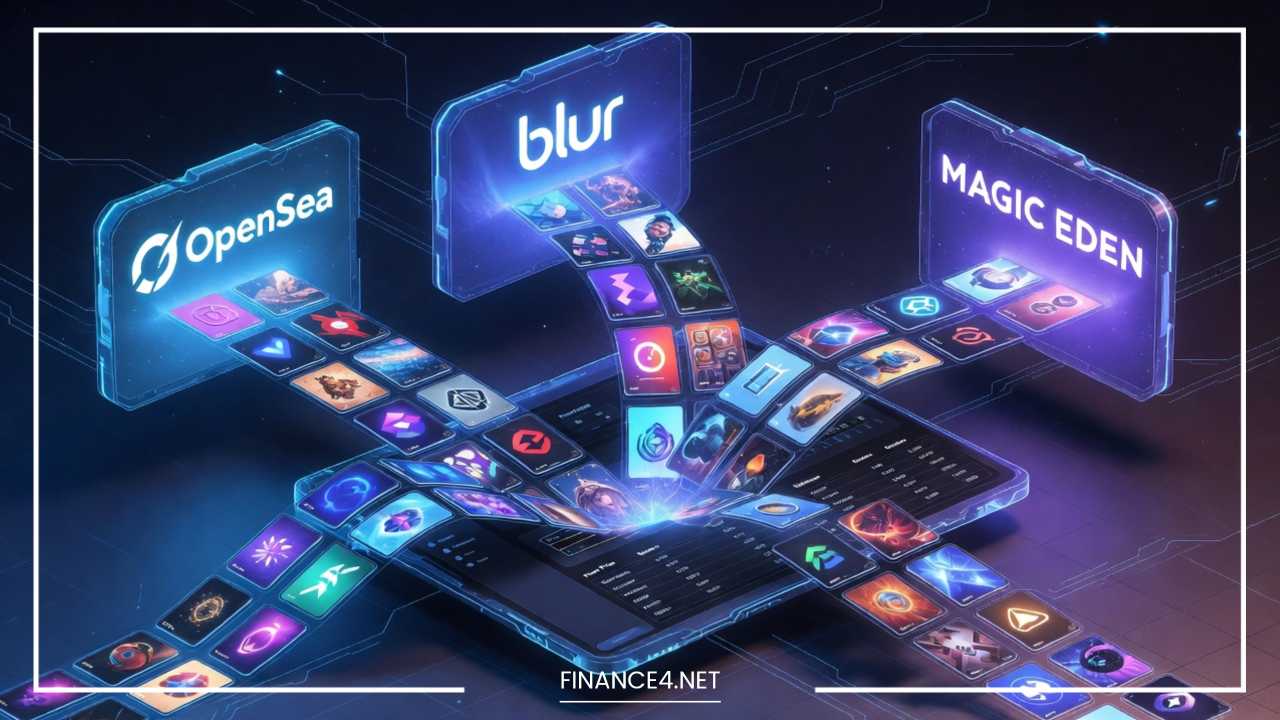
Best Aggregator for NFT Marketplaces | Compare, Trade & Discover NFTs
The digital asset landscape has undergone a tectonic shift since the early “Gold Rush” of 2021. As we navigate 2026, the non-fungible token (NFT) ecosystem is no longer a monolith confined to a single blockchain or a handful of hyped art collections. Instead, it is a vast, fragmented web of utility-driven assets spread across dozens of networks—from Ethereum and its high-performance Layer-2s like Base, Arbitrum, and Blast, to ultra-fast non-EVM chains like Solana and Monad.
For the modern collector, professional trader, or institutional investor, this fragmentation is a significant hurdle. Browsing twenty different browser tabs to find the best price for a tokenized real estate deed, a gaming skin, or a blue-chip collectible is inefficient and often leads to “slippage”—the loss of value due to price changes during the time it takes to execute a trade.
This is where NFT marketplace aggregators come in. These powerful “meta-platforms” act as a single command center, allowing you to discover, compare, and trade assets across the entire Web3 ecosystem from a unified interface. In this 2026 definitive guide, we will explore the top aggregators, their technical underpinnings, and how to choose the best one for your specific trading style.
What Is an NFT Marketplace Aggregator?
To understand an aggregator, you must first understand the problem of “Liquidity Fragmentation.” Every individual marketplace (like OpenSea or Magic Eden) has its own “order book”—a list of who wants to buy and sell at what price. If an asset is listed on Marketplace A but not Marketplace B, a user on Marketplace B might think the asset is unavailable or overpriced.
The Google Flights of Web3
An NFT aggregator is essentially the Google Flights of the NFT world. Just as you wouldn’t visit every airline’s website individually to find the cheapest flight to London, you shouldn’t have to visit every NFT marketplace to find the lowest “floor price” for a specific collection. Aggregators do the heavy lifting by scanning the entire blockchain for every active listing, bid, and sale.
Defining the 2026 Standards
In 2026, an aggregator is more than just a search engine. It has evolved into a:
-
Liquidity Pool: It consolidates hundreds of individual marketplace order books into one.
-
Execution Layer: It allows you to buy from five different marketplaces in a single “atomic” transaction.
-
Portfolio Hub: It provides a bird’s-eye view of your assets across Ethereum, Solana, Bitcoin, and Polygon.
Key Use Cases
-
Sniping: Finding newly listed NFTs at a price significantly below the current market average.
-
Floor Sweeping: Buying multiple low-priced NFTs from a single collection in one go to accumulate a large position.
-
Arbitrage: Identifying price discrepancies between two different marketplaces for the same asset—buying on the cheaper one and instantly listing on the more expensive one.
How NFT Aggregators Work: The Technical Overview
For those looking to understand the “magic” behind the screen, NFT aggregators rely on a sophisticated stack of blockchain technology and data science.
1. Data Indexing and APIs
Aggregators use specialized “indexers” to constantly watch the blockchain for events like Transfer and List. However, manual indexing is slow. In 2026, many aggregators have shifted toward Reservoir, a protocol that provides an open-source back-end for NFT liquidity. Reservoir normalizes data from every major marketplace into a standardized format, ensuring that “Gold Fur” on one platform means the same thing on another.
2. The Order Book Engine
The core of an aggregator is its “matching engine.” When you search for a specific NFT, the aggregator’s back-end queries its indexed database to find every instance of that token. It then sorts these results by price, ensuring that the Price Discovery is always in the user’s favor.
3. Smart Contract Execution and Batching
The most significant technical advantage is the use of batch-buy smart contracts. When you “sweep the floor” (buy 10 NFTs at once), the aggregator’s smart contract interacts with multiple marketplace contracts in a single blockchain transaction.
-
Gas Optimization: By bundling trades, you can save up to 40% on transaction fees compared to buying each item individually.
-
Atomic Transactions: This ensures that either the whole batch purchase succeeds, or it all fails. This prevents a scenario where you pay for 10 items but only receive 5 because the others were sold by someone else in the same block.
4. Oracle Integration for Valuation
In 2026, leading aggregators use AI-driven oracles to provide “fair value” estimates. These oracles analyze historical sales, trait rarity, and current market sentiment to tell you if an NFT is priced fairly or if it is an outlier.
Key Features to Look for in the Best NFT Aggregator
As the competition among platforms like Blur, Magic Eden, and OpenSea Pro intensifies, certain features have become the “gold standard” for 2026.
Multi-Chain and Multi-Marketplace Support
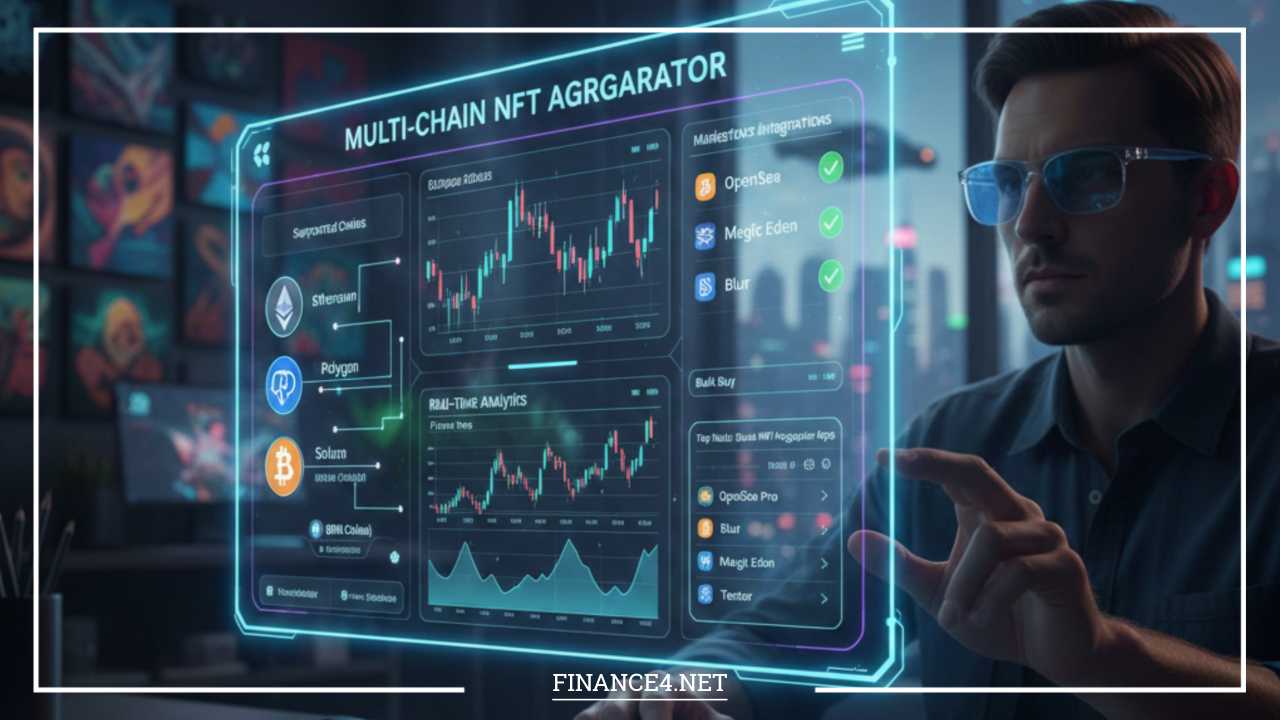
A top-tier aggregator must support at least five major chains: Ethereum (and its L2s), Solana, Bitcoin (Ordinals), Polygon, and Base. It should pull from at least 15+ marketplaces to ensure you are seeing the true market depth.
Real-Time Analytics and Rarity Tools
High-end aggregators integrate rarity scoring directly into the browsing experience.
-
Trait Sniper: The ability to filter by specific traits (e.g., “Laser Eyes” or “Crown”) across all marketplaces simultaneously.
-
Depth Charts: Seeing a visual “wall” of listings to understand how many NFTs need to be sold before the price increases.
Gas Optimization and Fee Transparency
Look for platforms that offer “Gasless” listing options. Furthermore, clear fee breakdowns are vital—some aggregators add a small “convenience fee,” while others are 100% free and earn revenue through affiliate commissions from the marketplaces they link to.
Safety and Security (The “Shield” Layer)
With the rise of “drainer” scams, the best aggregators in 2026 include:
-
Contract Verification: Ensuring you aren’t interacting with a malicious “spoof” marketplace.
-
Suspicious Item Warnings: Flagging NFTs that have been reported as stolen, which prevents you from buying an asset that major marketplaces might later delist.
Best NFT Aggregators in 2026: The Ultimate Comparison
Here is a breakdown of the leading platforms currently dominating the market in 2026.
1. Blur: The King of Professional Trading
Blur has maintained its position as the go-to platform for high-volume traders who care about speed above all else.
-
Overview: It functions more like a professional trading terminal (think Bloomberg for NFTs) than a gallery.
-
Key Features: Lightning-fast data refreshes, “Blend” (NFT lending), and zero marketplace fees.
-
Pros: Unrivaled speed; high reward incentives (BLUR tokens).
-
Cons: Not beginner-friendly; the interface is dense and data-heavy.
-
Best for: Professional flippers and “whales.”
2. Magic Eden Aggregator: The Multi-Chain Powerhouse
Originally a Solana-only marketplace, Magic Eden has successfully evolved into a premier multi-chain hub.
-
Overview: It provides a polished, unified experience for Ethereum, Solana, and Bitcoin Ordinals.
-
Key Features: Cross-chain rewards (Diamonds), a robust mobile app, and a “Launchpad” for new projects.
-
Pros: Best support for Bitcoin and Solana; very clean UI.
-
Cons: Can feel slightly slower than Blur when aggregating massive Ethereum collections.
-
Best for: Collectors who move between different blockchain ecosystems.
3. OpenSea Pro (Formerly Gem.xyz)
OpenSea Pro is the advanced arm of the world’s most famous NFT marketplace.
-
Overview: It offers a middle ground between the simple OpenSea gallery and the hyper-technical Blur terminal.
-
Key Features: “Live” minting feed, advanced inventory management, and deep integration with OpenSea’s safety data.
-
Pros: Extremely reliable; excellent “sweeping” tools.
-
Cons: Occasional platform fees for non-OpenSea listings.
-
Best for: Serious collectors who value safety and stability.
4. Uniswap NFT Aggregator
By integrating NFT trading directly into its decentralized exchange (DEX), Uniswap has bridged the gap between DeFi and NFTs.
-
Overview: It allows users to buy NFTs using any ERC-20 token (like USDC, UNI, or PEPE) in a single transaction.
-
Key Features: “Universal Router” for gas efficiency; swap-to-buy functionality.
-
Pros: Unrivaled liquidity; perfect for users who already keep their funds in DeFi.
-
Cons: Lacks the advanced rarity and charting tools of specialized aggregators.
-
Best for: DeFi power users.
5. Bitget NFT: The Global Challenger
A rising star in 2026, Bitget NFT focuses on zero-fee listings and broad accessibility.
-
Overview: It targets the global market with localized support and a mobile-first philosophy.
-
Key Features: Zero listing fees, support for 10+ blockchains, and integrated crypto-to-NFT purchases.
-
Pros: Very low cost; excellent for beginners.
-
Cons: Brand is still growing compared to “legacy” platforms.
-
Best for: Budget-conscious traders and global users.
NFT-Fi: The Financialization of Aggregators
A major trend in 2026 is the convergence of NFTs and Finance (NFT-Fi). Top aggregators no longer just help you “buy” an asset; they help you “leverage” it.
NFT Lending and Borrowing
Platforms like Blur (via Blend) allow you to use your NFT as collateral to borrow crypto. This means if you own a high-value asset, you can access liquidity without selling it. Aggregators now display “Loan-to-Value” ratios directly on the listing page.
Fractionalization
Some aggregators now support “Fractional NFTs,” where a high-value item (like a $100,000 real estate NFT) is split into 1,000 pieces. You can buy 1/1000th of the asset directly through the aggregator’s interface.
Perpetual NFT Rentals
For gaming NFTs, aggregators have introduced “Rental” modules. You can rent a high-level character for a week to complete a game, with the smart contract automatically returning the asset to the owner once the time is up.
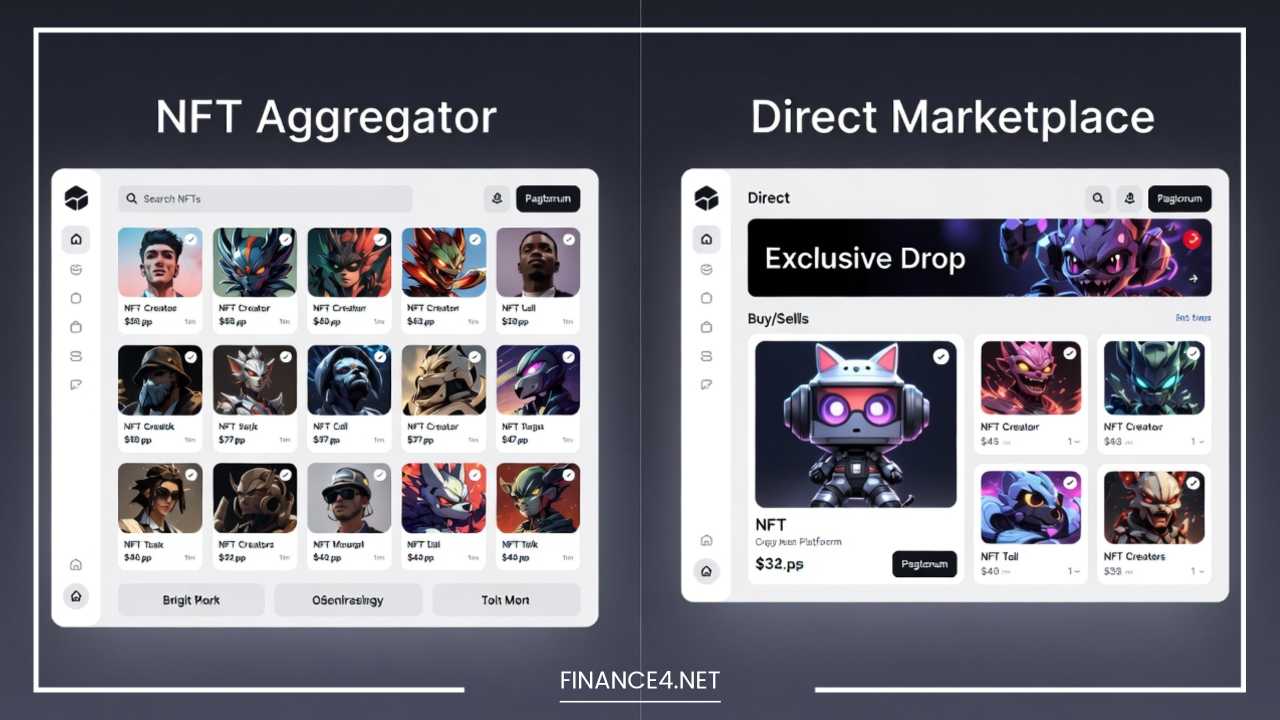
NFT Aggregator vs. Traditional Marketplaces
Why would anyone still use a traditional marketplace directly? It usually comes down to the user’s specific goals.
-
Speed & Efficiency: Aggregators win every time. They provide a broader view and faster execution.
-
Community & Curation: Traditional marketplaces (especially curated ones like SuperRare or Foundation) are better for discovering “fine art” or interacting with specific artist communities.
-
Exclusive Perks: Some marketplaces offer “loyalty points” or exclusive access to new drops that are only available if you buy directly from their site.
-
Trust & Support: Buying directly from a marketplace like OpenSea often provides a more robust customer support channel if a specific listing has an issue.
How to Choose the Right NFT Aggregator for Your Needs
To make the right choice, you must first identify your trader persona.
The Beginner Collector
You are buying your first few NFTs and care more about security and ease of use than saving a few dollars on gas.
-
Primary Need: Safety warnings and a clean UI.
-
Best Choice: OpenSea Pro or Magic Eden.
The Professional Day Trader
You care about milliseconds. You want to see a listing the moment it happens and buy it before the rest of the market reacts.
-
Primary Need: Speed, low fees, and advanced charting.
-
Best Choice: Blur or Tensor (for Solana).
The Multi-Chain Explorer
You trade Bitcoin Ordinals on Monday, Solana NFTs on Tuesday, and Base NFTs on Wednesday.
-
Primary Need: A single wallet connection for all chains.
-
Best Choice: Magic Eden or OKX NFT Marketplace.
The “Ape” (The Whale)
You are looking to buy 50+ NFTs from a collection at once to “sweep the floor.”
-
Primary Need: Gas-optimized batching and atomic transactions.
-
Best Choice: Uniswap NFT or Blur.
Risks and Limitations of NFT Aggregators
While they are powerful, aggregators are not without risks.
-
The “Ghost Listing” Problem: Sometimes an aggregator shows an NFT as available, but it was sold 30 seconds ago on the source marketplace. If you try to buy it, your transaction will fail, and you will still lose the “gas fee” spent on the attempt.
-
Smart Contract Risk: When you buy through an aggregator, you are adding an extra layer of smart contracts between your wallet and the marketplace. If the aggregator’s contract has a bug, your funds could be at risk.
-
Slippage and Front-Running: In high-volume situations, bots can see your pending transaction and pay a higher fee to buy the NFT out from under you.
-
Royalty Inconsistencies: Because aggregators pull from different sources, royalty enforcement can vary. A listing from a “royalty-optional” marketplace will show up next to a “royalty-enforced” listing, which can be confusing.
Future of NFT Marketplace Aggregation: 2027 and Beyond
Looking ahead, we expect to see several major shifts in how aggregation works:
1. AI-Powered Discovery
We are seeing the first “AI NFT Agents.” Future aggregators will likely feature AI assistants that can analyze your past purchases and social media sentiment to suggest “the next big thing” before it hits the trending charts.
2. Real-World Asset (RWA) Integration
Aggregators will move beyond JPEGs. In 2027, you will likely use an aggregator to compare the prices of tokenized houses, car titles, and luxury watches, all represented as NFTs.
3. Total Chain Abstraction
The next generation of aggregators will hide the “blockchain” part entirely. You will simply see an NFT you like, pay with your local currency or any token, and the aggregator will handle the bridging and swapping behind the scenes.
FAQs About NFT Aggregators
What is the “Floor Price”?
The floor price is the lowest price at which an NFT in a specific collection can be purchased. Aggregators are the best tool for finding the “true floor” across all marketplaces.
Do I need a separate wallet for each aggregator?
No. Most aggregators support “Universal Wallets,” allowing you to use one MetaMask, Phantom, or Ledger across all of them.
Is there a cost to using an aggregator?
Usually, no. Most aggregators make money via affiliate commissions from the marketplaces. However, always check the “Service Fee” section in the checkout pop-up.
Can I buy NFTs in bulk?
Yes, “sweeping” is a primary feature of aggregators like Blur and OpenSea Pro.
Are royalties enforced?
It depends on the platform, but most aggregators now allow you to “opt-in” to creator royalties during checkout.
Final Thoughts: Choosing the Best NFT Aggregator
The “best” aggregator is ultimately the one that aligns with your specific goals. If you are a professional seeking maximum efficiency and rewards, Blur remains unbeatable. If you are a collector who values variety and a beautiful user interface across multiple chains, Magic Eden and OpenSea Pro are the top contenders.
As the NFT market continues to mature in 2026, these tools are no longer “optional” for serious participants. They are the essential infrastructure that turns a fragmented, confusing market into a streamlined, professional trading environment.