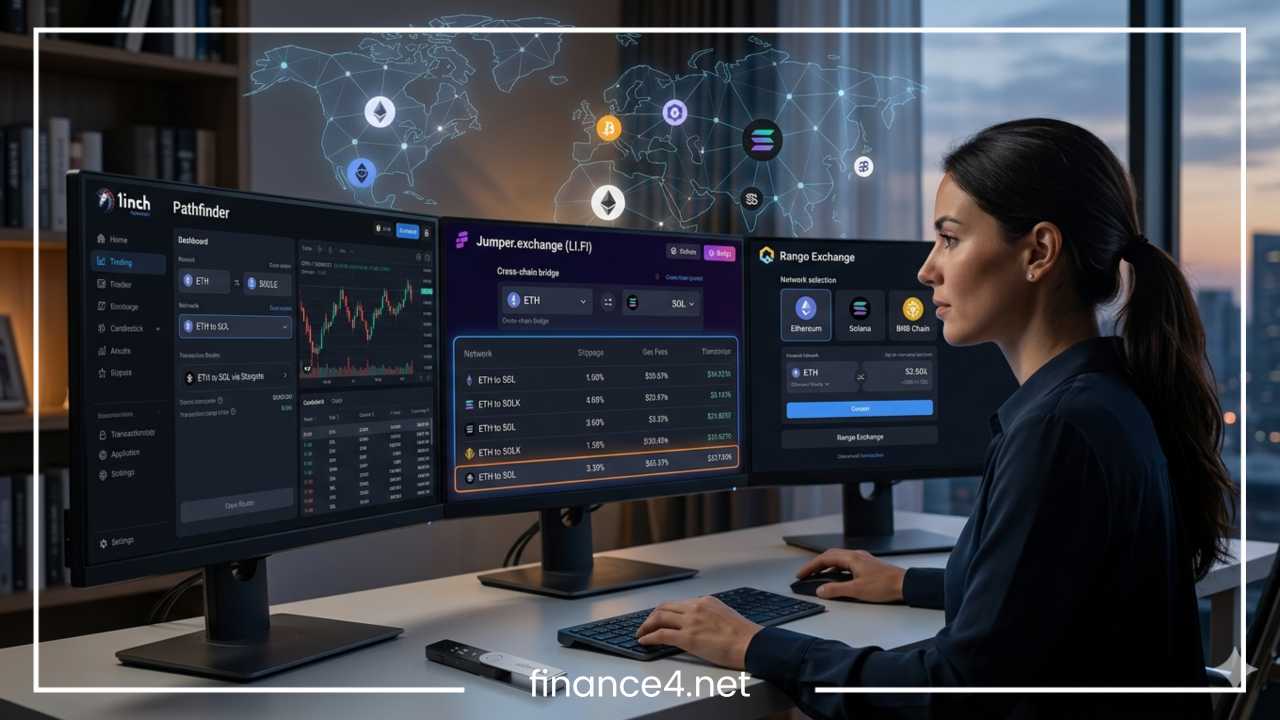
Best Bridging Aggregator Tokens
 by
by 
Best Bridging Aggregator Tokens | Top Cross-Chain Bridge Tokens
The modern blockchain landscape has evolved far beyond a single dominant network. Today, the decentralized ecosystem is a sprawling, multichain universe comprising high-performance layer-one networks, modular execution layers, and numerous layer-two scaling solutions. While this expansion has unlocked incredible innovation, speed, and specialization, it has also introduced deep fragmentation. Liquidity, users, and applications are now scattered across isolated environments, making seamless movement a critical prerequisite for the next wave of web3 adoption.
Moving assets and messages across these disparate environments has traditionally been a clunky, expensive, and risky endeavor. Early blockchain users had to rely on individual, single-route bridges to move funds from one network to another. However, using these individual bridges comes with significant drawbacks. Users are forced to manually research which bridge supports their specific asset pair, compare disparate fee structures, endure lengthy wait times, and accept the single point of failure inherent in that specific protocol. If a chosen bridge suffers an exploit or lacks sufficient liquidity depth, the user is left stranded or exposed to severe financial loss.
This is where bridge aggregators enter the equation. By functioning as meta-layers that sit on top of underlying liquidity pools and messaging protocols, bridge aggregators solve liquidity fragmentation. They act as intelligent routing engines, scanning dozens of individual bridges, liquidity pools, and messaging layers in real time to find the optimal path for any given transfer.
Throughout this comprehensive guide, readers will learn how bridging aggregators operate, why their native tokens capture economic value within the ecosystem, how to evaluate top-tier projects, and what risks and future trends will shape this vital sector of decentralized finance.
What Are Bridging Aggregators?
Bridging aggregators are advanced infrastructure protocols designed to unify the fragmented multichain landscape. At their core, they function similarly to decentralized exchange aggregators like 1inch, but instead of routing token swaps across decentralized exchanges on a single chain, bridging aggregators route value and arbitrary data transfers across completely different blockchain networks.
Traditional blockchain bridges typically operate on a locked-and-mint or burn-and-release mechanism tied to a specific pair of networks. Bridging aggregators, by contrast, interface with multiple underlying bridges, liquidity networks, and native asset pools simultaneously. Prominent examples in the current ecosystem include routing layers and developer toolkits such as LI.FI, Socket, Relay, and Rango.
The primary function of a bridging aggregator relies on route optimization. When a user or application initiates a cross-chain transfer, the aggregator algorithmically evaluates all available routes based on cost, speed, security audits, and historical reliability. It splits large transactions across multiple paths if necessary to minimize slippage, secures the best possible exchange rates, and ensures that execution is handled efficiently.
Furthermore, these protocols provide robust liquidity aggregation. Instead of relying on a single stagnant pool of capital, they pool liquidity from diverse sources, ensuring that large transfers can occur without catastrophic price impact. Gas optimization is another major benefit, as advanced aggregators allow users to pay gas fees on the destination chain using native tokens from the source chain, abstracting away the tedious need to acquire native gas tokens for every single network a user interacts with. Security considerations remain paramount, as aggregators inherently inherit the risk profiles of the underlying bridges they connect to, making comprehensive risk-scoring algorithms a vital part of their architecture.
What Are Bridging Aggregators Tokens?
Not every bridge aggregator has a native token, as some operate purely as fee-collecting software-as-a-service models or developer infrastructure. However, protocols that decentralize their operations or seek to align community incentives often launch native digital assets. These tokens serve several critical functions within the ecosystem:
-
Governance: Token holders vote on protocol upgrades, fee structures, supported chains, and treasury allocations, ensuring the protocol remains community-governed and decentralized.
-
Protocol Incentives: Tokens are often distributed as rewards to liquidity providers, active developers, and early users who drive volume and adoption to the network.
-
Fee Discounts: Holding or staking the native token often grants users reduced bridging and routing fees, creating a direct economic incentive for frequent traders and applications.
-
Staking: Users can stake tokens to secure the protocol, participate in slashing mechanisms, or earn a share of the protocol revenue generated through routing fees.
-
Treasury Management: Protocol treasuries denominated in native tokens fund grants, hackathons, strategic partnerships, and marketing campaigns to accelerate ecosystem growth.
How We Selected the Best Bridging Aggregator Tokens
Evaluating and ranking top cross-chain bridge tokens requires a rigorous analytical framework that looks beyond marketing hype. The selection criteria used to evaluate these assets focus on fundamental strength and real-world utility:
-
Market Adoption: The frequency of daily active users and the total number of transactions processed through the routing layer.
-
Total Value Locked: The amount of capital secured or actively facilitated by the protocol infrastructure.
-
Trading Volume: Cumulative cross-chain volume handled over various timeframes, demonstrating genuine economic demand.
-
Number of Supported Chains: The breadth of Layer 1, Layer 2, and app-chain networks integrated into the protocol.
-
Security History: The presence of robust audits, bug bounties, and historical resilience against exploits.
-
Developer Ecosystem: The ease with which third-party applications can integrate the protocol via software development kits and APIs.
-
Token Utility: Clear, functional use cases for the native token beyond speculative trading.
-
Governance Activity: The frequency and decentralization of community proposals and voting participation.
-
Partnerships: Collaborations with major wallets, decentralized applications, and scaling solutions.
-
Long-term Roadmap: Strategic vision for adapting to modular blockchains, chain abstraction, and intent-centric architectures.
Best Bridging Aggregator Tokens
deBridge
-
Overview: deBridge is a high-performance cross-chain interoperability and messaging infrastructure layer that enables real-time value transfer and arbitrary data calls across diverse blockchains.
-
Supported Chains: Ethereum, Arbitrum, Optimism, Polygon, Base, Solana, BNB Chain, and various other EVM-compatible networks.
-
Key Features: High-speed cross-chain execution, deep liquidity routing, and resistance to sandwich attacks via validator consensus.
-
Token Utility: DBR serves as the governance token for the deBridge DAO, directing protocol parameters, fee distribution, and ecosystem grants.
-
Strengths: Exceptional speed, robust security design, and strong developer adoption.
-
Limitations: Intense competition in the generalized messaging sector.
-
Best for: Developers and traders seeking lightning-fast execution speeds across major execution layers.
Router Protocol
-
Overview: Router Protocol is a cross-chain liquidity aggregator and interoperability framework designed to connect isolated blockchain networks seamlessly.
-
Supported Chains: Ethereum, Polygon, Avalanche, Fantom, Arbitrum, Optimism, and multiple non-EVM chains.
-
Key Features: Cross-chain messaging infrastructure, unified liquidity aggregation, and modular dApp integration tools.
-
Token Utility: ROUTE is used for network security via staking, governance voting, and paying transaction fees across the network.
-
Strengths: Comprehensive cross-chain framework with strong developer tooling.
-
Limitations: Complex architecture that requires continuous monitoring and updates.
-
Best for: Decentralized application builders looking for robust cross-chain messaging solutions.
Across Protocol
-
Overview: Across Protocol is a fast, capital-efficient bridging protocol built on an intent-based bridging architecture. It relies on decentralized relayers to fulfill user intents instantly.
-
Supported Chains: Ethereum, Arbitrum, Optimism, Base, Polygon, and zkSync.
-
Key Features: Instant settlement, pooled liquidity model, and lower capital requirements compared to traditional lock-and-mint bridges.
-
Token Utility: ACX empowers holders to govern the protocol, manage the treasury, and vote on system upgrades.
-
Strengths: Highly capital efficient with minimal slippage and rapid payout times.
-
Limitations: Relies heavily on the active participation of third-party relayers.
-
Best for: Users prioritizing instant transaction finality and low-cost Layer 2 transfers.
Synapse
-
Overview: Synapse is a secure cross-chain communication protocol and liquidity network that facilitates seamless asset transfers and data sharing.
-
Supported Chains: Ethereum, Arbitrum, Optimism, Avalanche, Polygon, and various scaling solutions.
-
Key Features: Cross-chain liquidity pools, generalized messaging, and modular bridge infrastructure.
-
Token Utility: SYN is utilized for protocol governance, liquidity provisioning incentives, and network security.
-
Strengths: Long-standing track record and widespread integration across decentralized finance protocols.
-
Limitations: Faces stiff competition from newer intent-based architectures.
-
Best for: Decentralized finance participants looking for established liquidity networks.
THORChain
-
Overview: THORChain is a decentralized cross-chain liquidity protocol that enables native asset swaps between different blockchains without wrapping tokens.
-
Supported Chains: Bitcoin, Ethereum, Litecoin, Bitcoin Cash, Avalanche, Binance Smart Chain, and Cosmos.
-
Key Features: Continuous liquidity pools, native asset swapping, and algorithmic node security.
-
Token Utility: RUNE acts as the settlement asset for all liquidity pools, provides network security through node bond staking, and drives governance.
-
Strengths: True native asset bridging without relying on wrapped tokens or synthetic assets.
-
Limitations: Complex economic model and reliance on specialized validator hardware.
-
Best for: Users who want to swap native assets like Bitcoin directly for Ethereum-based tokens in a decentralized manner.
Axelar
-
Overview: Axelar delivers secure cross-chain communication for Web3, providing a decentralized validator network that connects disparate blockchain ecosystems.
-
Supported Chains: Cosmos ecosystem chains, Ethereum, Avalanche, Polkadot, Filecoin, and numerous Layer 2 networks.
-
Key Features: Proof-of-Stake validator security, programmable cross-chain gateway, and institutional-grade infrastructure.
-
Token Utility: AXL is used to pay network fees, incentivize validators, and participate in decentralized governance.
-
Strengths: Exceptional security guarantees backed by a decentralized validator set.
-
Limitations: Higher transactional overhead due to heavy consensus requirements.
-
Best for: Institutional projects and developers requiring enterprise-grade security for cross-chain data calls.
Wormhole
-
Overview: Wormhole is a generic message-passing protocol that connects high-value blockchain networks and enables interoperability across diverse ecosystems.
-
Supported Chains: Solana, Ethereum, Aptos, Sui, Near, Polygon, Arbitrum, Optimism, and many others.
-
Key Features: Guardian network verification, token bridging, and robust developer toolkits.
-
Token Utility: W is utilized for governance across the Wormhole multichain ecosystem.
-
Strengths: Massive ecosystem reach, supporting non-EVM chains like Solana, Aptos, and Sui seamlessly.
-
Limitations: Historical security incidents that necessitated rigorous protocol upgrades.
-
Best for: Users and developers operating across both EVM and non-EVM execution environments.
LayerZero
-
Overview: LayerZero is an omnichain interoperability protocol that enables lightweight message passing across disparate blockchains through immutable smart contracts.
-
Supported Chains: Dozens of EVM and non-EVM networks, including almost all major Layer 1s and Layer 2s.
-
Key Features: Decentralized verifier networks, ultra-light nodes, and Omnichain Fungible Tokens.
-
Token Utility: ZRO governs the protocol and aligns incentives across participating decentralized applications.
-
Strengths: Highly scalable architecture that avoids heavy intermediary token pools.
-
Limitations: Complex trust assumptions depending on the chosen Decentralized Verifier Network configuration.
-
Best for: Omnichain applications seeking to deploy unified assets across multiple chains simultaneously.
Comparison Table
| Token | Primary Use | Chains Supported | Governance | Staking | Main Strength |
| deBridge (DBR) | Cross-chain value and messaging | Major EVM and Solana | Yes | Yes | High speed and sandwich resistance |
| Router Protocol (ROUTE) | Liquidity and app infrastructure | Diverse EVM and non-EVM | Yes | Yes | Modular developer toolkits |
| Across Protocol (ACX) | Intent-based fast bridging | Major Layer 2s and Ethereum | Yes | Yes | Extreme capital efficiency |
| Synapse (SYN) | Cross-chain liquidity network | Broad multichain footprint | Yes | Yes | Long-standing market presence |
| THORChain (RUNE) | Native asset liquidity swaps | Bitcoin, Ethereum, Cosmos, etc. | Yes | Yes | True native asset exchanges |
| Axelar (AXL) | Secure cross-chain communication | Cosmos, EVM, and others | Yes | Yes | Decentralized validator security |
| Wormhole (W) | Generic message passing | Multi-ecosystem EVM and non-EVM | Yes | Yes | Extensive non-EVM support |
| LayerZero (ZRO) | Omnichain interoperability | Universal chain support | Yes | Yes | Lightweight message verification |
Benefits of Investing in Bridging Aggregator Tokens
The rapid expansion of decentralized finance has turned cross-chain infrastructure into one of the most critical sectors in modern cryptocurrency markets. Investing in, holding, or actively participating in the governance of bridging aggregator tokens offers several compelling advantages for long-term participants who understand multichain dynamics:
-
Exponential Growth of Multichain DeFi: As decentralized applications and liquidity continue to disperse across an expanding array of layer-one networks, layer-two rollups, and app-chains, the absolute volume of assets moving between these environments grows exponentially. This secular growth trend drives continuous fundamental demand for routing and aggregation services, directly benefiting protocols that capture transaction flow.
-
Increasing Interoperability Standards: Modern blockchain design has shifted heavily toward modularity. Networks rely entirely on secure, efficient communication layers to function as a cohesive ecosystem rather than isolated silos. Aggregator tokens sit at the nexus of this communication layer, making them indispensable proxies for the health of the entire modular movement.
-
Powerful Network Effects: Leading bridging aggregators attract the highest concentration of liquidity providers, developers, and routing paths. This creates a self-reinforcing network effect: better routes attract more users, which in turn attracts deeper liquidity and more integrated protocols, building a wide economic moat that deters competing entrants.
-
Governance Opportunities and Strategic Influence: Holding native governance tokens allows participants to directly shape the evolution of critical web3 infrastructure. Token holders help steer protocol upgrades, fee adjustments, security parameters, and new chain integrations, granting them a direct voice in the strategic positioning of the protocol.
-
Sustainable Protocol Revenue: Many modern aggregator designs capture fractional fees from every cross-chain swap processed through their smart contracts. These revenue streams can be channeled back to token stakers or accumulated within the protocol treasury, transforming governance tokens into productive economic assets rather than purely speculative instruments.
-
Staking Rewards and Yield Alignment: Users can stake their tokens to secure validator networks, participate in slashing mechanisms, or support liquidity pools, earning passive yields that align long-term token holder retention with the underlying health and security of the protocol.
Risks to Consider
While bridging aggregator tokens present attractive opportunities for portfolio growth and ecosystem participation, engaging with this sector involves distinct, multifaceted risks that require thorough risk management and careful due diligence:
-
Smart Contract Exploits and Code Complexity: Cross-chain protocols manage exceptionally complex codebases that must interact simultaneously with multiple independent, heterogeneous blockchains. This massive attack surface increases the vulnerability to sophisticated smart contract exploits, logic errors, and flash-loan attacks.
-
Underlying Bridge Hacks: Because bridging aggregators rely on underlying third-party bridges and liquidity pools to route transactions, they inherit the security profiles of everything they connect to. If an underlying bridge is compromised by hackers, users utilizing the aggregator can suffer significant financial losses, even if the aggregator’s own smart contracts remain secure.
-
Token Volatility and Market Cycles: Utility and governance tokens associated with infrastructure protocols are subject to severe price volatility driven by broader cryptocurrency market sentiment, liquidity crunches, and speculative trading cycles. Downward market pressures can significantly impact token valuations regardless of underlying protocol usage metrics.
-
Regulatory Uncertainty and Compliance: Cross-chain asset transfers, multichain routing, and privacy-adjacent messaging features increasingly attract intense scrutiny from global regulatory bodies. Unclear legal classifications for cross-chain infrastructure tokens could impact protocol operations, listings, and developer participation.
-
Liquidity Exhaustion and Market Stress: During periods of extreme market volatility or sudden liquidations, liquidity across specific cross-chain routes can rapidly dry up. This can lead to failed transactions, unfulfilled swaps, high slippage, or exorbitant execution costs for end users.
-
Intense Sector Competition: The bridging aggregator space is intensely competitive and rapidly changing. New routing layers, intent-based solvers, and native protocol bridges emerge frequently, making it challenging for any single aggregator to maintain long-term dominance without continuous innovation.
-
Centralization Vulnerabilities: Some protocols rely on specific relayer networks, validator sets, sequencer architectures, or administrative multisig keys during their operational lifecycles. These components can introduce centralized points of failure or censorship vectors that undermine decentralization goals.
How to Choose the Right Bridging Aggregator Token
Navigating the vast selection of cross-chain assets requires a structured, objective evaluation process. Before committing capital, providing liquidity, or participating in protocol governance, investors and users should examine several core fundamental factors:
-
Robust and Enforceable Token Utility: Ensure the token possesses clear, enforceable utility within the protocol—such as fee discounts, governance voting rights, gas subsidization, or staking rewards—rather than existing purely for speculative trading.
-
Ecosystem Adoption and Volume: Look for consistent daily active users, high cumulative trading volume, and deep integrations with prominent wallets, decentralized exchanges, and major decentralized applications.
-
Comprehensive Security Audits: Verify that the protocol has undergone multiple rigorous security audits by top-tier cybersecurity firms and maintains an active, well-funded bug bounty program to incentivize white-hat hackers.
-
Total Value Locked and Liquidity Depth: Analyze the total capital secured or actively facilitated by the protocol to gauge market trust, institutional confidence, and liquidity depth across major corridors.
-
Developer Activity and Open-Source Health: Review public code repositories to ensure active development, frequent code commits, transparent updates, and strong community developer contributions.
-
Organic Revenue Generation: Investigate whether the protocol generates sustainable organic revenue from routing fees rather than relying entirely on inflationary token emission schedules to reward participants.
-
Community Governance Decentralization: Assess the distribution of voting power and the active participation rate in governance proposals to ensure power is not overly concentrated among core team members or venture capitalists.
-
Roadmap Execution and Adaptability: Check whether the development team consistently delivers on milestones outlined in their strategic roadmap, particularly regarding chain expansion, security enhancements, and adaptation to emerging architectural trends.
Future of Bridge Aggregation
The cross-chain infrastructure sector continues to evolve at a rapid, transformative pace, driven by shifting technological paradigms in the broader Web3 ecosystem. Several major technological trends are actively shaping the future of bridge aggregation:
-
Intent-Based Bridging Architectures: The industry is steadily moving away from manual, multi-step user interactions toward intent-centric architectures. In these models, specialized solvers compete in open markets to fulfill user cross-chain requests instantly and at the absolute best possible price, shielding users from the underlying complexity of bridge execution.
-
Chain Abstraction: Advanced development focuses heavily on chain abstraction, designing user experiences where the underlying blockchain network becomes entirely invisible to the end user. Individuals can interact with decentralized applications seamlessly without needing to manually switch networks, manage multiple gas tokens, or understand where their funds are stored.
-
Cross-Chain Account Abstraction: The implementation of smart contract wallets equipped with account abstraction enables complex operations across multiple chains simultaneously, maintaining unified account states and automated spending rules across disparate execution layers.
-
AI-Powered Route Optimization: The integration of artificial intelligence and machine learning models allows routing layers to predict network congestion, gas price fluctuations, and liquidity shifts in real time. This ensures that cross-chain transfers are executed across optimal paths with maximum efficiency and minimal cost.
-
Institutional Interoperability Solutions: Financial institutions and traditional enterprises require compliance-ready, permissioned cross-chain layers. The future involves building compliant interoperability solutions that allow traditional financial assets to move securely across both private enterprise ledgers and public blockchains.
-
Modular Blockchain Ecosystems: As specialized execution layers, data availability frameworks, and modular settlement layers continue to proliferate, bridging aggregators will serve as the indispensable glue holding modular architectures together, ensuring seamless communication across a hyper-fragmented technological stack.
Final Thoughts
Bridging aggregators have graduated from experimental niche tools into core Web3 infrastructure. By solving liquidity fragmentation, optimizing execution costs, and streamlining complex cross-chain interactions, they empower the multichain economy to function as a unified financial system rather than a collection of isolated islands.
When evaluating bridging aggregator tokens, distinguishing between short-term market hype and genuine, fundamental utility is essential for long-term success. Protocols that capture sustainable revenue, maintain rigorous security standards, and adapt to modern architectural shifts like intent-based bridging, chain abstraction, and AI-powered routing are best positioned for long-term survival. As decentralized finance continues its inevitable expansion across diverse networks, cross-chain interoperability tokens will remain at the very heart of multichain innovation.
Frequently Asked Questions
What is the best bridging aggregator crypto for moving assets across layer two networks?
Choosing the best bridge aggregator crypto depends on your specific focus regarding speed, cost, and chain support. Platforms like Across Protocol excel in instant, intent-based settlement for layer-two scaling solutions such as Arbitrum and Optimism, while protocols like LI.FI and Socket provide comprehensive routing across dozens of diverse ecosystems. Users looking for the best overall experience often evaluate protocols based on execution speed, historical security audits, and whether the native token offers fee discounts for frequent cross-chain transactions.
How do cross-chain bridge tokens capture value in decentralized finance?
Cross-chain bridge tokens capture economic value through several core mechanisms, including protocol governance rights, staking rewards, and fee-sharing models. Many advanced routing protocols collect fractional fees from every multichain swap processed through their smart contracts. These revenues are frequently channeled back to token stakers or accumulated within decentralized autonomous organization treasuries, transforming utility tokens into productive assets tied directly to the organic adoption and trading volume of the bridging layer.
What are the main security risks associated with blockchain bridge projects?
Blockchain bridge projects and bridging aggregators face significant security risks primarily stemming from smart contract vulnerabilities and code complexity. Because these protocols must interact simultaneously with multiple independent, heterogeneous networks, they present a large attack surface for exploits. Additionally, aggregators often route transactions through underlying third-party liquidity pools and bridges, meaning users can be exposed to financial losses if an underlying network is compromised, regardless of the aggregator’s standalone security audits.
Why is intent-based bridging becoming popular in multichain crypto tokens?
Intent-based bridging is transforming multichain crypto tokens and user experiences by shifting away from manual, multi-step transfer processes. Instead of forcing users to navigate complex lock-and-mint mechanisms across different networks, intent-based architectures allow specialized solvers to compete in open markets to fulfill user transfer requests instantly at the best possible price. This approach enhances capital efficiency, reduces transaction failure rates, and abstracts away the technical complexities of interacting with disparate blockchain layers.