Best Cross-Chain Governance Tokens
 by
by 
The Nexus of Control: Navigating the Best Cross-Chain Governance Tokens in 2025
The decentralized future is inherently multi-chain. As blockchain technology continues to evolve, a single, monolithic chain capable of handling all transactions and applications is proving to be an increasingly improbable vision. Instead, we are witnessing the flourishing of a vibrant ecosystem comprised of specialized blockchains, each optimized for different use cases. However, this fragmentation presents a critical challenge: how do these disparate networks communicate, interact, and, crucially, govern themselves in a cohesive and secure manner? The answer lies in cross-chain governance and the indispensable role played by governance tokens.
This article will delve into the intricacies of cross-chain governance, exploring why it’s vital for the scalability and sustainability of the decentralized web. We will examine the core functions of governance tokens within these interconnected protocols, the criteria for evaluating their efficacy, and highlight some of the leading cross-chain governance tokens shaping the landscape in 2025. Finally, we will touch upon the evolving governance mechanisms, inherent security risks, and the exciting future of this critical aspect of Web3.
What Is Cross-Chain Governance?
Cross-chain functionality refers to the ability of different blockchain networks to exchange information, assets, and value. This interoperability is paramount for the growth of decentralized applications (dApps) and the broader crypto economy, enabling users to seamlessly move between ecosystems and leverage the unique strengths of various chains.
However, where there’s interaction, there must be governance. The challenge of governance in multichain environments stems from the inherent sovereignty of each blockchain. Each chain typically has its own set of validators, consensus mechanisms, and governance processes. When protocols operate across multiple chains, decisions impacting the entire ecosystem – such as protocol upgrades, treasury management, or the introduction of new features – need a unified and decentralized decision-making framework that transcends individual chain boundaries.
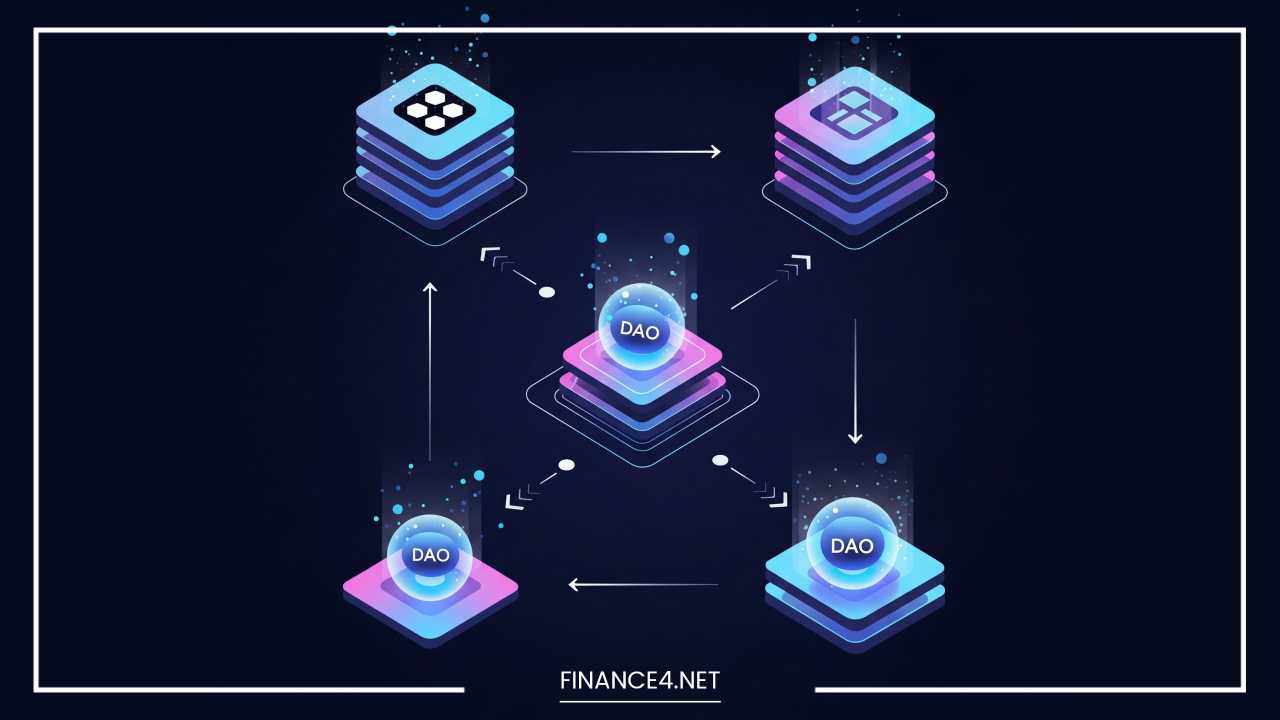
Cross-chain governance aims to solve these interoperability and coordination issues by providing a mechanism for token holders to participate in decisions that affect a protocol’s operations across all integrated chains. This ensures that the protocol remains aligned with its community’s interests, regardless of where its components reside.
Protocols that inherently require robust cross-chain governance include:
- Cosmos: An ecosystem of interconnected blockchains (the “Internet of Blockchains”) that relies on the Inter-Blockchain Communication (IBC) protocol for interoperability. Governance decisions on the Cosmos Hub, for instance, impact the security and functionality of many connected chains.
- Polkadot: A multi-chain network designed to enable various specialized blockchains (parachains) to operate together, sharing security and communicating via its Relay Chain. Governance decisions on the Relay Chain affect all parachains.
- LayerZero: An omnichain interoperability protocol that facilitates secure and efficient message passing between diverse blockchains, requiring a unified governance approach for protocol upgrades and parameters across its supported networks.
Without effective cross-chain governance, protocols operating in a multichain environment risk fragmentation, inconsistency, and a lack of accountability, ultimately hindering their ability to scale and serve their users.
Why Governance Tokens Matter in Cross-Chain Protocols
Governance tokens are digital assets that grant their holders voting rights and influence over the future development and operation of a decentralized protocol. In the context of cross-chain protocols, their role becomes even more critical due to the increased complexity and potential attack surface across multiple chains.
The primary roles of governance tokens include:
- Voting Power: Holders can vote on proposals related to protocol upgrades, changes in parameters, and the allocation of treasury funds. This direct participation empowers the community to shape the protocol’s evolution.
- Funding Decisions: Governance tokens often control a protocol’s treasury, allowing holders to decide how funds are utilized for development, grants, marketing, and ecosystem growth.
- Upgrades and Policy Decisions: Any significant change to the protocol’s smart contracts, economic model, or operational policies typically requires approval from governance token holders.
- Community Incentivization: Holding and staking governance tokens often comes with rewards, aligning the incentives of token holders with the long-term success and security of the protocol.
The difference between single-chain and cross-chain governance tokens lies in the scope and complexity of their influence. A single-chain governance token typically governs a protocol operating solely on one blockchain. Its decisions are confined to that specific environment. Cross-chain governance tokens, however, exert influence across multiple independent blockchains. This necessitates more sophisticated mechanisms to ensure that votes cast on one chain can securely and reliably impact actions on another.
The real-world influence of governance token holders in cross-chain protocols can be profound. They collectively act as the ultimate authority, determining everything from the fees charged by a cross-chain bridge to the inclusion of new chains within an interoperability network. This decentralized control is a core tenet of Web3, moving power away from centralized entities and into the hands of the community.
However, this power also carries significant security implications. If a substantial portion of governance tokens falls into malicious hands, it could lead to governance capture, where an attacker dictates unfavorable changes or drains the protocol’s treasury across all interconnected chains. This underscores the importance of robust governance token distribution, active participation, and well-designed security measures.
Criteria for Evaluating Cross-Chain Governance Tokens
When assessing the strength and potential of a cross-chain governance token, several key criteria come into play:
- Utility: Beyond simple voting rights, does the token offer practical utility within the ecosystem? This could include staking for network security, paying for services (like cross-chain messaging), or earning a share of protocol revenue. Strong utility drives demand and incentivizes long-term holding.
- Interoperability: How effectively does the token’s governance mechanism facilitate decisions across different blockchains? Does it leverage established interoperability protocols, and what is its roadmap for expanding its cross-chain reach?
- Decentralization: Is the governance truly decentralized, or is voting power concentrated in a few hands? Look for a wide distribution of tokens, high voter participation rates, and diverse delegate ecosystems. A highly decentralized governance model is more resilient to attacks and censorship.
- Tokenomics: What are the supply mechanics of the token? Is there inflation, and if so, how is it managed to incentivize participation without diluting value? Are there effective staking mechanisms that lock up supply and encourage long-term commitment? Well-designed tokenomics support the sustainability and value accrual of the token.
- Developer Activity and Community Involvement: A thriving ecosystem is built on continuous development and an engaged community. Look for active GitHub repositories, regular protocol upgrades, and vibrant community forums. A dedicated developer team and a passionate user base are strong indicators of a project’s long-term viability.
Top Cross-Chain Governance Tokens in 2025
The year 2025 sees several established and emerging projects vying for prominence in the cross-chain governance space. Here are some of the leading contenders:
1. ATOM (Cosmos)
ATOM is the native token of the Cosmos Hub, the central blockchain in the Cosmos ecosystem. Cosmos champions an “Internet of Blockchains” vision, allowing independent blockchains to connect and communicate via the Inter-Blockchain Communication (IBC) protocol. ATOM holders govern the Cosmos Hub through on-chain voting, making critical decisions on upgrades, parameter changes, and the allocation of community pool funds. A key innovation for ATOM’s governance in 2025 is Interchain Security. This allows newer, smaller Cosmos chains (consumer chains) to leverage the robust validator set and security of the Cosmos Hub by paying a fee in their native tokens or a portion of their transaction fees. This mechanism significantly expands ATOM’s utility and the scope of its governance, as ATOM stakers effectively secure more chains, and governance proposals on the Cosmos Hub can directly impact the economic and operational aspects of these consumer chains.
2. DOT (Polkadot)
DOT is the native token of the Polkadot network, a sharded blockchain platform designed to enable various blockchains (parachains) to operate in parallel, connected by a central Relay Chain. Polkadot utilizes a Nominated Proof-of-Stake (NPoS) consensus mechanism, where DOT holders can nominate validators to secure the Relay Chain. DOT’s governance system is highly sophisticated, featuring a referenda system where any DOT holder can propose and vote on network upgrades, changes to the Relay Chain, or the allocation of treasury funds. Furthermore, Polkadot’s cross-parachain governance allows for coordinated decision-making that affects the entire ecosystem of connected parachains, enabling seamless upgrades and feature implementations across the network. DOT holders are instrumental in selecting council members and enacting crucial changes that shape Polkadot’s multi-chain future.
3. ARB (Arbitrum)
ARB is the governance token for Arbitrum, a leading Layer 2 (L2) scaling solution for Ethereum that utilizes optimistic rollups. While Arbitrum primarily operates as an L2 on Ethereum, its governance has significant cross-chain implications as it dictates the evolution of a major Ethereum scaling solution that hosts numerous dApps and billions in TVL. Governance via the Arbitrum DAO empowers ARB holders to vote on key proposals, including upgrades to the Arbitrum Nitro stack, changes to system parameters, and the allocation of the substantial Arbitrum treasury. These decisions directly impact the user experience, security, and economic viability of applications built on Arbitrum, effectively influencing a significant segment of the broader Ethereum ecosystem.
4. OP (Optimism)
OP is the governance token for Optimism, another prominent Layer 2 scaling solution built on optimistic rollups for Ethereum. Optimism’s governance is designed to be highly decentralized and community-driven, with a focus on funding public goods. The Optimism Collective operates under a unique bicameral governance structure, comprising the Token House (where OP holders vote on proposals) and the Citizens’ House (focused on funding public goods through Retroactive Public Goods Funding and combating sybil attacks). This innovative model ensures that both direct token-weighted voting and a reputation-based system contribute to the protocol’s direction. Decisions made by OP holders influence the development of the Optimism Superchain, a network of L2s that will share Optimism’s infrastructure and security, making OP’s governance inherently cross-chain in its aspirations.
5. TIA (Celestia)
TIA is the native token of Celestia, a groundbreaking modular blockchain that focuses on providing a scalable data availability layer. Celestia separates the consensus and execution layers, allowing developers to deploy their own blockchains (rollups) that use Celestia purely for data ordering and availability. TIA holders govern the Celestia network, making decisions on core protocol upgrades, changes to the data availability sampling mechanism, and the allocation of network resources. This makes TIA a crucial cross-chain governance token, as its holders determine the foundational layer upon which numerous future modular blockchains will be built. The ability to govern this fundamental layer gives TIA significant influence over the entire modular blockchain ecosystem.
6. LDO (Lido DAO)
LDO is the governance token of Lido DAO, the leading liquid staking protocol. Lido allows users to stake their ETH, Solana (SOL), and other assets while receiving liquid staked tokens (e.g., stETH, stSOL) that can be used in DeFi. As Lido operates across multiple blockchains, including Ethereum, Solana, and Polygon, its governance model is inherently multi-chain. LDO holders govern the Lido DAO, making community-led decisions on crucial aspects such as the addition of new supported assets for liquid staking, the parameters of existing liquid staking protocols, and the management of the DAO’s treasury. Recently, Lido DAO has been exploring and implementing “dual governance” mechanisms to further involve stakers in crucial decisions, showcasing an evolving approach to cross-chain influence.
7. AURA (Aura Finance)
AURA is the governance token for Aura Finance, a protocol built on top of Balancer that aims to maximize yield and governance power for Balancer liquidity providers and BAL stakers. Aura Finance utilizes a layered governance approach that leverages the ve-token model (specifically veBAL, Balancer’s vote-escrowed token). AURA holders can collectively direct BAL emissions and vote on pool incentives across various chains where Balancer pools exist. This allows Aura Finance to exert significant influence over Balancer’s multichain liquidity and token distribution, effectively providing a powerful cross-chain governance layer for a core DeFi primitive.
8. LZ (LayerZero)
LayerZero is a prominent omnichain interoperability protocol designed for seamless and secure message passing across various blockchains. While its native token, LZ, officially launched and became actively traded in June 2024, its role in cross-chain governance is paramount. LZ token holders will govern the LayerZero protocol, making decisions on crucial upgrades, security parameters, and the expansion of the networks it supports. Given LayerZero’s ambition to be the underlying interoperability layer for a vast array of dApps and blockchains, the governance of LZ will directly impact the security and functionality of cross-chain communication across the entire decentralized landscape. As a core infrastructure provider, LZ’s governance will shape how assets and information flow between currently isolated blockchain ecosystems.
Governance Mechanisms: Models Used by Cross-Chain Projects
The pursuit of effective and secure cross-chain governance has led to the development and adoption of various innovative mechanisms:
- Snapshot Voting: Many DAOs, including those with cross-chain ambitions, utilize Snapshot for off-chain, gas-less voting. While the votes themselves are not recorded on-chain, the results are typically used to inform and guide on-chain actions. This reduces friction for voters but requires a trusted mechanism to bridge the off-chain vote to on-chain execution, often through a multisig or another governance smart contract.
- On-Chain Voting (e.g., Polkadot Referenda): In contrast to Snapshot, on-chain voting records all votes directly on the blockchain, making it highly transparent and immutable. Polkadot’s referenda system is a prime example, where proposals are submitted and voted on directly by DOT holders, with successful proposals automatically enacted by the network. This provides the highest level of decentralization and trustlessness for governance actions.
- Multisig Governance for Bridging Protocols: Many cross-chain bridges, particularly in their early stages, rely on multisignature (multisig) wallets for critical operations like upgrading contracts or managing treasury funds. A multisig wallet requires a predefined number of signers out of a total to authorize a transaction. While more centralized than token-holder voting, it offers an immediate security layer against single points of failure. The goal for many is to gradually decentralize these multisigs and integrate them with broader token-holder governance.
- veToken Models: The vote-escrowed token (veToken) model, popularized by Curve Finance, incentivizes long-term commitment and active participation. Users lock their governance tokens for a set period to receive ve-tokens, which grant boosted voting power and often higher rewards. This model helps align the interests of governance participants with the long-term health of the protocol, making governance capture more difficult and incentivizing thoughtful decision-making, even across multiple chains as seen with Aura Finance and Balancer’s veBAL.
- Quadratic Voting and Staking for Vote Weight: Some projects are exploring alternative voting mechanisms like quadratic voting, which aims to reduce the influence of large token holders by giving diminishing returns to additional votes from the same entity. Staking tokens to gain vote weight is a common practice, but mechanisms that differentiate between active participants and passive holders are becoming more refined to encourage genuine engagement.
Security and Risks in Cross-Chain Governance
While the promise of cross-chain interoperability is immense, it also introduces novel security challenges, particularly at the governance layer:
- Bridge Hacks and Their Impact on Governance: Cross-chain bridges have historically been a significant target for exploits, with billions of dollars lost to hacks. Many of these hacks exploit vulnerabilities in the bridge’s smart contracts or the security models of their underlying multi-signature or validator sets. A successful bridge hack can not only lead to asset loss but also undermine confidence in the protocol’s governance, especially if the governance mechanism was responsible for approving or overseeing the vulnerable bridge. The trust in cross-chain governance hinges heavily on the security of the underlying interoperability infrastructure.
- Governance Capture and Sybil Attacks: These are evergreen threats to decentralized governance. Governance capture occurs when a malicious actor or a coordinated group acquires enough governance tokens to unilaterally control the protocol’s decisions, potentially leading to self-serving actions or the draining of treasuries. Sybil attacks involve an attacker creating numerous fake identities to manipulate voting outcomes. In a cross-chain context, a governance capture on one chain might have cascading effects if the governance is tightly integrated across multiple networks.
- Mitigation Strategies: To counter these risks, robust mitigation strategies are essential:
- Timelocks: Implementing timelocks on governance-approved actions (e.g., treasury transfers, smart contract upgrades) provides a delay between when a proposal is approved and when it is executed. This gives the community time to react to malicious proposals and potentially revoke them.
- Audits: Regular and rigorous security audits of smart contracts and governance mechanisms by reputable third parties are crucial to identify and fix vulnerabilities before they can be exploited.
- On-Chain Transparency: Ensuring all governance proposals, votes, and execution logs are transparently recorded on-chain allows for public scrutiny and accountability, making it harder for malicious actors to operate unnoticed.
- Active Participation and Delegation: Encouraging a wide and active set of governance participants, along with robust delegation mechanisms, helps distribute voting power and makes governance capture more difficult.
- Progressive Decentralization: Many projects adopt a phased approach to decentralization, starting with more centralized control (e.g., a multi-sig) and gradually handing over more power to token holders as the community matures and governance mechanisms are battle-tested.
The Future of Cross-Chain Governance
The landscape of cross-chain governance is rapidly evolving, driven by the increasing need for seamless interoperability and decentralized coordination. Several key trends are shaping its future:
- Role of DAOs in Multi-Chain Ecosystems: Decentralized Autonomous Organizations (DAOs) will become the primary vehicle for governing complex multi-chain protocols. We will see more sophisticated DAO tooling and frameworks that specifically cater to the challenges of cross-chain coordination, allowing for more efficient and secure decision-making across disparate networks.
- AI + Governance Tooling: The integration of Artificial Intelligence (AI) into governance tooling is an exciting frontier. AI could assist in analyzing proposal data, identifying potential risks, flagging unusual voting patterns, and even summarizing complex proposals for voters, thereby improving the efficiency and security of governance processes. However, careful consideration of AI’s biases and limitations will be crucial.
- Trends: Governance-as-a-Service, ZK-governance, DAO-to-DAO Collaboration:
- Governance-as-a-Service (GaaS): Specialized platforms and service providers will emerge to offer standardized, secure, and user-friendly governance solutions for new and existing cross-chain protocols, lowering the barrier to entry for decentralized governance.
- ZK-governance (Zero-Knowledge Governance): Leveraging zero-knowledge proofs could enable more private and efficient voting mechanisms, particularly for large DAOs, while still maintaining on-chain verifiability. This could address concerns around voter privacy and front-running of governance decisions.
- DAO-to-DAO Collaboration: As the multi-chain ecosystem matures, we will likely see more formal and informal collaborations between DAOs. This could involve joint governance initiatives, shared treasuries for public goods, or even mergers of protocols, all facilitated by robust cross-chain governance frameworks.
Final Thoughts
Cross-chain governance tokens are at the vanguard of the decentralized revolution, serving as the essential infrastructure for enabling secure, interoperable, and community-driven decision-making across the burgeoning multichain crypto ecosystem. Their importance cannot be overstated, as they empower individuals to directly influence the development and direction of the protocols they use and invest in.
From the foundational Interchain Security of Cosmos’s ATOM to Polkadot’s sophisticated referenda system, and the layered governance of L2 solutions like Arbitrum and Optimism, the innovation in this space is profound. Tokens like Celestia’s TIA are defining the governance of modular blockchain layers, while Lido’s LDO and Aura Finance’s AURA showcase the power of community-led decisions in multi-chain DeFi. The recent launch of LayerZero’s LZ token further solidifies the role of governance in fundamental interoperability layers.
However, with great power comes great responsibility. The security risks inherent in cross-chain operations, from bridge hacks to governance capture, demand continuous vigilance, robust auditing, and the implementation of advanced mitigation strategies.
The future of cross-chain governance is bright, with the promise of more sophisticated DAO tooling, the integration of AI, and the rise of collaborative governance models. As the decentralized web continues its expansion, researching and actively participating in DAO governance will not only be an act of responsible citizenship in the crypto space but also a critical step in shaping the truly decentralized and interoperable future we envision. The best cross-chain governance tokens are those that are not only technologically sound but also foster an engaged, secure, and truly decentralized community.