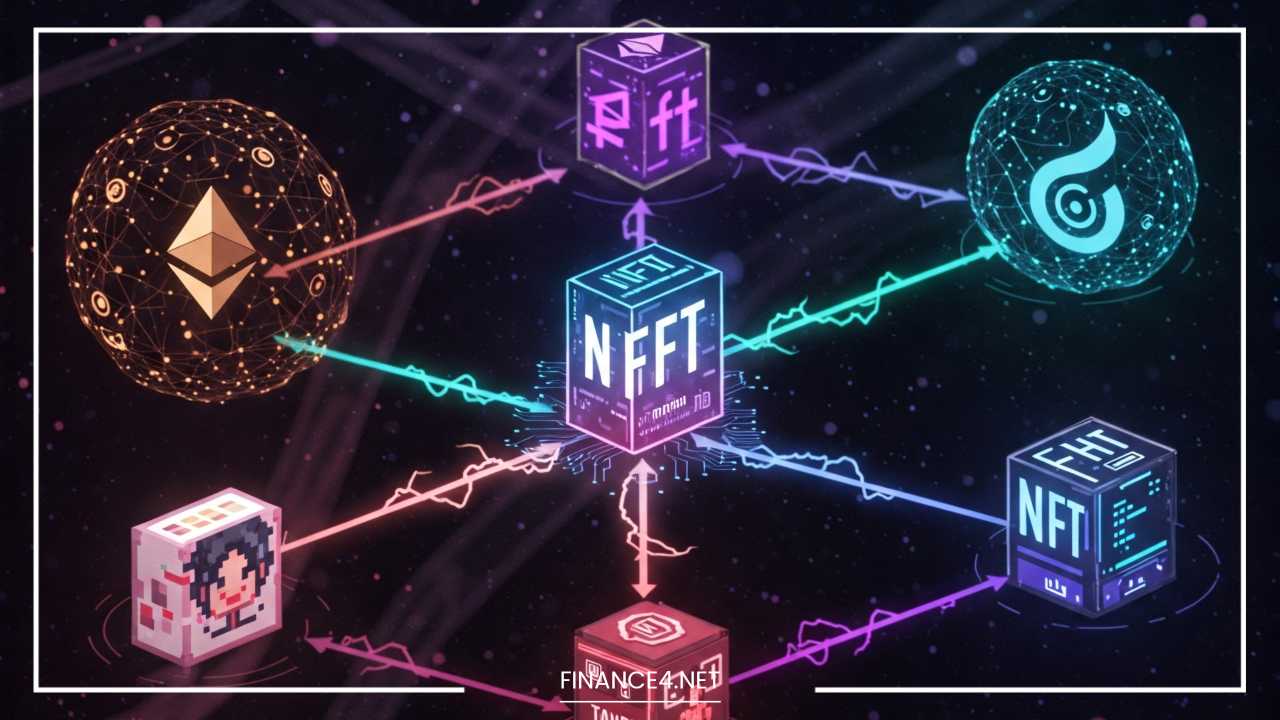
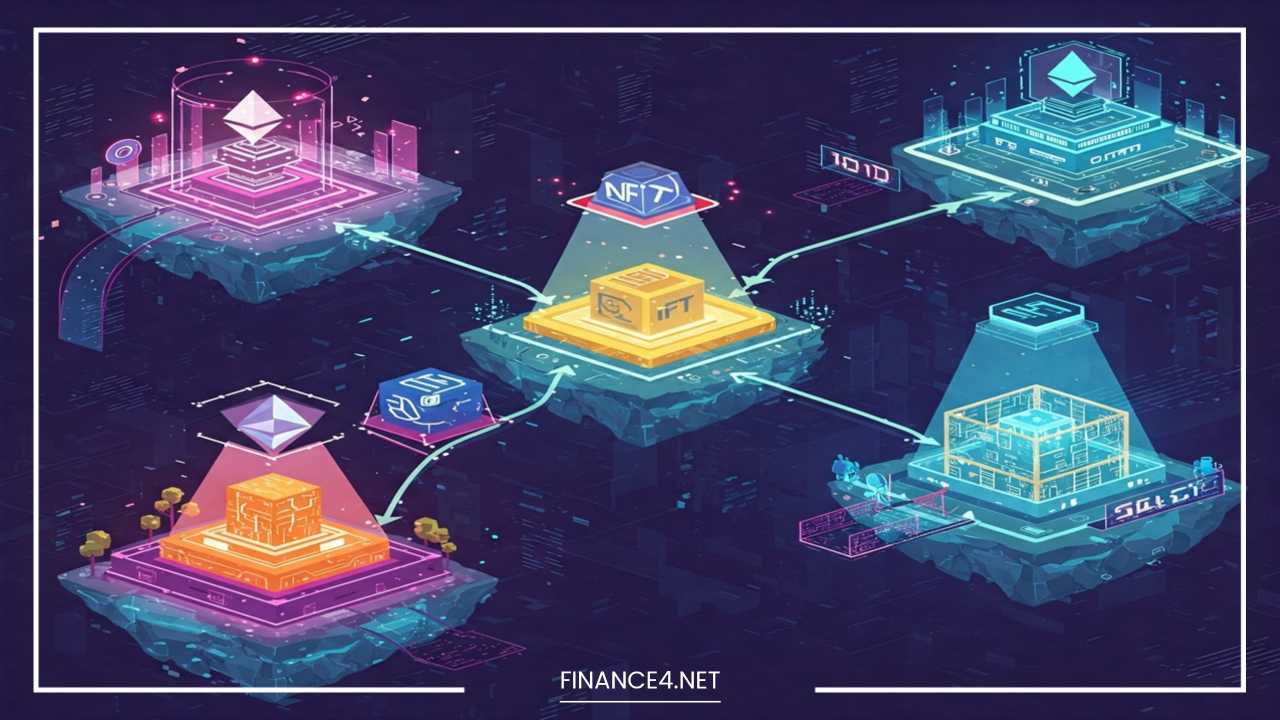
Top Cross-Chain Token Standards
 by
by 
Bridging the Blockchain Divide: Exploring the Top Cross-Chain Token Standards
The blockchain landscape, once a frontier dominated by a single pioneer, has blossomed into a vibrant, multi-chain universe. Different blockchains, each optimized for specific purposes, boast unique architectures, consensus mechanisms, and communities.
We have high-throughput chains designed for decentralized finance (DeFi), specialized networks for non-fungible tokens (NFTs), privacy-focused ledgers, and general-purpose platforms hosting a myriad of decentralized applications (dApps).
While this diversity fosters innovation and caters to varied needs, it also creates a fundamental challenge: fragmentation.
Assets, data, and users are siloed within their native chains. A token existing on one blockchain cannot natively be used or traded on another.
This lack of interoperability leads to fractured liquidity, hinders the composability of dApps across networks, and creates a cumbersome user experience, often requiring complex bridging solutions or centralized exchanges.
The vision of a truly interconnected Web3 relies heavily on overcoming these silos. Cross-chain interoperability – the ability for different blockchains to communicate and interact with each other – is not just desirable, but essential. And at the heart of much of this interaction lies the need for seamless cross-chain token transfers and representation.
Tokens, whether fungible (like cryptocurrencies or utility tokens) or non-fungible (like digital art or collectibles), represent value, ownership, or access within a blockchain ecosystem.
Enabling these tokens to move or be utilized across different chains unlocks immense potential: users can access better trading prices on different decentralized exchanges (DEXs), participate in lending protocols on a chain other than where their asset originated, or use an NFT as collateral or access on a foreign network.
However, simply “sending” a token from one chain to another is not a trivial task. Blockchains are designed with finality and security in mind, operating as independent ledgers.
Directly moving an asset without a secure, agreed-upon mechanism risks double-spending or loss of assets.
This is where cross-chain token standards, or more accurately, protocols and frameworks that enable standardized cross-chain token operations, become critical.
Just as standards like ERC-20 revolutionized token creation and interaction within ecosystems like Ethereum by providing a common interface for wallets, exchanges, and dApps, robust cross-chain standards are needed to provide reliable, secure, and predictable methods for handling tokens between chains.
These standards define how tokens are locked, burned, minted, transferred, and verified across disparate networks, laying the groundwork for a more fluid and integrated blockchain future.
This article delves into some of the leading approaches and emerging “standards” that are paving the way for seamless cross-chain token flows.
It’s important to note that unlike a single, universally adopted standard like ERC-20, the cross-chain space features competing protocols and frameworks, each with its own technical architecture, security model, and design philosophy.
However, they share the common goal of enabling value transfer and interaction across blockchain boundaries.
Understanding the Mechanics: How Cross-Chain Token Transfer Works (Generally)
Before exploring specific standards, it’s helpful to understand the fundamental mechanisms often employed to achieve cross-chain token transfers.
A native token from Chain A cannot simply appear on Chain B. Instead, cross-chain solutions typically involve:
- Locking/Burning on the Source Chain: The user locks the desired amount of the token on the originating chain (Chain A) in a smart contract or burns the tokens entirely.
- Verification: A mechanism verifies that the tokens have been successfully locked or burned on Chain A. This is the most critical and complex part, as it requires Chain B to somehow trust or verify the state of Chain A.
- Minting/Unlocking on the Destination Chain: Upon successful verification, an equivalent amount of a representation of that token is minted on the destination chain (Chain B), or previously locked tokens on Chain B are unlocked. This representation is often a “wrapped” token (e.g., wETH on a non-Ethereum chain) or a “canonical” bridge asset.
- Reverse Process: To move the token back to Chain A, the wrapped/canonical token is burned on Chain B, verification occurs, and the original tokens are unlocked from the contract on Chain A.
The “standard” part lies in how the verification and subsequent actions (minting/unlocking) are performed in a reliable and secure manner across different consensus mechanisms and architectures.
Different protocols employ varying levels of decentralization, trust assumptions, and technical complexity to achieve this.
Top Approaches and Standards in Cross-Chain Token Interoperability
While no single standard dominates the way ERC-20 does within a single chain, several prominent protocols and frameworks are defining the landscape for cross-chain token operations.
These can be broadly categorized based on their underlying mechanisms:
-
Inter-Blockchain Communication (IBC) Protocol (Cosmos Ecosystem):
- Origin: Developed as a core component of the Cosmos Network.
- Core Approach: IBC is an open, general-purpose protocol for relaying arbitrary data between independent, sovereign blockchains. It’s not specifically just for tokens, but token transfer is one of its primary and most successful applications. IBC achieves secure communication using light clients running on connected chains. A light client on Chain B tracks the header chain of Chain A, verifying proofs submitted by relayers (permissionless off-chain processes) about the state of Chain A.
- How it Facilitates Token Transfer: IBC defines the ICS-20 Fungible Token Transfer standard. When a user sends tokens via IBC, the tokens are escrowed (locked) in a module account on the source chain. A packet containing information about the transfer (sender, receiver, amount, destination chain) is sent via relayers. The light client on the destination chain verifies the proof that the tokens were escrowed on the source chain. Upon successful verification, a voucher token is minted on the destination chain, representing the escrowed tokens on the source. This voucher token is prefixed with the path it took to arrive (e.g.,
ibc/hash_of_path). To send tokens back, the voucher token is burned, a packet is sent back to the source, and the original tokens are unlocked. - Key Features and Benefits:
- Sovereignty: Chains connected via IBC remain sovereign, controlling their own state and governance.
- Security: Security relies on the security of the connected chains and the light client verification, not on a separate set of validators for the bridge itself. This avoids the “validator cartel” problem common in some other bridge designs.
- General Purpose: IBC can be used for any type of data transfer, not just tokens, enabling complex cross-chain application logic.
- Permissionless: Relayers are permissionless and can be run by anyone. Connecting a chain requires agreement between the chain’s governance and the hub/target chain.
- Limitations/Challenges:
- Requires chains to implement the IBC protocol and run light clients of connected chains, which can be computationally intensive for chains with very large state or complex consensus.
- Primarily used within the Cosmos ecosystem and compatible chains, though efforts are underway to connect non-IBC chains (like EVM chains) via intermediary protocols.
- Complexity for developers to implement the necessary modules.
- Status/Adoption: Widely adopted within the Cosmos ecosystem, connecting dozens of chains and facilitating significant value transfer. Considered a robust standard for inter-chain communication among sovereign networks.
-
Cross-Consensus Message Format (XCM) (Polkadot Ecosystem):
- Origin: Developed by the Polkadot team.
- Core Approach: XCM is a message format used within the Polkadot and Kusama ecosystems to enable communication between parachains (application-specific blockchains connected to the Polkadot Relay Chain) and the Relay Chain itself. While often referred to as a protocol, XCM is primarily a language or format for expressing intentions that one consensus system wants another to execute. Communication is secured by Polkadot’s shared security model provided by the Relay Chain validators.
- How it Facilitates Token Transfer: XCM defines operations for teleporting or transferring assets.
- Teleporting: Assets cease to exist on the source chain and are created on the destination chain. This is typically used for assets moving to or from the Relay Chain (which has ultimate authority).
- Transferring (Reserve-Based): Assets are locked on a “reserve” chain (often the chain where the asset originated or a common hub), and a representation is minted on the destination chain. When moving back, the representation is burned on the destination, and the assets are unlocked from the reserve. XCM messages containing instructions for asset transfer are passed between parachains and the Relay Chain. The security of the Relay Chain validators ensures that messages are delivered and executed correctly according to the XCM instructions.
- Key Features and Benefits:
- Shared Security: Leverages Polkadot’s robust shared security model, meaning cross-chain operations are as secure as the Relay Chain itself.
- Composability: Designed to enable complex interactions beyond simple token transfers, allowing dApps on different parachains to interact.
- Native to Polkadot: Built specifically for the parachain model, offering deep integration.
- Expressive: XCM is a powerful format capable of instructing remote chains to perform various actions.
- Limitations/Challenges:
- Primarily confined to the Polkadot and Kusama ecosystems. While bridges to external chains exist, the core XCM security model is tied to Polkadot’s shared security.
- Can be complex for developers to implement the logic for handling XCM messages within their parachain runtime.
- Requires participation in the Polkadot/Kusama ecosystem (becoming a parachain or parathread).
- Status/Adoption: The standard mechanism for communication and asset transfer between parachains and the Relay Chain within Polkadot and Kusama, actively used by numerous projects.
-
Generalized Message Passing Protocols (e.g., LayerZero, Wormhole):
- Origin: Independent projects focusing on cross-chain communication infrastructure.
- Core Approach: These protocols aim to provide a fundamental, often minimalist, layer for sending arbitrary messages between chains. They abstract away the complexities of chain-specific consensus and finality. Their security models typically involve external verifiers or oracle networks and relayers working in tandem. The oracle (e.g., a decentralized oracle network) attests to the state or event on the source chain (e.g., a token lock), while a separate relayer delivers the actual message payload to the destination chain. The destination chain endpoint verifies the message against the information provided by the oracle.
- How it Facilitates Token Transfer: These protocols provide the underlying infrastructure upon which cross-chain token bridges are built. A dApp or bridge protocol uses the message passing layer to:
- Listen for a token lock/burn event on the source chain.
- Send a message via the generalized message protocol to the destination chain containing details of the event and the intended recipient.
- The oracle verifies the source chain event.
- The relayer delivers the message.
- The destination chain’s endpoint verifies the message against the oracle’s attestation.
- Upon successful verification, the destination chain’s bridge contract mints the wrapped/canonical token for the recipient.
- Key Features and Benefits:
- Chain Agnostic: Designed to connect a wide variety of blockchains, including EVM-compatible and non-EVM chains.
- Flexibility: Can be used for any type of cross-chain message, enabling complex dApp interactions, not just token transfers.
- Abstraction: Aims to simplify the development of cross-chain applications by providing a common interface.
- Efficiency: Can be faster and potentially cheaper than light-client based solutions for some interactions.
- Limitations/Challenges:
- Security Model: Relies on the security and decentralization of the external oracle and relayer networks. Potential for collusion if these entities are compromised or centralized, although designs often incorporate checks and balances (e.g., separate entities for oracle and relayer functions).
- Trust Assumptions: Users are trusting the external verification mechanism provided by the protocol.
- Not a Token Standard Itself: These are infrastructure layers. The token standard is defined by the specific bridge implementation built on top of the message passing protocol (e.g., how the wrapped token behaves, what metadata it carries).
- Status/Adoption: Widely used by numerous prominent token bridges and dApps to enable cross-chain asset transfers and communication across a broad range of networks.
-
Chainlink Cross-Chain Interoperability Protocol (CCIP):
- Origin: Developed by Chainlink Labs.
- Core Approach: CCIP is a relatively newer, but significant, standard specifically designed for secure cross-chain messaging and token transfers. It leverages Chainlink’s established decentralized oracle network infrastructure. CCIP uses a network of Risk Management Networks (RMNs) and Oracle Networks to provide layered security. Oracle Networks deliver the message payload and attest to the source chain event, while independent RMNs monitor for suspicious activity and can halt transfers if necessary, acting as a crucial safety net.
- How it Facilitates Token Transfer: CCIP defines interfaces for requesting and executing token transfers between connected chains.
- User initiates a transfer on the source chain by interacting with the CCIP router contract, specifying the token, amount, and destination address/chain.
- The source chain router logs the transfer request.
- A dedicated Committing Oracle Network reads the event from the source chain and commits a signed report.
- A Executing Oracle Network receives the report and submits it to the destination chain’s router.
- Meanwhile, the Risk Management Network independently monitors the source chain and the Oracle Networks for anomalies.
- On the destination chain, the router verifies the report against the RMN’s independent verification.
- If all checks pass, the destination chain’s router instructs the token pool or minting contract to transfer/mint the equivalent tokens to the recipient.
- Key Features and Benefits:
- Layered Security: The combination of independent Oracle Networks and Risk Management Networks provides a robust, defense-in-depth security model designed to prevent single points of failure.
- Reliability: Leverages established oracle infrastructure.
- Programmable Token Transfers: CCIP allows for token transfers to be combined with arbitrary data payloads, enabling more complex cross-chain smart contract interactions alongside value movement.
- Abstraction: Provides a high-level interface for developers.
- Limitations/Challenges:
- Relatively newer compared to protocols like IBC or some generalized message passing layers.
- Requires chains/protocols to integrate with the CCIP standard.
- Relies on the security and decentralization of the Oracle and Risk Management Networks.
- Status/Adoption: Gaining significant traction, integrated by major DeFi protocols and service providers seeking a high-assurance standard for cross-chain token transfers and data messaging. Positioned as a potential industry standard due to its security focus.
Other Approaches and Considerations:
Beyond these prominent examples, the cross-chain landscape features other approaches, some more application-specific or utilizing variations of the mechanisms described:
- Sidechains and Peg Zones: Dedicated chains designed to be interoperable with a main chain, often using a two-way peg mechanism (locking on main chain, minting on sidechain). An example includes bridges connecting Layer 2 solutions to their underlying Layer 1. While enabling token movement, this is often a relationship between two specific chains rather than a generalized standard for many-to-many communication.
- Atomic Swaps: Allow users to trade tokens between different blockchains without a trusted third party by using hashed timelock contracts (HTLCs). While a form of direct cross-chain value exchange, it’s transaction-specific and not a mechanism for representing or moving arbitrary tokens across chains for dApp interaction or pooling liquidity.
- Notary Schemes / External Validators: Some older or simpler bridges rely on a set of external validators who attest to events on both chains. This introduces trust assumptions about the validator set and can be a potential point of centralization or attack if the majority of validators are compromised.
Challenges and Considerations for Cross-Chain Token Standards
Despite the progress, developing and implementing effective cross-chain token standards face significant hurdles:
- Security: This is paramount. Cross-chain bridges and protocols have been prime targets for exploits, resulting in hundreds of millions of dollars in losses. The diverse security models (light clients, external validators, oracle networks, shared security) each have different trust assumptions and potential vulnerabilities. A truly secure standard must minimize trust and be highly resilient to attacks.
- Decentralization: Achieving decentralization across different chains is challenging. Centralized components in bridging solutions (like centralized relayers or oracle operators) introduce single points of failure and censorship risk. Standards must promote decentralized operation of the underlying infrastructure.
- Efficiency and Cost: Cross-chain transactions can be slower and more expensive than intra-chain operations due to the need for consensus verification and message passing across networks with different block times and fee structures. Standards need to optimize for efficiency without sacrificing security.
- Developer and User Experience: Building and using cross-chain applications remains complex. Developers need clear interfaces and tools, while users need simple, intuitive ways to move and manage assets across chains. Standards should aim to abstract away underlying complexity.
- State Synchronization: Ensuring that the state seen on one chain accurately reflects the state on another chain in a timely manner is crucial for security and functionality, especially for complex cross-chain dApps.
- Standardization Adoption: The existence of multiple competing approaches makes it difficult for a single standard to emerge and gain universal adoption, potentially leading to further fragmentation.
The Future of Cross-Chain Tokens and Standards
The field of cross-chain interoperability and token standards is rapidly evolving. We are likely to see:
- Increased Focus on Security: Lessons learned from past exploits will drive the development of more robust and layered security models, potentially combining multiple verification mechanisms.
- Greater Abstraction: Protocols will increasingly aim to provide higher levels of abstraction, making it easier for developers to build cross-chain applications without needing deep knowledge of each connected chain’s intricacies. This could lead to more sophisticated cross-chain dApps that aren’t just about moving tokens but about interacting with smart contracts on other networks.
- Improved User Experience: Wallets and dApps will integrate cross-chain capabilities more seamlessly, making the process of moving and using tokens across chains as simple as interacting with tokens on a single chain today.
- Emergence of “Canonical” Standards: While a single universal standard might be difficult, certain protocols or frameworks might become de facto standards for specific types of cross-chain interactions or within certain ecosystems, similar to how ERC-20 dominates fungible tokens on EVM chains.
- Broader Connectivity: Efforts will continue to connect a wider range of blockchain architectures, including non-EVM chains, Layer 2 scaling solutions, and potentially even traditional financial systems.
Final Thoughts
The limitations imposed by blockchain silos highlight the critical need for effective cross-chain interoperability.
Tokens, as fundamental units of value and interaction within blockchain ecosystems, are at the forefront of this challenge.
While a single, universally adopted cross-chain token standard akin to ERC-20 is yet to emerge, the protocols and frameworks discussed – including IBC, XCM, generalized message passing solutions, and security-focused standards like Chainlink CCIP – represent significant strides towards enabling seamless token flows between disparate networks.
Each approach offers a unique blend of technical architecture, security assumptions, and design trade-offs. IBC provides a sovereign-centric, light-client-based solution within the Cosmos ecosystem.
XCM leverages Polkadot’s shared security for communication between parachains. Generalized message passing protocols offer flexible, chain-agnostic infrastructure often relying on external verification.
Chainlink CCIP provides a robust, layered security model specifically for reliable cross-chain messaging and token transfers.
The journey towards a truly interconnected blockchain future is still ongoing. Overcoming the challenges of security, decentralization, efficiency, and complexity requires continued innovation and collaboration across the industry.
However, the development and adoption of these leading cross-chain protocols and standards are laying the essential groundwork, promising a future where assets and applications can flow freely across the blockchain landscape, unlocking unprecedented possibilities for decentralized finance, gaming, NFTs, and beyond.
The era of the single-chain maximum is fading, and the era of interconnected, cross-chain ecosystems is rapidly approaching, driven by the evolution of secure and reliable token standards.