Best Aggregator for Bridging NEAR-Based NFTs
 by
by 
The Frontier of Digital Assets: Best Aggregator for Bridging NEAR-Based NFTs
The blockchain world is rapidly moving from siloed ecosystems toward a unified, multi-chain reality. At the forefront of this shift is the need for seamless asset mobility, particularly for Non-Fungible Tokens (NFTs). While established chains often dominate the discussion, the NEAR Protocol, with its superior scalability and low transaction costs, has cultivated a vibrant, yet often isolated, NFT ecosystem built on the NEP-171 standard.
Motivation: Why Bridging NEAR-Based NFTs Matters Now
The value of a digital asset is directly proportional to its liquidity and utility. For a NEAR-based NFT—whether it’s digital art, a gaming asset, or a piece of metaverse land—its true potential is unlocked only when it can freely move to high-liquidity marketplaces (like Ethereum/OpenSea), integrate into cross-chain DeFi applications, or be used in multi-chain gaming environments. Bridging is the key to achieving this global interoperability and maximizing value for both creators and holders.
What the Article Will Cover
This comprehensive article will define the concept of a “bridge aggregator” in the context of NFTs, establish the critical criteria for selecting the “best” solution, compare the leading platforms and native NEAR bridges, discuss the inherent risks of NFT bridging, and provide a step-by-step guide for safe and secure cross-chain transfers. We will place particular focus on how the evolving NEAR infrastructure, like the OmniBridge and Chain Signatures, is reshaping the landscape in 2025.
Brief Mention of Challenges in NFT Interoperability
Unlike fungible tokens (where 1 ETH is the same everywhere), bridging an NFT is complex. It requires meticulous preservation of unique metadata, ownership structure, and sometimes royalty mechanisms, which vary wildly between different blockchain standards (e.g., NEAR’s NEP-171 vs. Ethereum’s ERC-721). This complexity is precisely why specialized aggregators and robust infrastructure are becoming essential.
Quick Background: What Are NEAR NFTs & Why Bridge Them
Short Summary of NEAR Protocol
The NEAR Protocol is a Layer-1 blockchain designed for mass adoption, distinguished by its unique sharding mechanism known as Nightshade. This architecture provides exceptional speed and incredibly low, predictable transaction fees, making it an ideal environment for high-volume activities like gaming and NFT minting. Crucially, NEAR is focused on Chain Abstraction, simplifying the user experience across multiple chains.
What “NEAR-based NFT” Means
A NEAR-based NFT is an asset minted and governed by the NEP-171 token standard, which is NEAR’s equivalent of Ethereum’s ERC-721. These NFTs live either directly on the NEAR mainnet or on its foundational EVM-compatible layer, Aurora. While NEP-171 provides a low-cost environment, it necessitates a specialized translation layer (a bridge) to communicate seamlessly with other chains.
Use-Cases for Bridging NEAR NFTs
The motivations for bridging are diverse and compelling:
-
Cross-Chain Liquidity: Moving a collection from a NEAR-native marketplace (like Paras) to a global powerhouse like OpenSea or Blur to access deeper liquidity and a wider buyer base.
-
DeFi Integration: Using a valuable NFT as collateral on a lending protocol that may only exist on a chain like Polygon or Avalanche.
-
Metaverse/Gaming Utility: Transferring a NEAR-minted in-game asset (e.g., a character or weapon) to a multi-chain metaverse platform built on Ethereum or another Layer-2.
-
Chain Abstraction in Practice: Utilizing the NFT on a chain that offers a specific utility while maintaining the secure ownership and low-fee architecture of NEAR.
What Does “Aggregator for Bridging” Mean — and Why It’s Useful
Define “Bridge” and “Bridge Aggregator”
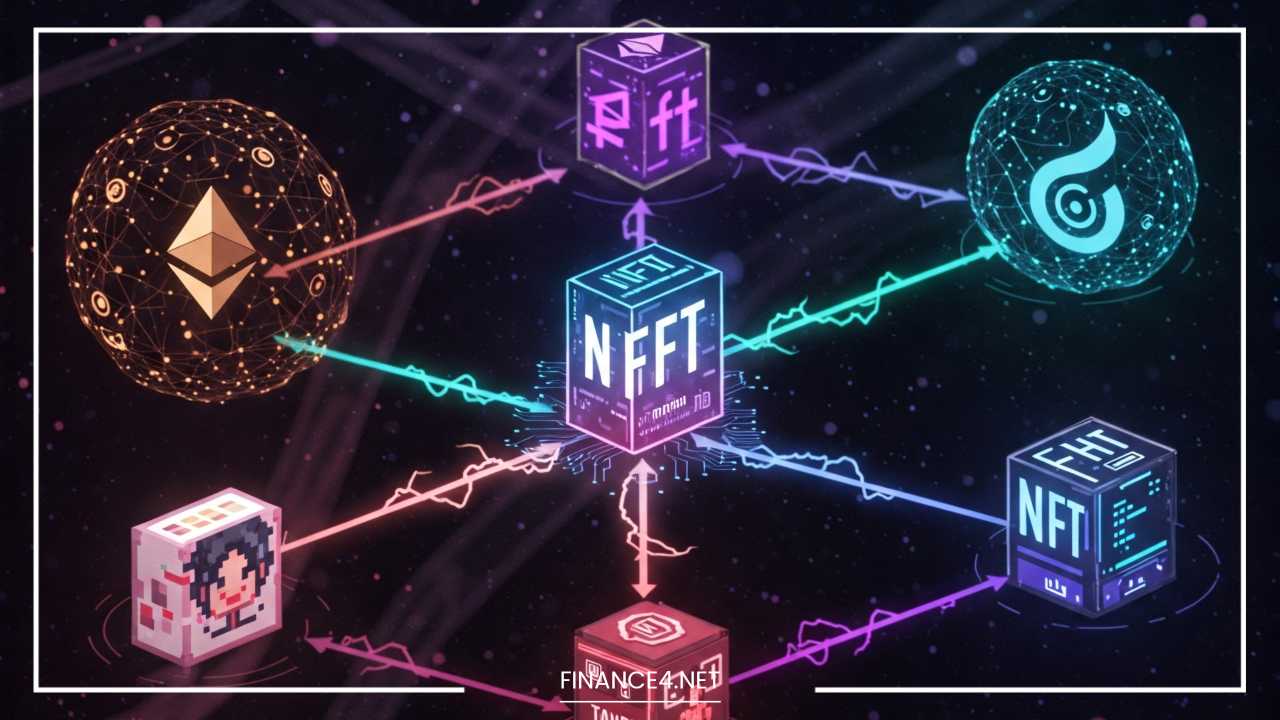
A cross-chain bridge is a protocol that enables the transfer of assets or data between two distinct blockchain networks. For NFTs, this typically involves a Lock-and-Mint or Burn-and-Mint mechanism. The original NFT is locked on the source chain (NEAR) and a wrapped, canonical version is minted on the destination chain (e.g., Ethereum).
A bridge aggregator sits on top of multiple individual bridges. Instead of a user having to compare Rainbow Bridge versus Wormhole versus Allbridge, the aggregator automatically scans all possible routes to find the best combination of speed, security, and cost for that specific asset transfer. Platforms like LI.FI (Jumper) or Rubic exemplify this routing capability for tokens, a model which is being adapted for NFTs.
Advantages of Aggregators Over Single Bridges
Aggregators offer distinct benefits crucial for non-fungible assets:
-
Route Optimization: For a complex route (e.g., NEAR $\to$ Solana), an aggregator can chain multiple bridges together to find a route a single bridge cannot offer, delivering the asset through the cheapest or fastest path.
-
Multi-Bridge Access: A single interface provides access to the security and chain support of dozens of underlying bridge protocols, mitigating reliance on one single point of failure.
-
Security & Reliability: If one underlying bridge is temporarily down or exploited, the aggregator can failover to a safer route.
-
NFT Standard Translation: The aggregator can often simplify the process of ensuring that the NEP-171 data is correctly wrapped and translated into the destination chain’s standard (e.g., ERC-721), streamlining the user experience.
Why Generic Token Bridges Aren’t Enough for NFTs
Most token bridges are insufficient for NFTs because:
-
They carry unique metadata (image files, traits, descriptions) which must be preserved.
-
They often have built-in royalty structures enforced by contract logic.
-
The transaction must verify a unique Token ID, not just an amount.
A successful NFT bridge must preserve all these unique properties; a generic token bridge, which only cares about the fungible value, will fail to preserve the essential non-fungible qualities, effectively destroying the asset’s utility.
Key Criteria to Evaluate When Choosing a “Best” Aggregator
The “best” aggregator is determined by its performance across several critical criteria when handling a NEAR-based NFT.
Chain Support & Compatibility
The platform must support direct or multi-hop routes between NEAR (including Aurora) and your target chain, with robust, bi-directional support for the NEP-171 standard.
NFT Support & Metadata Preservation
This is the most critical factor. The platform must explicitly confirm that it supports the bridging of NEP-171 assets and, crucially, that it preserves the asset’s original metadata and media URI. A bridge that loses the metadata renders the NFT worthless.
Reliability & Security
Given that bridges are high-value targets, the aggregator should prioritize routes through bridges that are multi-audited, employ Zero-Knowledge (ZK) technology, or utilize a proven mechanism like NEAR’s secure Chain Signatures via OmniBridge.
Cost & Fees
The total cost must be transparent, covering NEAR gas, the bridge’s commission, and the destination chain’s gas. The best aggregators optimize the route for the lowest total cost.
Speed & UX
A good aggregator provides accurate time estimates and a simple, single-transaction user interface, abstracting away the complexity of smart contract interactions and multiple bridge hops.
Liquidity & Routing Optimization
While NFTs don’t require liquidity pools, the aggregator’s quality is measured by its ability to find a viable, active bridging path instantly, even for niche NEP-171 collections, by having multiple integrated routes.
Metadata, Royalties, Ownership Integrity
The aggregator must ensure the new, wrapped NFT accurately reflects the original ownership and preserves the creator’s on-chain royalty structure, ideally by mapping to destination standards like ERC-2981.
Developer/dApp Integration Support
For creators, the best aggregators offer robust SDKs/APIs that allow the bridging function to be integrated directly into a dApp or marketplace, providing a native, seamless experience.
Community & Maintenance
Continuous code audits, an active developer community, and transparent communication channels are vital for the long-term reliability of the bridging infrastructure, especially for high-value assets.
Overview of Leading Aggregators & Bridges
The concept of a true NFT bridge aggregator is still evolving, but the “best” solution for NEAR often relies on platforms built upon or integrating specialized bridges.
1. Native NEAR Infrastructure (OmniBridge and Rainbow Bridge)
-
Rainbow Bridge: The original, trustless bridge between NEAR/Aurora and Ethereum. While incredibly secure and battle-tested, it is primarily focused on Fungible Tokens (NEP-141 $\leftrightarrow$ ERC-20). It is not a user-friendly, plug-and-play NFT solution for the average holder.
-
OmniBridge (NEAR’s Universal Solution): This is NEAR’s future. Leveraging Chain Signatures (a secure Multi-Party Computation or MPC system), OmniBridge is designed to enable seamless asset transfers between NEAR and any blockchain (Ethereum, Solana, etc.). The current status involves a hybrid architecture, using Chain Signatures for security but integrating protocols like Wormhole for initial chain expansion (Solana, Arbitrum, etc.). While its initial focus has been on fungible tokens, its architecture is ideal for canonical NEP-171 NFT bridging and is positioned to be the most secure, native path.
2. Specialized Cross-Chain Protocols (Wormhole Portal and Allbridge)
-
Portal (Wormhole): Wormhole is a leading cross-chain messaging protocol with a dedicated NFT bridging solution (Burn & Mint). Wormhole is heavily integrated into the NEAR/Aurora ecosystem. The OmniBridge is currently leveraging Wormhole for certain non-EVM routes, making it a critical component of the NEAR bridging strategy. If a collection is supported, Wormhole offers a high-security, established path.
-
Allbridge: A versatile, established bridge connecting many EVM and non-EVM chains, including NEAR. While primarily used for token transfers (Allbridge Core), its infrastructure is capable of handling non-fungible assets. Users must confirm specific NEP-171 collection support and destination chain whitelisting. It serves as a reliable single-bridge alternative for direct NEAR $\to$ EVM transfers.
3. Multi-chain Aggregators (LI.FI/Jumper)
-
LI.FI (Jumper Exchange): This is the quintessential cross-chain aggregator, routing swaps across dozens of bridges and DEXs. While their focus remains on fungible token swaps, the platform’s SDK is the model for the ideal NFT aggregator. When fully integrated with the native NEAR OmniBridge API and specialized NFT bridges (like Wormhole’s), LI.FI or a platform built on its technology will become the true “best aggregator” by optimizing the entire NFT transfer process.
-
The Aggregator Model: Currently, the best aggregator experience for NEAR NFTs is often a specialized dApp built on NEAR/Aurora that uses a routing engine to chain together the most efficient path—for example, NEAR NEP-171 $\to$ Aurora ERC-721 $\to$ Wormhole $\to$ Destination Chain.
| Solution Type | Focus | NEAR NFT Relevance (NEP-171) | Pros | Cons |
| OmniBridge | Native NEAR/AI | High (Future Canonical Path) | NEAR Foundation support, leverages Chain Signatures, trustless, designed for Chain Abstraction. | Still transitioning to full, universal NFT support; hybrid architecture relies on others for certain chains. |
| Portal (Wormhole) | Specialized Bridge | Moderate-to-High (via Integration) | Battle-tested, supports a proven Burn-and-Mint NFT mechanism, large ecosystem and is used by OmniBridge. | Requires users to use the specific Portal interface; security relies on the Guardian network integrity. |
| Aggregators (LI.FI Model) | Smart Routing | High (Ideal Long-Term Solution) | Finds best route for lowest cost/fastest time; abstracts complexity; great UX. | NFT support is often secondary to token swaps; limited direct NEP-171 support currently. |
Challenges & Risks of Bridging NFTs
Bridging non-fungible assets presents unique and severe risks that users and creators must be aware of.
Metadata Loss or Mismatch
If a bridge fails to correctly transfer the underlying asset’s unique metadata, the newly minted wrapped NFT will appear blank or incorrect on the destination chain’s marketplaces, destroying its market value. Immutable storage (like IPFS) is essential, but the bridge must preserve the correct URI pointer.
Smart-Contract Bug/Exploit Risk
Bridges are high-value targets. An exploit in a bridge’s smart contract can lead to the permanent loss of the locked original NFT on NEAR. Users must fully understand the trust assumptions (e.g., decentralized MPC vs. centralized multisig) of the bridge used by the aggregator.
Liquidity Risk / Bridging Failures
A bridge failure (e.g., relayer nodes going offline, network congestion) can lead to the NFT being locked indefinitely between chains, causing significant stress and uncertainty for the owner until the system recovers.
Gas/Transaction Fee Volatility
The total cost of a bridge transaction is the sum of two sets of gas fees. Volatility on the destination chain (e.g., high Ethereum gas) can spike the cost dramatically, causing the transaction to fail or become economically unviable.
Delays / Long Transaction Times
Bridging assets often involves multiple confirmation and verification steps across two different consensus mechanisms. Delays can occur due to network lag, bridge validator liveness issues, or required finality periods on the destination chain.
NFT Standard Compatibility
The difference between NEAR’s NEP-171 and standards like ERC-721 means the bridge must act as a perfect translator. Imperfect translation can result in the wrapped NFT not being recognized by target marketplaces or DeFi protocols.
Royalties Enforcement & Marketplace Compatibility Post-Bridge
If the bridge fails to correctly map the NEP-171 royalty structure, the creator may lose royalty income on the destination chain, especially if moving to a marketplace that does not enforce such fees.
Step-by-Step Guide / Best Practices for Bridging NEAR NFTs Safely
Successfully bridging a NEAR NFT requires diligence and preparation.
1. Checking Pre-requisites
Ensure your NFT is a standardized NEP-171 asset. Verify the specific NFT collection is supported by your chosen bridge/aggregator. Have both your NEAR wallet and your destination wallet (e.g., MetaMask) ready and funded with enough native gas tokens for both departure and arrival.
2. Choosing the Right Aggregator or Bridge
Prioritize Security: Select a platform built on or integrating audited infrastructure like OmniBridge or Wormhole. Prioritize Metadata: Look for explicit confirmation that the bridge preserves the image/metadata URI. Use the simplest, most direct route possible.
3. Verifying Bridge Health
Always check the bridge protocol’s official communication channels for recent maintenance notices or reports of temporary failures before initiating the transfer.
4. Doing a Test with a Low-Value NFT
If bridging a collection, bridge the least valuable one first. This confirms the process, speed, gas costs, and metadata integrity before risking a high-value asset.
5. Preserving Metadata & Ownership
After the bridge is complete, immediately check the wrapped NFT on the destination chain’s block explorer and a major marketplace (like OpenSea) to confirm the image, traits, and ownership are correctly displayed.
6. Understanding Gas/Fees
Be prepared to pay more than the estimated cost. Account for potential gas spikes on the destination chain and avoid bridging during periods of extreme network congestion on the target chain.
7. Security Hygiene
Only use the official, documented URL for the bridge or aggregator. Never click on links from unverified sources, and always confirm the wallet transaction details match your intended action before approving.
Future Outlook — What’s Coming & What to Watch For
The current state of NFT bridging is an interim phase. The future will be defined by natively interoperable protocols that remove the need for manual bridging entirely.
Bridging Infrastructure Evolution & Native Cross-Chain NFT Standards
The future points toward Zero-Knowledge (ZK) technology for trustless proof-of-transfer and the full implementation of Chain Abstraction and NEAR Intents. This will allow users to interact with an NFT on any chain using their NEAR account without being aware of the underlying bridging process, making the asset feel truly multi-chain.
NEAR Ecosystem Upgrades
The full rollout of OmniBridge and its integration with Chain Signatures is the most significant development. If OmniBridge is fully extended to NEP-171 assets, it will become the canonical, most secure way to move NFTs in and out of the NEAR ecosystem.
Growth in Multi-Chain Marketplaces / Gaming / Metaverse
As marketplaces (like Magic Eden) become more chain-agnostic and fully integrate cross-chain tools, the utility of bridged NEAR NFTs will skyrocket. The growth of games that require assets from multiple chains will further drive the demand for reliable, seamless aggregators.
Advice for Creators: Designing NFT Collections with Cross-Chain Compatibility
Creators minting on NEAR should design their NEP-171 contracts with maximum metadata stability (using decentralized storage) and standardized royalty compliance to ensure their assets are as bridge-friendly as possible, maximizing their collection’s liquidity and utility across the entire Web3 space.
Final Thoughts
The pursuit of the “Best Aggregator for Bridging NEAR-Based NFTs” is fundamentally the search for the protocol that provides the optimal balance of security, metadata preservation, and cost-efficiency.
While dedicated NFT bridge aggregators (in the model of token aggregators like LI.FI) are still emerging, the current best-in-class solutions are those that leverage battle-tested infrastructure like Portal (Wormhole) for their underlying technology and those that simplify the complex multi-step process for the user. In the long term, NEAR’s native OmniBridge promises to abstract away the complexity entirely.
For most users, the most critical takeaway is to prioritize security and metadata integrity above all else. Start with the most audited and community-vetted bridge, confirm its NEP-171 support, and always verify the wrapped NFT’s display and ownership immediately upon arrival. The future of NEAR NFTs is multi-chain, and selecting the right aggregator is the first, most crucial step in unlocking their full potential.