Comparing Bridging Solutions: Wormhole vs. Anyswap
 by
by 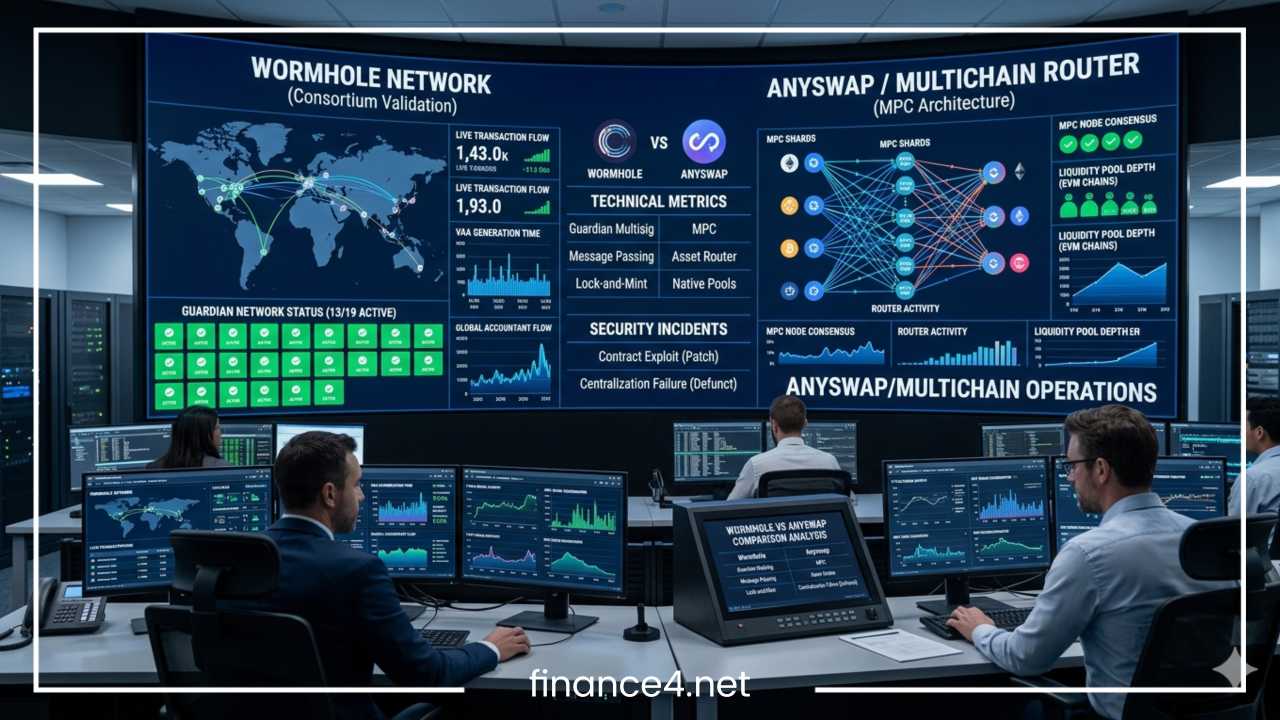
Wormhole vs Anyswap: Comparing Cross-Chain Bridging Solutions
The expansion of the blockchain landscape has moved from a singular, Ethereum-centric framework to a highly fragmented, multi-chain ecosystem. Today, diverse Layer 1 networks, Layer 2 scaling solutions, and application-specific blockchains coexist to serve distinct transactional and computational needs. However, this diversification introduces a fundamental challenge: liquidity fragmentation. Web3 assets and capital are isolated within their respective native ecosystems, limiting capital efficiency and hampering user experiences.
To unify these isolated environments, cross-chain communication infrastructure has become an absolute necessity. Blockchain bridges serve as the connective tissue of decentralized finance (DeFi), enabling token transfers, smart contract interactions, and data sovereignty to span across disparate networks.
Among the foundational architectures developed to address this problem, Wormhole and Anyswap (which later rebranded to Multichain) stand out as major historical and technical benchmarks. While both protocols were built to achieve interoperability, they approached the challenge from contrasting architectural and philosophical viewpoints. Wormhole emerged as a generalized message-passing network designed for cross-chain data extensible to arbitrary applications, whereas Anyswap was engineered primarily as a rapid, router-based liquidity network optimized for multi-chain asset swapping. Analyzing and comparing these two distinct paradigms provides critical insights into the trade-offs of speed, security, and scalability that define cross-chain infrastructure.
Understanding Blockchain Bridges
To evaluate the design choices of Wormhole and Anyswap, it is first necessary to understand how cross-chain communication functions fundamentally. Because blockchains are isolated state machines, they cannot natively read data from outside their own network boundaries. When an asset moves from Chain A to Chain B, it does not physically travel over an internet pipeline; instead, the bridge coordinates a state change across both networks to replicate the asset’s value. This coordination relies heavily on specific minting, burning, and liquidity routing mechanisms.
Core Architectural Mechanisms
Bridges process cross-chain transfers using three main operational models:
-
Lock-and-Mint Model: In this model, a user deposits a native token into a smart contract vault on the source chain, where it is securely locked. A monitored message is then generated and sent to the destination chain, where an equivalent amount of a synthetic counterpart, known as a wrapped asset, is minted.
-
Burn-and-Release Model: This mechanism is the reverse of lock-and-mint, used when returning wrapped assets back to their native ecosystem. The user burns the wrapped tokens on the destination chain, triggering the smart contract on the source chain to release the locked native tokens back to the user.
-
Liquidity-Based Bridges: Instead of issuing wrapped synthetic tokens, these bridges utilize pre-funded, native liquidity pools on both the source and destination networks. A user deposits an asset into the source pool, and an equivalent native asset is released to them from the destination pool. This entirely avoids wrapped asset dependency but requires heavy capital allocation to prevent pool imbalances.
Technical Coordination Layers
To ensure that these state changes occur accurately and securely without double-spending, bridges deploy specific off-chain and on-chain actors. Validators and node operators monitor the state of the source chain to verify that a transaction has occurred and reached absolute finality before issuing a proof. Relayers act as messengers, physically taking these cryptographic proofs and submitting them alongside payload data to the destination chain’s smart contracts.
The fundamental differentiator among cross-chain protocols lies in their trust assumptions. Users must trust either a centralized entity, a distributed consortium of known signers, or a fully decentralized cryptographic proof system to validate that the assets on the source chain are truly secured before interacting with the destination chain.
Because bridges serve as massive aggregators of locked capital across multiple ecosystems, they present incredibly attractive targets for malicious actors. Cross-chain logic requires highly intricate smart contracts capable of interacting with multiple distinct virtual machines and consensus rules, making bridge security one of the most complex engineering challenges in Web3.
What is Wormhole?
Wormhole was originally incubated as a specialized, bi-directional token bridge connecting Ethereum and Solana. The architecture was designed to alleviate the stark isolation of Solana’s high-throughput environment, allowing liquidity to flow seamlessly into its ecosystem from Ethereum’s capital-dense DeFi markets. Over iterations, Wormhole evolved from a basic token wrapper into a generalized, decentralized message-passing protocol that serves as a foundational interoperability layer for dozens of high-profile networks.
Core Architecture and the Guardian Network
Wormhole operates as an observation network rather than a standalone blockchain. Its security and validation stack relies entirely on a specialized consortium known as the Guardian Network. The network is comprised of 19 top-tier validator entities that run nodes tasked with constantly monitoring the state of all supported blockchains.
When an application interacts with Wormhole on a source chain, it calls a native Wormhole Core Contract and emits a message payload. The Guardians independently observe this event. Once the transaction achieves finality on the source chain, each Guardian signs a cryptographic hash of the message payload. When at least a 13-of-19 supermajority of Guardians have signed the message, the signatures are aggregated into a structure called a Verifiable Action Approval (VAA).
Once a VAA is generated, it is retrieved by an off-chain network of automatic relayers. The relayer delivers the VAA directly to the Wormhole Core Contract on the target destination chain. The destination contract verifies the cryptographic signatures of the Guardians within the VAA; if valid, it parses the payload and executes the requested command, such as minting tokens or releasing data to a destination smart contract.
Product Offerings and Ecosystem Expansion
Wormhole’s design separates generalized messaging from consumer-facing applications, enabling developers to build varied products on top of its core infrastructure:
-
Portal Token Bridge: Built directly on Wormhole’s message-passing architecture, Portal handles the lock-and-mint and burn-and-release mechanisms for cross-chain asset transfers, enabling users to move tokens without slippage across networks.
-
NFT Bridging: Portal also extends its framework to ERC-721 and SPL non-fungible tokens, allowing metadata and digital collectibles to maintain provenance while moving between distinct execution environments.
-
Wormhole Connect: A simple widget and SDK integration that allows Web3 developers to embed Portal’s bridging capabilities directly into their application’s user interface, keeping users contained within a single application experience.
-
Wormhole Gateway: An application-specific blockchain designed to connect Cosmos-based appchains with the broader Web3 ecosystem, serving as a liquidity router that maps external assets natively into the Cosmos Inter-Blockchain Communication (IBC) framework.
Through this modular developer tooling, Wormhole has achieved massive network effects, providing extensive coverage across diverse execution environments, including Solana, Ethereum, BNB Chain, Avalanche, Aptos, Sui, and various Layer 2 rollups.
What is Anyswap / Multichain?
Anyswap launched as a decentralized cross-chain swapping protocol engineered to facilitate direct asset routing across a wide variety of networks. In its earliest iterations, it relied heavily on the Fusion network’s technology to execute cross-chain interactions. Realizing the broader commercial potential of pure asset routing, the protocol underwent a major rebranding to Multichain, shifting its core focus from a basic swap user interface into a specialized, high-capacity cross-chain asset router.
Router-Based Architecture and MPC Technology
Unlike Wormhole’s generalized message-passing infrastructure, Anyswap was built from the ground up to optimize capital movement via a sophisticated router-based architecture. This model utilized co-dependent smart contracts on all supported chains linked together by an off-chain validation layer governed by Secure Multi-Party Computation (MPC) nodes.
The MPC node network used a cryptographic process known as Distributed Key Generation (DKG). Instead of a standard multi-signature scheme where individual validators hold distinct private keys, an MPC system generates a single private key that is split into multiple shards distributed across the node operators. To authorize a cross-chain swap or asset transfer, a predefined threshold of these node shards must collaborate mathematically to sign a transaction without ever reconstructing the full private key on any single machine.
Anyswap deployed this MPC validation stack across two distinct asset-transfer mechanisms:
-
Native Cross-Chain Routers: For assets that exist natively on multiple networks (such as stablecoins like USDC or USDT), Anyswap established deep, co-dependent native liquidity pools across chains. When a user initiated a transfer, the router simply locked the asset in the source pool and transferred an equivalent native asset directly out of the destination pool, mitigating the systemic risks associated with synthetic wrapped assets.
-
AnyswapV2/V3 Bridges: For tokens that lacked native multi-chain deployments, the system defaulted to an automated lock-and-mint router, generating wrapped derivatives (such as anyUSDC) that could be instantly routed and automatically unwrapped through its built-in automated market maker (AMM) functionalities.
Ecosystem Footprint and Capital Integration
Anyswap achieved remarkable capital efficiency and rapid growth by target-matching emerging EVM-compatible networks that lacked official or efficient native bridges. It became the dominant, primary bridge infrastructure powering the Fantom ecosystem, and integrated deep liquidity routing networks across Avalanche, Polygon, BNB Chain, and Arbitrum. At its peak, its vast chain coverage and ease of use attracted billions of dollars in Total Value Locked (TVL), establishing it as the primary infrastructure for yield-farming participants, stablecoin arbitrageurs, and cross-chain DeFi protocols.
Architecture Comparison
The technical divergence between Wormhole and Anyswap highlights two entirely different methodologies for solving the cross-chain interoperability problem. While Wormhole positions itself as an un-opinionated, generalized data transport layer, Anyswap focused on optimizing a speed-and-liquidity network tailored for token swaps.
Consensus, Validation, and Trust Assumptions
Wormhole’s validation model relies on explicit, authoritative multi-signature aggregation. Each of its 19 Guardians runs a full node for every single connected blockchain, ensuring they directly parse and validate the true state of the source networks. The trust assumption is concentrated within a known, public group of professional validation corporations.
Conversely, Anyswap opted for an MPC network. While MPC cryptography is highly efficient because it outputs a single, clean signature that reduces on-chain gas costs for verification, its security is highly dependent on how the underlying key shards are managed and hosted. If the node infrastructure lacks true geographic and operational separation, the MPC model risks high concentration of power.
Messaging versus Asset Routing
The core functional capabilities of the two platforms represent an entirely different scope of work:
-
Wormhole: Operates as a generalized message passing layer. It does not care what the data payload contains. A developer can pass a governance vote across chains, call a remote smart contract function on an entirely different virtual machine, or transfer data logs. Asset bridging is merely one application (Portal) built on top of this messaging foundation.
-
Anyswap: Engineered strictly as an asset routing mechanism. Its primary goal was moving liquidity across chains with minimal friction. It did not offer generic smart contract execution or cross-chain data passing outside of transactional metadata needed to execute token swaps or redemptions.
Speed, Finality, and the Liquidity Model
Wormhole prioritizes strict state finality. Guardians must wait for a source chain to reach absolute consensus finality before signing a message, which can introduce deliberate latency depending on the source network’s block structure (e.g., waiting for multiple confirmation blocks on Ethereum). Its liquidity model relies heavily on locked canonical assets backing synthetic wrapped tokens on destination networks.
Anyswap focused heavily on user experience and rapid execution. By combining cross-chain liquidity pools with MPC routing, the system could clear transactions rapidly by assuming the short-term re-org risks of underlying networks in exchange for instantaneous liquidity dispatch. However, this required deep pool management and exposed users to substantial friction during periods of severe market panics when capital moved rapidly in a single direction.
Comparison Matrix
| Technical Category | Wormhole Bridge | Anyswap / Multichain Bridge |
| Validation Architecture | Guardian Network (Consortium Multisig) | Secure Multi-Party Computation (MPC) |
| Core Functionality | Generalized Message Passing (Data + Assets) | Asset Routing and Liquidity Swaps |
| Signing Mechanism | 13-of-19 Independent Signatures (VAA) | Threshold Cryptography (Key Sharding) |
| Liquidity Paradigm | Wrapped Assets (Lock-and-Mint) | Native Liquidity Pools + Wrapped Assets |
| Primary Advantage | Extensible developer infrastructure; highly secure for non-EVM data | Exceptional chain coverage; gas efficiency; native swaps |
| Primary Limitation | Higher latency due to strict state finality requirements | Fragmented focus; high structural reliance on pool depth |
Security Analysis
The history of cross-chain interoperability is defined by its vulnerabilities. Because bridges consolidate enormous sums of capital within immutable smart contracts and rely on complex off-chain communication infrastructure, they represent some of the most critical attack surfaces in blockchain history. Both Wormhole and Anyswap have suffered catastrophic disruptions, though for completely opposite reasons: one failed due to a flaw in smart contract implementation, while the other collapsed due to total systemic centralization.
The Wormhole Smart Contract Exploit
Wormhole suffered a devastating security exploit that resulted in the unauthorized extraction of approximately 120,000 wrapped Ether (wETH) from its Solana bridge contract, a loss valued at roughly $320 million at the time.
The exploit did not stem from a failure of the Guardian Network or a compromise of their cryptographic keys. Instead, it was an entirely on-chain smart contract verification vulnerability. On the Solana network, smart contracts interact with separate programs called Instructions. Wormhole’s contract relied on a system program to verify that valid Guardian signatures were being presented.
The attacker exploited a flaw in the contract logic by passing a spoofed, uninitialized storage account containing fake data that bypassed the signature verification check. This allowed the attacker to trick the Wormhole contract into believing the 13-of-19 Guardian signatures had successfully approved a deposit on Ethereum when no such deposit occurred. Consequently, the attacker minted 120,000 wETH out of thin air on Solana, and proceeded to bridge a large portion back to Ethereum to drain the underlying native liquidity vaults.
Remediation and Security Iterations
The recovery from the hack demonstrated the substantial backing behind Wormhole. Institutional stakeholder Jump Crypto stepped in to fully back the drained asset pool, depositing 120,000 native ETH into the Ethereum vault to maintain the 1:1 backing of the wrapped wETH on Solana and prevent a cascading insolvency crisis across Solana’s DeFi ecosystem.
Following the hack, Wormhole underwent comprehensive structural upgrades:
-
Global Accountant: An isolated component that tracks the total circulating supply of all wrapped tokens across all destination networks in real time. If an application attempts to move more tokens off a chain than were structurally deposited, the system automatically triggers an immutable rate limit and halts the transaction.
-
Defense-In-Depth Audits: The protocol implemented routine, continuous smart contract reviews alongside massive white-hat bug bounty programs to isolate potential state-machine interpretation errors before they reach production environments.
The Anyswap / Multichain Operational Collapse
While Wormhole’s exploit was a technical code vulnerability fixed with engineering patches, the downfall of Anyswap (Multichain) was an existential structural collapse rooted in operational centralization.
Throughout its growth, Multichain publicly marketed its MPC node infrastructure as a highly decentralized network of independent signers incapable of single-person control. However, a critical systemic failure occurred when the platform’s CEO mysteriously disappeared, completely breaking communication with the rest of the operational team.
It was subsequently revealed that the network’s node architecture was entirely centralized. All of the MPC private key shards were being hosted on cloud servers under the sole access, control, and ownership of the CEO. When the CEO was taken into custody by local authorities, his hardware devices, mnemonic phrases, and cloud infrastructure passwords were confiscated.
This single point of failure completely paralyzed the protocol:
-
The remaining development team lacked the root access credentials necessary to log into the servers to perform basic technical maintenance.
-
Because the operational keys were completely centralized within a single legal jurisdiction, the funds backing the bridge assets were fundamentally compromised.
-
A series of mysterious, unauthorized withdrawals stripped more than $125 million from Multichain’s pools, heavily draining its Fantom, Moonriver, and Dogecoin bridges.
With keys compromised and no method to restart or maintain the system, Multichain officially announced a total cessation of operations. The unbacked wrapped tokens plummeted in value, triggering a multi-million dollar liquidity crisis across ecosystems like Fantom, which had relied on Multichain as its primary economic artery. The fallout resulted in long-term litigation, asset freezing orders, and liquidator appointments by international courts trying to claw back remaining funds for affected depositors.
Structural Risk Analysis
Comparing these two historic incidents underscores a critical principle in blockchain infrastructure design: smart contract risks can be audited, patched, and economically insured, but centralized operational risk is an existential vulnerability.
Wormhole’s structure proved resilient because its physical node operators remained distinct, contactable, and operationally independent; once the code bug was corrected, the bridge resumed secure operations. Anyswap’s failure proved completely fatal because its underlying cryptography was undermined by centralized key allocation practices, demonstrating that advanced mathematical frameworks like MPC are useless if the physical server hosting architecture creates a single point of failure.
Ecosystem Adoption and Use Cases
The architectural trade-offs of both protocols naturally guided them toward entirely different sectors of the Web3 economy, creating distinct network footprints.
Wormhole Use Cases
Wormhole has established itself as the premier layer for building complex, cross-chain applications (xApps) that require more than just asset transfers. Because it excels at generalized message passing, applications use Wormhole to unify their operating state across completely different blockchain architectures.
-
Cross-Chain Governance: Protocols like Uniswap utilize Wormhole’s validated messaging layers to pass governance votes executed on Ethereum down to deployments on remote Layer 2 networks, ensuring unified protocol management without requiring users to manually move their governance tokens back to mainnet.
-
xAssets (Native Multichain Tokens): Projects can deploy their native tokens as Wormhole xAssets. Instead of having separate, disjointed wrapped versions on every chain, the token contract natively tracks its state across dozens of networks simultaneously, ensuring zero-slippage cross-chain migrations.
-
Interoperable Gaming and NFTs: Web3 gaming architectures deploy Wormhole to keep high-frequency player interactions on affordable networks like Solana, while allowing the underlying in-game assets or profile NFTs to settle securely on Ethereum.
Anyswap / Multichain Use Cases
Before its collapse, Anyswap was the undisputed leader in DeFi liquidity velocity. Its use cases were deeply tied to the rapid, yield-maximizing behavior of retail DeFi participants.
-
Cross-Chain Yield Farming: Yield aggregators and retail liquidity providers used Anyswap to instantly route massive blocks of stablecoins across networks to capture volatile, short-lived farming incentives. If an EVM chain launched a new decentralized exchange with triple-digit yields, Anyswap was the primary pipeline used to capture that alpha.
-
Arbitrage Execution: Because Anyswap maintained deep, native liquidity routers, arbitrageurs could instantly pass assets between networks to close price discrepancies for tokens across disparate automated market makers, maintaining peg parity throughout the broader DeFi market.
Fees, Performance, and User Experience
From a user perspective, interacting with a bridge comes down to three main friction points: speed, cost, and execution safety. Wormhole and Anyswap optimize for these criteria differently due to their core architectural pipelines.
Transaction Speed and Finality
Wormhole’s operational speed is strictly bound to the safety parameters of the source chain. Because the 19 Guardians must protect against chain reorganizations (re-orgs) where blocks can be dropped or rewritten, they will not issue a signoff until a transaction achieves absolute finality.
Moving an asset from Solana to Ethereum via Wormhole occurs within seconds on the Solana side because Solana reaches finality nearly instantly. However, moving an asset from Ethereum back to Solana requires waiting for Ethereum’s epoch finality, causing an intentional, built-in processing delay.
Anyswap optimized exclusively for velocity by absorbing short-term chain finality risks within its off-chain MPC routing mechanics. For native pool routing, transactions were resolved within minutes across EVM chains. However, this model exposed users to substantial friction during periods of severe network congestion. If a destination pool ran entirely out of liquidity due to uneven capital flows, user transactions would become stuck in the router contracts for hours or days until liquidity providers rebalanced the system.
Gas Efficiency and Cost Structure
Wormhole requires users to pay gas fees on the source chain to initiate a transfer, and gas fees on the destination chain to claim their assets via the VAA proof. To improve user experience, automatic relayers wrap these costs into a single, upfront fee on the source chain, but interacting with Wormhole’s complex signature verification logic on-chain remains a relatively gas-intensive process for EVM smart contracts.
Anyswap’s MPC approach was highly gas-optimized on the destination chain because it required verifying only one consolidated signature instead of tracking multiple independent signs. However, the system extracted a fixed, non-trivial operational routing fee (often a small percentage of the total transferred volume, with minimum caps) to compensate its MPC node network and cover liquidity management overhead.
Pros and Cons Comparison
To summarize the trade-offs inherent in both bridge styles, we can break down their core architectural, operational, and structural advantages and limitations.
Wormhole
Pros
-
True Generalized Extensibility: Supports passing arbitrary data packets, allowing for cross-chain governance, messaging, and multi-network application state logic.
-
Institutional Structural Backing: Backed by professional, independent validation consortiums and major industry market makers, ensuring capital restoration when code vulnerabilities emerge.
-
Advanced Accounting Safeguards: Implements structural supply tracking layers (Global Accountant) to actively monitor net flow and isolate smart contract errors from compromising total system liquidity.
Cons
-
Concentrated Trust Consortium: Relies entirely on a fixed multi-signature network of 19 Guardians, requiring absolute trust in their corporate and operational integrity.
-
Implementation Complexity: Intricate multi-virtual-machine smart contract configurations create wider code attack surfaces that require continuous auditing.
Anyswap / Multichain
Pros
-
Rapid EVM Asset Swapping: Highly effective native router network that bypassed the need for asset wrapping, minimizing slippage for stablecoin transfers.
-
Extensive Network Coverage: Rapid integration enabled immediate liquidity routing across a vast array of emergent and alternative EVM layer networks.
Cons
-
Catastrophic Centralization Risks: Cryptographic MPC keys were managed through vulnerable server hosting configurations under individual control, creating a fatal single point of failure.
-
Liquidity Pool Imbalances: High vulnerability to pool depletion and stuck transactions during periods of volatile, unidirectional market panics.
-
Total Operational Collapse: System completely failed and closed operations due to legal and infrastructure concentration, causing permanent capital impairment for users holding its wrapped assets.
Future of Cross-Chain Interoperability
The collapse of older bridge designs and the evolution of protocols like Wormhole have fundamentally changed how the blockchain industry conceptualizes cross-chain architecture. The market is aggressively shifting away from primitive, asset-wrapping “bridges” and moving toward comprehensive interoperability infrastructure layers. Modern architectures are moving away from trusting human signers or centralized servers, focusing instead on structural and cryptographic trust minimization.
Emergent Technical Paradigms
The industry is rapidly adopting several core innovations to replace legacy bridging models:
-
Zero-Knowledge (ZK) Bridges: ZK-bridges use mathematical proofs to verify state transitions across chains without relying on external validators. Instead of trusting a consortium of signers, smart contracts on a target chain can mathematically verify an proof that a transaction occurred on a source chain using succinct cryptographic validity proofs, reducing trust assumptions to pure mathematics.
-
Intent-Based Bridging: This framework separates the user experience from the physical bridging pipeline. Users state an “intent” (e.g., “I want to exchange 10 ETH on Ethereum for an equivalent value of USDC on Solana”). Professional market makers, known as fillers, instantly fulfill the request using their own native destination capital. The fillers then aggregate and settle the transaction batches asynchronously in the background. This shifts the risk of bridging entirely onto institutional balance sheets, protecting retail users from transaction delays or smart contract exploits.
-
Modular Interoperability Frameworks: Protocols are decoupling the transport layer from the verification layer. Competitors allow applications to customize their own security profiles—combining decentralized oracle networks, independent security checkers, and adjustable multi-sigs to eliminate single points of operational failure.
Final Thoughts
The evolution and divergent fates of Wormhole and Anyswap illustrate the core engineering principles that govern cross-chain interoperability. Wormhole demonstrated the long-term viability of building an un-opinionated, generalized message-passing layer. By focusing on robust architecture, expanding developer frameworks, and weathering security events with institutional support, it transitioned from a simple asset pipeline into an essential layer of Web3 infrastructure.
Conversely, Anyswap (Multichain) stands as a stark cautionary tale for the decentralized finance industry. While its router-based architecture and liquidity pools provided unmatched speed and chain coverage for asset swapping, its foundational infrastructure was fatally undermined by centralized key management and operational single points of failure. Its sudden collapse serves as a permanent reminder that cryptographic sophistication cannot compensate for centralized infrastructure risks.
Ultimately, different cross-chain architectures were built to solve different facets of the liquidity fragmentation problem. As Web3 continues to mature, the industry is incorporating the lessons taught by these early systems—building a resilient, multi-chain landscape defined by intent-driven liquidity routing and trust-minimized cryptographic verification.
Frequently Asked Questions
Is Wormhole bridge safer than Multichain after the exploit?
Yes. While the Portal bridge built on Wormhole suffered a major contract exploit resulting in a loss of $320 million, the vulnerability was an on-chain smart contract code flaw that was promptly audited, structurally patched, and financially restored by institutional backers. Conversely, the collapse of Multichain (formerly Anyswap) was caused by irreversible, total systemic centralization where all private keys were under the physical control of a single individual. Wormhole’s decentralized validation network of 19 independent corporate Guardians prevents single points of human or operational failure, making its architecture vastly safer than the legacy Multichain framework.
What is the difference between Wormhole vs. Multichain token bridging models?
The fundamental difference lies in asset execution and scope:
-
Wormhole uses a generalized message-passing framework. It is an un-opinionated data layer that reads state changes across completely different virtual machines (such as EVM and Solana). Its asset bridge mostly relies on a strict lock-and-mint model to deploy verified wrapped tokens across destination networks.
-
Multichain (Anyswap) focused strictly on asset velocity, using a router-based architecture powered by Multi-Party Computation (MPC) nodes. It heavily prioritized native liquidity pools across compatible EVM chains to execute direct chain-to-chain swaps, bypassing wrapped tokens whenever possible to minimize capital friction.
Why did the Multichain bridge stop working and what happened to the funds?
The Multichain protocol officially ceased operations because its underlying validation infrastructure was critically centralized. The protocol’s CEO was placed under custody by authorities, leading to the confiscation of all server credentials, hardware devices, and cloud infrastructure hosting the Multi-Party Computation (MPC) key shards. Because the remaining development team lacked administrative entry access to maintain the physical node architecture, the platform became non-functional. Shortly thereafter, over $125 million in user assets were pulled out via unauthorized transactions, forcing stablecoin issuers like Circle and Tether to freeze affected addresses to protect depositors.
What are the best alternative cross-chain crypto bridges to use today?
Since the transition away from early liquidity bridges, several advanced interoperability protocols have captured the market share:
-
Across Protocol: A leading choice for Layer 2 rollups, utilizing a highly optimized, intent-based infrastructure where independent relayers fulfill transfers out of their own pockets for near-instant execution.
-
Stargate (LayerZero Ecosystem): An omnichain liquidity transport protocol that allows users to swap native assets across more than 20 EVM-compatible platforms using unified liquidity pools with instant finality.
-
Defiway: Highly popular among cross-chain arbitrage traders due to its predictive model, utilizing multi-signature security mechanics alongside a fixed-fee percentage to ensure predictable transaction costs.
-
Orbiter Finance: A specialized, high-velocity cross-rollup bridge optimized for instantaneous transfers and incredibly low gas fees across alternative Ethereum scaling solutions.
How do I troubleshoot a stuck transaction on a cross-chain bridge?
If an asset transfer stalls between the source network and target destination, follow these technical recovery steps:
-
Check State Finality: Copy your transaction hash and paste it into a dedicated block explorer for the source chain. Verify if the transaction has achieved absolute consensus finality. Bridges like Wormhole will intentionally delay signoffs if the origin network is experiencing severe congestion or chain reorganizations.
-
Utilize Protocol Explorers: Paste your source hash into a multi-chain monitoring engine (such as the Wormhole Explorer). This lets you see if the off-chain validation layer has successfully compiled the cryptographic signatures (or VAA payload) needed to clear the asset.
-
Manual Claim / Find Redeem: If the transaction status is marked as complete on the source side but the tokens have not arrived in your target wallet, the automatic relayer may have dropped the payload due to sudden gas spikes. Locate the “Find Redeem” or “Recover” utility on the bridge UI, connect your target wallet, and manually pay the local network gas fee to execute the minting or release function yourself.
-
Verify Target Liquidity: Ensure the destination network contains adequate pool depth for your asset. If a bridge router runs out of native target tokens, your balance remains securely locked in the smart contract vault until liquidity providers rebalance the pool.