Best Bridging Aggregator for Gaming Tokens
 by
by 
Best Bridging Aggregator for Gaming Tokens: Unlocking the Interoperable GameFi Future
The world of blockchain gaming, or GameFi, has exploded, moving beyond simple concepts to encompass vast, complex, and cross-chain ecosystems. At the heart of this evolution is the digital asset—the gaming token—which represents everything from in-game currency and governance rights to fractional ownership of valuable in-game items. However, the very decentralization that gives these tokens their value creates a significant logistical challenge: fragmentation. Tokens born on one chain often need to travel to another for trading, liquidity, or even to participate in a different game or a better marketplace. This necessity makes the bridging aggregator the unsung hero of the GameFi universe.
This comprehensive article will dive deep into what a bridging aggregator is, why it is indispensable for gaming tokens, and critically, how to identify the best platforms to unlock true cross-chain interoperability for both gamers and game developers.
Background: Blockchain & Gaming Token Landscape
The rise of blockchain gaming has been driven by the “play-to-earn” and “play-and-own” models, where verifiable digital ownership and financial incentives are baked into the core experience. This led to a surge in projects, each often launching on different blockchains, Layer 2s (L2s), or specialized side-chains to achieve the necessary speed and low transaction costs (gas) that gaming demands.
This success, however, led to the problem of fragmentation. A popular gaming token might reside on an L2 for high-speed gameplay, but the best liquidity pool or DEX for that token might be on a different L1 (like Ethereum) or a separate L2. This is where bridging is required: the fundamental process of locking an asset on a source chain and minting a representation of it on a destination chain (or vice versa) to allow its use across distinct ecosystems.
The Aggregator’s Role in GameFi
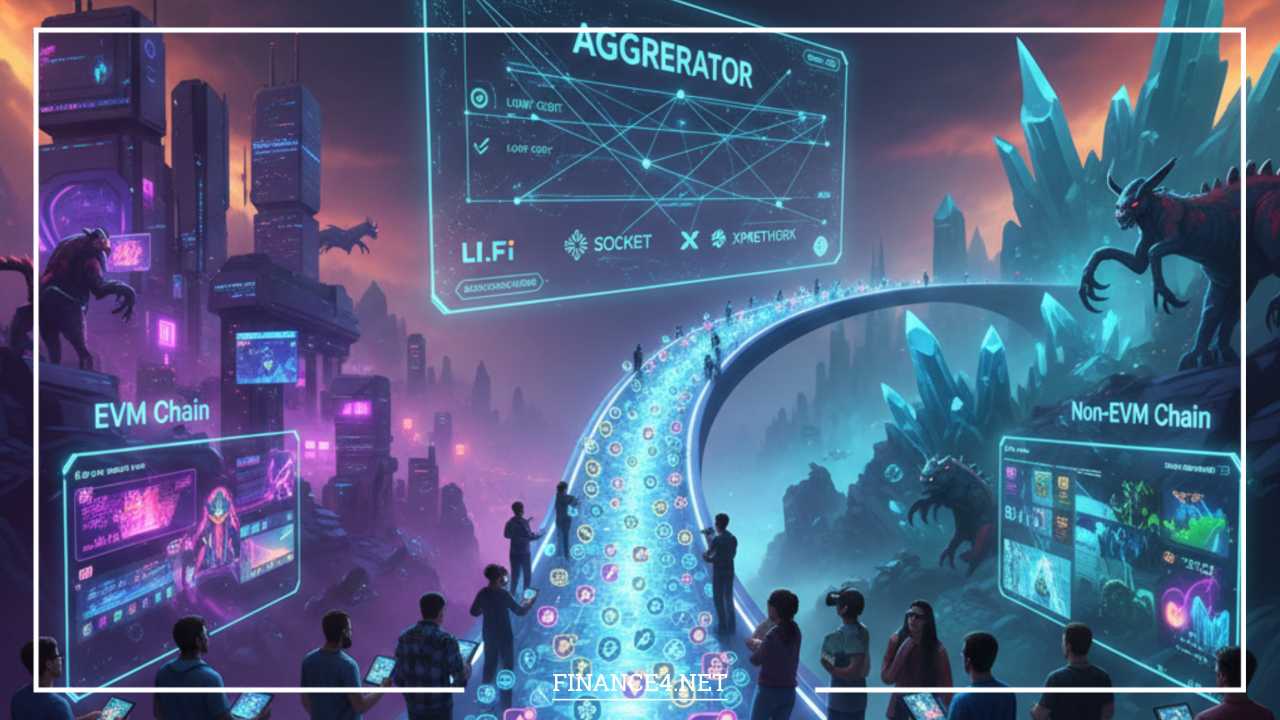
A basic bridge offers a single route. A bridging aggregator, by contrast, acts as a sophisticated digital travel agent. It is a tool or service that aggregates multiple bridge protocols and cross-chain liquidity networks to analyze and find the single most optimal path for a token transfer based on user-defined criteria—typically cheapest, fastest, or most secure.
For gamers, game developers, and token holders, the aggregator is paramount because it delivers:
- Ease of Movement: Simplifying a complex, multi-step process into a single transaction.
- Interoperability: Seamlessly connecting disparate game ecosystems and marketplaces.
- Cost Efficiency: Ensuring gas and bridge fees are minimized.
- Liquidity: Finding pools with sufficient depth to avoid major price impact (slippage), which is a high risk for often-niche gaming tokens.
Aggregators like Socket (and its user-facing product, Bungee) and Li.Fi (Jumper) are prime examples. They not only route through standard bridges (like Hop or Synapse) but often integrate with DEX aggregators on the destination chain to perform a “bridge-and-swap” in one atomic transaction, providing a service far beyond what a simple bridge can offer.
Key Evaluation Criteria: What Makes a Good Bridging Aggregator for Gaming Tokens
The criteria for evaluating a bridging aggregator must be heavily weighted by the specific characteristics of gaming tokens: high-volume micro-transactions, a need for near-instant finality, and often, smaller market caps and liquidity.
1. Chain and Token Coverage
- Relevance to Gaming: Game tokens are often deployed on high-throughput, low-cost chains like Polygon, Immutable X, Ronin, BNB Chain, or emerging L2s (Optimism, Arbitrum, zkSync). A top aggregator must support these often-specialized chains, especially newer L2s and non-EVM chains (like Solana, Flow, etc., though many focus on the EVM ecosystem). Breadth of supported networks directly translates to the utility for a multi-chain gamer.
- Custom Token Support: Many gaming tokens are newly minted. The aggregator must have the technical ability to route and support custom token contracts and less-standard token standards prevalent in GameFi.
2. Liquidity and Slippage Mitigation
- Relevance to Gaming: Small-cap gaming tokens often have fragmented liquidity. When bridging, a lack of liquidity on the target chain will result in high slippage (the difference between the expected and received amount), effectively penalizing the user.
- Aggregator Solution: The best aggregators route through protocols that use unified liquidity pools or, critically, integrate with DEX aggregators on the destination chain. This ensures the full transaction path—bridge-in and swap-out—is optimized for minimal price impact.
3. Fees / Gas / Cost Efficiency
- Relevance to Gaming: Gamers have a low tolerance for high fees, particularly for moving smaller token amounts (which is common in play-to-earn). High costs can render the economic model of a game unviable.
- Aggregator Solution: The core value proposition is finding the cheapest route by comparing gas costs, bridge fees, and protocol spreads. The aggregator must be fully transparent about these costs.
4. Speed / Finality
- Relevance to Gaming: Moving tokens to participate in a flash event, purchase a limited-time item, or quickly list an NFT on a marketplace requires near-real-time finality.
- Aggregator Solution: Superior routing engines prioritize speed, often preferring optimistic/canonical bridges or those that leverage faster messaging layers (like LayerZero or Wormhole) over slower, non-custodial methods.
5. Security / Trust-Minimisation
- Relevance to Gaming: Bridges are notorious targets for exploits; millions have been lost. Niche game tokens might be routed through less-audited, lower-security bridges.
- Aggregator Solution: The aggregator must perform vetting and curation of the underlying bridges, favoring robust, audited, and battle-tested protocols. Platforms like MetaMask Bridges (which uses a curated aggregator layer) emphasize this selection process to minimize user risk.
6. User Experience (UX) and Integration
- Relevance to Gaming: Gamers are not necessarily crypto-power users. The process must be simple, intuitive, and integrated.
- Aggregator Solution: A seamless, single-click interface that clearly displays fees and time is essential. Even better is an aggregator that can be embedded directly into a game’s wallet or marketplace UI (via an SDK/API), making the bridging process invisible to the end-user.
7. Innovative Features: Gas Refuel & Atomic Swaps
- Relevance to Gaming: A critical pain point: a user bridges a token to a new chain but has no native gas token (e.g., ETH, MATIC) to pay for the transaction to use the bridged token.
- Aggregator Solution: The best aggregators, notably Bungee (Socket), offer a “Refuel” feature that bundles a small swap of the asset being bridged for the destination chain’s native gas token, ensuring the user lands with a usable wallet. This “bridge token + gas in one step” is a huge advantage for mass adoption in GameFi.
Specific Challenges for Gaming Tokens & How Aggregators Address Them
Gaming tokens face unique challenges that an off-the-shelf bridge often fails to handle:
| Challenge for Gaming Tokens | How Aggregators Provide a Solution |
| Fragmentation of Game Ecosystems | Automatically scans all available liquidity and bridge protocols across dozens of L1s/L2s to connect the game’s primary chain to secondary trading/liquidity chains (e.g., Ronin to Ethereum). |
| Low Liquidity / High Slippage Risk | Integrates DEX aggregators to execute a bridge-and-swap in one transaction, ensuring the transfer path finds the best price and deepest pool. |
| Custom Token Standards / Niche Chains | The aggregator’s smart routing engine can be continuously updated to include support for new L2s or side-chains (like Game-specific rollups) and their non-standard token contracts. |
| Gas/Tokens Constraint (The “Gas Problem”) | Innovative features like “Refuel” automatically fund the user’s wallet with a minimal amount of the destination chain’s native gas token, mitigating the biggest UX hurdle for new crypto users. |
| Security Concerns for Niche Tokens | By vetting and curating only the most audited and secure underlying bridges, the aggregator shields the gaming token’s community from having to interact with less-secure or unproven protocols. |
| UX for Non-Crypto Users | Simplifies the entire process into a single, understandable UI (e.g., “Bridge $GTOKEN from Chain A to Chain B in 3 minutes for $0.50”), making it accessible to a mainstream gaming audience. |
Top Bridging Aggregators Suitable for Gaming Tokens
The market for aggregators is dynamic, but a few have established themselves as leaders in solving cross-chain liquidity and routing, making them exceptionally well-suited for GameFi:
| Aggregator Name | Core Mechanism / Unique Features | Why It Stands Out for Gaming Tokens | Potential Drawbacks |
| Socket (Bungee) | Multi-chain aggregator that focuses on routing through bridges and DEXs. Refuel feature is a major differentiator. | Best UX/Refuel: The “Refuel” feature solves the gas problem, which is critical for new gamers. Strong API/SDK for in-game integration. | Primarily focused on EVM-compatible chains. Reliance on the security of all integrated bridges. |
| Li.Fi (Jumper) | A comprehensive bridge and DEX aggregator that offers an extremely versatile SDK/API for dApps. Strong emphasis on finding the optimal route. | Robust Routing: Excellent at finding the fastest/cheapest path due to wide integration of over 20+ bridges and DEX aggregators. High developer adoption for dApp integration. | UX can be information-dense for absolute beginners; the sheer number of routes can sometimes lead to slight over-complication. |
| XY Finance | Self-described Web3-oriented bridge aggregator that explicitly supports Game Assets and NFTs. | GameFi Focus: Explicitly supports a wide range of game assets and NFT transfers, catering directly to GameFi needs. Low fees and reward-based UI. | Chain coverage might be less broad than larger meta-aggregators, focusing more on popular GameFi chains. |
| Rango Exchange | A cross-chain aggregator that combines bridges and DEXs for seamless on-chain and cross-chain swaps. | Non-EVM Support: Strong routing capabilities often include non-EVM networks like Cosmos/Starknet ecosystems, vital as gaming expands beyond the EVM stack. | Security relies on the aggregation of many different protocols, requiring a robust vetting process. |
Use-Case Examples: How It Works in Practice
Imagine a player, Alice, has earned 10,000 $GTOKEN on Polygon where the game is running, but she wants to sell it on a DEX on Arbitrum which offers better liquidity for a higher price.
- Manual Bridging (The Old Way): Alice would have to use the Polygon Bridge (Chain A → Ethereum L1), wait for finality, pay high L1 gas fees, then use another bridge (Ethereum L1 → Arbitrum L2), and finally manually swap $GTOKEN for USDC on an Arbitrum DEX. This is complex, slow, and expensive.
- Aggregator Bridging (The New Way):
- Alice goes to her Game Wallet (which has integrated the Socket SDK).
- She selects “Bridge $GTOKEN from Polygon to Arbitrum” and enters “10,000.”
- The aggregator’s routing engine instantly scans paths (e.g., Synapse bridge + Uniswap, or Hop bridge + Balancer) and presents the optimal route: “Fastest: 2 mins, $3.50 total cost, 9,985 $GTOKEN received.” The cost is low because the route bypasses Ethereum L1.
- Alice clicks “Bridge.” The aggregator executes the atomic bridge-and-swap via the chosen protocol. Critically, because the aggregator is smart, it might also include a small “Refuel” to ensure Alice gets 0.001 ETH for gas on Arbitrum.
- In two minutes, Alice’s wallet has 9,985 $GTOKEN (or USDC) and the required native gas token, ready for her to use immediately on Arbitrum.
This simplified, cost-transparent, and gas-aware process is why embedded aggregators are the future of GameFi UX.
Risks & Considerations
Even with the advancements in bridging aggregators, users and developers must be aware of inherent risks:
- Smart Contract/Bridge Hacks: The aggregator only routes; it does not eliminate the risk of the underlying smart contracts being exploited. Security is only as strong as the weakest bridge in the route.
- Liquidity Risk / Slippage: While mitigated, high volume or transfers of extremely low-cap tokens can still suffer significant slippage if the underlying liquidity pools are drained or too thin.
- Token Standard/Compatibility Risk: Bridging sometimes results in “wrapped” tokens. A project must ensure that the wrapped version of its token is recognized and supported by dApps on the destination chain to avoid compatibility issues.
- Destination Chain Costs / Gas Token Requirement: Even with “Refuel,” the user is often swapping a portion of their asset for gas, adding an implicit, unavoidable cost to the transaction.
- Regulatory / Compliance Risk: As cross-chain transfers can obscure asset origins, the regulatory environment around bridging is still evolving and could impose new compliance burdens.
- UX Risk for Gamers: Despite simplification, errors (like selecting the wrong token or chain) are still possible and can result in lost or stranded funds. The interface must be foolproof.
Best Practices for Gamers & Game Developers
For Gamers: Actionable Tips
- Always Check the Route: Before confirming, review the aggregator’s proposed route: Fee, Time, and Projected Output Amount. Look for aggregators that display the underlying bridge being used.
- Test with Small Amounts: When bridging to a new chain or using a new aggregator for the first time, bridge a minimal amount to ensure the process works as expected and the token arrives in a usable format.
- Prefer “Refuel” Features: If you are bridging to a chain you don’t frequently use, prioritize aggregators with built-in gas/refuel functionality to avoid being stranded without the native gas token.
- Security Over Speed: If the difference in time is only a minute but one route uses a significantly more trusted bridge (e.g., an official canonical bridge), opt for security.
- Use Audited Wallets: Ensure your wallet is non-custodial and secure, as you are authorizing complex smart contract interactions.
For Game Developers / Token Projects: Strategic Integration
- Integrate an SDK: Instead of directing players to an external website, use an aggregator’s SDK (like Li.Fi or Socket) to embed the bridging UI directly within your game’s client or wallet. This offers a superior, unified user experience.
- Provide Destination Liquidity: Proactively bootstrap liquidity for your game token on the most important target chains (e.g., a major DEX on a popular L2). This reduces slippage for your users and makes the aggregator’s routing more efficient.
- Ensure Custom Token Support: Work directly with your chosen aggregator to verify that your newly minted or custom-standard gaming token is correctly recognized and routed across their network.
- Educate Your Users: Provide clear, step-by-step instructions (with warnings about high slippage or potential delays) that simplify the cross-chain process for your predominantly non-crypto-native user base.
- Plan for Fallback: Always have a backup plan. If your primary aggregator or its underlying protocol fails, have a known, trusted, single-bridge alternative ready to recommend.
Future Trends & What to Watch
The bridging aggregator space is still in its infancy, and its evolution will be primarily driven by the needs of GameFi:
- Deeper Embedding: Aggregators will disappear into the background. The goal is “one-click interoperability” where the player simply clicks a button to use their token on a new chain, without knowing they used a bridge or an aggregator.
- More Non-EVM Support: As gaming expands onto non-EVM chains (Solana, Sui, Cosmos/IBC), aggregators will be forced to expand their routing engines to include these diverse ecosystems, providing true “any-to-any” connectivity.
- Native Asset Bridging: The reliance on wrapped tokens (which adds risk and complexity) will decrease as protocols like LayerZero’s Omnichain Fungible Tokens (OFTs) become more common, allowing the token’s native form to be moved.
- Advanced Route Automation: Utilizing AI and sophisticated algorithms to predict gas fees, monitor liquidity pool depth, and dynamically choose the optimal route just before execution to ensure the highest final token amount.
- Emergence of “Game-Chain Bridges”: Specialized aggregators or protocols custom-built for a specific gaming ecosystem (e.g., between a cluster of game-specific L2s) will emerge to offer ultra-low-cost and instantaneous transfers within that network.
Final Thoughts
The gaming token is the engine of the GameFi economy, and the bridging aggregator is the essential infrastructure that ensures this engine runs smoothly, connecting players, marketplaces, and game worlds. Without efficient, cost-effective, and secure cross-chain travel, the promise of an interoperable metaverse remains just a theoretical concept.
Aggregators like Socket/Bungee and Li.Fi stand out by focusing on the core user pain points: minimizing cost and solving the gas problem with features like Refuel. For gamers, thoughtful use of these tools unlocks vast opportunities. For developers, integrating them is a non-negotiable step toward building an ecosystem that prioritizes seamless user experience and retention.
The future of GameFi is multi-chain, and the best bridging aggregator is the key that unlocks its full potential.