Best Aggregator for Bridging Cross-Chain DeFi Options
 by
by 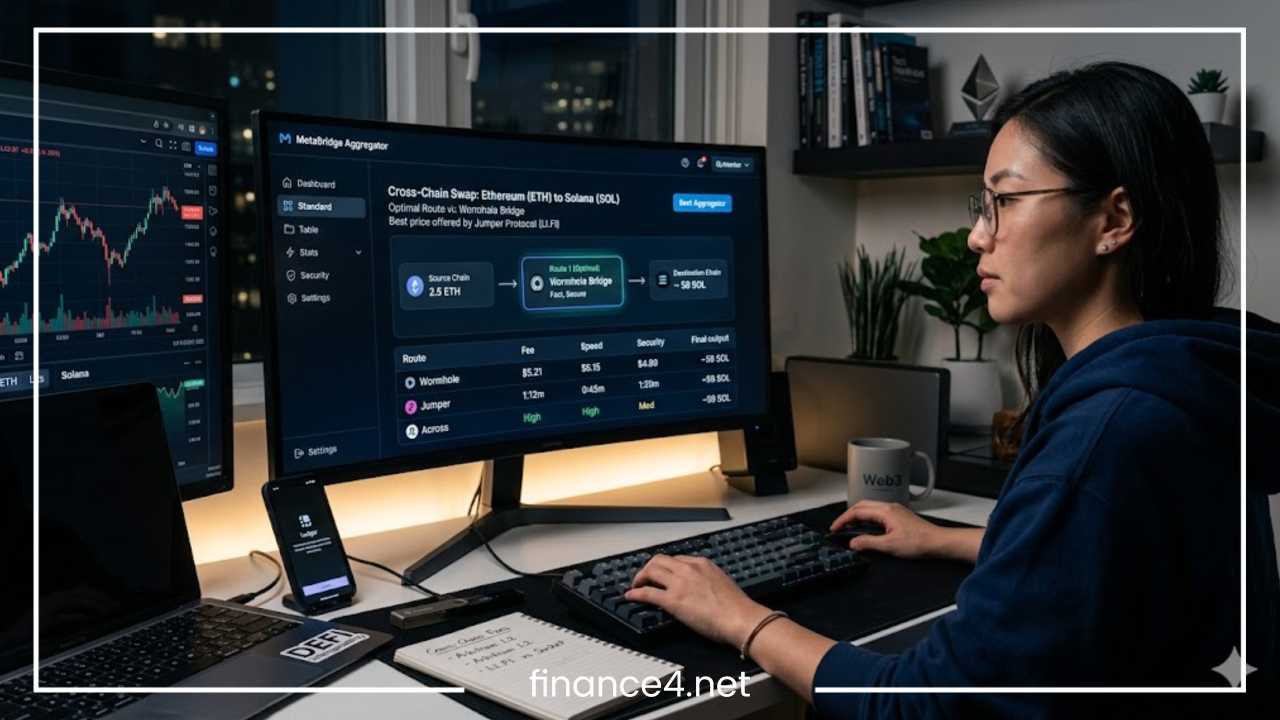
Best Aggregator for Bridging Cross-Chain DeFi Options | Fast & Secure Swaps
The decentralized finance landscape has evolved from a single-chain environment dominated by Ethereum into a sprawling, multi-chain ecosystem. Today, capital, innovation, and user activity are distributed across dozens of networks, including Layer 1 blockchains like Solana, Avalanche, and BNB Chain, alongside Layer 2 scaling solutions such as Arbitrum, Optimism, and Base. While this multi-chain expansion offers users unprecedented opportunities for high yields, low fees, and diverse financial instruments, it introduces a massive operational challenge: fragmented liquidity.
When liquidity is split across isolated blockchains, moving assets between networks becomes a complex, costly, and time-consuming process. In the early days of multi-chain exploration, traders had to manually navigate individual, native crypto bridges. This required interacting with multiple decentralized applications, converting tokens repeatedly, and manually calculating gas fees across separate chains. This fragmented workflow often resulted in high slippage, unexpected transfer delays, and exposing capital to unnecessary security vulnerabilities.
Cross-chain bridge aggregators solve this fundamental problem. Much like how travel aggregators scan hundreds of airlines to find the cheapest and fastest flight, a bridge aggregator analyzes dozens of cross-chain bridges and decentralized exchanges to discover the most efficient path for moving capital. By consolidating multi-chain liquidity into a single interface, these protocols eliminate the guesswork from cross-chain DeFi.
Using a sophisticated bridge aggregator allows market participants to access lower fees by avoiding congested routes, experience faster transaction settlement times, discover better exchange rates through optimized routing engines, minimize price slippage on large order sizes, and reduce smart contract risk by routing capital through verified, highly secure protocols. Ultimately, bridge aggregators have transitioned from a luxury tool for advanced traders to a foundational piece of infrastructure required for the smooth operation of modern web3 applications.
What Is a Cross-Chain Bridge Aggregator?
To understand the value of a cross-chain bridge aggregator, it is helpful to contrast it with traditional infrastructure operating within the decentralized finance space. A standard blockchain bridge is a singular, direct pipeline built to connect two specific networks or move assets via a rigid, predetermined mechanism. For instance, a native bridge might lock an asset on Ethereum and mint a wrapped equivalent on a Layer 2 network. These traditional bridges operate in silos; they do not communicate with competitive networks, nor do they adjust their pricing based on external market conditions.
A decentralized exchange aggregator, on the other hand, operates entirely within the boundaries of a single blockchain. It sources liquidity from dozens of automated market makers on that specific network to find the best trading price for a token swap, but it cannot move those assets to an external blockchain.
A cross-chain bridge aggregator combines the power of these two technologies while introducing a higher layer of abstract logic. It serves as a comprehensive meta-layer that connects to multiple independent bridges, liquidity networks, and decentralized exchange routers simultaneously. Instead of forcing a user to manually research whether a native bridge, an optimistic bridge, or a liquidity relayer offers the best rate at any given moment, the aggregator utilizes a programmatic routing engine to scan the entire decentralized market in real time.
The core architecture of a bridge aggregator relies on three core components working in tandem:
-
Routing Engines: Algorithmic protocols that calculate every mathematical permutation of a cross-chain transaction. The engine evaluates asset availability, protocol fees, current gas prices across both the source and destination chains, and historical settlement speeds to determine the absolute fastest or most cost-effective path.
-
Liquidity Sourcing: Rather than holding proprietary pools of capital, aggregators tap into external pools across the entire industry. They pull liquidity from automated market makers, private market makers, just-in-time liquidity providers, and third-party bridging protocols to fulfill transactions of any volume.
-
Smart Contract Automation: A unified contract architecture that wraps complex multi-step processes into a single click for the end user. If a transaction requires swapping Token A to Token B on the source chain, bridging Token B to the destination chain, and then swapping Token B to Token C, the aggregator automates this entire sequence, shielding the user from the underlying complexity.
Through this infrastructure, bridge aggregators serve as the backbone of blockchain interoperability, transforming a fragmented network of isolated codebases into a fluid, cohesive internet of value.
Why Cross-Chain Bridging Matters in DeFi
The core economic philosophy of decentralized finance revolves around capital efficiency: the ability to deploy assets where they can generate the highest possible return with the lowest frictional cost. However, because different blockchains excel at different use cases, capital cannot remain static.
An investor might hold core capital in stablecoins or blue-chip assets on Ethereum due to its institutional-grade security. Yet, that same investor may notice an incredibly lucrative yield farming opportunity on Arbitrum, a high-interest lending pool on Base, a newly launched liquid staking derivative on Solana, or a highly liquid trading pair on BNB Chain or Polygon. To capture these opportunities, capital must move dynamically across networks.
Without an aggregated system, moving assets efficiently is restricted by severe friction points:
-
High Gas Fees: Initiating multiple manual swaps and bridging transactions during times of high network traffic can lead to compounding gas costs that completely wipe out the profit margins of the intended DeFi strategy.
-
Bridge Delays: Traditional optimistic bridging protocols often require lengthy challenge periods for fraud proofs, which can trap user capital for hours or even days.
-
Failed Transactions: Slippage miscalculations or sudden liquidity drops mid-route can cause a manual multi-chain transaction to fail, leaving funds stranded in intermediate token formats on unfamiliar networks.
-
Fragmented Liquidity: A specific cross-chain bridge might have deep liquidity for wrapped Bitcoin but completely lacks depth for stablecoins, forcing users to execute suboptimal trades that incur massive price impact.
By neutralizing these pain points, bridge aggregators ensure that capital can flow instantly to where it is valued most, lowering the barrier to entry for retail participants and allowing institutional market makers to rebalance portfolios with surgical precision.
How Bridge Aggregators Work
The operational lifecycle of a cross-chain aggregator transaction is an elegant sequence of cryptographic verification, liquidity matching, and automated execution. While the user experience appears seamless, the underlying protocol executes a highly complex series of computations within a matter of seconds.
The journey begins when a user connects their web3 wallet to the aggregator interface and selects their source asset on the starting network alongside their desired destination asset on the target network. The user specifies the exact volume of capital they wish to transfer.
Once this data is inputted, the aggregator’s routing engine initiates a comprehensive scan. It queries the application programming interfaces and smart contract states of every integrated bridge and decentralized exchange. The protocol evaluates the available liquidity across multiple paths, calculating the exact breakdown of gas costs on both chains, the protocol fees charged by intermediate bridges, the expected speed of each transfer path, and the projected slippage or price impact of any associated token swaps.
The aggregator then presents the user with an array of optimized options. Typically, the interface categorizes these routes based on user priorities: the absolute cheapest route, the absolute fastest route, or a balanced path that minimizes risk and cost.
Once the user approves the transaction and signs it with their private key, the smart routing engine handles the execution phase through one of several advanced methodologies:
-
Liquidity Pools: The aggregator routes funds through decentralized networks where liquidity providers maintain pools of identical assets on multiple chains, allowing for a rapid swap of local tokens for remote tokens.
-
Messaging Protocols: The system utilizes underlying cross-chain communication frameworks to securely pass arbitrary data and state changes between distinct blockchains, certifying that an asset has been destroyed or locked on the source chain before validating its release on the destination network.
-
Intents-Based Bridging: A sophisticated model where the user defines an intended end-state, such as wanting one thousand USDC on Arbitrum in exchange for their Ether on Ethereum, rather than specifying the exact pathway. Specialized market participants known as solvers or relayers compete to fulfill this intent immediately using their own capital, taking on the underlying bridging risk themselves in exchange for a small premium.
-
Swap and Bridge in a Single Transaction: If the user holds a non-standard asset, the aggregator routes the token through a local decentralized exchange to convert it into a highly liquid bridging asset, sends it across the optimal bridge, and swaps it into the final requested token on the destination chain, all executing via a single programmatic flow.
This process frequently utilizes atomic swaps, where either the entire multi-chain sequence completes successfully or the transaction reverts completely, preventing situations where capital becomes lost or stranded in an incomplete state mid-way through a bridge route.
Key Features to Look for in the Best Cross-Chain Aggregator
Not all bridge aggregators are created equal. When evaluating which platform to integrate into your daily decentralized finance workflows, several critical pillars must be analyzed to ensure your capital remains secure, your transactions execute quickly, and your fees are minimized.
Security
Security is the absolute baseline of any cross-chain interaction. Because bridges are high-value targets for malicious actors, a premier aggregator must prioritize defense-in-depth. Look for platforms that undergo continuous, rigorous smart contract audits by reputable, top-tier security firms. The platform’s architecture should be entirely non-custodial, meaning the protocol never takes custody of your private keys or assets; funds move strictly through immutable smart contracts. Furthermore, advanced aggregators integrate Maximum Extractable Value protection, shielding users from front-running bots that attempt to exploit trade orders during the cross-chain routing process.
Speed
In the volatile cryptocurrency markets, execution speed can represent the difference between a highly profitable trade and a missed opportunity. The best aggregators utilize advanced route optimization algorithms that filter out notoriously slow networks or congested bridging mechanisms. By prioritizing intents-based architectures and rapid liquidity relayers, top-tier platforms can achieve near-instant settlement, often moving assets across chains in under a minute.
Low Fees
Friction costs can silently erode portfolio performance. A high-quality aggregator must provide exceptional gas optimization within its smart contracts, minimizing the computational overhead required to execute multi-chain swaps. The platform should clearly display a complete, transparent breakdown of all underlying costs—including source chain gas, bridge protocol fees, destination chain execution fees, and any aggregator service fees—before the user signs the transaction.
Multi-Chain Support
An aggregator is only as valuable as the networks it connects. The leading protocols in the space feature extensive cross-chain compatibility, bridging the gap between Ethereum Virtual Machine networks like Arbitrum, Base, and Polygon, and non-EVM ecosystems such as Solana, Bitcoin Layer 2s, and Cosmos-based chains. This comprehensive coverage ensures users can navigate the entire web3 ecosystem from a single command center.
Deep Liquidity
Deep liquidity integration is essential for mitigating the risks of price slippage. When an aggregator can draw from billions of dollars in collective liquidity across hundreds of integrated decentralized exchanges and capital pools, it guarantees that even high-volume institutional transfers can be executed with minimal market impact or unfavorable price deviations.
User Experience
A fragmented codebase should not mean a confusing interface. The premier aggregators place immense focus on clean, intuitive frontend design. Essential UX characteristics include native integration with a vast array of hardware and software wallets, real-time transaction tracking modules that show the exact step-by-step progress of your assets across blockchains, and simplified, one-click execution flows that make cross-chain interactions feel as simple as a local token swap.
Best Aggregators for Bridging Cross-Chain DeFi Options
To provide a clear understanding of the current cross-chain interoperability landscape, let us analyze the premier bridge aggregators and cross-chain routers dominant in the market today. Each platform utilizes unique architectural designs to optimize for speed, security, and network coverage.
LI.FI
LI.FI is an institutional-grade cross-chain bridge and decentralized exchange aggregation protocol. It functions as a powerful middleware solution, linking dozens of independent bridging networks and decentralized exchanges together.
-
Supported Chains: Extensive support across more than 20 EVM chains (including Ethereum, Arbitrum, Optimism, Base, Linea, and Polygon) alongside full native integration with major non-EVM ecosystems like Solana.
-
Strengths: Exceptional developer infrastructure and highly advanced smart routing algorithms. LI.FI doesn’t just provide a consumer-facing app; its robust application programming interface and software development kits power the cross-chain functionality of many of the industry’s most popular wallets and DeFi dashboards.
-
Ideal Use Case: Suited for both retail power users who demand the most cost-effective routing and developers looking to embed enterprise-grade cross-chain swapping directly into their own decentralized applications.
-
Performance Profile: Offers highly competitive fees by dynamically splitting routes across multiple liquidity sources, coupled with exceptional security protocols that include real-time monitoring of underlying bridge health.
Socket
Socket is a modular interoperability protocol that serves as a foundational data and asset delivery layer for the multi-chain ecosystem. Rather than acting as a simple superficial wrapper, Socket unifies bridging, asset swapping, and data transmission into a singular developer framework.
-
Supported Chains: Deep, comprehensive integration with all major Layer 2 scaling networks built on top of Ethereum, alongside core Layer 1 ecosystems.
-
Strengths: Its modular architecture allows applications to customize their cross-chain parameters based on specific security and speed preferences. Socket is renowned for its cross-chain framework and its power behind major consumer wallet integrations, allowing users to move funds seamlessly without ever leaving their primary wallet interface.
-
Ideal Use Case: Advanced decentralized finance users who prioritize modular safety profiles and application developers seeking to construct custom, chain-agnostic user experiences.
-
Performance Profile: Known for exceptional speed optimization, particularly when routing assets through native rollups and highly optimized layer-2 data pathways.
Rango Exchange
Rango Exchange stands out as a powerful multi-chain aggregator designed explicitly to conquer the divide between vastly different blockchain architectures. It acts as a universal translator for the crypto space, seamlessly uniting ecosystems that utilize entirely different cryptographic standards.
-
Supported Chains: Outstanding coverage across EVM networks, Bitcoin native layers, Solana, the Cosmos Inter-Blockchain Communication ecosystem, and TRON.
-
Strengths: Unrivaled breadth of network coverage. Rango can confidently calculate complex multi-step routing paths across radically different consensus mechanisms, such as converting a native Cosmos token into an asset on an Ethereum Layer 2 in a clean, automated sequence.
-
Ideal Use Case: Diversified multi-chain investors who maintain active portfolios across entirely separate blockchain frameworks and need to move capital outside the standard EVM sandbox.
-
Performance Profile: While multi-ecosystem hops can occasionally take longer due to varying block confirmation times on underlying networks, Rango maximizes capital efficiency by finding pathways that traditional EVM-only aggregators cannot see.
XY Finance
XY Finance is a prominent cross-chain decentralized exchange and bridge aggregator optimized for rapid, cost-effective asset deployment. The protocol focuses on eliminating liquidity barriers to provide ultra-fast swap operations.
-
Supported Chains: Broad support for over 20 distinct blockchains, focusing heavily on high-growth EVM networks, gaming-centric chains, and emerging Layer 2 solutions.
-
Strengths: Exceptionally clean, user-centric frontend interface coupled with proprietary liquidity pools that run alongside aggregated third-party sources to facilitate rapid settlement.
-
Ideal Use Case: Yield farmers and active retail traders who need to instantly rotate capital into fast-moving market opportunities or trending liquidity incentives across diverse networks.
-
Performance Profile: Focuses heavily on reducing transaction execution latency, offering swift, highly reliable swaps with highly optimized gas configurations.
Rubic
Rubic is an established multi-chain swap protocol that aggregates thousands of tokens across an extensive array of blockchains, providing an all-in-one platform for cross-chain trading.
-
Supported Chains: Broad ecosystem reach covering more than 40 distinct blockchains, encompassing EVM networks, Solana, TRON, and Bitcoin layers.
-
Strengths: Features a highly versatile One-Click cross-chain swap widget that can be easily integrated into any web environment. It also incorporates built-in provider rating systems to give users insight into the reliability of different underlying routes.
-
Ideal Use Case: Everyday DeFi participants seeking an uncomplicated, highly comprehensive single platform capable of swapping nearly any crypto asset in existence across any network.
-
Performance Profile: Provides a highly flexible balance between transaction cost and settlement speed, allowing users to manually filter routes based on personal transaction preferences.
Stargate
Stargate is an entirely unique entity within this list. Rather than operating strictly as a superficial aggregator of third-party contracts, Stargate is a composable liquidity transport layer built on top of native cross-chain messaging technology. It serves as a primary source of institutional-grade liquidity that other aggregators frequently route through.
-
Supported Chains: Comprehensive native deployment across major Layer 1 and Layer 2 systems, including Ethereum, Arbitrum, Optimism, Base, BNB Chain, and Avalanche.
-
Strengths: Solves the core bridging trilemma by offering instant guaranteed finality, unified liquidity pools across networks, and the ability to transfer native assets directly rather than relying on risky wrapped token mechanisms.
-
Ideal Use Case: High-volume institutional traders and capital-preservation-focused investors who demand absolute certainty of transaction completion with zero wrapped token risk.
-
Performance Profile: Delivers exceptional safety profiles and predictable, low-overhead transaction fees, though it is bound to the specific asset pools maintained natively within the Stargate network.
Across Protocol
Across Protocol is an incredibly innovative, fast, and secure optimistic cross-chain bridge optimized specifically for moving capital between Ethereum and its associated Layer 2 rollups. Like Stargate, it acts as a premier underlying liquidity network that aggregators lean on for optimal performance.
-
Supported Chains: Hyper-focused on the Ethereum ecosystem and all dominant Layer 2 scaling solutions, including Arbitrum, Optimism, Base, and Polygon.
-
Strengths: Utilizes an advanced intent-based architecture powered by an independent network of liquidity relayers. Relayers fulfill user requests instantly using their own funds and are repaid later through an optimistic verification loop, absorbing the wait times on behalf of the end user.
-
Ideal Use Case: Cost-conscious DeFi traders executing high-frequency movements between Ethereum and Layer 2 networks who demand the absolute lowest fees and fastest settlement times.
-
Performance Profile: Regularly clocks the fastest transfer speeds and lowest fee metrics across the entire Layer 2 landscape due to its gas-efficient architecture and highly competitive relayer marketplace.
Aggregator Comparison Summary
| Aggregator | Primary Ecosystem Focus | Supported Chains | Key Architectural Advantage | Best For |
| LI.FI | EVM + Solana | 20+ Networks | Powerful API and SDK integration with top routing logic | Developers & Power Traders |
| Socket | EVM Layer 2 Scaling | 15+ Networks | Modular infrastructure with deep wallet embedment | Custom App Integration |
| Rango Exchange | Multi-Architecture | 50+ Networks | Connects EVM, Cosmos, Solana, and Native Bitcoin | Cross-Ecosystem Investors |
| XY Finance | EVM + Gaming Chains | 20+ Networks | Unified aggregator + native liquidity provision | Speed-Focused Yield Farmers |
| Rubic | Universal Multi-Chain | 40+ Networks | Mass token coverage with highly flexible user widgets | General Retail Traders |
| Stargate | Omnichain Messaging | 10+ Networks | Native asset transfers with instant guaranteed finality | Large-Scale Capital Allocators |
| Across Protocol | Intent-Based Rollups | Ethereum + L2s | Relayer network absorbing bridging latency | Ultra-Low-Fee L2 Swaps |
Security Risks in Cross-Chain Bridging
While cross-chain bridge aggregators provide unparalleled convenience and efficiency, it is vital to acknowledge that interacting with cross-chain infrastructure carries unique risks. Bridges represent massive honey pots of consolidated capital, making them prime targets for sophisticated global hackers and exploits. Understanding these vulnerabilities is the first step toward safeguarding your digital assets.
The security threats inherent to cross-chain operations can be categorized into four primary vectors:
-
Smart Contract Vulnerabilities: The code that governs cross-chain locks, mints, and token burns is highly complex. Even minute flaws, logic errors, or edge-case oversights in the smart contracts can be exploited by malicious entities to drain entire liquidity pools.
-
Bridge Hacks & Protocol Exploits: Historical data reveals that structural bridge hacks account for some of the largest losses in decentralized finance history. These often occur when attackers discover vulnerabilities in the asset wrapping mechanisms or lock/unlock verification scripts.
-
Validator Compromise: Many bridges rely on a multi-signature consensus network or a dedicated set of external validators to confirm that an asset has been deposited on the source chain before releasing it on the destination chain. If a malicious actor gains control of a threshold majority of these validator private keys, they can authorize fraudulent transfers, effectively stealing the underlying collateral.
-
Liquidity Risks: During times of extreme market volatility or network stress, the liquidity pools underlying certain bridge routes can become severely depleted. This can lead to situations where a cross-chain swap stalls mid-route, or executes at far worse rates than initially quoted, leaving the user exposed to extended asset lockups.
To navigate the multi-chain ecosystem using the safest bridge aggregator practices, users should adhere to strict operational guidelines:
-
Verify All URLs and Smart Contracts: Phishing attacks are rampant. Always ensure you are interacting with the official, verified web application interface of the aggregator.
-
Utilize Audited and Time-Tested Protocols: Prioritize routing paths through bridges and aggregators that have documented histories of comprehensive multi-firm audits and substantial total value locked, which serves as a metric of real-world stress testing.
-
Initiate Small Test Transactions: When moving a significant volume of capital across an unfamiliar route or into a new network, always execute a small, low-value test transaction first to confirm everything settles successfully before sending your full balance.
-
Isolate Capital via Hardware Wallets: Never store your primary assets in hot software wallets connected to unverified web browsers. Manage your cross-chain approvals exclusively through a secure hardware wallet, and routinely revoke smart contract permissions for applications you are no longer actively using.
How to Choose the Right Bridge Aggregator
Selecting the ideal platform depends heavily on your specific trading objectives, capital size, and technical familiarity. There is no singular one-size-fits-all solution; rather, different aggregators excel under different conditions.
For Lowest Fees
If your absolute priority is minimizing frictional costs, look for intent-based aggregators or platforms that integrate highly competitive relayer networks, such as Across Protocol or LI.FI. These platforms specialize in optimizing gas usage and eliminating unnecessary intermediary contract hops, making them ideal for small-to-medium retail traders who cannot afford to have their profits consumed by network fees.
For Fastest Transactions
When speed is paramount—such as during a rapid market selloff or the time-sensitive launch of a new DeFi product—choose aggregators that prioritize intents-based routing or platforms like XY Finance and Stargate. By bypassing the multi-hour finality delays of standard optimistic architecture, these protocols can settle cross-chain assets in seconds.
For Advanced Traders
Professional traders managing institutional-grade volume require deep liquidity networks, advanced slippage controls, and comprehensive MEV protection. For this user segment, LI.FI or Stargate represent the gold standard, providing the deep capital integration necessary to move millions of dollars across networks with minimal price impact.
For Beginners
If you are new to the multi-chain landscape, prioritize user experience and simplicity above all else. Platforms like Rubic provide incredibly clear, step-by-step visual walk-throughs of your transaction’s progress, reducing the anxiety of waiting for cross-chain transfers to settle.
For Multi-Chain DeFi Users
For investors whose strategies require moving outside the standard boundaries of the Ethereum Virtual Machine, Rango Exchange is the definitive choice. Its unique ability to seamlessly link Solana, Cosmos, Bitcoin, and EVM layers under a single interface eliminates the need to maintain multiple disjointed bridging applications.
Future of Cross-Chain DeFi Aggregation
The current paradigm of cross-chain bridging—where users must manually think about separate networks, maintain multiple native gas tokens, and manage individual network configurations—is rapidly transitioning toward a more elegant architecture known as chain abstraction. In the near future, the complex machinery of underlying blockchains will become entirely invisible to the end user.
This evolution is driven by several transformative trends:
-
Intent-Based Execution: Instead of micromanaging the exact technical path of a swap, users will simply state their desired economic outcome. Advanced solver networks will compete globally to fulfill that intent instantly, absorbing all underlying routing complexities, gas management, and cross-chain friction on behalf of the user.
-
Account Abstraction: Smart accounts will enable users to maintain a single unified wallet balance across the entire internet of blockchains. Gas fees will be paid automatically in whatever token the user holds, eliminating the tedious requirement of holding native tokens like Ether, SOL, or BNB on every single network just to process transactions.
-
Omnichain Liquidity Layers: Technologies and specialized messaging frameworks are allowing protocols to build native, omnichain tokens that exist across multiple networks simultaneously without requiring risky wrapping or traditional lock-and-mint mechanisms.
-
AI-Driven Route Optimization: Machine learning algorithms will increasingly be integrated into aggregator backend architectures. These systems will predict network congestion, anticipate gas spikes, and dynamically reroute capital across hundreds of pathways before latency occurs, securing unprecedented levels of transaction efficiency.
As these trends converge, cross-chain aggregation will shift from an active user intervention tool into a passive, silent infrastructure layer, realizing the ultimate goal of decentralized finance: a completely unified, frictionless global financial network.
Final Thoughts
The multi-chain expansion of decentralized finance has unlocked immense financial innovation, but it has also introduced a fragmented ecosystem that requires robust infrastructure to navigate safely and efficiently. Cross-chain bridge aggregators have emerged as an indispensable component of this landscape, transforming a complicated web of isolated networks into a fluid, accessible financial marketplace.
By automating the complex processes of liquidity sourcing, route optimization, and smart contract execution, these protocols empower users to prioritize what truly matters: capital efficiency, transaction security, and execution speed. Whether you are a retail user seeking low-fee transfers across Ethereum Layer 2s, an advanced trader moving high volumes with minimal slippage, or an explorer venturing into diverse non-EVM ecosystems, utilizing a top-tier bridge aggregator is essential for optimizing your decentralized operations.
As the industry advances toward complete chain abstraction and seamless omnichain liquidity, the barriers dividing blockchains will continue to dissolve. To stay ahead of the curve, protect your capital, and maximize your returns, take the time to compare bridge aggregators, select the platform that aligns with your specific strategy, optimize your multi-chain swaps, and always prioritize security above all else when bridging assets across the decentralized frontier.
Frequently Asked Questions
What is the cheapest crypto bridge aggregator for low fee swaps?
The cheapest crypto bridge aggregator is one that pulls real-time routing data from multiple protocols to find the path with the lowest combination of gas fees, protocol fees, and slippage. Aggregators like Jumper (by LI.FI), Rango Exchange, and RocketX are widely considered the best options. Instead of relying on a single bridge, they scan dozens of liquidity pools to find the absolute most cost-effective route, which is particularly vital when executing cross-chain swaps under $100 where fixed gas costs can easily eat up your entire transaction.
What is the safest cross chain bridge to use in DeFi?
When looking for the safest cross-chain bridge, security experts recommend using canonical bridges (the official bridges built by the networks themselves, like the Arbitrum Bridge or Optimism Gateway) for EVM-to-EVM transfers because they rely directly on the underlying security of the networks. For cross-ecosystem transfers (like Ethereum to Solana or Sui), battle-tested messaging protocols like Wormhole and LayerZero (Stargate) are considered the most secure options. They have undergone multiple rigorous smart contract audits, hold deep liquidity, and utilize decentralized validator networks to eliminate single points of failure.
How do I bridge Bitcoin to Solana without using a centralized exchange?
To bridge native BTC to Solana without using a centralized exchange (CEX) like Binance or Coinbase, you must use a cross-chain aggregator that supports UTXO (Bitcoin’s native architecture) and non-EVM chains.
-
Aggregators like Rango Exchange or Symbiosis allow you to connect a native Bitcoin wallet (like Leather or Unisat) alongside a Solana wallet (like Phantom).
-
The protocol routes your native BTC through a decentralized liquidity pool, wraps it into a Solana-compatible asset (like WBTC or tBTC), and deposits it directly into your Solana wallet in a single, non-custodial workflow.
Why do crypto bridge fees change, and how can I minimize them?
Crypto bridge fees fluctuate constantly based on network congestion (on both the source and destination chains) and the liquidity depths of the specific token pools you are trading. To minimize these costs:
-
Compare Aggregators: Always check final payout amounts across different platforms, as the “advertised fee” rarely includes slippage or destination network gas bundles.
-
Time Your Transmissions: Avoid bridging during peak Ethereum gas hours (typically mid-day US time).
-
Use Stablecoins: Whenever possible, bridge high-liquidity assets like USDC or USDT, which utilize highly optimized frameworks like Circle’s CCTP (Cross-Chain Transfer Protocol) to offer 1:1, low-slippery asset transfers.
What happens if my cross chain bridge transaction gets stuck?
If your cross-chain bridge transaction gets stuck, it is usually because of a sudden spike in gas fees on the destination chain or a temporary desynchronization between validator nodes. Your funds are almost never lost; they are simply waiting for confirmation.
-
To fix this, copy your transaction hash from the source chain and paste it into a cross-chain explorer like Wormhole Scan or LI.FI Explorer.
-
Most reputable bridge aggregators provide a built-in tracking interface with a “claim” or “resume” button if a manual signature is required to push the stuck transaction through.