Best Bridging Aggregator for Cardano
 by
by 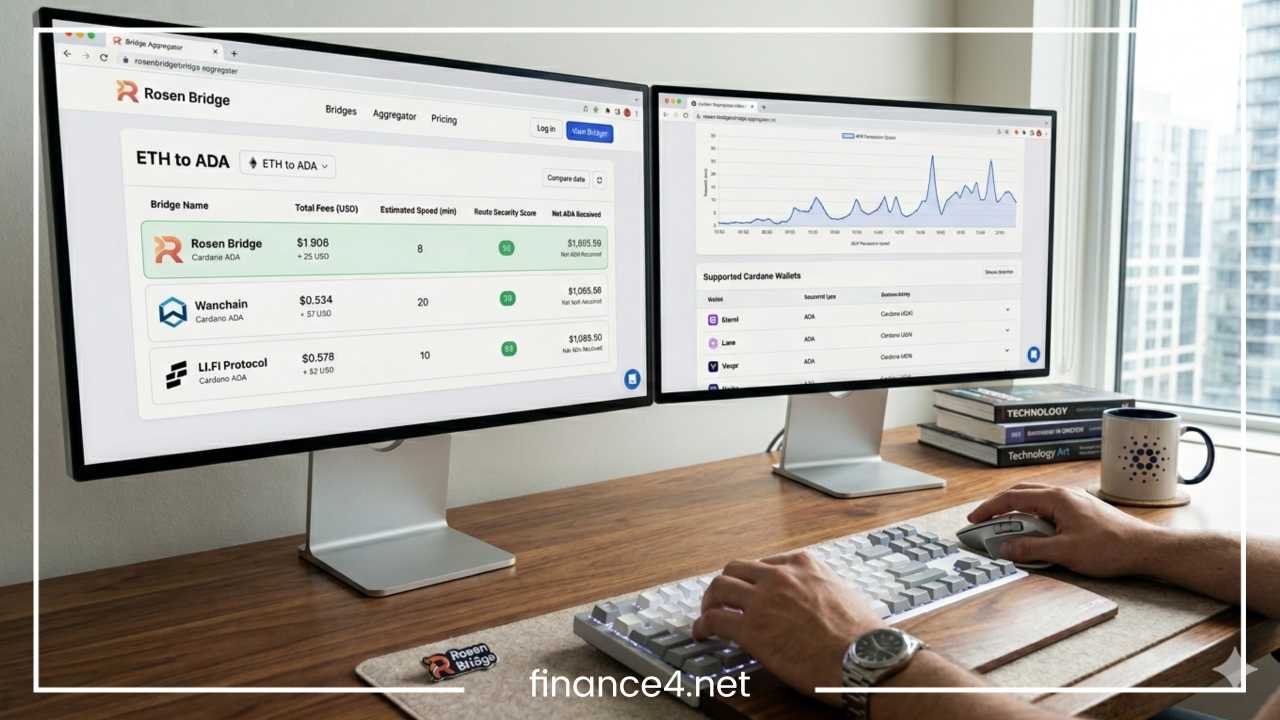
Best Bridging Aggregator for Cardano: Compare Fees & Speed
The Cardano blockchain has long been celebrated for its rigorous academic approach, its unique Extended Unspent Transaction Output (EUTxO) model, and its commitment to decentralization and security. However, as the broader decentralized finance (DeFi) landscape has evolved, a significant challenge has emerged: isolation. For a long time, Cardano operated as a high-security island, largely disconnected from the massive liquidity pools found on Ethereum, BNB Chain, and various Layer 2 solutions.
Interoperability—the ability for different blockchain networks to communicate and exchange value—has become the cornerstone of modern Web3. Without it, assets remain trapped within their native ecosystems, limiting the utility of the tokens and the growth of decentralized applications (dApps). For Cardano to thrive, it requires robust “highways” that allow capital to flow seamlessly in and out of its ecosystem.
This is where bridging technology comes into play. While individual bridges provide the basic infrastructure for moving assets, the landscape has become increasingly fragmented and complex. A user might find dozens of ways to move USDT from Ethereum to Cardano, each with different costs, wait times, and security risks. To solve this complexity, bridging aggregators have emerged. These platforms act as the ultimate optimization layer, ensuring that users can navigate the multi-chain world with maximum efficiency and minimal friction.
What Is a Bridging Aggregator?
A bridging aggregator is a sophisticated software layer that sits on top of multiple individual cross-chain bridges. Its primary function is to serve as a search and execution engine for cross-chain transactions. Instead of a user having to manually check five different bridges to see which one offers the lowest fee or the fastest transfer time, the aggregator does this work automatically in the background.
To understand the value of an aggregator, it is essential to distinguish between a bridge and an aggregator. A bridge is the actual infrastructure or protocol that facilitates the transfer of data or assets between two distinct blockchains. An aggregator, on the other hand, is a meta-protocol. It does not necessarily own the liquidity or the “vaults” used for the transfer; instead, it plugs into various bridges (and often Decentralized Exchanges) to find the most efficient path for a user’s request.
Aggregators work by scanning the current state of the market across their integrated partners. When a user requests a swap from, for example, USDC on Polygon to ADA on Cardano, the aggregator evaluates several variables:
The cost charged by the underlying bridge plus the network gas fees on both the source and destination chains.
The price impact of the trade, especially if the bridge involves swapping assets through a liquidity pool.
The estimated time until the transaction reaches finality on the destination chain.
Whether the bridge has enough capital to facilitate the transfer without a significant delay.
It is important to note that while aggregators provide a more user-friendly and efficient interface, they do not eliminate the underlying risks. Because an aggregator routes your funds through a specific bridge, the user is still subject to the security model and potential vulnerabilities of that specific bridge.
Why Cardano Needs Bridging Aggregators
Cardano occupies a unique position in the blockchain world, which makes the need for aggregators particularly acute. Most of the DeFi world is built on the Ethereum Virtual Machine (EVM) model, which uses an account-based system. Cardano’s EUTxO model is fundamentally different. This architectural gap means that building a bridge to Cardano is technically more challenging than bridging between two EVM chains like Ethereum and Avalanche.
Furthermore, Cardano has historically faced challenges with liquidity fragmentation. Even as its native DeFi ecosystem grows with platforms like Minswap and Indigo, much of the world’s stablecoin liquidity remains on other chains. Bridging aggregators are essential for bringing that liquidity into Cardano to power its lending protocols, stablecoin minting, and yield farming opportunities.
Common use cases for Cardano bridging include:
Many users want to move their ADA to Ethereum or Arbitrum to participate in specific DeFi protocols or to use ADA as collateral in multi-chain lending markets.
Cardano-native stablecoins are growing, but the ability to bring in USDC or USDT from other chains is vital for providing a stable medium of exchange within the Cardano ecosystem.
As gaming and digital art move toward a multi-chain future, users need ways to move value across chains to purchase specific assets or participate in cross-chain gaming economies.
Essentially, bridges and their aggregators act as the circulatory system for the crypto economy. Without them, Cardano would remain an isolated ecosystem; with them, it becomes a vital organ in the global body of decentralized finance.
Key Factors to Compare
When evaluating the best bridging aggregator for Cardano, users must look beyond the user interface. There are five critical pillars that determine whether a bridging experience is successful or costly.
Fees
The cost of bridging is often the most significant deterrent for users. Fees are generally comprised of three parts. First are the gas fees on the source chain, which can be exorbitant on Ethereum during periods of high congestion. Second are the bridge fees, which are either a flat rate or a percentage of the transaction volume. Finally, there are the aggregator routing fees—the small premium paid for the convenience of finding the best route. A high-quality aggregator will show you a transparent breakdown of these costs before you click “confirm.”
Speed
Speed in bridging is defined by “time to finality.” This is the duration from when you send the transaction on the source chain to when the assets are usable on the destination chain. Some bridges rely on native liquidity pools and can complete transfers in minutes. Others use a “lock and mint” mechanism that requires many block confirmations on both chains to ensure security, which can take anywhere from twenty minutes to several hours. Aggregators allow you to prioritize speed if you are in a rush to catch a market move.
Security
Security is the most critical factor, yet the hardest for the average user to quantify. You must consider whether a bridge is custodial (managed by a central entity) or non-custodial (managed by smart contracts or a decentralized set of validators). You should also look at the validator model—does it use Multi-Party Computation (MPC) or a decentralized network of relayers? Historically, bridges have been the target of some of the largest hacks in crypto history, so using an aggregator that prioritizes audited and time-tested bridges is paramount.
Supported Chains
A bridging aggregator is only as good as the destinations it can reach. For Cardano users, the most important connections are usually to Ethereum, BNB Chain, Polygon, and Arbitrum. However, as the industry moves toward “app-chains” and specialized L2s, the ability to bridge to niche networks becomes a competitive advantage for an aggregator.
UX and Routing Intelligence
The user experience (UX) includes how well the platform handles “routing intelligence.” If a direct bridge is too expensive, can the aggregator find a “multi-hop” route? For example, it might bridge from Ethereum to a sidechain first, and then to Cardano, to save on total fees. Good aggregators also provide slippage protection, ensuring you don’t lose a significant portion of your trade to price fluctuations during the bridging process.
Types of Cardano Bridge Architectures
To use an aggregator effectively, you must understand what is happening under the hood. There are three primary ways assets move to and from Cardano.
Lock and Mint (Wrapped Assets)
This is the most traditional method. A user sends a native asset (like ETH) to a smart contract on the source chain, where it is locked. A representation of that asset (like wETH) is then minted on Cardano. When the user wants to go back, the wrapped asset is burned on Cardano, and the original asset is released on the source chain. While effective, this creates “wrapped asset risk”—if the bridge is hacked, the wrapped asset on Cardano may become unbacked and worthless.
Native Liquidity Bridges
These bridges do not mint new tokens. Instead, they maintain liquidity pools of the same asset on multiple chains. If you want to bridge USDC from Ethereum to Cardano, you deposit USDC into the Ethereum pool and withdraw USDC from the Cardano pool. This is generally faster and avoids the risk of unbacked wrapped assets, but it is limited by the amount of liquidity available in the pools.
Aggregator-Based Routing
This is the most advanced form. It doesn’t rely on a single method but rather uses an algorithm to determine which of the above methods is best at that specific moment. It might use a lock-and-mint bridge for a large, slow transfer where security is the priority, or a liquidity-based bridge for a small, fast transaction.
Top Bridging Aggregators for Cardano
The following platforms represent the leading edge of cross-chain connectivity for the Cardano ecosystem. Each has its own strengths, whether in security, speed, or the breadth of supported assets.
Rosen Bridge
Rosen Bridge has quickly become a favorite within the Cardano community due to its unique security architecture and Cardano-centric design. Unlike many bridges that rely on complex smart contracts on every chain, Rosen uses a “Watchers” and “Guards” system. Watchers monitor the various chains for events, while Guards (a smaller, highly secure set of nodes) verify those events and sign transactions.
What makes Rosen a top choice for Cardano is its focus on Ergo and Cardano interoperability, providing a very secure pathway for assets that doesn’t rely on the same vulnerabilities often found in EVM bridge contracts. It is optimized for high-security transfers and is increasingly being used as a backbone for routing liquidity into the Cardano DeFi space.
Wanchain
Wanchain is one of the most established names in the interoperability space. It operates its own Layer 1 blockchain that acts as a decentralized hub for bridging. Wanchain supports over 25 different chains, and its integration with Cardano is one of the most robust in the industry.
Wanchain uses a decentralized MPC (Multi-Party Computation) model, which ensures that no single entity has control over the locked assets. For Cardano users, Wanchain offers a direct L1-to-L1 bridging experience. It is often the best choice for users who want to bridge “blue-chip” assets like BTC, ETH, or DOT directly into the Cardano ecosystem without going through multiple intermediaries.
LI.FI Protocol
LI.FI is the quintessential “aggregator of aggregators.” While it started as an EVM-focused tool, its expansion into non-EVM chains has made it a powerful ally for Cardano users. LI.FI’s smart routing engine, known as Jumper, evaluates hundreds of bridge and DEX combinations to find the absolute cheapest or fastest route.
If you are looking for a platform that offers the most “meta” view of the market, LI.FI is the leader. It doesn’t just bridge; it swaps and bridges in a single transaction. This means you can go from native ETH on Ethereum to native ADA on Cardano in one click, with the protocol handling all the intermediate swaps in the background.
Symbiosis Finance
Symbiosis is a cross-chain liquidity protocol that functions as both a bridge and a swap aggregator. It specializes in “any-to-any” swaps, meaning it can handle virtually any token pair regardless of the chain. Symbiosis is particularly useful for Cardano users interacting with sidechains or Layer 2s. Its interface is designed for simplicity, making it a strong candidate for users who find the technical aspects of bridging intimidating.
Synapse Protocol
Synapse is widely regarded for its deep liquidity and high-speed transfers. It utilizes a cross-chain messaging protocol and specialized liquidity pools to facilitate near-instant transfers between supported chains. While its Cardano support is part of a broader multi-chain strategy, it remains a go-to for traders who prioritize execution speed and want to avoid the long waiting times associated with older bridge models.
Across Protocol
Across is built on an optimistic oracle model, which makes it one of the fastest and cheapest bridges for transfers between Layer 1 and Layer 2. While it primarily focuses on the Ethereum ecosystem, its relayer-based model is incredibly efficient. Relayers fulfill user bridge requests using their own capital and are reimbursed later. This means the user gets their funds almost instantly, while the “settlement” happens in the background.
Orbiter Finance
Orbiter Finance is a decentralized cross-chain bridge that focuses on Layer 2 assets. It is unique because it is “maker-based,” meaning that individual liquidity providers (makers) fulfill the bridge requests. This architecture allows for very low fees and very high speeds, as it bypasses the need for heavy smart contract interactions on the mainnet. It is an excellent choice for users moving assets between various Ethereum rollups and the Cardano ecosystem.
Axelar Network
Axelar is more than just a bridge; it is a full interoperability infrastructure layer. It provides a decentralized network and tools that allow dApp developers to create cross-chain experiences. For a Cardano user, Axelar’s technology often works behind the scenes in other aggregators. Its strength lies in its “Proof of Stake” security model, which utilizes a massive set of validators to ensure the integrity of cross-chain messages.
Fees Comparison
Comparing fees across aggregators is difficult because they change by the second based on network congestion. However, we can categorize them based on their general cost structure.
| Aggregator | Avg Fees | Hidden Costs | Best For |
| Rosen Bridge | Low to Medium | Minimal | High security & Ergo/Cardano native swaps |
| Wanchain | Low | Node incentive fees | Direct L1-to-L1 transfers |
| LI.FI | Variable | DEX slippage | Finding the absolute cheapest route |
| Symbiosis | Medium | Pool rebalancing fees | Simple “any-to-any” token swaps |
| Synapse | Medium | Liquidity provider fees | Speed and deep liquidity |
| Across | Very Low | Relayer gas offsets | Small to medium fast transfers |
Fees vary primarily because of the complexity of the route. An aggregator that has to perform three different swaps and two bridge hops will inherently be more expensive than a direct liquidity bridge. Always look for the “Net Received” amount in the interface, as this is the most honest representation of the total cost.
Speed Comparison
The speed of a bridge is often a trade-off with decentralization and security.
Most relayer-based bridges (like Across) or liquidity-pool bridges (like Synapse) fall into this category. They are ideal for active traders.
Most “lock and mint” bridges or those requiring high validator consensus (like Wanchain or Rosen) take longer because they wait for several confirmations on both sides to prevent “double-spend” attacks.
During times of high network congestion or low liquidity, some bridges can take significantly longer.
When using an aggregator, you will usually see an estimated time. It is a best practice to add a 25% buffer to this estimate, as blockchain network times are probabilistic, not deterministic.
Risks of Using Bridge Aggregators
Despite their benefits, bridge aggregators are not a “magic bullet” for safety. In fact, bridging is widely considered one of the most dangerous activities in DeFi.
The primary risk is a vulnerability in the bridge’s code. If a hacker finds a way to mint unbacked tokens or drain the liquidity vault, the assets you hold on the destination chain could lose their value. Because aggregators connect to many bridges, they indirectly expose you to many different codebases.
Another risk is “routing failure.” In a multi-step transaction, it is possible for the first half of the transaction to succeed while the second half fails (for example, due to a sudden spike in gas prices). In these cases, your funds might get stuck in an “intermediate” state, requiring manual intervention or the use of a bridge’s “rescue” tool.
Finally, there is the risk of liquidity shortages. If everyone tries to bridge from Cardano to Ethereum at the same time, the Ethereum side of a liquidity bridge might run dry, leading to massive slippage or failed transactions.
How to Choose the Best Aggregator
Choosing the right platform depends on your specific goals for that transaction.
If you are moving a small amount of money, the gas fees and bridge fees will eat up a large percentage of your capital. In this case, use an aggregator like Across or Orbiter that specializes in low-cost transfers.
If you are moving a significant portion of your portfolio, security is your only priority. Platforms like Wanchain or Rosen Bridge, which have long track records and robust validator models, are the preferred choice.
If you are trying to catch a time-sensitive opportunity in a Cardano DEX, use a liquidity-based aggregator like Synapse or LI.FI to get your funds across as fast as possible.
Before committing to a bridge:
-
Check the route preview to see exactly which bridges are being used.
-
Verify whether you are receiving a native asset or a wrapped version.
-
Always perform a small “test” transaction first to ensure the route is working as expected.
Step-by-Step: How to Bridge Assets from Cardano
If you are ready to move assets, the process generally follows this flow:
-
Connect Wallet: Visit your chosen aggregator and connect your Cardano wallet (like Nami, Eternl, or Vespr) and your destination wallet (like MetaMask).
-
Select Chains and Tokens: Choose Cardano as the source (or destination) and select the specific token you wish to move.
-
Choose Your Route: The aggregator will present several options. Compare the “estimated receive” amount and the “estimated time.”
-
Confirm and Authorize: You will need to sign a transaction in your Cardano wallet to send the assets to the bridge.
-
Monitor the Progress: Most aggregators provide a transaction tracker. You can watch as the transaction is “sent,” “confirmed,” and “received.”
-
Verify Arrival: Once the aggregator signals success, check your destination wallet to ensure the assets have arrived.
Future of Cardano Bridging
The future of Cardano’s interoperability is moving toward “Zero-Knowledge” (ZK) bridges. These use mathematical proofs to verify the state of one chain on another, eliminating the need for centralized validators or relayers. This would make bridging as secure as the underlying blockchains themselves.
Additionally, as Cardano’s “Sidechain” strategy matures, we will see more native interoperability where assets can move between the Cardano mainnet and specialized sidechains (like Midnight or Wanchain’s L1) with almost zero friction. Bridging aggregators will evolve to include these native pathways, making the distinction between “on-chain” and “cross-chain” almost invisible to the end user.
Final Thoughts
There is no single “best” bridging aggregator for Cardano; there is only the best aggregator for your specific transaction. For those who prioritize decentralization and the Cardano ethos, Rosen Bridge and Wanchain offer unparalleled security. For those seeking the lowest fees and the most efficient routes across the entire Web3 landscape, LI.FI and Across provide the cutting-edge technology needed to navigate a multi-chain world.
As the Cardano ecosystem continues to expand, these bridging tools will remain the essential infrastructure that connects ADA holders to the global liquidity of the crypto economy. By understanding the trade-offs between fees, speed, and security, you can bridge with confidence and take full advantage of everything the decentralized world has to offer. Always remember to do your own research and verify your routes before moving significant capital.
Frequently Asked Questions
What is the cheapest way to bridge from Ethereum to Cardano? The cheapest route often involves using an aggregator like LI.FI or Jumper to compare the current gas fees on Ethereum against available liquidity on Cardano. Because Ethereum gas fees fluctuate, these aggregators can find “off-peak” routes or suggest using a Layer 2 like Arbitrum as an intermediate step to significantly lower the total cost.
How do I bridge USDC to Cardano without high fees? To avoid high fees when moving stablecoins, look for aggregators that support USDCx (Cardano’s natively backed USDC) or liquidity-based bridges like Wanchain. Instead of a traditional “lock and mint” which might have high contract fees, native liquidity swaps allow you to exchange USDC on one chain for its equivalent on Cardano with minimal slippage.
Is Rosen Bridge safe for Cardano users? Rosen Bridge is considered one of the most secure options for Cardano because it avoids the “honeypot” risk of complex smart contracts on the destination chain. By using a decentralized system of Watchers and Guards on the Ergo blockchain to verify transactions, it provides a high-security threshold that is specifically designed to protect Cardano-native assets.
Can I bridge ADA directly to MetaMask? You cannot hold ADA directly on the Ethereum mainnet in a MetaMask wallet because MetaMask does not natively support the Cardano network’s EUTxO architecture. However, you can use a bridging aggregator to swap your native ADA for Wrapped ADA (wADA) on Ethereum or another EVM chain, which can then be managed via MetaMask.
What is the best Cardano wallet for cross-chain bridging? For the best experience, use a “Light Wallet” that supports CIP-30 standards, such as Eternl, Lace, or Vespr. These wallets integrate seamlessly with bridge aggregator interfaces, allowing you to sign cross-chain transactions and view bridged assets (like wrapped tokens) immediately upon arrival.
How long does it take to bridge assets to Cardano? Bridging speed depends on the architecture. Liquidity bridges (like Synapse) can take between 2 to 10 minutes. Security-focused bridges (like Rosen or Wanchain) may take 20 to 60 minutes, as they require more block confirmations to ensure the transaction is irreversible before releasing funds on Cardano.
Do I need ADA to pay for bridge fees? If you are bridging to Cardano, you typically pay the fees in the native gas token of the source chain (like ETH or BNB). If you are bridging from Cardano, you will need a small amount of ADA in your wallet to cover the transaction and processing fees.
What are the risks of using a bridge aggregator? The main risk is that an aggregator is only as safe as the underlying bridge it selects. While the aggregator finds the best price, your funds are still subject to the smart contract security of the bridge performing the move. Always check the “Route Details” to ensure the aggregator is using a reputable, audited protocol.