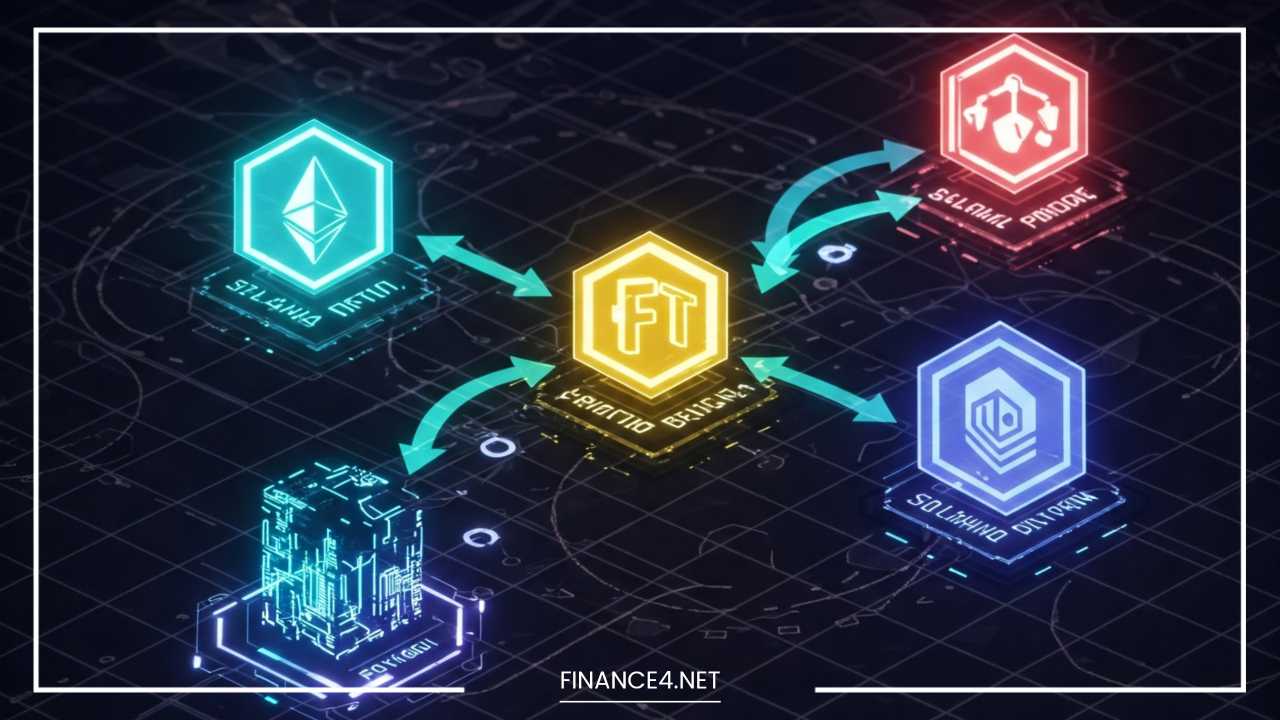
How to Create Multi-Chain Bridging Tokens
 by
by 
How to Create Multi-Chain Bridging Tokens | Step-by-Step Guide for Developers
The rapid evolution of the blockchain landscape has ushered in an era where single-chain applications often fall short of meeting the growing demands for scalability, liquidity, and user reach. This limitation has given rise to the crucial concept of interoperability, paving the way for multi-chain ecosystems. In this interconnected future, “bridging tokens” emerge as fundamental components, enabling seamless value transfer and interaction across disparate blockchain networks.
This article will delve into the intricacies of creating multi-chain bridging tokens, exploring their architecture, development process, security considerations, and the promising future they hold for a truly interconnected decentralized world.
What Are Multi-Chain Bridging Tokens?
At its core, a multi-chain bridging token is an asset that can exist and be utilized across multiple independent blockchain networks. While a “native token” lives solely on its originating chain (e.g., ETH on Ethereum, SOL on Solana), a “bridged token” is a representation of an asset that has been moved or “wrapped” from one blockchain to another.
The primary function of these tokens is to facilitate the flow of liquidity and functionality between otherwise isolated blockchain ecosystems. For instance, when you see “USDC on Solana” or “USDC on Polygon,” these are typically bridged versions of the native USDC stablecoin that originated on Ethereum. Similarly, “Wrapped Bitcoin (WBTC)” allows Bitcoin holders to utilize their BTC within the Ethereum DeFi ecosystem without directly transferring the native Bitcoin.
These tokens are critical for a myriad of use cases:
- DeFi (Decentralized Finance): Users can move assets to chains with lower transaction fees or access specific DeFi protocols and liquidity pools unavailable on their native chain.
- NFTs (Non-Fungible Tokens): Bridging NFTs allows them to be traded or utilized in gaming environments or marketplaces on different chains, expanding their reach and utility.
- Gaming: In-game assets can be bridged to different chains for lower transaction costs or to integrate with specific gamefi platforms.
- Cross-Chain Governance: Holders of governance tokens can participate in voting and decision-making across different deployments of a decentralized autonomous organization (DAO) on various chains.
Core Concepts and Terminology
Understanding the landscape of interoperability requires familiarity with several key concepts:
- Bridges vs. Interoperability Protocols: While “bridges” often refer to the specific mechanisms for transferring assets between two chains, “interoperability protocols” are broader frameworks that enable general communication, including arbitrary message passing, between multiple chains. Bridges can be built on top of or powered by these protocols.
- Wrapping and Pegging Mechanisms: The most common method for creating a bridged token is “wrapping.” This involves locking the native token on its source chain and then “minting” an equivalent wrapped version on the destination chain. The wrapped token is “pegged” 1:1 to the native asset, meaning its value should always reflect that of the original. When the wrapped token is burned on the destination chain, the native token is “unlocked” on the source chain.
- Custodial vs. Trustless Bridges:
- Custodial Bridges: Rely on a centralized entity or a small set of validators to hold the locked assets. Users must trust this central party not to misuse or lose funds. While often faster, they introduce a single point of failure and censorship risk.
- Trustless Bridges (Decentralized Bridges): Utilize cryptographic proofs, a network of independent validators, or multi-party computation (MPC) to secure the locked assets. These bridges aim to minimize reliance on any single entity, offering greater security and censorship resistance, albeit sometimes with higher complexity or costs.
- Notable Protocols: Several prominent protocols underpin the current multi-chain landscape:
- Wormhole: A generic message passing protocol enabling cross-chain communication and asset transfers, notably used for bridging tokens like Solana’s wrapped assets to other EVM chains.
- LayerZero: Focuses on secure and lightweight cross-chain message passing, allowing dApps to build “omnizain” functionality where smart contracts on different chains can communicate directly.
- Axelar: Provides a secure, programmable interoperability layer for Web3, enabling seamless asset transfers and general message passing across numerous chains.
- Multichain (formerly Anyswap): A well-known cross-chain router protocol for various tokens and NFTs. It has, however, faced significant security incidents, highlighting the risks in this space.
- Chainlink CCIP (Cross-Chain Interoperability Protocol): Offers a secure and reliable way for applications to send data, messages, and tokens across different blockchains, leveraging Chainlink’s decentralized oracle network.
Architecture of a Multi-Chain Token
The architecture of a multi-chain bridging token is not a monolithic entity but rather a distributed system interacting across various blockchains. Key components include:
- Smart Contracts on Each Chain:
- Original Chain (Source Chain): A smart contract is deployed that acts as a “locker” or “escrow” for the native token. When a user wishes to bridge tokens, they deposit them into this contract.
- Destination Chains: On each target chain where the token is to be bridged, a corresponding smart contract is deployed. This contract is typically a “minter” or “wrapper” that creates new instances of the bridged token. These minted tokens are usually ERC-20 compliant (for fungible tokens) or ERC-721 (for NFTs), allowing them to interact with the DeFi ecosystem on that chain.
- Messaging Layer (Cross-Chain Communication): This is the heart of the bridge, responsible for securely relaying information between the smart contracts on different chains. When tokens are locked on the source chain, an event is emitted. The messaging layer detects this event and securely transmits a message to the destination chain’s smart contract, instructing it to mint the equivalent bridged tokens. This layer can be powered by decentralized oracle networks, validator sets, or specialized interoperability protocols.
- Token Minting/Burning Logic or Locking/Unlocking:
- Lock-and-Mint: As described, tokens are locked on the source chain, and new identical tokens are minted on the destination chain. To reverse the process, the wrapped tokens are burned on the destination chain, and the original tokens are unlocked from the source chain’s escrow.
- Burn-and-Mint: Less common for direct bridging, this involves burning tokens on the source chain and then minting new ones on the destination. This is often seen in native token migrations or upgrades.
- Lock-and-Unlock (Liquidity Pools): Some bridges use liquidity pools on both sides. Tokens are locked on the source chain, and an equivalent amount is released from a pre-existing liquidity pool on the destination chain. This approach can be more capital-efficient but relies on sufficient liquidity.
- Relayer/Oracle Mechanisms: Off-chain entities (relayers or oracles) play a crucial role in monitoring events on one chain and transmitting verified information to another. They might be responsible for:
- Monitoring the source chain for token lock events.
- Verifying the validity of these events.
- Submitting transactions to the destination chain’s smart contract to trigger minting or unlocking.
- Ensuring the integrity and order of messages.
- Maintaining Supply Consistency and Security: A critical aspect of multi-chain token architecture is ensuring that the total supply of the asset remains consistent across all chains. For a lock-and-mint model, this means that for every token locked on the source chain, exactly one wrapped token is minted on the destination, and vice-versa. Robust security measures, including multi-signature schemes, time locks, and frequent audits, are paramount to prevent exploits that could lead to double-spending or unauthorized minting.
Steps to Create a Multi-Chain Bridging Token
Creating a multi-chain bridging token involves a systematic approach, combining smart contract development with careful consideration of interoperability protocols and security.
A. Choose Your Chains
The first step is to identify the blockchain networks you wish your token to inhabit. Consider factors such as:
- Ecosystem Activity: Where are your target users? Which chains have thriving DeFi, NFT, or gaming communities?
- Transaction Costs and Speed: Different chains offer varying costs and speeds, impacting user experience.
- Developer Tooling and Community Support: The ease of development and availability of resources can significantly influence your choice.
- Security Model: Understand the underlying security assumptions of each chain.
Popular choices include:
- Ethereum: The largest DeFi ecosystem, but with high gas fees.
- BNB Chain (BSC): Lower fees and faster transactions, popular for gaming and general dApps.
- Polygon: An Ethereum Layer 2 scaling solution offering low fees and fast transactions.
- Solana: High throughput and low transaction costs, appealing for high-frequency applications.
- Avalanche: A fast, EVM-compatible blockchain with a growing ecosystem.
- Arbitrum/Optimism: Other prominent Ethereum Layer 2s.
B. Choose a Bridging Strategy
You have two primary paths for bridging your token:
- Utilize an Existing Interoperability Protocol: This is generally the recommended approach due to the complexity and security risks associated with building a bridge from scratch. Protocols like LayerZero, Axelar, or Wormhole provide battle-tested infrastructure for cross-chain communication and token transfers. They offer SDKs and pre-built modules, significantly reducing development time and security overhead.
- Pros: Enhanced security (audited protocols), faster development, broader network of supported chains, often better decentralization.
- Cons: Reliance on the protocol’s security model, potential fees, less control over the underlying bridging mechanism.
- Build Your Own Bridge: This involves developing all components from scratch, including the messaging layer, relayer networks, and custom smart contracts for locking/minting.
- Pros: Full control over the bridge’s design and features, no reliance on third-party protocols.
- Cons: Extremely high development complexity, significant security risks (history of bridge hacks), requiring extensive audits and ongoing maintenance. This option is generally not recommended for most projects due to the immense security implications.
For the purpose of this guide, we will focus on leveraging existing protocols, as it’s the more practical and secure approach for most developers.
C. Create Token Contracts
Your multi-chain token needs a fundamental smart contract on each chosen chain.
- Base Token Contract (e.g., ERC-20 for fungible tokens, ERC-721 for NFTs):
- Start by defining your token’s properties:
name,symbol,decimals,totalSupply. - Utilize established libraries like OpenZeppelin for secure and audited ERC-20 or ERC-721 implementations. These provide standard functions like
transfer,approve,transferFrom,mint, andburn. - Example (Simplified ERC-20 using OpenZeppelin):
Solidity
// SPDX-License-Identifier: MIT
pragma solidity ^0.8.20;

import "@openzeppelin/contracts/token/ERC20/ERC20.sol";
import "@openzeppelin/contracts/access/Ownable.sol";

contract MyBridgedToken is ERC20, Ownable {
    constructor(uint256 initialSupply) ERC20("MyBridgedToken", "MBT") Ownable(msg.sender) {
        _mint(msg.sender, initialSupply); // Optionally mint initial supply to deployer
    }

    // Functions for bridging logic will be added here or in a separate bridge contract
    // This contract will primarily act as the "mintable" or "burnable" representation on the destination chain.
    function mint(address to, uint256 amount) public onlyOwner {
        _mint(to, amount);
    }

    function burn(address from, uint256 amount) public onlyOwner {
        _burn(from, amount);
    }
}
Note: In a real bridging scenario, the mint and burn functions would typically be called by the bridge contract or a trusted relayer/minter role, not directly by an Owner or msg.sender for security.
- Start by defining your token’s properties:
- Chain-Specific Deployment Considerations:
- Deploy your
MyBridgedTokencontract on each target chain (e.g., Ethereum, Polygon, BNB Chain). - The total supply on each chain will be dynamic, controlled by the bridging mechanism. The initial supply might be zero, with tokens minted only as they are bridged in.
- Consider gas optimizations for your smart contracts, especially on chains with higher fees.
- Deploy your
D. Set Up Bridge Logic
This is where the chosen interoperability protocol comes into play. You will integrate their SDKs and build logic that interacts with their messaging layers.
- Lock/Mint or Burn/Release Mechanisms:
- On the Source Chain (e.g., Ethereum):
- Create a
Bridgesmart contract. - When a user wants to bridge tokens, they will call a
lockfunction on yourBridgecontract, approving it to transfer theirMyBridgedToken(or a native token like ETH, which would then be wrapped) into its custody. - This
lockfunction will then interact with the chosen interoperability protocol’s endpoint to send a message to the destination chain. The message will typically include the recipient’s address on the destination chain, the token amount, and a unique identifier for the transaction.
- Create a
- On the Destination Chain (e.g., Polygon):
- A
Bridgesmart contract on Polygon will listen for incoming messages from the interoperability protocol’s endpoint. - Upon receiving a valid message indicating a locked transaction on Ethereum, the Polygon
Bridgecontract will call themintfunction on theMyBridgedTokencontract on Polygon, creating the wrapped tokens for the recipient. - To bridge back, the process reverses: tokens are burned on Polygon, a message is sent to Ethereum, and the original tokens are unlocked.
- A
- On the Source Chain (e.g., Ethereum):
- Example of using LayerZero SDKs (Conceptual):LayerZero introduces “Omnichain Fungible Tokens (OFTs)” which abstract away much of the bridging complexity.
- Extend
OFT: Instead of a simpleERC20, your token contract would extend LayerZero’sOFTcontract.Solidity
// SPDX-License-Identifier: MIT pragma solidity ^0.8.20; import "@layerzerolabs/contracts/token/oft/OFT.sol"; contract MyOFTToken is OFT { constructor( string memory _name, string memory _symbol, address _lzEndpoint ) OFT(_name, _symbol, _lzEndpoint) {} // Your token-specific logic } - Deployment: Deploy
MyOFTTokenon each desired chain, providing the respective LayerZero endpoint address for that chain. - Sending Tokens: To bridge tokens, users would simply call the
sendFromfunction (inherited fromOFT) on theirMyOFTTokencontract on the source chain. This function handles the underlying LayerZero messaging to mint tokens on the destination chain.Solidity
// Example of sending tokens using LayerZero's OFT
// In your frontend or a dApp interacting with MyOFTToken
function bridgeTokens(address _from, uint16 _dstChainId, bytes calldata _toAddress, uint256 _amount, address payable _refundAddress, address _zroPaymentAddress, bytes calldata _adapterParams) external payable {
    // Estimate fees
    (uint256 nativeFee, uint256 zroFee) = myOFTToken.estimateSendFee(
        _dstChainId,
        _toAddress,
        _amount,
        false, // _useZro
        _adapterParams
    );

    // Send tokens
    myOFTToken.sendFrom(
        _from,
        _dstChainId,
        _toAddress,
        _amount,
        _refundAddress,
        _zroPaymentAddress,
        _adapterParams
    );
}
This example illustrates the concept. Actual implementation would involve proper frontend integration and handling of
_adapterParamsand fee payments.
- Extend
- Example of using Axelar SDKs (Conceptual):Axelar similarly offers a robust interoperability solution. You would typically interact with Axelar’s Gateway contracts.
- Deployment: Deploy your standard ERC-20 token on each chain.
- Axelar Gateway Interaction: Users would approve your ERC-20 token for the Axelar Gateway contract on the source chain and then call the
callContractWithToken(or similar) function on the Gateway, specifying the destination chain, recipient address, and your token’s address and amount.Solidity
// Conceptual interaction with Axelar Gateway
// In your source chain bridge contract or a user-facing function
import "@axelar-network/contracts/interfaces/IAxelarGateway.sol";

address axelarGateway; // Address of Axelar Gateway on the current chain
address myTokenAddress; // Address of your token on the current chain

function bridgeMyToken(string memory _destinationChain, bytes memory _destinationAddress, uint256 _amount) public {
    IAxelarGateway gateway = IAxelarGateway(axelarGateway);
    ERC20(myTokenAddress).transfer(address(gateway), _amount); // Transfer tokens to gateway
    gateway.callContractWithToken(_destinationChain, _destinationAddress, myTokenAddress, _amount);
}
On the destination chain, a corresponding contract would listen for messages from the Axelar Gateway and mint the equivalent token.
E. Deploy and Test
Rigorous testing is non-negotiable for bridging tokens due to the high-value nature of the assets involved.
- Testnets: Deploy your token and bridge contracts on various testnets (e.g., Sepolia for Ethereum, Amoy for Polygon, BNB Smart Chain Testnet, Avalanche Fuji). This allows you to simulate real-world bridging scenarios without risking actual funds.
- Simulating Bridging Events:
- Perform transfers from one testnet to another and back.
- Test edge cases: small amounts, large amounts, invalid addresses, network congestion.
- Verify token balances on both source and destination chains are consistent before and after bridging.
- Monitor gas consumption and transaction finality.
- Auditing for Security: This is the most critical step. Before deploying to mainnet, engage reputable blockchain security firms to conduct comprehensive audits of all your smart contracts and bridging logic.
- Audits identify vulnerabilities like reentrancy attacks, integer overflows/underflows, access control issues, and logic flaws specific to cross-chain communication.
- A public audit report builds trust and transparency for your users.
Security Considerations
The history of blockchain bridges is unfortunately riddled with high-profile hacks, making security the paramount concern when creating multi-chain tokens.
- Smart Contract Vulnerabilities: Common vulnerabilities in smart contracts (e.g., reentrancy, unhandled exceptions, incorrect access control, logic errors) are amplified in bridging scenarios, as a single exploit can affect assets across multiple chains.
- Bridge-Specific Risks:
- Wormhole Hack (2022): A vulnerability in the signature verification process allowed an attacker to mint 120,000 wETH on Solana without corresponding ETH locked on Ethereum. This highlighted the importance of robust cryptographic validation.
- Multichain Incident (2023): Multiple assets worth hundreds of millions of dollars were drained from Multichain’s MPC wallets due to unexplained circumstances, raising concerns about their centralized control over private keys. This underscores the risks of custodial or semi-custodial bridge models.
- Oracle Manipulation: If a bridge relies on external oracles to relay information (e.g., price feeds, event confirmations), these oracles can be manipulated, leading to incorrect minting or burning of tokens.
- Relayer Compromise: If relayers are centralized or susceptible to attack, they could transmit false messages, leading to unauthorized asset transfers.
- Consensus Attacks: Bridges that rely on a small set of validators are vulnerable if a majority of those validators collude or are compromised.
- Best Practices:
- Multi-Signature (Multi-Sig) Wallets: For critical operations (e.g., upgrading contracts, changing parameters, emergency pauses), require multiple authorized parties to sign transactions.
- Comprehensive Audits: As mentioned, repeated and thorough audits by independent security firms are essential.
- Rate Limits and Circuit Breakers: Implement mechanisms to limit the maximum amount of tokens that can be bridged within a certain timeframe (rate limits) or to temporarily halt bridging operations in case of suspicious activity or detected vulnerabilities (circuit breakers).
- Decentralized Relayer/Oracle Networks: Prefer protocols that use decentralized and diverse networks of relayers or oracles to minimize single points of failure.
- Time-Locked Upgrades: Implement time locks for contract upgrades or significant parameter changes, allowing the community or security researchers time to review and identify potential issues.
- Bug Bounty Programs: Incentivize ethical hackers to find and report vulnerabilities before malicious actors.
- Real-time Monitoring: Implement robust monitoring systems to detect unusual activity, large transfers, or deviations from expected behavior.
Regulatory and Compliance Aspects
The multi-chain nature of bridging tokens introduces complex regulatory and compliance challenges.
- Cross-Border Token Transfer Implications: Moving tokens across chains can be seen as cross-border transactions, potentially falling under various jurisdictions’ financial regulations.
- Regulatory Gray Areas: The legal classification of bridged tokens is still evolving. Are they securities, commodities, or something else? The answer can vary by jurisdiction and impact compliance requirements.
- KYC/AML (Know Your Customer/Anti-Money Laundering): If your bridging solution involves any form of custodial service or interaction with centralized entities, KYC/AML procedures become critical. This is particularly relevant for bridges that act as intermediaries or facilitate fiat on/off-ramps. Even for trustless bridges, the movement of potentially illicit funds through them is a concern for regulators.
- Sanctions Compliance: Bridges must be mindful of sanctioned addresses and jurisdictions. Integrating with tools that screen addresses for sanction compliance may become necessary.
- Tax Implications: Bridging tokens can have tax implications for users, which can vary widely based on individual circumstances and local tax laws. While not directly a bridge developer’s responsibility, it’s a user consideration.
Navigating this evolving regulatory landscape requires ongoing legal consultation and a proactive approach to compliance.
Future Trends and Innovations
The quest for seamless interoperability continues to drive significant innovation in the blockchain space.
- Evolution Toward Omnichain Assets: The concept of “omnizain” or “native interoperability” aims to make assets truly chain-agnostic. Projects like LayerZero are pushing this by allowing a single token contract to exist on multiple chains, with the protocol handling the underlying message passing and state synchronization. This reduces the need for explicit “wrapping” in the traditional sense, making the user experience more fluid.
- Native Interoperability (e.g., Cosmos IBC, Polkadot XCM): Some blockchain ecosystems are designed with interoperability at their core.
- Cosmos SDK and Inter-Blockchain Communication (IBC): Allows sovereign blockchains built with Cosmos SDK to communicate and exchange assets securely without relying on external bridges.
- Polkadot and Cross-Consensus Message Format (XCM): Enables parachains within the Polkadot ecosystem to communicate and share logic and assets directly.
- Composability and Smart Contract Interoperability Across Chains: Beyond just token transfers, the future lies in enabling smart contracts on different chains to interact directly and compose with each other. This would allow for truly decentralized applications that can leverage the strengths of multiple blockchains seamlessly, opening up new paradigms for DeFi, gaming, and more. This might involve protocols for shared state, cross-chain function calls, and unified liquidity layers.
- Enhanced Security Models: Expect continued research and development into more robust and decentralized security models for bridges, potentially leveraging zero-knowledge proofs, advanced cryptography, and even AI-driven threat detection.
Final Thoughts
Creating multi-chain bridging tokens is a complex yet essential endeavor in the journey towards a truly interconnected decentralized future. While offering immense benefits in terms of liquidity, scalability, and user reach, the process demands meticulous attention to architectural design, smart contract development, and, most critically, security. The history of bridge exploits serves as a stark reminder of the vulnerabilities inherent in cross-chain communication.
By understanding the core concepts, leveraging battle-tested interoperability protocols, and prioritizing rigorous testing and auditing, developers can contribute to building secure and reliable multi-chain assets. As the industry moves towards omnizain assets and native interoperability, the lines between “native” and “bridged” tokens may blur, leading to a more seamless and user-friendly experience. Innovation must always be coupled with caution, ensuring that the bridges we build are strong enough to withstand the challenges of a rapidly evolving digital frontier. The future of decentralized finance, gaming, and the broader Web3 ecosystem hinges on our ability to connect disparate blockchains securely and efficiently, making the creation of robust multi-chain bridging tokens a cornerstone of this exciting evolution.