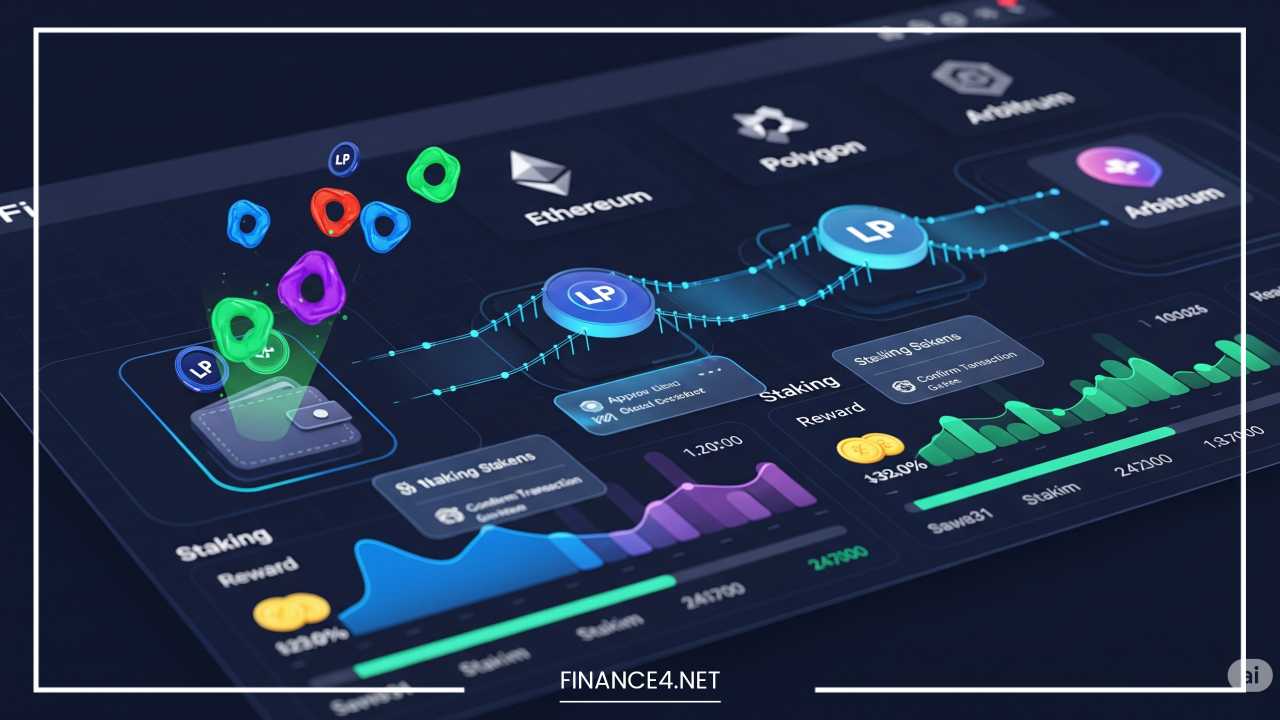
How to Stake Bridging Aggregator Tokens for Rewards
 by
by 
How to Stake Bridging Aggregator Tokens for Rewards
The decentralized finance (DeFi) landscape is constantly evolving, with new innovations emerging to solve critical problems in the blockchain ecosystem. One such innovation is bridging aggregators, which have become indispensable tools for navigating the increasingly complex multichain world. As these aggregators gain traction, so do their native tokens, offering users not just utility but also avenues for earning passive income through staking.
This comprehensive guide will delve into the intricacies of staking bridging aggregator tokens, providing a step-by-step walkthrough, exploring the underlying mechanics, and highlighting the potential rewards and inherent risks.
1. Introduction
The decentralized finance (DeFi) ecosystem thrives on interconnectedness. However, the proliferation of numerous independent blockchains has created a fragmented liquidity landscape, making it challenging for users to seamlessly move assets and data between networks. This is where bridging aggregators like LI.FI, Socket, and Jumper step in. These innovative platforms act as crucial intermediaries, finding the most efficient and cost-effective routes for cross-chain transfers, abstracting away the complexity of multiple bridges and DEXs.
Within this dynamic environment, staking has emerged as a fundamental mechanism for securing decentralized networks and distributing rewards to participants. It’s a process where users lock up their cryptocurrency holdings to support the operations of a blockchain network, in return for earning more tokens as a reward. For bridging aggregator tokens, staking not only offers a compelling way to earn passive income but also plays a vital role in strengthening the very infrastructure that enables seamless multichain interactions.
The purpose of this article is to educate users on the intricate process of staking these cutting-edge tokens. We will demystify the technical jargon, provide clear, actionable steps, and equip you with the knowledge to confidently participate in this exciting facet of DeFi, ultimately empowering you to earn rewards while contributing to the robustness of the multichain future.
2. Understanding Bridging Aggregator Tokens
Bridging aggregators are the unsung heroes of multichain interoperability. Imagine a vast network of islands, each representing a different blockchain. To travel between these islands, you’d typically need to find a specific ferry (a bridge) and then perhaps a local taxi (a DEX) upon arrival. Bridging aggregators simplify this by acting as a travel agent, identifying the most efficient combination of ferries and taxis to get you from island A to island B with minimal fuss and cost. They achieve this by integrating multiple bridges, decentralized exchanges (DEXs), and liquidity networks, offering users a single interface for complex cross-chain swaps and transfers.
The tokens associated with these aggregators can take various forms. Most commonly, they are native utility tokens designed to power the platform’s ecosystem. Examples include LI.FI’s token (if and when launched), Socket’s token, or other similar governance or utility tokens. In some cases, you might also encounter LP (Liquidity Provider) tokens if the aggregator offers liquidity mining opportunities for its own or partner liquidity pools. These LP tokens represent a user’s share in a liquidity pool, where they have provided a pair of assets.
Beyond staking, these tokens often have several crucial use cases. Governance is a primary function, allowing token holders to participate in decentralized autonomous organizations (DAOs) and vote on key protocol upgrades, fee structures, and treasury management. This empowers the community to shape the future direction of the aggregator. Some tokens might also offer reduced transaction fees for users who hold or pay with them on the platform. Furthermore, they can be used for liquidity provision in various DEXs, enabling greater capital efficiency for cross-chain operations and earning trading fees for the providers. The underlying value of these tokens is often tied to the growing adoption and transaction volume of the bridging aggregator platform itself.
3. What Is Staking?
At its core, staking in DeFi is the act of locking up your cryptocurrency holdings to support the operations of a blockchain network. It’s akin to depositing money in a savings account to earn interest, but with a more active role in the network’s security and governance. In Proof-of-Stake (PoS) blockchains, staking is the fundamental mechanism for validating transactions and securing the network. Stakers commit their tokens to a validator, who then proposes and validates new blocks. In return for their participation and contribution to network security, stakers receive newly minted tokens or a share of transaction fees as rewards.
It’s crucial to differentiate staking from liquidity provision. While both involve locking up assets for rewards, their fundamental purposes differ. Staking primarily focuses on securing a network and participating in its governance. You’re typically locking a single asset to support the underlying blockchain or protocol. Liquidity provision, on the other hand, involves depositing a pair of assets into a decentralized exchange (DEX) liquidity pool. The purpose here is to facilitate trading between those assets, and liquidity providers earn a share of the trading fees generated by the pool. While both offer rewards, liquidity provision often comes with the risk of impermanent loss.
There are various types of staking:
- Single-sided staking: This is the simplest form, where you stake a single token directly on a platform or within a smart contract. You lock up your native bridging aggregator token and earn more of that same token or another designated reward token.
- LP staking (Liquidity Provider staking): As mentioned, this involves staking LP tokens that you receive after providing liquidity to a DEX pool. You essentially earn rewards for both providing liquidity and then further staking your LP position. This can offer higher yields but also carries the risk of impermanent loss.
- Validator delegation: In some PoS networks, you can delegate your tokens to a chosen validator who then stakes on your behalf. This is a common model for larger PoS blockchains and can also apply if a bridging aggregator operates its own validator network.
Understanding these distinctions is key to choosing the right staking strategy for your bridging aggregator tokens, aligning with your risk tolerance and reward expectations.
4. Why Stake Bridging Aggregator Tokens?
Staking bridging aggregator tokens offers a compelling blend of financial incentives and ecosystem participation. The reasons to engage in this activity are multifaceted, appealing to both seasoned DeFi participants and newcomers alike.
Foremost among the incentives are the rewards themselves. These typically come in the form of an Annual Percentage Yield (APY), which can be quite attractive compared to traditional financial instruments. The APY is often derived from a combination of newly minted tokens, a share of the platform’s transaction fees, or even a portion of the revenue generated by the bridging aggregator. Beyond direct token rewards, staking frequently grants governance rights. Holding and staking these tokens empowers you to participate in crucial decisions regarding the protocol’s future – from fee adjustments to technical upgrades and the allocation of treasury funds. This active participation allows you to shape the very infrastructure you rely on for cross-chain interactions. Furthermore, in the ever-evolving DeFi landscape, staking can sometimes position you for potential airdrops from new projects or ecosystem partners, rewarding early and active supporters.
Beyond the direct financial benefits, staking bridging aggregator tokens is a powerful way to support the ecosystem. By locking up your tokens, you reduce the circulating supply, which can positively impact the token’s price stability. More importantly, your staked tokens contribute to the security and decentralization of the underlying protocol. For projects that rely on a Proof-of-Stake mechanism or similar consensus models, your participation directly strengthens the network’s resilience against attacks and ensures its smooth operation.
While the rewards are enticing, it’s essential to weigh the potential risks vs. returns. The APY can be volatile, fluctuating based on network activity, token price, and the total amount of staked tokens. Smart contract risks, platform vulnerabilities, and potential impermanent loss (if LP staking) are also considerations. However, for those who believe in the long-term vision of multichain interoperability and the value proposition of bridging aggregators, staking presents an opportunity to earn passive income while actively contributing to a vital segment of the DeFi landscape. The returns, when managed strategically and with an understanding of the risks, can be substantial.
5. How to Stake Bridging Aggregator Tokens: Step-by-Step Guide
Staking bridging aggregator tokens might seem daunting at first, but by breaking it down into manageable steps, it becomes a straightforward process. Here’s a comprehensive guide to help you get started:
Step 1: Acquire the Token
Before you can stake, you need to own the bridging aggregator token. The methods for acquiring these tokens are similar to any other cryptocurrency:
- Decentralized Exchanges (DEXs): This is often the primary way to acquire these tokens. You’ll need to use a DEX on the chain where the token is primarily traded (e.g., Uniswap on Ethereum, PancakeSwap on BNB Chain, QuickSwap on Polygon). You’ll typically swap a well-known cryptocurrency like ETH, BNB, MATIC, or a stablecoin for the desired aggregator token.
- Example: To acquire LI.FI (hypothetically, if launched), you would go to app.uniswap.org, connect your wallet, select ETH or USDC as your input token, and LI.FI as your output token, then execute the swap.
- Bridging Services: If the token exists on multiple chains, you might need to use a bridge to move it to the chain where staking is supported. Often, the bridging aggregator itself can facilitate this.
- Example: If you have a token on Avalanche but the staking platform is on Ethereum, you’d use a bridge like Synapse or the aggregator’s own bridging service to transfer it.
- Centralized Exchanges (CEXs): Less common for newer or smaller aggregator tokens, but if the project gains significant traction, it might be listed on a CEX like Binance, Coinbase, or Kraken. This offers an easier on-ramp from fiat currency.
Step 2: Choose the Staking Platform
Once you have your tokens, you need to identify where to stake them.
- Native Staking dApp: Many projects offer their own dedicated staking decentralized application (dApp) directly on their website. This is often the most direct and secure method, as it’s controlled by the project developers.
- Example: LI.FI, if it launched a staking mechanism, would likely have a dedicated “Stake” section on its official website (e.g., app.li.fi/stake).
- DeFi Protocols (Third-Party): Some aggregator tokens can be staked or used in liquidity pools on other DeFi protocols like Balancer, Curve, Aura Finance, or Convex Finance. These platforms often offer boosted rewards or more complex yield strategies.
- Yield Aggregators: Platforms like Beefy Finance or Yearn Finance automate the compounding of rewards and often optimize yield strategies across various protocols. While convenient, they add another layer of smart contract risk.
Always ensure you are on the official website of the staking platform to avoid phishing scams. Double-check URLs carefully.
Step 3: Connect Wallet
Regardless of the platform, the first interaction will be to connect your cryptocurrency wallet.
- MetaMask: This is the most common and widely supported browser extension wallet.
- Steps: Click on “Connect Wallet” (or similar button) on the staking platform. Select MetaMask from the options. A MetaMask pop-up will appear asking you to confirm the connection to the site. Click “Next” and then “Connect.”
- WalletConnect: This allows you to connect various mobile wallets (e.g., Trust Wallet, Rainbow Wallet) by scanning a QR code with your phone.
- Other Wallets: Some platforms support specific hardware wallets (e.g., Ledger, Trezor) or other browser wallets.
Once connected, your wallet address will typically be displayed on the platform.
Step 4: Approve and Stake Tokens
This is the core of the staking process.
- Approve Tokens: Before a smart contract can interact with your tokens, you need to grant it permission. This is a one-time transaction per token per contract.
- Steps: On the staking platform, you’ll see an “Approve” or “Enable” button. Click it. Your wallet will prompt you to confirm the transaction. Review the gas fees and confirm. This transaction typically has a lower gas cost than the actual staking transaction.
- Stake Tokens: After approval, the “Stake” button will become active.
- Steps: Enter the amount of tokens you wish to stake. Double-check the amount. Click “Stake” (or “Deposit”). Your wallet will again prompt you to confirm the transaction. This transaction will involve higher gas fees as it’s moving your tokens into the staking contract. Confirm the transaction in your wallet.
Important Note on Gas Fees: Transactions on networks like Ethereum can incur significant gas fees, especially during peak times. Consider staking during off-peak hours (e.g., late night UTC) to potentially save on fees. Networks like Polygon, Arbitrum, or Optimism have significantly lower gas fees.
Example Walkthrough (Hypothetical LI.FI Staking dApp):
- Navigate to
app.li.fi/stake(hypothetical official staking dApp). - Connect your MetaMask wallet.
- You’ll see your
LI.FItoken balance. Enter the amount you want to stake in the input field. - Click “Approve LI.FI”. A MetaMask pop-up appears. Confirm the transaction.
- Once approved, the button changes to “Stake LI.FI”. Click it. Another MetaMask pop-up appears. Confirm the transaction.
- Congratulations! Your tokens are now staked.
Step 5: Monitor Rewards and Manage Stake
Staking is not a set-it-and-forget-it process if you want to maximize rewards.
- Monitor Rewards: The staking platform will typically display your accumulated rewards. These rewards can be claimed periodically or compounded back into your stake.
- Claiming Rewards: You’ll usually see a “Claim Rewards” button. Clicking this initiates a transaction to send your accumulated rewards to your wallet.
- Compounding: If the platform offers a “Compound” or “Restake” option, this allows you to automatically (or manually) add your earned rewards back into your staked balance, leading to higher future earnings through the power of compounding. This often involves a transaction fee.
- Unstaking: When you decide to withdraw your tokens, there will be an “Unstake” or “Withdraw” option. Be aware of any lock-up periods or unbonding times, which will be clearly stated on the platform. This also requires a transaction.
By following these steps, you can successfully stake your bridging aggregator tokens and begin earning rewards. Always prioritize security by verifying URLs and understanding the smart contract interactions.
6. Platforms That Support Staking Bridging Aggregator Tokens
The decentralized nature of these tokens means that staking opportunities can arise from various sources, each with its own advantages and potential complexities. Understanding these platforms is crucial for making informed decisions.
-
Native Platforms (e.g., LI.FI Staking dApp, Socket Protocol Staking):
- Description: Many bridging aggregators, especially those with established tokenomics, will launch their own dedicated staking interfaces or “dApps” (decentralized applications). These are usually found directly on their official websites.
- Advantages: Often the most direct and secure way to stake, as you’re interacting directly with the project’s smart contracts. Rewards are typically disbursed directly by the protocol, and governance rights are often most directly tied to staking on the native platform. They might also offer specific features unique to the protocol’s tokenomics.
- Examples: While specific staking for LI.FI or Socket might be in development or conceptual, protocols like THORChain ($RUNE) have their own native staking for network security and liquidity provision. Others might offer single-sided staking for their governance tokens.
-
Third-Party DeFi Protocols (e.g., Balancer, Aura, Convex, Curve):
- Description: Bridging aggregator tokens, particularly if they are used in liquidity pools, can be staked or utilized within the broader DeFi ecosystem on established liquidity and yield protocols.
- Balancer/Curve: If the aggregator token is paired with another asset (e.g., ETH, USDC) in a Balancer or Curve liquidity pool, you can provide liquidity and receive LP tokens. These LP tokens can then often be staked on the same platform for additional rewards (e.g., BAL or CRV tokens) or boosted through external incentives.
- Aura/Convex Finance: These protocols are “Votium” or “Boost” layers built on top of other DeFi protocols (like Curve or Balancer). They allow users to deposit LP tokens and earn boosted yields by aggregating voting power and directing emissions. If a bridging aggregator token is part of a Curve or Balancer pool, its LP tokens might be eligible for boosted yields on Aura or Convex.
- Advantages: Access to higher, compounded yields through complex strategies, participation in large, established DeFi ecosystems.
- Considerations: Adds another layer of smart contract risk. Requires understanding of how these protocols interact. Impermanent loss risk for LP staking.
-
Yield Aggregators (e.g., Beefy Finance, Yearn Finance):
- Description: These platforms simplify the yield farming process by automatically compounding rewards and optimizing strategies across various underlying DeFi protocols.
- Advantages: Convenience, automation of compounding, potentially higher net APY due to optimized strategies and reduced gas fees from batching transactions.
- Considerations: You delegate control of your assets to the aggregator’s smart contracts, introducing an additional layer of smart contract risk. Less direct control over specific staking parameters.
Before choosing a platform, research its security audits, track record, and the specific terms and conditions for staking your chosen bridging aggregator token. Diversifying your staking across different platforms can also be a strategy to mitigate risk.
7. Risks and Considerations
While the allure of rewards from staking bridging aggregator tokens is strong, it’s paramount to understand the inherent risks involved. A thorough grasp of these potential pitfalls allows for more informed decision-making and better risk management.
- Smart Contract Risks: The core of any DeFi protocol is its smart contract code. Bugs, vulnerabilities, or exploits within these contracts can lead to the loss of staked funds. Even well-audited contracts are not entirely immune to risks. It’s crucial to only stake on platforms with a strong track record of security audits by reputable firms.
- Impermanent Loss (if LP staking): This risk is specific to liquidity provision (LP staking) where you’ve paired your bridging aggregator token with another asset in a liquidity pool. Impermanent loss occurs when the price ratio of the assets in the pool changes significantly after you’ve provided liquidity. If one asset drastically outperforms or underperforms the other, you may end up with a lower dollar value than if you had simply held the individual assets. While often offset by trading fees and staking rewards, it’s a critical consideration for LP stakers.
- Platform Risk (Rug Pulls, Bugs): Beyond smart contract vulnerabilities, the platform itself can pose a risk. While less common with established bridging aggregators, newer or less reputable projects could engage in “rug pulls” (where developers abandon the project and drain funds). Even legitimate projects can suffer from operational bugs or mismanagement that negatively impact users. Always verify the legitimacy and reputation of the staking platform.
- Lock-up Periods and Slashing (if applicable):
- Lock-up Periods: Some staking mechanisms require you to lock your tokens for a specific duration (e.g., 7 days, 30 days, or even longer). During this period, your tokens are inaccessible, and you cannot unstake them, even if market conditions change unfavorably. Understand the lock-up terms before committing.
- Slashing: This risk is more prevalent in Proof-of-Stake (PoS) networks where stakers delegate to validators. Slashing occurs if a validator misbehaves (e.g., goes offline, double-signs transactions). A portion of the staked tokens (including those delegated to the validator) can be “slashed” or penalized. While less common for simple single-sided staking of utility tokens, it’s a critical consideration if you’re delegating to a validator for a bridging aggregator’s underlying PoS chain.
- Token Price Volatility: The value of your rewards and your initial staked capital are inherently linked to the price of the bridging aggregator token. If the token’s market price drops significantly, the fiat value of your rewards and your principal could decrease, even if you are earning a high APY in tokens.
Thorough due diligence (DYOR – Do Your Own Research) is paramount. Assess the project’s fundamentals, team, community, security audits, and understand the specific risks associated with the staking mechanism you choose.
8. Maximizing Your Rewards
Beyond simply staking, there are several strategies and tools you can employ to maximize the rewards you earn from your bridging aggregator tokens. Smart management can significantly boost your overall returns.
- Compounding: This is arguably the most powerful strategy for long-term growth. Compounding involves reinvesting your earned rewards back into your staked principal. This allows your rewards to start earning rewards themselves, leading to exponential growth over time.
- Manual Compounding: You periodically claim your rewards and then manually restake them. This incurs transaction fees each time, so it’s best done when accumulated rewards are significant enough to offset the gas costs.
- Automated Compounding (Yield Aggregators): As discussed in Section 6, yield aggregators like Beefy Finance or Yearn Finance automate the compounding process for you. They pool users’ funds, perform compounding at optimal intervals to minimize gas fees, and often deploy complex strategies to maximize yield. While convenient, remember they introduce an additional layer of smart contract risk.
- Multi-Platform Strategies: Don’t limit yourself to just one staking platform. Explore different opportunities to optimize your returns.
- Native Staking + LP Staking: You might stake a portion of your tokens on the native dApp for governance rights and a stable base APY, while another portion is used for LP staking on a DEX (e.g., Balancer) and then potentially boosted on a platform like Aura or Convex for higher yields.
- Diversification: Spreading your tokens across multiple platforms can also be a risk management strategy, mitigating the impact of a single platform’s vulnerability.
- Using Analytics Tools: The DeFi ecosystem is rich with data, and leveraging analytics tools can give you an edge.
- DeFiLlama: An invaluable resource for tracking total value locked (TVL) across various protocols and chains, identifying top yield farms, and comparing APYs. You can often find specific pools or staking opportunities for bridging aggregator tokens here.
- Dune Dashboards: Community-created dashboards on Dune Analytics often provide granular insights into specific protocols, including staking metrics, reward distributions, and historical APYs. Search for dashboards related to your bridging aggregator or the protocols it integrates with.
- Protocol-Specific Analytics: Many projects and larger DeFi protocols provide their own analytics dashboards, showing current APYs, staked amounts, and reward distribution schedules.
By actively managing your staked assets, exploring different yield-generating opportunities, and utilizing available analytics, you can significantly enhance the rewards earned from your bridging aggregator tokens. However, always remember that higher potential rewards often come with higher risks, so balance your strategies with your risk tolerance.
9. Real-World Examples
While specific staking initiatives for all bridging aggregator tokens might be evolving, we can look at similar token models and conceptualize how staking for a token like hypothetical $LI.FI or $MELD (Meld, a multi-chain lending protocol that utilizes bridging technology) would function and what rewards users could expect.
Case Study: Staking a Hypothetical Bridging Aggregator Token (e.g., $LI.FI)
Let’s imagine LI.FI launches its native token, $LIFI, with a staking mechanism.
- User Scenario: A user, Alice, believes in the long-term vision of LI.FI as a leading bridging aggregator. She acquires 10,000
$LIFItokens through a DEX. - Staking Choice: Alice decides to stake her
$LIFIon the official LI.FI staking dApp to earn a share of platform fees and governance rights. - Process:
- Alice navigates to
app.li.fi/stake(hypothetical). - Connects her MetaMask wallet.
- Approves the LI.FI staking contract to spend her
$LIFItokens. - Enters 10,000 and clicks “Stake.”
- Confirms the transaction in MetaMask.
- Alice navigates to
- Rewards:
- APY: The LI.FI dApp displays an estimated APY of 8-15%, paid in
$LIFItokens. This APY is generated from a percentage of transaction fees collected by the LI.FI aggregator and potentially new$LIFIemissions. - Governance Rights: By staking, Alice automatically gains voting power proportional to her staked amount in the LI.FI DAO. She can now vote on proposals related to integrating new chains, adjusting bridge fees, or allocating treasury funds.
- Potential Airdrops: As an early staker, Alice might be eligible for future airdrops from partners building on the LI.FI ecosystem or from new features launched by LI.FI itself, rewarding active community participation.
- APY: The LI.FI dApp displays an estimated APY of 8-15%, paid in
- Community-Driven Incentives: The LI.FI DAO might introduce further incentives. For instance, stakers who actively participate in governance by voting on a certain number of proposals might receive bonus
$LIFIrewards. This encourages active and informed participation beyond just holding. - DAO Governance Rewards: Some protocols might have a portion of their treasury dedicated to rewarding active DAO participants, which often includes stakers who contribute significantly to discussions and voting.
This hypothetical scenario illustrates how staking a bridging aggregator token offers a dual benefit: direct financial rewards through APY and indirect value through governance participation and potential ecosystem benefits. The exact mechanics and rewards would depend on the specific tokenomics designed by each aggregator.
10. Future Outlook for Bridging Aggregator Tokens and Staking
The landscape of multichain interoperability is still in its nascent stages, and bridging aggregators are poised to play an increasingly critical role. The future outlook for their tokens and staking mechanisms is dynamic, driven by evolving tokenomics, growing adoption of Layer 2 solutions, and increasing institutional interest.
- Evolving Tokenomics: As bridging aggregators mature, their tokenomics are likely to become more sophisticated. We may see hybrid models that combine aspects of traditional staking (for security/governance) with innovative mechanisms for liquidity provision, fee sharing, and even insurance. The focus will shift towards sustainable reward generation, moving beyond mere inflationary emissions to real yield derived from protocol activity. This could involve direct revenue share from bridge fees, cross-chain arbitrage profits, or even a share of gas savings facilitated by the aggregator.
- Role in Multichain Liquidity and L2 Adoption: Bridging aggregators are fundamental to solving the liquidity fragmentation across various blockchains and Layer 2 (L2) solutions. As more L2s emerge (e.g., Arbitrum, Optimism, zkSync, StarkNet), the need for seamless asset transfers between them and the mainnet will intensify. Bridging aggregator tokens, through their staking mechanisms, can incentivize the provision of deep liquidity across these diverse networks, ensuring efficient and low-cost transfers. Stakers will effectively become beneficiaries of the increasing volume of cross-chain activity.
- Institutional Interest and LRT Integrations: The institutional adoption of DeFi is on the horizon. Institutions require robust, secure, and efficient infrastructure for cross-chain operations. Bridging aggregators, by abstracting complexity and optimizing routes, fit this need perfectly. As institutional capital flows into DeFi, the demand for underlying utility tokens, including those of aggregators, is likely to increase. Furthermore, we could see integrations with Liquid Restaking Tokens (LRTs) or similar concepts, where staked aggregator tokens can be re-staked or utilized in other DeFi protocols, creating greater capital efficiency and potentially higher compounded yields. This would allow institutions and sophisticated users to leverage their staked assets across multiple layers of the DeFi stack.
In essence, the future of bridging aggregator tokens and staking is intertwined with the broader success of the multichain ecosystem. As blockchain adoption grows and more users interact across different networks, the utility and value of these aggregators will only increase, making their tokens and associated staking opportunities more appealing and impactful in the long run.
11. Final Thoughts
Staking bridging aggregator tokens presents a compelling opportunity to not only earn passive income in the dynamic world of decentralized finance but also to actively contribute to the future of multichain interoperability. These innovative platforms are vital connectors in a fragmented blockchain landscape, and by staking their tokens, you become an integral part of their growth and security.
We’ve covered the fundamentals: understanding what bridging aggregators do and the nature of their associated tokens, delving into the mechanics of staking, and highlighting the significant benefits, including attractive APYs, crucial governance rights, and the potential for ecosystem-driven rewards. Our step-by-step guide has demystified the process, from acquiring tokens to connecting your wallet, approving smart contracts, and monitoring your valuable rewards. We also explored the diverse landscape of staking platforms, from native dApps to sophisticated third-party yield aggregators.
However, it is equally important to remember the risks. Smart contract vulnerabilities, the nuances of impermanent loss in LP staking, and platform-specific risks are all considerations that demand your attention. Maximizing your rewards requires strategic thinking, leveraging compounding, exploring multi-platform approaches, and utilizing powerful analytics tools.
For any new staker, the ultimate tip remains: Do Your Own Research (DYOR). Before committing your hard-earned assets, thoroughly investigate the specific bridging aggregator, its tokenomics, the chosen staking platform, and the associated smart contract audits. Understand the lock-up periods, the reward structure, and critically assess your own risk tolerance.
By embracing the opportunity to stake bridging aggregator tokens, you are not just seeking financial rewards; you are investing in the infrastructure that is building a more connected, efficient, and user-friendly decentralized future. Take the plunge, but do so with knowledge and caution, and you’ll be well-positioned to reap the benefits of this exciting frontier in DeFi.