Best Bridging Aggregator for Cosmos Tokens
 by
by 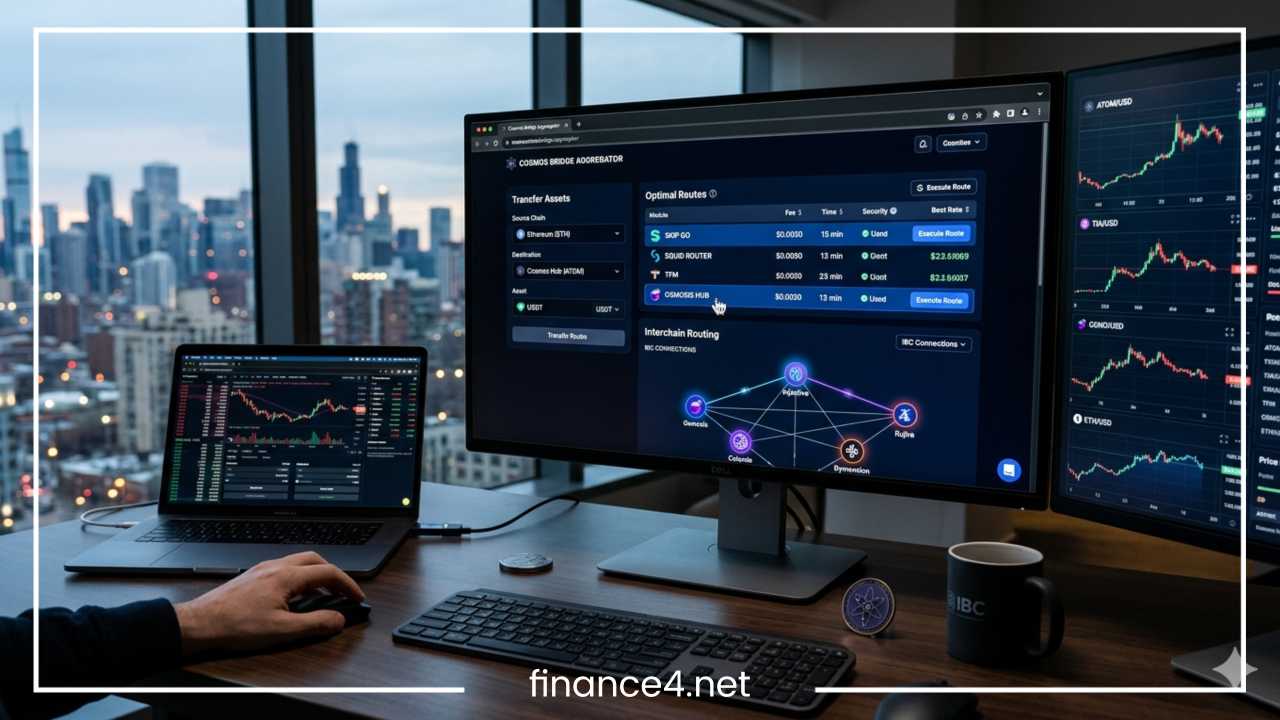
Best Bridging Aggregators for Cosmos Tokens (Full Comparison Guide)
Interoperability is the core philosophy of the Cosmos ecosystem. Unlike monolithic blockchains that aim to house all activity on a single layer, Cosmos is built as an ever-expanding “Internet of Blockchains.” While this architecture offers unparalleled scalability and sovereignty for developers, it introduces a significant challenge for the average user: fragmentation.
With hundreds of independent “zones” such as Osmosis, Celestia, dYdX, and Injective, moving assets from one chain to another can be a logistical headache. Users often find themselves navigating a maze of different bridges, liquidity pools, and gas requirements. This is where bridging aggregators become essential. They act as a unifying interface, finding the most efficient, secure, and cost-effective path to move tokens across the interchain and beyond.
The necessity for these tools has grown as the ecosystem has moved from a handful of chains to a massive web of modular layers. In the early days, a user only needed to know how to move ATOM. Today, a user might need to move liquid staked derivatives, stablecoins, or data-availability tokens across three or four different consensus environments just to participate in a single DeFi vault.
What is a Bridging Aggregator?
To understand an aggregator, one must first understand the distinction between a single bridge and an aggregated route. A bridge is a specific protocol or piece of infrastructure that connects two blockchains. For example, a bridge specifically built to move assets from Ethereum to the Cosmos Hub is a single point-to-point solution.
An aggregator, by contrast, does not necessarily own the underlying bridge infrastructure. Instead, it sits on top of multiple bridges, decentralized exchanges (DEXs), and the Inter-Blockchain Communication (IBC) protocol. It functions much like a travel search engine. Just as a traveler uses a single site to compare flights from multiple airlines to find the cheapest or fastest route, a bridging aggregator scans various paths to deliver a user’s tokens to their destination.
The Problem of Fragmented Liquidity
In a fragmented landscape, liquidity for a single token like USDC might be spread across five different chains and three different bridge versions (e.g., Axelar-wrapped USDC, Noble native USDC, and Wormhole-wrapped USDC). If a user manually bridges to the wrong chain, they might find themselves with a version of a token that has no liquidity, effectively “trapping” their funds until they bridge back. Aggregators solve this by identifying not just the connection, but the “liquidity depth” at the destination.
The Multi-Hop Reality
Most users do not realize that a “one-click” bridge in an aggregator often involves three or four distinct transactions. This is known as multi-hopping. An aggregator handles the “signing” process for these hops, ensuring that the output of one transaction is correctly used as the input for the next. This prevents human error, such as sending the wrong token amount to a relayer address.
The Skyscanner Analogy
Think of a bridge as an airline. If you want to fly from New York to a remote island, there might not be a direct flight. You have to book a flight to a hub, then a regional flight, then perhaps a boat. A bridging aggregator is the travel agent that books all three tickets for you in one package, ensuring the timings align so you don’t miss your connections.
How Cosmos Bridging Works
The mechanics of moving assets in the Cosmos ecosystem are more sophisticated than in most other networks. Because Cosmos is modular, the “bridge” used depends entirely on where the asset is coming from and where it is going.
IBC (Inter-Blockchain Communication)
IBC is the gold standard for bridging within Cosmos. It is a peer-to-peer communication protocol that allows two blockchains to talk to each other directly without a middleman. Because it relies on light clients and cryptographic proofs, it is considered “trust-minimized.”
Unlike traditional bridges that rely on a central “vault” or a set of multi-sig signers, IBC works by having each chain verify the block headers of the other. If you are moving ATOM from the Cosmos Hub to Osmosis, you are using IBC. It is fast, secure, and usually the cheapest way to move value because it eliminates the “bridge fee” typically charged by third-party protocols.
External Bridges
When a user wants to bring an asset from outside the “Cosmosverse”—such as ETH from Ethereum or SOL from Solana—IBC alone is not enough. This requires external bridges. These protocols act as the translation layer between the different consensus mechanisms of the two chains.
These often involve “wrapped” assets. For instance, when you bridge ETH to Cosmos via Axelar, the original ETH is locked in a smart contract on Ethereum, and an equivalent amount of “axlETH” is minted on the destination Cosmos chain. Aggregators are vital here because they help users distinguish between high-security bridges and experimental ones.
Cross-chain Routing Challenges
The main difficulty in bridging is “path discovery.” A user might want to move USDT from Polygon to the Kujira network. There may not be a direct bridge. The optimal path might involve:
-
Bridging USDT from Polygon to Axelar via a liquidity pool.
-
Swapping USDT for axlUSDT on a cross-chain router.
-
IBC-transferring axlUSDT to Osmosis.
-
Swapping axlUSDT for native USDT (Noble).
-
IBC-transferring the native USDT to Kujira.
An aggregator automates this entire sequence into a single experience, handling the gas fees in different denominations (e.g., paying Polygon gas in MATIC and Cosmos gas in ATOM) behind the scenes.
Key Criteria for Evaluating Bridging Aggregators
When selecting an aggregator, users should weigh several factors to ensure their assets remain safe and their costs stay low. Not all aggregators are created equal; some prioritize speed, while others prioritize the absolute lowest cost.
Security and Trust Assumptions
Security is the most critical factor. Users should look for aggregators that prioritize audited routes and trust-minimized protocols like IBC. It is important to understand the “trust assumptions” of the underlying bridges.
For instance, does the route rely on a centralized relayer? Is the bridge secured by a decentralized set of validators, or a small 5-of-9 multisig? A high-quality aggregator will often flag “experimental” or “high-risk” routes, giving the user the choice to opt for a slower but more secure path.
Route Efficiency: Price vs. Speed
The “best” route is subjective. A DeFi trader might be willing to pay $10 in fees to have their tokens arrive in 20 seconds to catch a trading opportunity. A long-term staker might prefer a path that costs $0.05 even if it takes 15 minutes. Top-tier aggregators provide a toggle or a list of options, showing the estimated time of arrival (ETA) alongside the total fees and expected slippage.
Supported Chains and Asset Depth
A great Cosmos aggregator should support the widest possible range of zones. Beyond just the “Big Three” (Hub, Osmosis, Injective), a top-tier tool will include support for newer modular chains like Celestia, Dymension, and Saga. Furthermore, they should support diverse asset types, including Liquid Staking Tokens (LSTs) and stablecoins like USDC, USDT, and IST.
UX, Wallet Integration, and Abstracted Gas
The user interface should be intuitive. Native support for Cosmos wallets like Keplr and Leap is a must. However, “Gas Abstraction” is the new frontier. This allows a user to bridge from Ethereum to Cosmos even if they don’t have any Cosmos-native tokens (like ATOM or OSMO) to pay for the destination gas. The aggregator “pre-funds” the destination wallet or takes the gas fee out of the bridged amount itself.
Best Bridging Aggregators for Cosmos Tokens
Several platforms have emerged as leaders in the Cosmos bridging space. Each has a slightly different focus, ranging from pure IBC optimization to broad multi-chain compatibility.
Skip (Skip Go)
Skip Protocol has become a foundational piece of infrastructure in the Cosmos ecosystem. Their flagship user-facing tool, Skip Go, is widely regarded as the most powerful “interchain-native” aggregator.
What it does
Skip Go focuses on finding the fastest and most efficient IBC routes across the entire Cosmos. It uses “Smart Relaying” technology to ensure transactions don’t get stuck due to relayer downtime. It effectively “pre-scans” the network state to ensure the destination chain is producing blocks and the relayers are active.
Best use case
Moving any Cosmos-native token between different Cosmos zones, especially during periods of high network congestion.
Pros
-
Unmatched Reliability: Their status as core infrastructure providers means their routes are highly stable.
-
Speed: They prioritize the lowest-latency IBC paths.
-
Wallet Integration: Skip is natively integrated into the Keplr and Leap “Swap” buttons.
-
Visual Interface: Their dashboard provides a clear map of how your assets are moving.
Cons
-
Learning Curve: While the interface is clean, the “Advanced” settings can be daunting for newcomers.
-
EVM Scope: While they have added EVM support, their primary “home field” advantage is still within the IBC ecosystem.
Ideal User
The “Cosmos native” who spends most of their time within the ecosystem and wants the most reliable IBC experience possible.
Squid Router (Axelar-based)
Squid is a cross-chain liquidity router built on top of the Axelar Network. It is designed to make “any-to-any” swaps feel as simple as a single-chain trade.
What it does
Squid aggregates liquidity from DEXs across dozens of chains (including Ethereum, Solana, and many Cosmos zones) and uses Axelar’s General Message Passing (GMP) to execute swaps and bridges in one step. It specializes in “Cross-Chain Swaps,” where you start with one token on Chain A and end with a completely different token on Chain B.
Best use case
Onboarding into Cosmos from an EVM chain like Ethereum, Arbitrum, or Base, or moving from Cosmos to Solana.
Pros
-
Industry-Leading UX: It feels like using a simple DEX rather than a bridge.
-
Massive Reach: Supports over 100 chains, making it the most “universal” of the Cosmos-compatible aggregators.
-
One-Click Native Assets: You can buy native ATOM or native OSMO directly with ETH in one click.
Cons
-
Network Dependency: It is heavily reliant on Axelar’s security model and validator set.
-
Fees: Because it often involves a swap on a DEX plus a bridge fee, it can be more expensive than a pure IBC transfer.
Ideal User
Users who frequently move between the EVM world and the Cosmos world and value a “one-click” experience above all else.
TFM (Terminal Flow Management)
TFM is one of the oldest and most comprehensive aggregators specifically built for the “Cosmoverse.” It bills itself as the “gateway to the interchain.”
What it does
TFM acts as both a DEX aggregator and a bridge aggregator. It scans every liquidity pool on every Cosmos chain to find the best price for a trade, then uses IBC to move the assets to the user. It is essentially an “Execution Engine” that finds the best prices across the entire ecosystem simultaneously.
Best use case
Large-scale trading and arbitrage, or finding liquidity for obscure “long-tail” tokens that are only listed on small zones.
Pros
-
Price Optimization: Excellent at splitting trades across different pools to reduce slippage.
-
Pro Features: Provides detailed charts, limit orders, and comprehensive routing maps.
-
Early Support: They are usually the first to support new Cosmos SDK chains as soon as they launch.
Cons
-
Complexity: The “Pro” interface can be overwhelming for a beginner who just wants to move $50.
-
Manual Steps: Occasionally requires the user to sign more transactions than Squid or Skip.
Ideal User
DeFi power users and professional traders who want the best possible execution price for their swaps and need deep technical data.
Router Protocol
Router Protocol is a modular interoperability layer that supports a wide array of both Cosmos and non-Cosmos chains. It uses a “middle-chain” architecture to facilitate transfers.
What it does
It provides a cross-chain intent framework. Users define a desired outcome, and the protocol handles the complexity. It is particularly strong at connecting the Cosmos ecosystem to “non-standard” chains that other aggregators might miss.
Best use case
Cross-chain DeFi interactions where users need to interact with a specific smart contract or vault on the destination chain, not just move a token.
Pros
-
Highly Flexible: Its “Voyager” application supports a massive number of chains.
-
Intent-Based: It focuses on the “end goal” of the transaction.
-
Security: It has its own validator set specifically dedicated to cross-chain security.
Cons
-
Fragmented UX: The experience can sometimes feel less “native” to Cosmos users than Skip or TFM.
-
Liquidity: For certain niche Cosmos tokens, the liquidity might not be as deep as on Osmosis-centric aggregators.
Ideal User
Advanced users looking for programmable cross-chain logic and connections to a vast array of L1s and L2s.
Osmosis Bridge (and the IBC Hub)
While Osmosis is technically a Decentralized Exchange, its “Assets” page has evolved into one of the most widely used bridge aggregators in the world.
What it does
Osmosis has integrated various bridging providers (like Noble for USDC, Squid for EVM assets, and Nomic for Bitcoin) directly into its dashboard. It provides a “curated” list of bridges that the Osmosis governance has deemed safe.
Best use case
Simple, safe deposits and withdrawals to and from the Osmosis ecosystem, which acts as the liquidity hub for the entire interchain.
Pros
-
High Security: Only the most battle-tested bridges are integrated.
-
Institutional Liquidity: As the primary DEX of Cosmos, it has the deepest liquidity for almost every major pair.
-
Free Transfers: Many IBC transfers to and from Osmosis are subsidized or have zero gas fees.
Cons
-
Not Universal: It is primarily designed to move assets into or out of Osmosis. It is not a tool for moving assets between two other chains (e.g., Kujira to Injective) without passing through Osmosis.
-
Curated List: You won’t find every new or experimental chain here.
Ideal User
Beginners and security-conscious users who want a “verified” experience and don’t mind the ecosystem being centered around Osmosis.
Comparison Table
| Aggregator | Best For | Technical Focus | Primary Chains | Security Model |
| Skip Go | IBC Reliability | Speed & Relaying | Full Cosmos + Solana/EVM | IBC + Multi-Bridge |
| Squid Router | EVM to Cosmos | UX & Convenience | 100+ (EVM, Cosmos, BTC) | Axelar PoS + GMP |
| TFM | Best Trade Prices | DEX Aggregation | All Cosmos Zones | IBC + DEX Liquidity |
| Router Protocol | Multi-chain DeFi | Programmability | EVM, Cosmos, L2s | Router Chain Validators |
| Osmosis Bridge | Safety & Simplicity | Curated Assets | Cosmos + Select EVM | Curated Providers |
Use Cases: Which Aggregator Should You Use?
To choose the right tool, you must first define your priority: is it speed, cost, or the specific chain you are targeting?
Case 1: The Cosmos Purist (Cosmos-to-Cosmos)
If you are moving tokens between two Cosmos chains (e.g., from Celestia to Injective), Skip Go is the premier choice. It is purpose-built for IBC and offers the most reliable relaying service. In the Cosmos ecosystem, a transaction can sometimes “hang” if the relayer (the server that carries the message) runs out of gas. Skip Go mitigates this by using their own network of relayers, ensuring your transaction won’t get “stuck” in limbo between chains.
Case 2: The Onboarder (Ethereum to Cosmos)
If you have ETH or USDC on an Ethereum Layer 2 like Arbitrum and want to buy a Cosmos-specific token like TIA or INJ, Squid Router is the most seamless option. Without an aggregator, you would have to bridge to a Cosmos chain, then find a DEX, then swap. Squid does all of this in one transaction. It is the “easy button” for entering the ecosystem.
Case 3: The Whale (High Volume Trading)
If you are performing a large trade (e.g., swapping $100,000 worth of ATOM for STARS), TFM is the best option. Its DEX aggregation logic will split your trade across multiple pools and chains (for example, swapping some on Osmosis and some on Astroport) to minimize price impact. This “smart routing” can save thousands of dollars in slippage on large orders.
Case 4: The Bitcoin Maximalist (BTC to Cosmos)
If you want to use your Bitcoin in Cosmos DeFi, look for aggregators that integrate with Nomic or Babylon. The Osmosis Bridge interface currently provides one of the cleanest ways to bring native BTC into the Cosmos ecosystem as nBTC, which can then be used as collateral or for trading.
Risks and Limitations of Aggregated Bridging
While bridging aggregators make the interchain much easier to use, they are not a “magic bullet.” Users must remain aware of the inherent risks of cross-chain activity.
Smart Contract Vulnerabilities
Aggregators interact with multiple smart contracts across different chains. A vulnerability in any of the underlying bridges or the aggregator’s own routing contract could lead to a loss of funds. Historically, bridge hacks have been some of the largest in crypto history. By using an aggregator, you are technically increasing your “surface area” of risk, as you are relying on both the bridge security and the aggregator’s code.
Liquidity Fragmentation and “Ghost Assets”
If an aggregator tries to route a trade through a pool with low liquidity, you may experience significant slippage. Furthermore, there is the risk of “ghost assets”—wrapped tokens that have lost their peg or their bridge support. Always double-check that the token you are receiving is the “native” or “canonical” version used by the destination chain.
Delayed Finality and The “Hanging” Transaction
Bridging is not always instant. While IBC is fast (usually 10–60 seconds), bridging from Ethereum can take 10–20 minutes because the bridge must wait for “finality” on the Ethereum mainnet to ensure the transaction cannot be reversed. Aggregators provide estimates, but they cannot control the underlying speed of the blockchains. If a transaction stays “pending” for a long time, it is usually a delay in the underlying bridge, not the aggregator itself.
Dependency on Relayers
IBC transfers rely on “relayers” to move the data packets between chains. If relayers are underfunded or down, transactions can hang in a “pending” state. While your funds are never “lost” (they will eventually time out and return to your wallet), it can be a stressful experience. Using top-tier aggregators like Skip minimizes this risk through their robust relayer infrastructure.
The Future of Cosmos Bridging: What Comes Next?
The landscape of Cosmos bridging is moving toward a state of “invisible interoperability.” The goal is for the user to never even know they are “bridging.”
Intent-Based Bridging and Solvers
The next major trend is “intents.” Instead of a user specifying a bridge route, they simply sign a message saying, “I want to spend 1 ETH on Mainnet to get 500 ATOM on the Hub.” Specialized “solvers” then compete to fulfill this request. This moves the risk and the technical complexity away from the user and onto professional market makers.
ZK-IBC and Universal Connectivity
IBC is no longer limited to just the Cosmos SDK. With the development of Zero-Knowledge (ZK) proofs, IBC can now be extended to Ethereum and other chains without requiring a full light client on-chain. This “ZK-IBC” will allow for the trust-minimized security of Cosmos to be applied to the entire blockchain world, making aggregators even more secure and reducing the need for third-party “wrapped” assets.
Chain Abstraction
We are entering the era of “Chain Abstraction,” where wallets will hide the name of the chain entirely. You will simply see your total balance of USDC, and the wallet (powered by an aggregator like Skip or Squid) will automatically pull that liquidity from wherever it sits across the interchain when you go to make a purchase or a trade.
Final Thoughts
The Cosmos ecosystem’s greatest strength—its modularity and sovereignty—is also its greatest UX challenge. Bridging aggregators are the essential tools that bridge the gap between technical complexity and user convenience.
There is no single “best” bridging aggregator for all situations; the right choice depends on your starting point and your priority.
-
For pure Cosmos-to-Cosmos reliability, Skip Go is unrivaled.
-
For moving value from the EVM world with maximum ease, Squid Router provides the best experience.
-
For those seeking the best price on complex, high-volume trades, TFM remains the top choice.
-
For those who prioritize safety and a curated list of assets, the Osmosis Bridge interface is the gold standard.
As the “Internet of Blockchains” continues to grow, these aggregators will become the primary way we interact with Web3, turning a fragmented web of chains into a single, unified, and powerful financial layer. Always remember to start with small test amounts when using a new bridge or aggregator, and stay informed about the security audits of the tools you use. The interchain is yours to explore—use these tools to do it wisely.
Frequently Asked Questions (FAQ)
What is the cheapest way to bridge tokens to Cosmos?
The cheapest way to bridge tokens within the Cosmos ecosystem is almost always through the native IBC (Inter-Blockchain Communication) protocol. Because IBC is a peer-to-peer communication standard built into the Cosmos SDK, it eliminates the need for third-party “bridge fees.” To minimize costs further, use an aggregator like Skip Go to find the most direct route, which reduces the number of “hops” and associated gas fees.
How do I bridge Ethereum to Cosmos without high gas fees?
Bridging directly from Ethereum Layer 1 can be expensive due to mainnet gas. To save money, consider moving your assets to an Ethereum Layer 2 (like Arbitrum, Polygon, or Base) first. From there, use a bridging aggregator like Squid Router. Squid allows you to swap and bridge from an L2 directly into a Cosmos zone in a single transaction, significantly reducing the total gas overhead compared to bridging from the Ethereum mainnet.
Which Cosmos bridge supports the most chains?
Currently, Squid Router (powered by Axelar) and Router Protocol support the widest variety of chains. While Skip Go and TFM are specialized for the hundreds of zones within the Cosmos interchain, Squid connects those zones to over 100 external networks, including Ethereum, Solana, Avalanche, and various Rollups.
Are bridging aggregators safer than single bridges?
Bridging aggregators are generally as safe as the underlying protocols they route through. Most top-tier aggregators like Skip and TFM prioritize audited, high-liquidity routes and native IBC paths, which are considered the gold standard for security. However, because aggregators interact with multiple smart contracts, you are technically exposed to the security of both the aggregator and the specific bridge used for your transaction.
Can I bridge Bitcoin to the Cosmos ecosystem?
Yes, you can bridge Bitcoin to Cosmos using decentralized providers like Nomic (nBTC) or Babylon. The Osmosis Bridge interface currently offers one of the most user-friendly ways to deposit native Bitcoin and receive a version that can be used in Cosmos DeFi applications. This allows Bitcoin holders to earn yield or provide liquidity within the interchain.
What should I do if my cross-chain bridge transaction is stuck?
If a transaction is “pending” for a long time, it is usually due to a delay in the relayer or network congestion on the destination chain.
-
Check the Explorer: Use a tool like Mintscan (for Cosmos) or Axelarscan (for Squid/Axelar) to see the status of your transaction hash.
-
Wait for Timeout: IBC transactions have a “timeout” period. If the transaction fails to land, the funds are automatically returned to the source wallet.
-
Use a Reliable Aggregator: Tools like Skip Go use smart relaying to monitor network health before you send, which prevents most “stuck” scenarios.
Do I need ATOM tokens to pay for gas when bridging?
One of the best features of modern bridging aggregators is Gas Abstraction. Platforms like Squid and Skip often allow you to pay for the destination gas using the token you are bridging. This means you can bridge from Ethereum to Injective even if you don’t have any INJ or ATOM in your wallet to start with; the aggregator handles the conversion for you.