Best Aggregator for Bridging With Minimal KYC
 by
by 
Best Aggregator for Bridging With Minimal KYC
The decentralized finance ecosystem has evolved from a single-chain playground into a vast, interconnected web of Layer 1 and Layer 2 protocols. As liquidity fragments across networks like Ethereum, Solana, Arbitrum, and Base, the need to move assets efficiently has become paramount. This process, known as bridging, is the backbone of cross-chain interoperability. However, as the industry matures, a significant divide has emerged between user experience and regulatory oversight.
Aggregators have stepped in to solve the complexity of bridging by finding the most efficient routes across dozens of individual bridges. For many users, the most critical feature of these platforms—beyond speed and cost—is the preservation of privacy through minimal Know Your Customer (KYC) requirements. In a world of increasing data collection, the ability to interact with a protocol using nothing but a self-custodial wallet is not just a preference; it is a core tenet of the decentralized ethos. This article explores the landscape of bridge aggregators, focusing on how they function and which platforms offer the best balance of efficiency and privacy.
Understanding Crypto Bridges
At its simplest, a crypto bridge is a protocol that allows a user to move the value of an asset from one blockchain to another. Because blockchains are essentially closed silos that cannot natively communicate with one another, a bridge acts as a middleman or a translator. Without bridges, an asset held on Ethereum would be trapped there, unable to participate in the high-yield opportunities on Polygon or the low-fee environment of Optimism.
The mechanics of bridging generally fall into three categories. The most common is the Lock-and-Mint model, where a user locks an asset (like ETH) in a smart contract on the source chain, and a “wrapped” version of that asset (like wETH) is minted on the destination chain. Another popular method is the Liquidity Pool model, where the bridge maintains deep pools of native assets on both chains and simply swaps them for the user. Finally, Cross-Chain Messaging Protocols allow for more complex interactions, passing data packets between chains to trigger actions without necessarily wrapping tokens.
Bridging is essential for several reasons. It allows users to flee high gas fees on the Ethereum mainnet for the efficiency of Layer 2s. It also enables yield farming across diverse ecosystems, allowing capital to flow where it is most productive. However, bridging is not without its risks. Bridges are often “honeypots” for hackers due to the massive amounts of collateral they hold. Additionally, users face risks related to smart contract exploits, delays in finality, and high slippage if liquidity is thin.
What is a Bridge Aggregator?
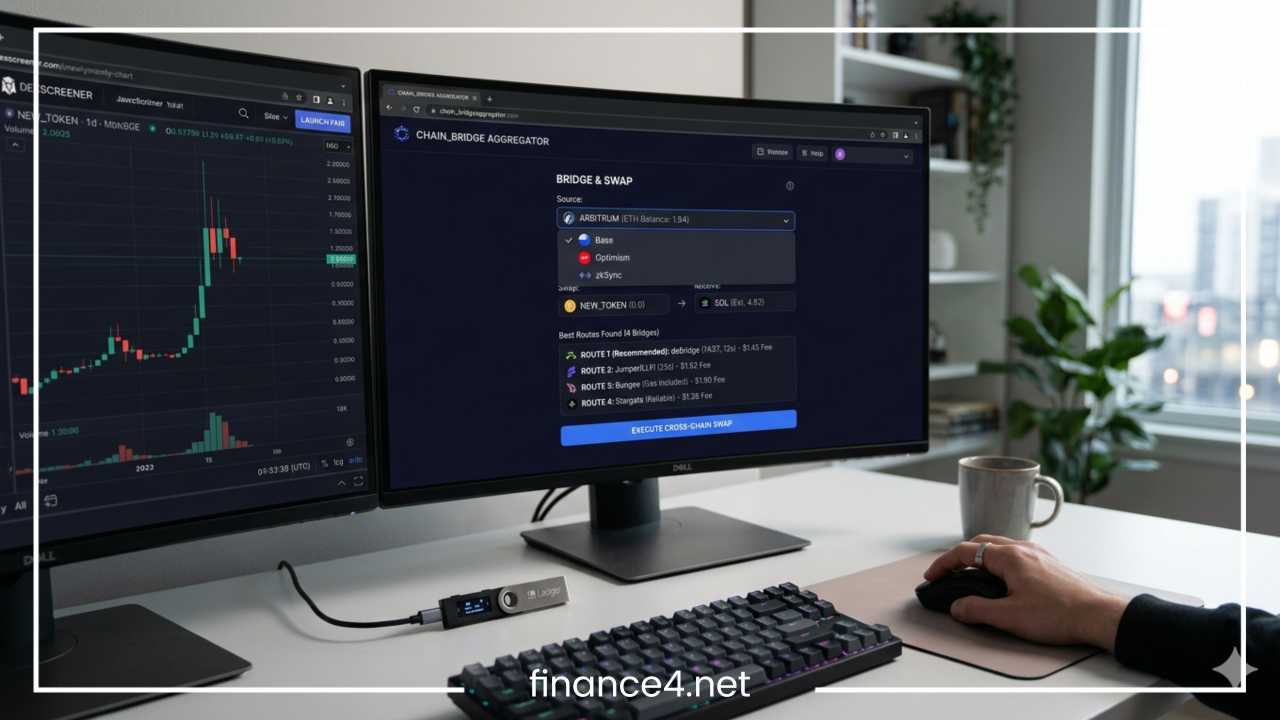
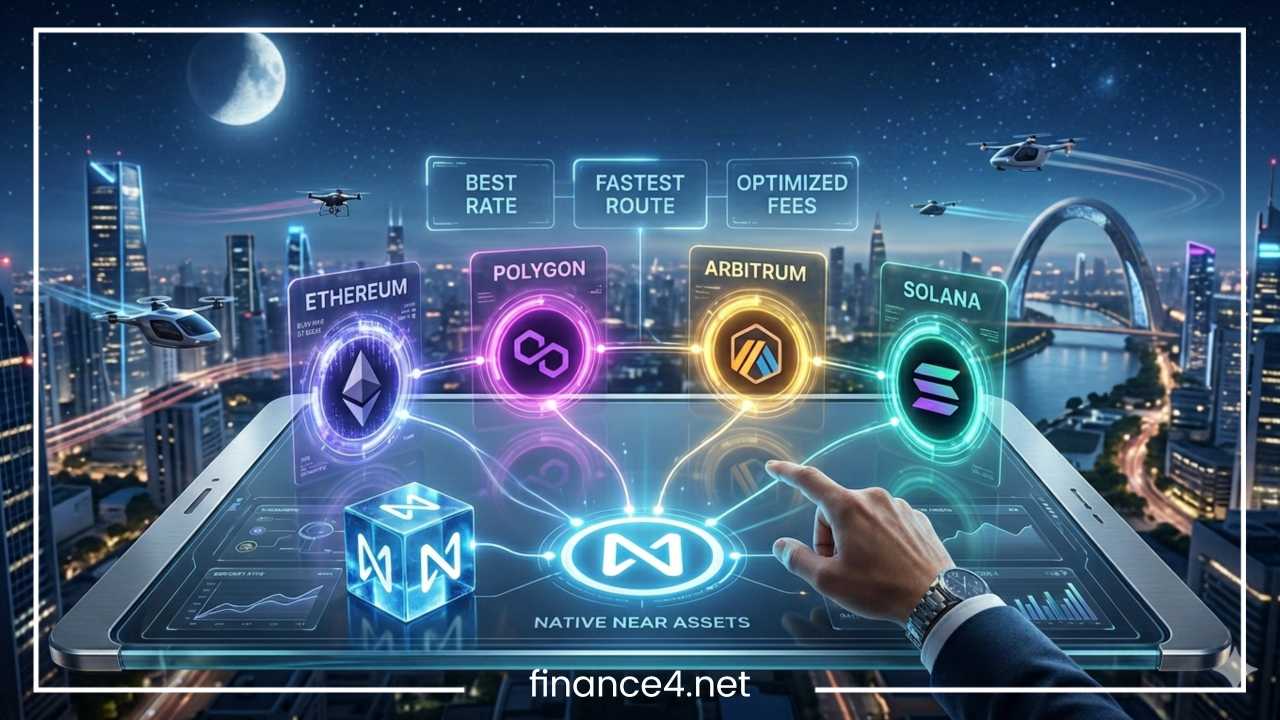
If a bridge is a single highway connecting two cities, a bridge aggregator is a high-tech GPS that monitors every available highway, ferry, and tunnel to find the fastest and cheapest route. An aggregator does not usually hold liquidity itself; instead, it plugs into multiple individual bridges—such as Stargate, Across, Hop, and Celer—and compares their rates, speeds, and security levels in real-time.
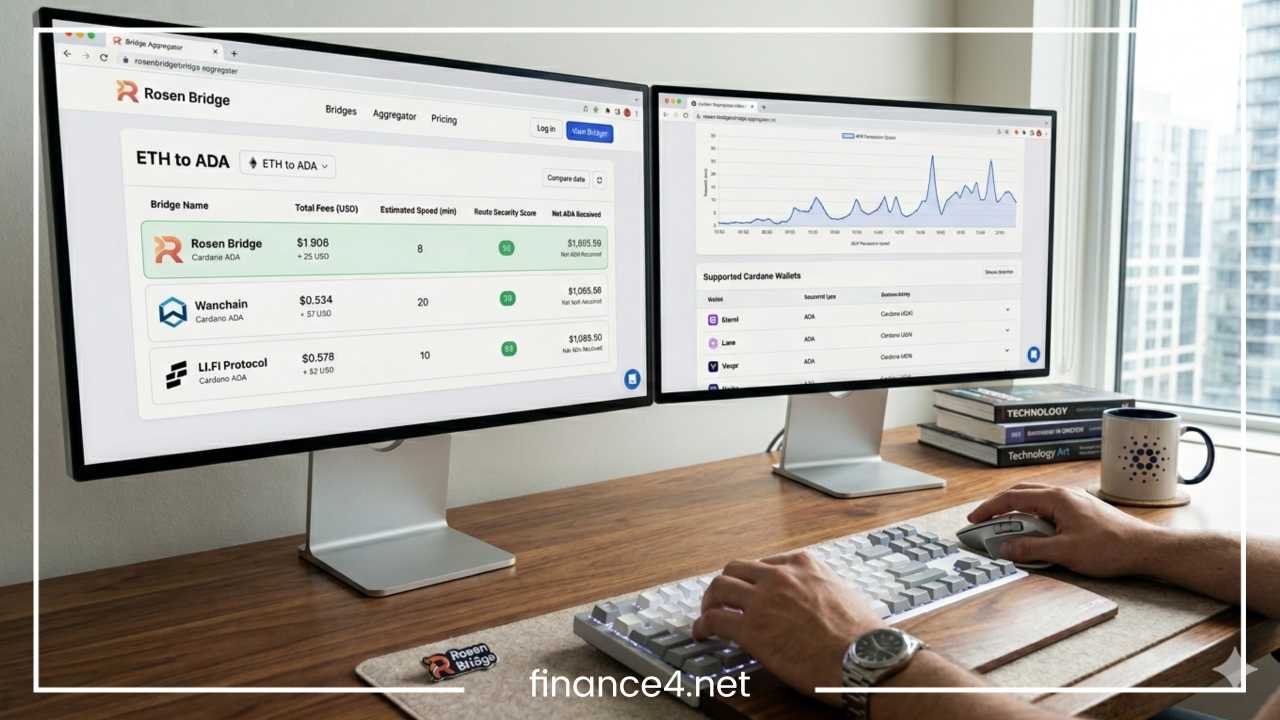
The primary benefit of an aggregator is rate discovery. Fees can fluctuate wildly based on the current liquidity of a specific bridge. An aggregator ensures that the user doesn’t have to manually check five different websites to see who is offering the best deal. Furthermore, aggregators provide route optimization. If a direct bridge between two obscure chains does not exist, an aggregator might route the transaction through a third “hub” chain automatically, saving the user from performing multiple manual swaps.
Aggregators also reduce the “fragmentation” problem. Instead of a user having to learn the interface of ten different bridges, they can use one platform to access the entire cross-chain market. Some advanced aggregators even employ transaction splitting, where a large transfer is broken into smaller pieces and sent across multiple bridges simultaneously to prevent price impact and slippage.
Understanding Minimal KYC in Crypto Bridging
Know Your Customer (KYC) refers to the mandatory process of identifying and verifying the identity of a client. In traditional finance, this involves submitting government IDs, proof of address, and sometimes biometric data. In the crypto world, KYC is often the gatekeeper between decentralized protocols and centralized exchanges.
“Minimal KYC” in the context of bridging refers to a user experience where identity verification is either non-existent or restricted to specific edge cases. For the vast majority of bridge aggregators, the interaction is non-custodial and permissionless. This means the protocol interacts only with the user’s wallet address. There is no account creation, no email requirement, and no request for a passport scan.
The demand for minimal KYC platforms is driven by a desire for privacy and accessibility. Many users live in jurisdictions where access to financial services is restricted, or they simply do not wish to link their real-world identity to their on-chain activity, which is already public and searchable. By maintaining a wallet-only interaction, bridge aggregators uphold the original promise of blockchain technology: a global, open financial system accessible to anyone with an internet connection. However, users must be aware that “no KYC” does not mean “no compliance.” Many aggregators use automated tools to block wallets associated with known exploits or sanctioned addresses.
Key Criteria for Evaluating Bridge Aggregators
When choosing a bridge aggregator, especially one focused on minimal KYC, several factors should be weighed to ensure the safety and efficiency of the transaction.
KYC Policy and Limits
The most important factor for privacy-conscious users is whether the platform remains wallet-based. Some aggregators may not require KYC for small amounts but might trigger a verification request if a transaction exceeds a certain threshold (e.g., $10,000 or $50,000). Understanding these triggers is essential for maintaining a seamless experience.
Supported Chains and Assets
An aggregator is only as good as its reach. A top-tier platform should support major Layer 1s (Ethereum, Solana, Avalanche), Layer 2s (Arbitrum, Optimism, Base, ZKsync), and even non-EVM chains. The variety of supported tokens also matters, as users often need to bridge stablecoins or niche ecosystem tokens.
Liquidity and Fees
Bridging costs are comprised of the source chain gas fee, the bridge provider’s fee, and the aggregator’s service fee (if any). Users should look for platforms that offer “gas-optimized” routes. Liquidity depth is equally important; if a bridge has low liquidity, the “slippage” (the difference between the expected price and the execution price) can be higher than the actual fee.
Security and Audits
Since aggregators interact with multiple smart contracts, their security surface area is large. Users should prioritize aggregators that have been audited by reputable firms and have a proven track record of handling high volume without major exploits.
User Experience and Speed
A clean interface that clearly shows the estimated time of arrival for the funds is invaluable. Some bridges take minutes, while others can take hours. A good aggregator will rank routes by speed so the user can make an informed choice.
Best Bridge Aggregators with Minimal KYC
While the landscape is constantly shifting, several aggregators have established themselves as leaders by providing deep liquidity and a commitment to a wallet-first, minimal KYC experience.
LI.FI (Jumper Exchange)
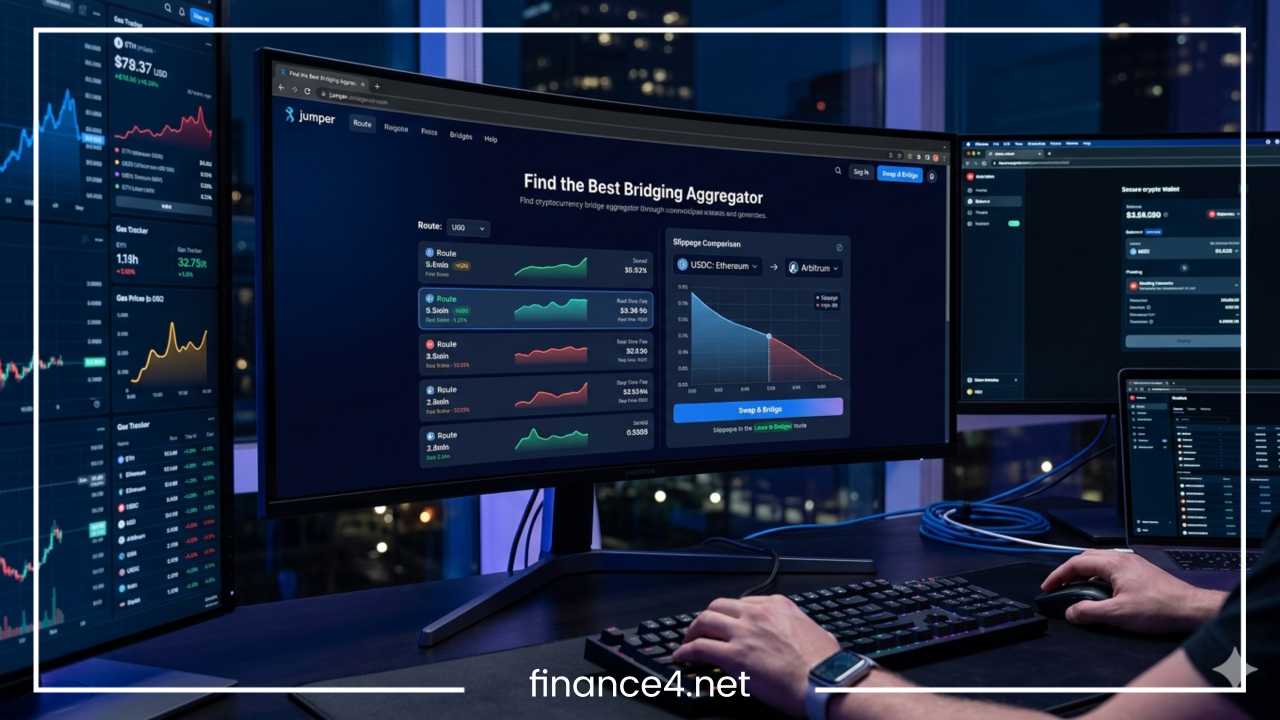
LI.FI is one of the most robust aggregation protocols in the industry, and its flagship consumer interface, Jumper Exchange, is a favorite for many. It aggregates dozens of bridges and decentralized exchanges (DEXs), allowing for “cross-chain swaps” where a user can swap Token A on Chain X for Token B on Chain Y in a single click.
-
Supported Chains: 20+ chains including Ethereum, Arbitrum, Polygon, Solana, and various ZK-rollups.
-
KYC Policy: No identity verification required for standard bridging and swapping. It is a purely wallet-based interaction.
-
Pros: Highly sophisticated routing, supports complex cross-chain swaps, and offers a “protection” feature against slippage.
-
Cons: The interface can be overwhelming for absolute beginners due to the amount of data provided.
-
Best Use Case: Users looking for the absolute cheapest or fastest route among the widest variety of bridges.
Socket (Bungee Exchange)
Socket is the protocol powering Bungee, an aggregator known for its “Refuel” feature. This feature is particularly useful for users who are bridging to a new chain and don’t have the native gas token (like moving to Polygon but having no MATIC). Bungee allows you to send a small amount of gas along with your bridge transaction.
-
Supported Chains: Focuses heavily on the Ethereum EVM ecosystem and its Layer 2s.
-
KYC Policy: Non-custodial and wallet-based. No KYC required for typical cross-chain movements.
-
Pros: Excellent “Refuel” feature, very fast UI, and clear breakdown of bridge fees vs. gas fees.
-
Cons: Less focus on non-EVM chains compared to some competitors.
-
Best Use Case: Bridging to a new Layer 2 where you need a small amount of native gas to start transacting.
Rango Exchange
Rango stands out as a “multi-chain” aggregator that bridges the gap between EVM, Cosmos, Solana, and even Bitcoin. It is designed to be the ultimate cross-chain hub, handling assets that many other aggregators cannot touch.
-
Supported Chains: 50+ blockchains, including Bitcoin, Thorchain, Solana, and the Cosmos ecosystem.
-
KYC Policy: No KYC for decentralized swaps. Users connect their wallets and execute trades directly.
-
Pros: Unmatched support for non-EVM chains; can route through Thorchain for native BTC swaps.
-
Cons: Transactions involving multiple non-EVM chains can sometimes be slower due to the underlying chain finality.
-
Best Use Case: Users moving assets between vastly different ecosystems, such as swapping Solana for native Bitcoin.
Synapse
While Synapse is technically a bridge protocol itself, it functions as a routing layer and aggregator for its supported ecosystems. It is widely regarded as one of the most battle-tested protocols in the space.
-
Supported Chains: 15+ EVM and non-EVM chains.
-
KYC Policy: Permissionless and decentralized. No identity checks are required to use the Synapse bridge or its swap functions.
-
Pros: Deep liquidity for stablecoins and a very simple, clean user interface.
-
Cons: Limited to the bridges and routes specifically supported within the Synapse ecosystem.
-
Best Use Case: High-volume stablecoin transfers between major EVM chains.
deBridge
deBridge uses a cross-chain interoperability and liquidity transfer protocol that allows for the seamless exchange of assets. Its “dePort” and “deSwap” features provide a decentralized way to move value without relying on centralized intermediaries.
-
Supported Chains: Major EVM chains and Solana.
-
KYC Policy: Wallet-based interaction with no mandatory identity submission for DeFi users.
-
Pros: High security standards and low latency for transfers.
-
Cons: Smaller list of supported “niche” chains compared to Rango or LI.FI.
-
Best Use Case: Users prioritizing security and institutional-grade infrastructure for cross-chain transfers.
Privacy vs Compliance: The Hidden Trade-Off
The “Minimal KYC” status of bridge aggregators exists because these platforms are essentially software interfaces for smart contracts. They do not hold user funds in the traditional sense; they simply facilitate the movement of funds from one decentralized contract to another. Because they are non-custodial, many jurisdictions do not currently classify them as “Money Transmitters” in the same way they do for Coinbase or Binance.
However, there is a hidden trade-off. While the aggregator may not ask for your name, the blockchain itself is a transparent ledger. Sophisticated blockchain analytics tools can track the flow of funds from a KYC-verified exchange to a bridge and then to a “private” wallet. Therefore, bridging with minimal KYC provides pseudonymity, not absolute anonymity.
Furthermore, the industry is seeing a trend toward “zkKYC” or decentralized identities (DIDs). These technologies could allow users to prove they are not on a sanctions list or that they are a resident of a specific country without actually revealing their name or passport details to the aggregator. This “Zero-Knowledge” approach may be the future of compliance in the bridging space.
Risks of Using No-KYC Bridge Aggregators
While bridge aggregators offer immense utility, they are among the most complex tools in DeFi, and complexity often breeds risk.
Smart Contract Vulnerabilities
When you use an aggregator, you are essentially interacting with two layers of code: the aggregator’s contract and the underlying bridge’s contract. If either has a bug, your funds could be stuck or lost. Large-scale bridge hacks have accounted for billions of dollars in lost funds over the last few years.
Phishing and Fake Sites
Because these platforms are popular, malicious actors often create “clone” websites. If you connect your wallet to a fake version of Bungee or Jumper, the site could drain your assets. Always double-check the URL and consider bookmarking the official site.
Routing Failures and Stuck Transactions
Sometimes, a transaction might succeed on the source chain but fail to trigger on the destination chain due to a lack of liquidity or a relayers error. While funds are rarely lost in these scenarios, they can be “stuck” in a bridge contract for hours or days until manually pushed through by the bridge’s support team.
Regulatory Uncertainty
Governments are increasingly looking at “DeFi Front-ends.” There is a possibility that in the future, aggregators may be forced to implement geoblocking or more stringent KYC for users in certain regions.
How to Use a Bridge Aggregator Safely
To navigate the cross-chain world safely while maintaining your privacy, follow these best practices:
-
Verify the Domain: Never click on sponsored links in search engines. These are often phishing scams. Go directly to the official Twitter/X account or documentation of the aggregator to find the correct link.
-
Use a Hardware Wallet: For any significant amount of money, use a Ledger, Trezor, or similar device. This ensures that even if your computer is compromised, your private keys remain safe.
-
Test with Small Amounts: Before moving a large sum, send a “test bridge” of $10 or $20. This confirms that the route is active and that you understand how to claim the funds on the destination chain.
-
Check the Slippage and Fees: Aggregators show you the “Expected Output.” If the output is significantly less than what you are sending, the slippage is too high. You may want to wait for more liquidity or choose a different route.
-
Revoke Permissions: After a bridge transaction is complete, use a tool like Revoke.cash to remove the aggregator’s permission to spend your tokens. This is a crucial “hygiene” step in DeFi to protect against future smart contract exploits.
Future of Cross-Chain Aggregation
The long-term goal of the crypto industry is to make the “chain” invisible to the user. In the future, you won’t need to know that you are “bridging” from Ethereum to Arbitrum. You will simply open an app, and the aggregator will handle the background logic of moving funds to wherever the transaction needs to take place.
This is known as Intent-Based Architecture. Instead of the user selecting a specific bridge and a specific route, they simply state their intent: “I want to buy this NFT on Base using my ETH on Ethereum.” The aggregator then competes with other “solvers” to find the most efficient way to fulfill that intent.
Additionally, as Zero-Knowledge (ZK) technology matures, we will see the rise of ZK-Bridges. These bridges use mathematical proofs to verify the state of another chain, eliminating the need for the “trust” currently required in many multi-signature bridge models. This will significantly increase the security of aggregators.
Final Thoughts
Bridge aggregators have become the essential connective tissue of the decentralized economy. By offering a way to find the best rates across a fragmented landscape without the need for intrusive KYC, they uphold the core values of the blockchain movement: privacy, efficiency, and self-sovereignty.
However, the convenience of minimal KYC comes with the responsibility of self-education. Users must remain vigilant about smart contract risks, verify the authenticity of the platforms they use, and understand that on-chain privacy is a nuanced spectrum. As the technology moves toward intent-based routing and ZK-proofs, the process of bridging will likely become even more seamless, further lowering the barriers to entry for a truly multi-chain world. Choosing the right aggregator today is about balancing the need for speed and low fees with a commitment to maintaining control over your digital identity.
Frequently Asked Questions
What is the best no KYC bridge for US users?
While many centralized exchanges (CEXs) have restricted access for users in the United States, decentralized bridge aggregators like Jumper (LI.FI) and Bungee remain accessible. Because these platforms are non-custodial and interact directly with your wallet (like MetaMask or Phantom), they do not typically impose the same regional restrictions as centralized platforms, making them the preferred choice for US-based DeFi users seeking privacy.
How can I bridge ETH to Solana without KYC?
The most efficient way to bridge Ethereum to Solana without identity verification is using a multi-chain aggregator like Rango Exchange or deBridge. These tools allow you to connect an Ethereum wallet and a Solana wallet simultaneously. They route your ETH through liquidity providers who swap it for native SOL or USDC on Solana in a single transaction, bypassing the need for a centralized intermediary.
Are there any bridge aggregators with zero fees?
While almost all bridges require a network gas fee, some aggregators like Jumper often list “Gas Optimized” routes that minimize the overhead. Additionally, keep an eye out for “bridge missions” or incentive programs from Layer 2 networks like Arbitrum or Base, which occasionally offer fee rebates or “gasless” bridging through specific partner aggregators to encourage ecosystem growth.
Is bridging crypto without KYC safe?
Bridging via reputable aggregators is generally safe because it is non-custodial; the platform never “owns” your funds. However, you are still subject to the smart contract risks of the underlying bridges. To stay safe, always verify you are on the official website, use a hardware wallet for large transfers, and use a “revocation” tool to clear contract permissions once the bridge is complete.
Can I bridge Bitcoin to Ethereum without an exchange?
Yes. Aggregators like Rango and protocols like Thorchain allow for native cross-chain swaps. You can swap native BTC for wrapped BTC (WBTC) or ETH on the Ethereum network without ever creating an account or submitting an ID. This is a popular method for Bitcoin holders to enter the DeFi ecosystem while maintaining their privacy.
What is the fastest bridge aggregator for stablecoins?
For stablecoins like USDC or USDT, Synapse and Stargate (often routed through the LI.FI protocol) are typically the fastest. Because stablecoins have deep liquidity across almost every chain, these aggregators can often complete a cross-chain transfer in under three minutes with minimal slippage.
Why do some bridges ask for KYC for large amounts?
Even if an aggregator is decentralized, the “liquidity providers” or fiat on-ramps they plug into may have internal compliance triggers. If a transaction is flagged by automated Anti-Money Laundering (AML) systems—usually due to very high volume or a high-risk wallet history—a bridge may pause the transaction and request verification. Sticking to well-known, fully decentralized routes typically avoids these triggers for standard user volumes.