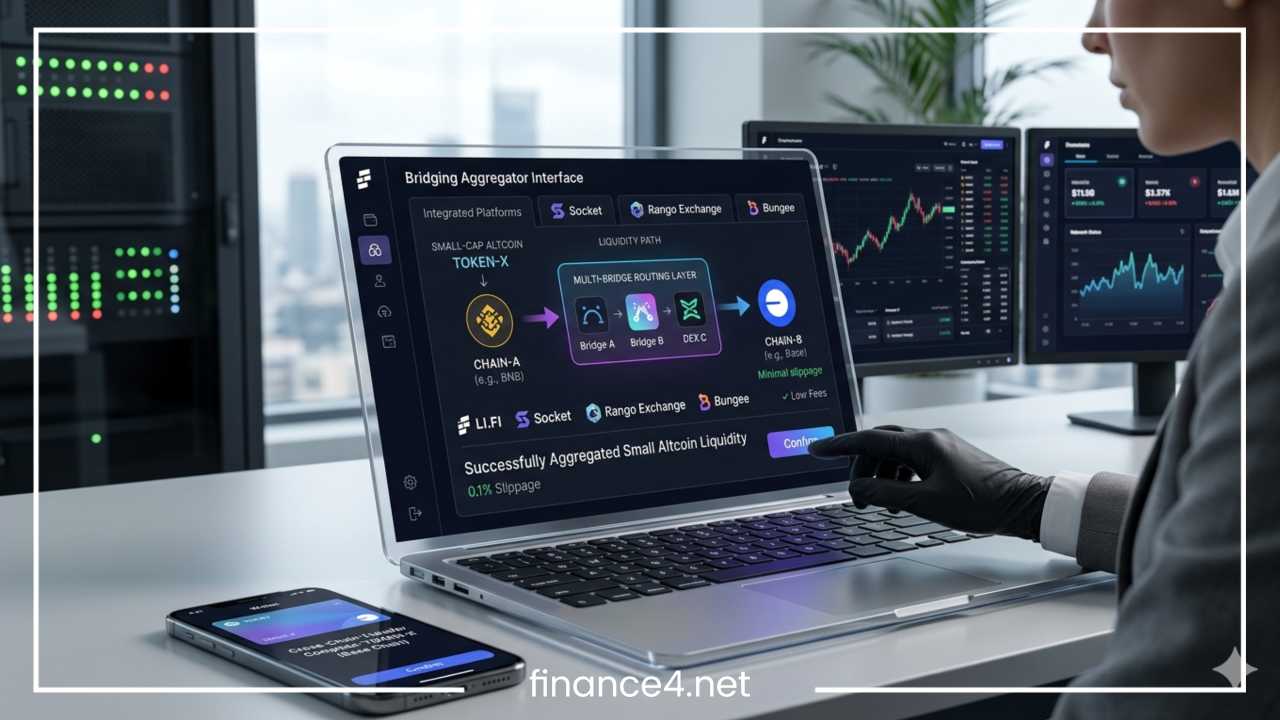
Multi-Hop Bridging Aggregator for Altcoins
 by
by 
Multi-Hop Bridging Aggregator for Altcoins | Best Cross-Chain Swaps
Cross-chain fragmentation remains one of the most persistent friction points in decentralized finance. As the blockchain ecosystem expands into dozens of specialized layer one networks, layer two rollups, and application specific chains, liquidity has become deeply scattered. For users trying to move digital assets across this fragmented landscape, the standard toolkit often falls short. This is particularly true for altcoins, which frequently lack the deep, direct liquidity pools enjoyed by major baseline assets like Ethereum or major stablecoins.
The limitations of traditional one-chain-at-a-time bridging are clear to anyone who has tried to transfer a lesser-known token across networks. Historically, users have had to rely on direct single-hop bridges. If a bridge did not exist between Chain A and Chain C for a specific altcoin, the transfer became an exercise in manual multi-step transactions. A user would typically need to swap their altcoin for a baseline asset like USDC or ETH on the source chain, pay gas fees, execute a single-hop bridge to an intermediate network, pay more gas, and then execute another swap on the destination chain. This process is time-consuming, expensive, and prone to user error.
To solve this complexity, the market has shifted toward multi-hop bridging aggregators. These platforms function as intelligent routing layers that automate complex, multi-step transaction paths across disparate networks. Instead of forcing a user to manually stitch together separate swaps and bridge transfers, a multi-hop bridging aggregator calculates and executes an entire journey in a single transaction workflow.
By evaluating thousands of potential routing combinations across various decentralized exchanges and cross-chain messaging protocols, these systems find the most efficient paths. The core focus of this article is to examine how these routing layers work, why they are indispensable for altcoin transactions, and how users can evaluate them based on routing efficiency, cost, speed, liquidity depth, and protocol risk.
What Is a Multi-Hop Bridge?
A multi-hop bridge refers to a cross-chain transfer mechanism that routes an asset through one or more intermediate networks or intermediary tokens before it reaches its final destination chain. In traditional networking, data packets often travel through multiple routers to reach their destination rather than taking a direct line. Similarly, in blockchain architecture, a multi-hop bridge moves value through a sequence of hops when a direct peer-to-peer route does not exist or is economically inefficient.
To understand the difference, consider a direct bridge versus a multi-hop route. A direct bridge connects Chain A directly to Chain C. If a dedicated liquidity pool or canonical lock-and-mint mechanism connects those two specific environments for a given token, the asset moves in a single step. However, if no direct bridge supports the specific altcoin between Chain A and Chain C, a multi-hop route becomes necessary.
A simplified multi-hop example involves moving an altcoin from Chain A through an intermediate Chain B before landing on Chain C:
-
Altcoin on Chain A converts to an intermediary liquid asset on Chain A
-
The asset crosses via a bridge from Chain A to Chain B
-
The asset is re-routed or swapped on Chain B
-
The asset crosses via another bridge from Chain B to Chain C
-
The final asset is delivered on Chain C
An intermediate chain or intermediary token is often necessary because liquidity for long-tail altcoins is heavily concentrated on specific hub chains, such as Ethereum mainnet or major layer two networks like Arbitrum and Optimism. Rather than maintaining direct liquidity pools for every altcoin across every minor chain—an impossible economic feat—protocols rely on deep hub liquidity.
The architecture behind this relies heavily on liquidity pools, wrapped assets, canonical assets, and specialized bridge protocols. Liquidity pools provide the depth required to swap tokens at each step, while canonical assets ensure that the representation of value remains secure and verifiable as it moves across different consensus environments.
What Is a Cross-Chain Aggregator?
While a multi-hop bridge provides the underlying path, a cross-chain aggregator acts as the intelligence engine that orchestrates the entire process. An aggregator differs fundamentally from a standalone bridge by operating as a meta-layer. Instead of locking users into a single bridging protocol or a single set of liquidity pools, an aggregator queries and combines multiple underlying systems simultaneously.
A comprehensive cross-chain aggregator integrates several distinct components:
-
Bridges that connect different layer one and layer two networks
-
Decentralized exchanges and automated market makers deployed across multiple chains
-
Fragmented liquidity sources scattered across secondary markets
-
Cross-chain messaging protocols that communicate state changes between networks
-
Dynamic swap routes that minimize price impact
Aggregation fundamentally improves route discovery by opening up options that no single bridge or decentralized exchange can offer on its own. Without an aggregator, a user must manually visit multiple bridge interfaces, check liquidity depths, estimate gas costs across different networks, and manually execute sequential trades. This manual approach is not only inefficient but also exposes the user to market volatility and front-running during the gaps between transactions.
By automating this discovery phase, aggregators remove the cognitive load from the user. They treat the entire multi-chain ecosystem as a single unified liquidity layer, scanning thousands of potential routing permutations in milliseconds to present the most optimal path for a given transaction.
How Multi-Hop Bridging Aggregators Work
The operation of a multi-hop bridging aggregator is a sophisticated orchestration of route discovery, pricing calculation, and smart contract execution. When a user interacts with an advanced aggregator, the protocol executes a structured sequence behind the scenes to turn a complex cross-chain request into a seamless experience.
The route-selection process follows a rigorous computational workflow:
-
The user selects the source chain and the destination chain within the interface
-
The user inputs the specific token and the exact amount they wish to transfer
-
The aggregator scans all available routing paths across integrated bridges and decentralized exchanges
-
It evaluates liquidity depth and real-time exchange rates at every potential node
-
It estimates bridge fees, protocol fees, and gas consumption on every network involved
-
It calculates projected slippage based on current pool depths and trade sizes
-
It identifies intermediate chains and intermediary tokens required to bridge the liquidity gap
-
It packages the execution steps into a single transaction payload for the user
-
The destination asset is delivered to the user wallet upon final settlement
To visualize how this functions in practice, consider a conceptual example. A user wants to convert an illiquid altcoin on a newer layer one network into a specific token on Arbitrum. A direct route might feature catastrophic slippage due to shallow liquidity pools. Instead, the aggregator calculates a multi-hop path:
ETH to USDC on Ethereum, then USDC to Arbitrum, then Arbitrum USDC to the target altcoin on Arbitrum
Alternatively, depending on where deep liquidity pools reside for that specific asset, the route might look entirely different:
Altcoin to USDC, then bridged via a high-liquidity messaging protocol to an intermediate layer two network, then swapped into the final destination asset
The aggregator dynamically selects this path because it ensures that the user receives the highest possible net output after accounting for all bridge tolls, swap fees, and gas expenditures across the multi-hop journey.
Why Altcoins Need Multi-Hop Cross-Chain Swaps
While major assets like Ethereum, wrapped Bitcoin, and major stablecoins benefit from ubiquitous direct bridges and deep, centralized liquidity pools, altcoins occupy a vastly different reality. The structural characteristics of altcoin markets make multi-hop cross-chain swaps an absolute necessity rather than a luxury.
Altcoins typically suffer from limited liquidity compared to baseline assets. A liquidity pool for a mid-cap or small-cap altcoin on a specific decentralized exchange might only hold a modest amount of capital. Attempting a large cross-chain transfer directly through a single-hop bridge for such an asset often results in massive price impact and severe slippage.
Furthermore, smaller decentralized exchange markets and a general lack of native bridges compound the issue. Many emerging chains launch without dedicated, secure bridges to every other ecosystem. Instead, they rely on a handful of primary connections to major hubs. Fragmented liquidity across these emerging networks means that an altcoin’s value cannot easily leap from a niche chain to another niche chain without passing through a high-liquidity hub network.
Different token standards and long-tail asset characteristics add further friction. An altcoin might exist as a native token on one chain, an SPL token on another, and an ERC-20 wrapped variant on a third. Price differences for the same altcoin across different chains are common due to localized supply and demand imbalances, as well as delayed arbitrage. Multi-hop bridging aggregators exploit these dynamics or navigate around them, ensuring that altcoin holders can access fair market pricing and execute swaps without being trapped by the liquidity silos of a single blockchain.
Best Features to Look for in a Multi-Hop Bridging Aggregator
Navigating the landscape of cross-chain infrastructure requires an understanding of what separates a mediocre routing tool from an elite aggregator. When evaluating platforms that handle multi-hop swaps for altcoins, several core features demand close inspection.
Multi-Route Discovery
A superior aggregator must look beyond a single pre-determined path. It should be capable of finding multiple disparate paths rather than relying on one hardcoded bridge partner. By querying diverse routing engines, the platform can uncover hidden liquidity pockets that reduce overall costs.
Liquidity Depth
For altcoins, liquidity depth is the primary bottleneck. The chosen aggregator must accurately assess whether a route has enough depth to absorb the intended trade size without triggering runaway slippage. Real-time depth checking prevents transactions from failing midway or executing at disastrous exchange rates.
Competitive Fees
Cross-chain transfers involve multiple layers of cost. Users must evaluate bridge fees charged by the transport protocol, decentralized exchange trading fees incurred during swaps, network gas fees on every touched chain, and any native aggregator service fees. A good aggregator aggregates these costs transparently so hidden expenses do not erode the transfer value.
Slippage Protection
Quoted output figures can differ significantly from final output figures, especially in volatile altcoin markets. Robust aggregators implement strict slippage tolerance controls, setting minimum received thresholds that automatically cancel or revert the transaction if market conditions shift unfavorably during execution.
Route Optimization
Optimization should never be a one-size-fits-all metric. Advanced aggregators allow users to optimize routes based on specific priorities, such as achieving the absolute lowest cost, securing the highest output amount, completing the transaction with the fastest execution time, or minimizing protocol risk by avoiding unproven bridges.
Chain and Token Coverage
For altcoin traders, breadth of coverage is critical. An aggregator must support long-tail assets, emerging layer two networks, and alternative layer one ecosystems. Limited token coverage forces users back into manual, multi-step workarounds.
Transaction Transparency
Transparency builds trust. Before a user signs a transaction, the aggregator should clearly display every single hop, intermediary token, estimated gas expenditure, and protocol involved in the route.
Security
Security is paramount. Users must examine the smart contract audit history of the aggregator, the reputation and track record of the underlying bridges it utilizes, and whether the architecture relies on trusted multisig validators or decentralized cryptographic verification.
Best Cross-Chain Swap Routes: What Makes One “Best”?
A common misconception in decentralized finance is the search for a universally best cross-chain route. In practice, no single route remains optimal across all market conditions. The ideal path shifts dynamically depending on a complex matrix of variables.
The definition of the best route is entirely contextual and depends on:
-
The specific token and its unique market capitalization
-
The exact trade amount, where smaller trades favor low-fee routes and large trades prioritize deep liquidity
-
The source chain and destination chain congestion levels
-
Current gas prices across all participating networks
-
Prevailing market volatility and liquidity conditions
-
The user’s required speed of settlement
To manage these variables, sophisticated aggregators calculate a composite route score. This score algorithmically weights output amount, total fees, execution time, and underlying risk factors to determine the optimal path for that exact microsecond. A route optimized for a five-dollar transfer will look entirely different from a route optimized for a six-figure institutional rebalancing, even if the source and destination tokens are identical.
Multi-Hop Bridge vs. Traditional Bridge vs. DEX Aggregator
Understanding where multi-hop aggregators fit into the broader technological stack requires a direct comparison with traditional single-hop bridges and standard decentralized exchange aggregators.
| Feature | Traditional Bridge | DEX Aggregator | Multi-Hop Aggregator |
| Cross-chain transfers | Yes | Sometimes | Yes |
| Multiple bridges | Usually no | No/limited | Yes |
| Multi-hop routing | Limited | Mainly swaps | Core function |
| Altcoin coverage | Variable | Variable | Potentially broader |
| Route optimization | Limited | Strong for swaps | Strong across bridges + swaps |
Traditional bridges excel at moving a specific asset from Chain A to Chain B through a locked-and-minted or burn-and-mint mechanism. However, they fail when dealing with fragmented altcoins that lack direct pairing. DEX aggregators excel at finding the best swap rates within a single network, but they typically lack the cross-chain messaging capabilities required to move assets across consensus boundaries. Multi-hop aggregators combine the strengths of both worlds, uniting cross-chain transport layers with intra-chain liquidity pools into a cohesive routing architecture.
Risks of Multi-Hop Bridging
While multi-hop bridging aggregators unlock unprecedented flexibility for altcoin traders, they also introduce complex risk vectors that users must carefully weigh. Adopting a balanced perspective requires acknowledging that convenience often comes with architectural complexity.
The primary concern centers on smart contract vulnerabilities. Because a multi-hop transfer interacts with multiple protocols, decentralized exchanges, bridge smart contracts, and cross-chain messaging layers in a single transaction, the attack surface expands significantly. A security flaw in any single component along the route can jeopardize the entire transaction or compromise locked liquidity pools.
Bridge exploits remain a historical Achilles heel of the multi-chain ecosystem. When an aggregator routes funds through a less-established bridge, the user inherits the security assumptions and historical vulnerabilities of that specific protocol. Furthermore, liquidity risks can manifest mid-route. If market volatility spikes while a transaction is in flight, an intermediate pool may experience severe slippage, or the transaction may fail, leaving funds stranded on an intermediate chain.
Failed intermediate transactions present unique recovery challenges. If a hop fails halfway through a multi-chain execution sequence, manual intervention or complex refund mechanisms may be required to retrieve funds. Token contract risks also multiply; malicious tokens, honeypots, or poorly implemented upgradeable proxy contracts on intermediate chains can trap funds.
Additional technical hazards include maximum extractable value and front-running vulnerabilities during the bridging process, chain congestion that stalls intermediate transactions, sudden gas-price spikes that outpace transaction budgets, and overall bridge downtime. The fundamental rule of multi-hop architecture is that more hops inherently mean more potential points of failure. Users must balance the economic benefits of a complex route against the compounding risk profile of touching multiple disparate networks.
How to Use a Multi-Hop Bridging Aggregator Safely
Navigating multi-hop cross-chain swaps requires disciplined operational security and a methodical approach to transaction execution. Following a practical safety checklist significantly reduces the likelihood of lost funds or failed transactions.
-
Verify the official token contract addresses on both the source and destination chains before initiating any transfer to avoid scam tokens and fake wrappers
-
Double-check the destination network and wallet address parameters to ensure assets are not routed to incompatible address formats
-
Review every proposed hop in the aggregator preview window to understand the exact path your funds will take
-
Compare the expected output against the minimum received threshold to protect against sudden slippage swings
-
Check total cumulative fees across all chains involved to ensure the transfer remains economically viable
-
Avoid unnecessarily complicated routes with an excessive number of hops if a simpler, slightly more expensive path offers better security
-
Start with a small test transaction when transferring large sums through a new aggregator or unfamiliar route
-
Verify the security history and audit status of every bridge and protocol integrated into the selected path
-
Never approve unlimited token spending permissions for an aggregator or smart contract without fully understanding the scope of the approval
Future of Multi-Hop Cross-Chain Swaps
The evolution of cross-chain architecture is moving rapidly toward removing manual route selection entirely from the user experience. The next generation of bridging infrastructure focuses on intent-based transactions and solver networks. Instead of a user specifying that an asset must go from Chain A through Chain B to Chain C via specific decentralized exchanges, the user simply states an intent, such as wanting a specific token on a destination network at a target price.
Solver networks compete in real-time auctions to fulfill these intents off-chain, executing the complex multi-hop bridging, swapping, and gas-paying maneuvers behind the scenes. This shift underpins the broader industry movement toward chain abstraction and unified liquidity. Rather than forcing users to think about chains, gas tokens, and bridges, future systems will make multi-chain interactions feel like native single-chain experiences.
Automated route optimization, advanced cross-chain maximum extractable value mitigation, and robust native support for long-tail altcoin assets will continue to mature. Settlement times will shrink from minutes to seconds as fast finality layers and decentralized verification networks improve. Ultimately, the future of multi-hop bridging aggregators is invisibility—transforming from standalone applications that users consciously navigate into foundational routing infrastructure embedded directly into wallets and decentralized applications.
Final Thoughts
Multi-hop bridging aggregators represent a fundamental shift in how value moves across decentralized networks. They are not simply another category of bridge; they are sophisticated routing layers that synthesize disparate bridges, decentralized exchanges, fragmented liquidity pools, and isolated blockchains into a cohesive, functional path for alternative assets.
When dealing with altcoins that lack direct bridging pairs and suffer from scattered liquidity, these aggregators provide the only practical mechanism to execute seamless cross-chain swaps. However, this architectural power demands careful consideration of routing fees, gas expenditures, and compounding smart contract risks.
The ideal cross-chain swap is rarely the absolute cheapest or the fastest in isolation. True optimization requires a balanced combination of high net output, reasonable cost, execution reliability, and robust protocol security. As intent-based architectures and chain abstraction continue to evolve, multi-hop routing will remain the bedrock of a truly interconnected multi-chain economy.
Frequently Asked Questions
How does a multi-hop bridging aggregator find the best cross-chain swap route for altcoins?
A multi-hop bridging aggregator scans thousands of potential routing paths across multiple decentralized exchanges, liquidity pools, and messaging protocols simultaneously. It evaluates real-time token exchange rates, bridge tolls, network gas fees, and projected slippage across various intermediate networks to assemble an optimized transaction path that delivers the highest net output for long-tail altcoins.
What is the difference between a single-hop bridge and a multi-hop bridging aggregator?
A traditional single-hop bridge moves an asset directly from a source chain to a destination chain using a fixed liquidity pool or lock-and-mint mechanism. If no direct connection exists for a specific altcoin, the transfer fails or requires manual intervention. A multi-hop bridging aggregator automates complex routes by chaining multiple swaps and bridge transfers together across different networks in a single transaction workflow.
Why do altcoins require multi-hop cross-chain routing instead of direct bridges?
Altcoins frequently suffer from shallow liquidity pools, fragmented markets, and a lack of native direct bridges connecting every minor layer one or layer two network. Because liquidity for these long-tail assets is heavily concentrated on major hub chains, a multi-hop path allows a transfer to route through intermediary networks and high-liquidity tokens to complete the swap efficiently.
Are cross-chain swap aggregators safe to use for large altcoin transfers?
While aggregators simplify the user experience, they interact with multiple smart contracts, messaging layers, and bridge protocols in a single execution. This expanded attack surface introduces compounding risks, including smart contract vulnerabilities, potential bridge exploits, and intermediate liquidity slippage. Users can mitigate these risks by checking protocol audit histories, reviewing every proposed hop, and starting with small test transactions.
How can I minimize high gas fees and slippage when swapping tokens across chains?
To reduce costs and price impact, users should look for aggregators that support dynamic route optimization, transparent fee breakdowns, and strict slippage tolerance controls. Choosing routes that avoid unnecessary intermediate hops and executing trades during periods of lower network congestion helps preserve capital on complex cross-chain transfers.