Best NFT Aggregator Platforms
 by
by 
Best NFT Aggregator Platforms | Top NFT Marketplace Aggregators
The digital asset ecosystem has evolved past the point of casual collectors browsing single storefronts for digital art. As non-fungible tokens matured into complex financial assets, utility-driven gaming items, and decentralized property identifiers, the infrastructure supporting them had to scale accordingly. In the early days, collectors were forced to jump from one individual platform to another to compare prices, verify floor data, and purchase assets. This fragmented landscape resulted in significant inefficiencies, high gas costs, and missed trading opportunities.
To solve these pain points, NFT aggregators emerged as the ultimate solution for modern digital asset traders. An NFT aggregator functions as a unified interface that pulls real-time listing data, liquidity pools, and historical pricing from dozens of individual marketplaces across multiple blockchain networks. By compiling this disparate data into a single, high-performance dashboard, these platforms allow traders to discover the absolute lowest prices, execute complex bulk orders, minimize network transaction fees, and access deep cross-market liquidity simultaneously.
Whether you are a retail collector searching for a specific digital asset or an advanced portfolio manager executing rapid automated floor sweeps, understanding how marketplace aggregators function is essential. This comprehensive guide details the operational mechanics of NFT aggregation, explores the industry-leading platforms driving the market, and provides an actionable blueprint to help you select the ideal platform for your specific trading objectives.
What Is an NFT Aggregator?
An NFT aggregator is a decentralized web3 application that pulls listing data, pricing information, metadata, and transaction liquidity from multiple independent NFT marketplaces, presenting them within a single unified user interface. Instead of requiring a user to visit separate platforms independently to verify if an asset is listed at a lower price elsewhere, the aggregator acts as a search engine and execution layer that indexes the entire on-chain digital asset market in real time.
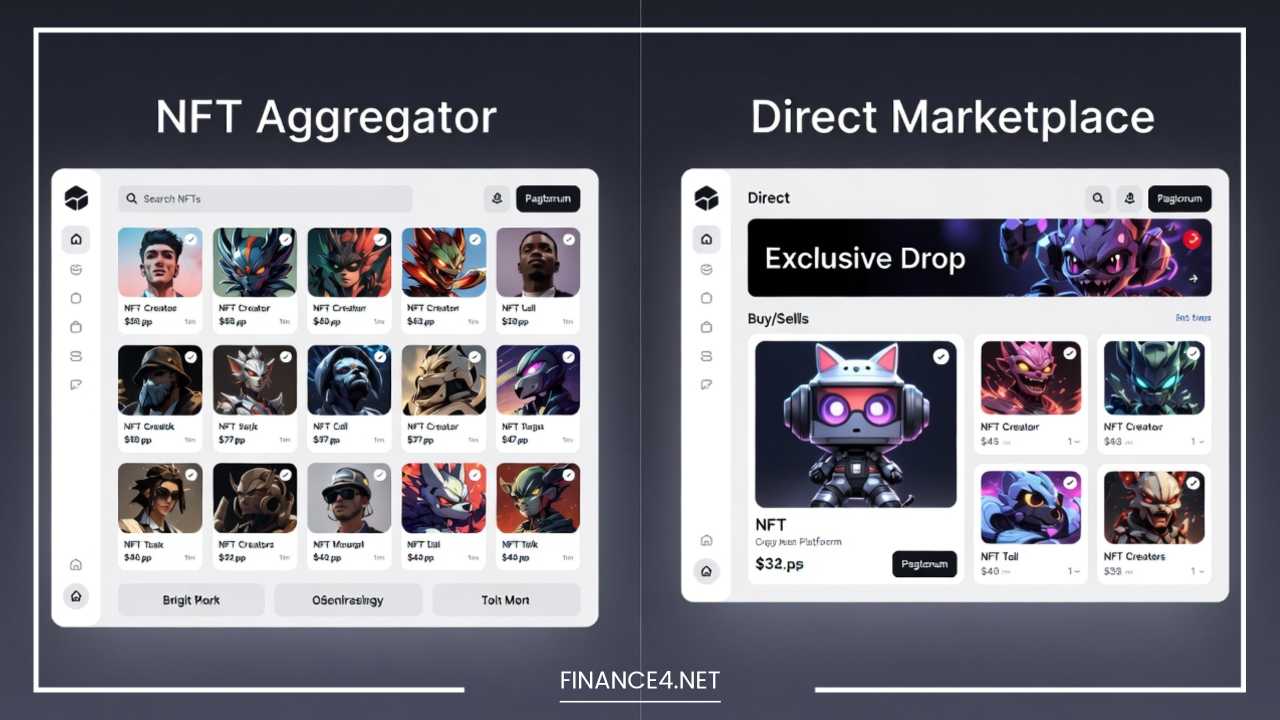
To understand the core difference, think of a traditional NFT marketplace, such as standard OpenSea, as an isolated digital storefront. It only displays assets that users have natively listed on its specific smart contracts. If a collector lists an asset exclusively on a different platform, an OpenSea user cannot view or purchase it without navigating away. Conversely, an NFT aggregator acts like a travel booking site for web3 assets. It does not rely solely on its own database; rather, it queries the smart contracts of every major marketplace simultaneously.
Aggregators grew rapidly in popularity due to the fragmentation of on-chain liquidity. As specialized networks expanded and new platforms competed for volume by undercutting platform fees, listings became scattered across the Web3 ecosystem. For traders, checking every platform manually became impossible. Aggregators solved this by introducing automated protocol routing, advanced data dashboards, and batch settlement capabilities, fundamentally transforming how digital assets are traded.
How NFT Aggregators Work
NFT aggregators operate through a sophisticated multi-step technical process that coordinates front-end data presentation with smart contract execution.
Multi-Marketplace Indexing
The aggregator runs dedicated indexing nodes that continuously scan various blockchains for event logs generated by marketplace smart contracts. When a user lists an asset on any supported platform, the aggregator immediately indexes the metadata, price, token ID, and host contract, displaying it on the centralized dashboard within seconds.
Smart Contract Execution and Aggregation
When a trader decides to buy assets through an aggregator, the transaction does not pass directly through the native marketplace’s front end. Instead, the user interacts with the aggregator’s custom smart contract wrapper. This wrapper acts as an intermediary, receiving the user’s funds, interacting with the targeted external marketplace contracts, executing the purchases, and distributing the assets back to the user’s wallet in a single atomic transaction.
Batch Buying and Gas Optimization
One of the most powerful underlying mechanics is batch execution. If a trader wants to buy ten separate digital assets across three distinct marketplaces, a traditional workflow requires signing ten individual wallet approvals and paying ten separate network transaction fees. Aggregator contracts bundle these ten instructions into a single cryptographic transaction. By optimizing code execution paths and utilizing advanced batch routing algorithms, aggregators significantly cut down the structural gas overhead required by the underlying blockchain network.
Benefits of Using NFT Aggregators
Utilizing an aggregator offers distinct structural advantages over trading on individual, isolated marketplaces.
-
Unified Multi-Marketplace Access: Traders gain instant visibility into global supply. By scanning dozens of platforms simultaneously, users eliminate the risk of missing undervalued listings hidden on smaller or newer platforms.
-
Optimal Capital Pricing: Because all active listings for a specific collection are indexed side-by-side, users can instantly identify the absolute floor price across the entire network, ensuring they never overpay for an asset.
-
Advanced Bulk Purchases and Sweeping: Aggregators allow high-volume traders to execute floor sweeps, which means buying up a massive quantity of the lowest-priced assets in a collection in one motion, preventing front-running by other market participants.
-
Significant Gas Savings: Through smart contract batching, high-frequency traders save considerable sums on blockchain gas fees over time, maximizing total profitability.
-
Real-Time Data Streaming: Most top aggregators utilize live WebSocket connections to stream data instantly, giving users a massive speed advantage during high-volume public mints or rapid market sell-offs.
-
Comprehensive Portfolio Management: These platforms provide analytical tools that allow users to track their entire inventory’s value, historical cost basis, net asset value, and un-realized gains from a single dashboard.
-
Deep Enhanced Liquidity: By pooling the depth of multiple platforms into one order book, large buyers and sellers experience less slippage and enjoy faster execution times.
Best NFT Aggregator Platforms
Blur
Blur is a highly specialized NFT marketplace and aggregator built specifically to meet the high-performance demands of professional traders and liquidity providers. Launched with a data-dense interface reminiscent of an institutional financial terminal, Blur explicitly eschews traditional, heavy gallery layouts in favor of raw speed, depth charts, and rapid order execution.
The platform operates primarily on the Ethereum mainnet and has expanded its ecosystem via deep integrations with its native layer-2 scaling network, Blast. Blur revolutionized the broader web3 sector by introducing a native zero platform fee model and an optimized bidding architecture that rewards users with platform governance tokens for providing active liquidity to the market. It also features sophisticated collection-wide bidding and built-in peer-to-peer lending protocols, allowing advanced users to utilize their digital assets as collateral for instant loans.
Pros
-
Blazing fast infrastructure optimized for real-time floor sweeping and order updates.
-
Zero platform transaction fees for buying, selling, or aggregating listings.
-
Deep integrated financial tools, including real-time analytic charts and lending capabilities.
Cons
-
Visually complex interface that can be intensely intimidating for beginners or casual collectors.
-
Heavy focus on Ethereum and its immediate layer-2 extensions, limiting broader multi-chain utility.
Best For: Professional high-frequency traders, flippers, and institutional liquidity providers operating on the Ethereum ecosystem.
Magic Eden Aggregator
Magic Eden originally established itself as the undisputed leader for digital assets on the Solana blockchain before executing an aggressive multi-chain expansion strategy. Today, its advanced aggregation protocol seamlessly unifies liquidity across Solana, Ethereum, Polygon, Base, and the Bitcoin network.
The platform is highly unique because it aggregates traditional smart-contract-based assets alongside native Bitcoin digital artifacts, such as Ordinals and Runes. Magic Eden provides an incredibly polished user experience that blends an approachable retail marketplace storefront with professional-grade cross-market aggregation. Its robust loyalty program rewards users across different chains, creating a highly unified ecosystem for collectors who frequently move liquidity between diverse Layer-1 and Layer-2 blockchains.
Pros
-
Exceptional multi-chain integration supporting EVM, Solana, and Bitcoin ecosystems simultaneously.
-
The absolute gold standard for trading and aggregating Bitcoin Ordinals and Runes.
-
Highly intuitive interface with a powerful cross-chain wallet infrastructure.
Cons
-
The broad multi-chain interface can sometimes experience slight data refresh delays compared to single-chain hyper-specialized terminals.
-
Standard marketplace transactions feature a platform fee structure that can be higher than zero-fee competitors.
Best For: Multi-chain web3 collectors and retail traders looking for a single unified portal to manage Solana, EVM, and Bitcoin assets.
OpenSea Pro
OpenSea Pro is the direct evolution of Gem, an early pioneer in the aggregation space that OpenSea acquired to capture the advanced trading segment of the market. Operating as a distinct, high-performance interface running parallel to the core OpenSea platform, OpenSea Pro aggregates data from well over 170 individual marketplaces.
The platform equips advanced users with live floor tracking, instantaneous bulk buying tools, gas-optimized routing matrices, and sophisticated data visualization suites. OpenSea Pro bridges the gap between massive retail brand liquidity and institutional-grade trading tools, giving users access to deep inventory depth across numerous Ethereum virtual machine (EVM) compatible chains and alternative Layer-1 networks.
Pros
-
Draws from an unmatched index of over 170 unique external marketplaces for incredible inventory coverage.
-
Highly sophisticated portfolio tracking, inventory management, and profit-and-loss mapping systems.
-
Highly reliable data feeds backed by extensive web3 corporate infrastructure.
Cons
-
The presence of distinct platform features across standard OpenSea and OpenSea Pro can feel fragmented.
-
Fee structures on older or fringe aggregated marketplaces may still apply during fulfillment.
Best For: Advanced analytical users who require wide marketplace coverage alongside institutional portfolio tracking systems.
Tensor
Tensor has established itself as the primary high-velocity trading hub within the Solana digital asset ecosystem. Modeled explicitly around financial trading methodologies, Tensor provides Solana market participants with real-time order books, candlestick charts, collection depth visualizations, and instant execution pathways.
The platform’s core strength lies in its meticulous technological optimization for Solana’s high-throughput architecture. Tensor allows professional traders to execute lightning-fast collection sweeps, manage programmatic automated bidding strategies, and toggle between detailed financial views and classic retail layouts instantly. Its deep integration with Solana protocols ensures that data lag is virtually non-existent, positioning it as the direct competitive counterpart to Blur within the non-EVM landscape.
Pros
-
Unmatched processing speed and real-time execution optimized directly for Solana’s architecture.
-
Advanced order-book style trading mechanisms, including automated bidding and limit orders.
-
Deep localized liquidity, ensuring highly accurate floor tracking for Solana collections.
Cons
-
Highly specialized focus on Solana, making it completely unsuitable for cross-chain EVM collectors.
-
Steep learning curve for retail users unfamiliar with active financial order books.
Best For: Active Solana-native power users, flippers, and high-frequency day traders.
Uniswap NFT
Uniswap NFT brought the power of digital asset aggregation directly into the heart of the decentralized finance (DeFi) ecosystem. By integrating advanced aggregation protocols directly into its core interface, Uniswap allows users to trade digital assets alongside standard ERC-20 liquidity pools.
The protocol aggregates listings from prominent platforms including OpenSea, Blur, Rarible, and LookRare. Uniswap’s core focus is simplifying the overall purchasing experience by utilizing their highly optimized Universal Router smart contract. This unique architecture allows users to purchase multi-marketplace assets using any arbitrary ERC-20 token in their wallet, completely bypassing the manual step of swapping altcoins for Ether before executing an order.
Pros
-
Seamless cross-asset purchasing, allowing users to buy digital assets using arbitrary DeFi tokens.
-
Built directly into a highly trusted, deeply secure decentralized exchange interface.
-
Excellent smart contract optimization that delivers measurable gas savings during routing.
Cons
-
Lacks the deep analytical charting, depth graphs, and order-book mechanics of dedicated professional terminals.
-
Settlement speeds are tied directly to standard DeFi router queues.
Best For: DeFi-centric users who want to purchase digital assets directly using diverse token portfolios without shifting interfaces.
Reservoir
Reservoir operates on a completely distinct philosophy compared to standard trading interfaces. Instead of functioning as a consumer-facing trading dashboard, Reservoir is a decentralized, developer-focused open-source aggregation infrastructure layer.
Reservoir provides all-encompassing developer tools, including turn-key aggregation APIs, software development kits (SDKs), and modular web UI components. This framework enables crypto wallets, decentralized applications, and niche communities to easily pull instant multi-chain order book depth, execute instant cross-platform trades, and launch custom-branded marketplace front ends without writing complex backend parsing logic. It acts as the underlying architecture that powers the aggregation features inside many consumer web3 wallets and decentralized platforms.
Pros
-
Highly flexible developer tools, comprehensive endpoints, and robust documentation.
-
Complete backend management of complex multi-chain tracking, pricing calculations, and order execution.
-
Empowers communities to easily retain control over their own application branding and custom fees.
Cons
-
Not a direct consumer application; requires active software engineering knowledge to utilize effectively.
-
Lacks a centralized user-facing trading platform for immediate asset sweeping.
Best For: Web3 developers, crypto wallet providers, software engineers, and community founders building custom digital asset platforms.
Rarible Aggregator
Rarible has transitioned from its roots as a standalone community marketplace into a comprehensive, multi-chain creator and trading hub. Its integrated aggregator allows users to scan and buy across major platforms like OpenSea and LooksRare while maintaining a deep focus on creator sovereignty.
Rarible stands out by balancing professional-grade multi-chain aggregation with community-driven values, such as strict structural reinforcement of creator royalties. The platform allows users to tap into deep aggregated pools across Ethereum, Polygon, and Immutable X, while simultaneously offering no-code minting environments for artists and structural toolkit management for decentralized autonomous organizations (DAOs) looking to manage community collections.
Pros
-
High-quality creator tools combined with a solid, clean multi-chain aggregation layer.
-
Strong platform advocacy and structural reinforcement for fair creator royalty distributions.
-
Highly accessible, clean, and elegant interface that works exceptionally well for retail users.
Cons
-
Lower native trading liquidity compared to hyper-specialized professional day-trading terminals.
-
Fewer raw statistics and analytical modules for rapid algorithmic asset flipping.
Best For: Digital creators, independent artists, and community members who value ecosystem sustainability alongside market aggregation.
Platform Comparison Matrix
| Platform | Supported Chains | Batch Buying Support | Advanced Analytics Suite | Target User Base |
| Blur | Ethereum, Blast | Fully Supported | Institutional Grade | Pro Traders & Flippers |
| Magic Eden | Solana, Bitcoin, EVM | Fully Supported | High Quality | Multi-Chain Collectors |
| OpenSea Pro | Multi-chain (EVM Focus) | Fully Supported | Institutional Grade | Advanced Analytical Users |
| Tensor | Solana Native | Fully Supported | Institutional Grade | Solana Power Users |
| Uniswap NFT | Ethereum Ecosystem | Partially Supported | Standard Baseline | DeFi Power Users |
| Reservoir | Broad Multi-Chain | Developer API Driven | Developer API Driven | Web3 Engineers & Teams |
| Rarible | Multi-chain | Supported | Standard Baseline | Creators & Communities |
How to Choose the Best NFT Aggregator
Selecting the correct aggregator platform requires an honest evaluation of your specific trading goals, budget, and technological comfort level.
Blockchain and Network Compatibility
Your choice must align directly with where your target digital asset collections reside. If you are primarily hunting for historical digital artifacts on the Bitcoin network, an EVM-only tool is useless; you will require a cross-chain aggregator like Magic Eden. Conversely, if you operate purely within the Solana DeFi ecosystem, a hyper-optimized network terminal like Tensor is the standard choice.
Fee Structuring and Operational Costs
Every basis point counts when trading digital assets. Analyze whether the aggregator levies a custom surcharge on top of the external marketplace fees. Zero-fee models like Blur allow heavy flippers to preserve their strict margins during high-frequency trades.
Execution Speed and Interface Responsiveness
During competitive mint events or market panics, a fraction of a second dictates whether a transaction succeeds or fails. Choose a platform that integrates direct WebSockets and real-time mempool tracking if execution speed is your primary performance metric.
Analytical Depth and Tooling
Determine if you require raw data features such as real-time depth charts, candlestick price trends, historical listing walls, and automated bidding infrastructure. If you simply want to buy a single piece of digital art to hold long-term, choose a clean retail aggregator over an overwhelming data terminal.
NFT Aggregator vs NFT Marketplace
Understanding the operational differences between these two platform categories is crucial for structuring efficient on-chain workflows.
| Structural Feature | Individual NFT Marketplace | Integrated NFT Aggregator |
| Inventory Source | Exclusively relies on internal platform listing contracts. | Synchronizes listings globally from dozens of external platforms. |
| Data Breadth | Restricted exclusively to internal transaction histories. | Aggregates full multi-platform analytics and deep order volumes. |
| Execution Latency | Optimized locally for its specific internal listings. | Relies on external routing, which can occasionally introduce minor processing steps. |
| Order Flexibility | Limited strictly to standard single-item checkout mechanics. | Advanced batching enables massive single-click multi-item collection sweeps. |
| Transaction Cost | Subject to static standard platform fees and individual signature gas costs. | Gas-optimized smart contracts cut down relative network costs for bulk actions. |
Risks of NFT Aggregators
While aggregators offer undeniable capital efficiency, they are not without distinct operational risks that users must mitigate.
-
Smart Contract Vulnerability: Aggregators process transactions via custom smart contract wrappers that interact with external protocols. This layered complexity introduces additional vectors for code vulnerabilities or smart contract hacks.
-
Metadata Discrepancies: Because aggregators pull data from disparate external nodes, minor indexing delays can occasionally display inaccurate pricing info or fail to show that an item has already been purchased, leading to failed transactions and wasted gas.
-
Malicious and Counterfeit Collections: Sophisticated bad actors can list fake or unverified look-alike collections on obscure marketplaces. If an aggregator indexes those fringe platforms loosely, these fraudulent assets can leak into the primary dashboard view.
-
High Volatility Slippage: During severe market crashes or explosive hype cycles, floor prices shift faster than cross-market indexes can clear, resulting in high transaction failure rates due to aggressive price slippage settings.
Future of NFT Aggregators
As web3 infrastructure matures, the aggregation landscape is positioned for significant technological transformations.
AI-Driven Market Discovery
Future aggregation frameworks will deeply integrate machine learning models to analyze on-chain wallet movements, instantly flagging anomalous floor sweeps or predicting macro collection trends before they manifest on public dashboards.
Trustless Cross-Chain Execution Layers
The current barrier between non-EVM networks and Ethereum architectures will break down entirely. Next-generation aggregation protocols will allow users to natively sweep a combination of Solana, EVM, and Bitcoin assets simultaneously in a single, trustless transaction powered by cross-chain intent bridges.
Tokenization of Real-World Assets (RWAs)
As physical real estate, institutional debt instruments, and global logistics documentation migrate on-chain as non-fungible tokens, aggregators will transition from trading digital art to serving as institutional discovery portals for tokenized physical property and global financial assets.
Final Thoughts
NFT aggregator platforms have fundamentally redefined the landscape of digital asset trading by replacing fragmented market structures with unified, hyper-efficient, data-rich execution environments. By consolidating deep cross-market liquidity, offering gas-optimized batch purchasing pathways, and serving up institutional-grade data feeds, they ensure that modern collectors and professional traders can maximize capital efficiency effortlessly.
The ideal platform depends entirely on your specific strategic operational profile:
-
Blur stands as the definitive choice for dedicated, high-volume Ethereum day traders requiring lightning-fast floor sweeps.
-
Magic Eden provides the ultimate multi-chain playground for collectors managing assets across Solana, EVM networks, and Bitcoin Ordinals.
-
OpenSea Pro delivers unmatched data indexing depth paired with stellar portfolio-tracking architecture for professional analytical minds.
-
Tensor remains the supreme speed terminal for anyone specializing in the high-velocity Solana landscape.
By aligning your unique network preferences, transaction frequencies, and analytic software needs with the specific structural strengths of these leading aggregators, you can successfully navigate the digital asset economy with a powerful competitive edge.
Frequently Asked Questions
What is the best NFT aggregator for beginners?
For individuals new to the digital asset space, platforms that combine high-quality retail interfaces with multi-chain aggregation offer the smoothest onboarding experience. The Magic Eden Aggregator provides a highly intuitive storefront that lets beginners browse and buy NFTs across Ethereum, Solana, and Bitcoin without needing deep technical trading knowledge. The platform’s clean design minimizes the steep learning curve typically associated with professional trading terminals.
How do NFT marketplace aggregators save on gas fees?
NFT marketplace aggregators optimize network transaction costs by utilizing custom smart contract wrappers that support batch buying. Instead of requiring a trader to sign separate transactions and pay individual base fees for every single digital asset they purchase, the aggregator bundles multiple purchase orders from various marketplaces into one single cryptographic transaction. This drastically cuts down the processing overhead on networks like Ethereum.
Can you buy NFTs across different marketplaces at the same time?
Yes, this is the primary functionality of an NFT aggregator. By indexing the global order books of multiple independent storefronts simultaneously, these platforms allow you to add items hosted on OpenSea, Blur, Rarible, and LooksRare into a unified shopping cart. You can then execute the entire multi-marketplace order in one single click using the aggregator’s routing protocol.
What is the difference between Blur and OpenSea Pro?
While both platforms target advanced web3 power users, Blur operates with a zero platform fee structure and features a heavily data-dense layout built for hyper-velocity day trading, floor sweeping, and native financial lending. OpenSea Pro (formerly Gem) focuses on providing highly reliable statistical index data across more than 170 unique external marketplaces alongside comprehensive portfolio tracking and profit-and-loss management tools.
Are NFT aggregator platforms safe to connect to crypto wallets?
Using an aggregator introduces smart contract risk, as your transaction routes through the aggregator’s intermediary code before reaching the native marketplace contract. To maximize security, only connect your web3 wallet to established, audited platforms like OpenSea Pro, Blur, or Tensor. Additionally, it is highly recommended to use a dedicated hot wallet for daily trading rather than your primary cold storage hardware wallet.
Which NFT aggregator is best for Solana floor sweeps?
Tensor is widely considered the leading high-performance trading terminal for the Solana ecosystem. It is engineered specifically to match Solana’s rapid block production times, providing real-time candlestick tracking, historical depth charts, and instantaneous automated collection sweeping mechanisms that give professional flippers a distinct speed advantage over standard marketplace frontends.