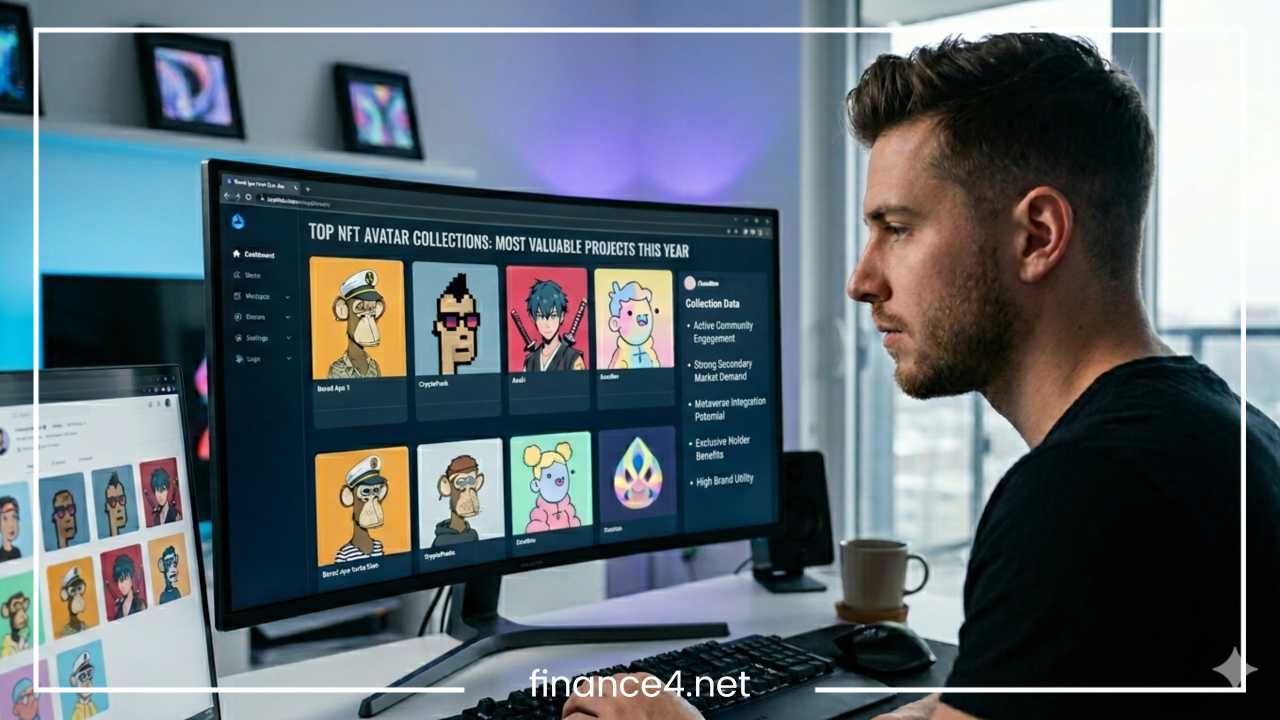
NFT Derivative Trading with Built-in Oracles
 by
by 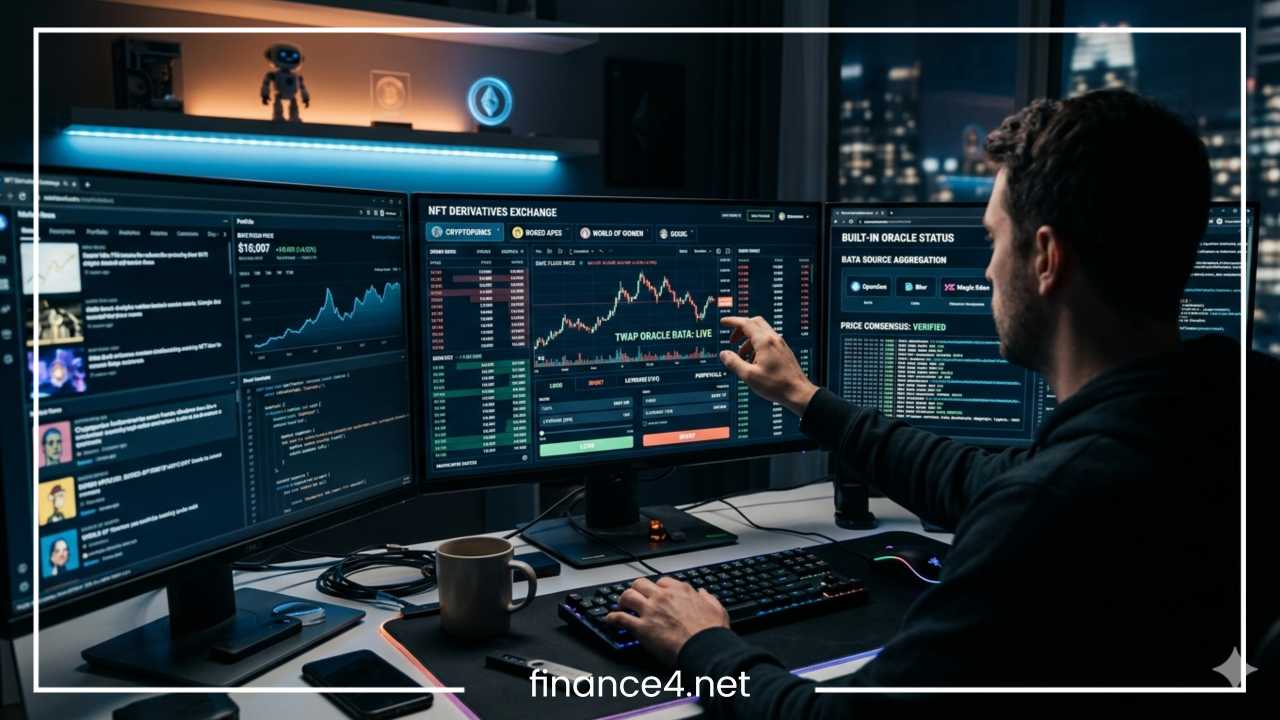
NFT Derivative Trading with Built-in Oracles: The New Frontier of Liquidity
The evolution of Non-Fungible Tokens (NFTs) has been one of the most rapid and disruptive shifts in the history of digital assets. While the initial wave of adoption was driven primarily by profile picture (PFP) collections and digital art, the ecosystem has matured into a sophisticated landscape encompassing gaming assets, Real World Assets (RWAs), decentralized identity, and intellectual property. However, despite this expansion, the NFT market faces a persistent, structural challenge: a lack of capital efficiency.
Unlike fungible tokens such as Bitcoin or Ethereum, which are highly liquid and easily traded on global exchanges, NFTs are inherently illiquid. Each asset is unique, making it difficult to find a counterparty for a specific item at a moment’s notice. This “lumpy” liquidity prevents the market from reaching its full potential as a financial asset class. For an asset class to reach institutional maturity, it requires more than just a spot market; it requires a sophisticated financial superstructure.
The bridge between raw ownership and a sophisticated financial market lies in derivative trading. By decoupling the price movement of an asset from the asset itself, derivatives allow market participants to hedge risk, speculate on floor prices, and gain exposure without needing to own the underlying NFT. To make this work, however, a critical piece of infrastructure is required: the oracle.
When we combine NFT derivatives with built-in oracles, we unlock a paradigm shift in price discovery and liquidity. This article explores how integrated data feeds provide the foundation for a robust financial layer on top of unique digital assets, transforming NFTs from static collectibles into dynamic financial instruments that can be hedged, leveraged, and traded with the same precision as traditional commodities.
Understanding NFT Market Limitations
To understand why derivatives are the logical next step, we must first diagnose the inefficiencies inherent in the current NFT spot market. The limitations are not merely technical; they are fundamental to the “non-fungible” nature of the assets.
The Illiquidity Trap
In a standard fungible market, liquidity is deep and continuous. If you hold 100 tokens, you can usually sell them into a “bid” at a known price. In NFTs, liquidity is often binary: you either have an offer or you don’t. Selling a high-value NFT frequently requires waiting days, weeks, or months for a buyer who values the specific traits of that piece. This makes it nearly impossible for investors to exit positions quickly during market downturns, leading to “trapped capital” that cannot be redeployed.
Fragmented Markets and Standardized Pricing
NFT markets are notoriously fragmented. An asset might be listed on multiple marketplaces with different fee structures, varying levels of visibility, and different technical standards. Furthermore, pricing is rarely standardized. While the “floor price” (the lowest price for any item in a collection) serves as a benchmark, it does not account for rare traits or historical significance. This “trait-based valuation” creates a massive spread between what a seller wants and what a buyer is willing to pay. Without a unified price feed, price discovery becomes a manual, labor-intensive process.
High Volatility and Manipulation
Because NFT markets are “thin” (meaning there are few buy and sell orders at any given time), they are highly susceptible to volatility. A single “whale” sweeping the floor can send prices up by 50% in an hour, while a single distressed seller can crash the perceived value of a entire collection. This environment also invites wash trading—where users trade with themselves to create an illusion of volume and value—further distorting the true market price.
The Capital Intensity Problem
To get exposure to a specific NFT project, a participant currently has to buy the asset in full. This is highly capital intensive. If a “blue chip” NFT costs 50 ETH, an investor must lock up 50 ETH to participate in its price action. This excludes the majority of market participants and slows down the overall velocity of money within the ecosystem.
Derivatives address these issues by allowing traders to interact with the value of the collection rather than the physical transfer of the individual token, effectively virtualizing the market.
Basics of Derivative Trading
Before applying derivatives to the NFT space, it is essential to define the core financial vehicles that make up this sector. Derivatives are financial contracts that “derive” their value from an underlying asset.
Futures and Forward Contracts
A futures contract is an agreement to buy or sell an asset at a predetermined price at a specified time in the future. In the context of NFTs, this allows a collector to lock in a sell price today for an asset they plan to sell in three months, protecting them against a market crash. If the floor price drops, the profit on the short futures contract offsets the loss in the value of the physical NFT.
Options (Calls and Puts)
Options provide the right but not the obligation to buy (Call) or sell (Put) an asset at a specific price. This is particularly useful for NFT launches. An investor might buy a call option on a new gaming collection, giving them the right to buy at a certain price if the game becomes a hit, while only risking the small “premium” paid for the option itself.
Perpetual Swaps
Perpetual swaps are the most popular derivative in the crypto space. Unlike standard futures, they have no expiry date. They use a “funding rate” mechanism to ensure the contract price stays closely aligned with the spot price. For NFTs, perpetuals allow traders to go long or short on the floor price of a collection with high leverage (e.g., 5x or 10x), allowing for massive exposure with minimal upfront capital.
Leverage and Margin
Derivatives introduce the concept of margin trading to NFTs. Instead of paying 100% of an NFT’s value, a trader might only put down 10% as collateral. While this increases the potential for profit, it also introduces the risk of liquidation—where the position is forcibly closed if the market moves against the trader.
Hedging vs. Speculation
Derivatives serve two primary masters:
-
Hedgers: A gallery owner holding a million dollars in NFTs might use derivatives to “short” the market index, ensuring that if the market value of their art drops, their derivative profits offset the loss.
-
Speculators: A trader who believes a new gaming NFT project will gain traction can gain exposure to the price movement using a fraction of the capital required to actually buy the assets.
What Are Oracles in Web3?
A derivative is only as good as the price feed it relies on. Since smart contracts live on a blockchain, they are isolated from the outside world. They cannot “see” what an NFT is selling for on a centralized marketplace or even another blockchain without a bridge. This bridge is the oracle.
The Function of an Oracle
An oracle is a data feed that pushes off-chain information (like the current floor price of a Bored Ape) onto the blockchain so a smart contract can execute based on that data. If a derivative contract says “Pay the user if the floor price exceeds 50 ETH,” the contract needs a trusted source to confirm that price in a decentralized manner.
Types of Oracles
-
Price Oracles: The most common type, providing real-time valuation of assets.
-
Event/Data Oracles: Relaying specific events, such as a “reveal” of an NFT collection’s metadata or the outcome of an in-game event.
-
Cross-Chain Oracles: Transferring data between different blockchain ecosystems, essential for a multi-chain NFT future.
Challenges: The Oracle Problem
The primary challenge is reliability and security. If an oracle relies on a single source of data, that source can be manipulated. If the data is slow (high latency), traders can “front-run” the oracle by acting on information before the smart contract updates. For NFT derivatives to work, the oracle must be:
-
Tamper-proof: Resistant to price manipulation on the source exchanges.
-
Low Latency: Fast enough to reflect real-time market shifts.
-
Aggregated: Pulling data from multiple sources to ensure a “Global Volume-Weighted Average Price.”
Built-in Oracles for NFT Derivatives
The “built-in” oracle approach represents a move away from generic, third-party data feeds toward protocol-specific infrastructure designed specifically for the nuances of NFT data. This is the core innovation that makes NFT derivatives viable at scale.
Integrated Protocol Logic
A built-in oracle is integrated directly into the trading protocol’s core architecture. Instead of asking an external provider “What is the price?”, the protocol itself runs nodes that aggregate data from every major NFT marketplace (OpenSea, Blur, Magic Eden, etc.). This eliminates the middleman and reduces the “hop” between data generation and data consumption, significantly lowering latency.
Specialized Valuation Mechanisms
Built-in oracles for NFTs must be more sophisticated than those for fungible tokens. They often employ advanced mathematical models:
-
TWAP (Time-Weighted Average Price): This averages the price of an NFT over a specific period (e.g., 1 hour or 24 hours). This prevents a “flash crash” or a single manipulated sale from triggering mass liquidations.
-
VWAP (Volume-Weighted Average Price): This gives more weight to sales that happen at higher volumes, ensuring that a single “outlier” sale doesn’t skew the entire price feed.
-
Trait-Weighted Models: Advanced built-in oracles use machine learning to weigh the value of specific traits. If an NFT with a “Gold Skin” sells for 10x the floor, the oracle recognizes this as an outlier or a specific sub-tier price rather than a move in the general floor price.
On-Chain Sales Data Indexing
By indexing sales directly from the blockchain (the “source of truth”), built-in oracles can bypass the delays often found in marketplace APIs. This creates a “heartbeat” for the protocol that is independent of any single marketplace’s uptime or data accuracy.
Design Ideas: Oracle Committees
To maintain decentralization, built-in oracles often use a committee of decentralized validators. These validators each fetch data independently, and a consensus mechanism (such as a medianizer) is used to determine the final price pushed to the derivative smart contract. This makes it prohibitively expensive for an attacker to corrupt the feed.
Architecture of an NFT Derivatives Platform
Building a platform for NFT derivatives requires a multi-layered architectural approach that ensures security, speed, and fairness.
The Smart Contract Layer
This is the settlement engine. It manages user balances, margin requirements, and the logic for opening and closing positions. Crucially, it handles liquidations. If a trader’s position goes against them and they no longer have enough collateral, the smart contract must automatically close the position to protect the protocol’s solvency. In a built-in oracle system, the liquidation trigger is directly tied to the internal data feed.
The Pricing Engine
This component sits between the oracle and the smart contract. It takes the raw data from the built-in oracle and applies the necessary mathematical filters (TWAP/VWAP). It also calculates the “Funding Rate” for perpetual swaps, which is a periodic payment made between long and short traders to keep the derivative price pegged to the spot price.
Matching Engine: Order Book vs. AMM
How are trades executed?
-
Central Limit Order Book (CLOB): Users post “limit orders” (e.g., “I want to long the floor at 10 ETH”). This requires high throughput and is often handled on Layer 2 or Layer 3 solutions to avoid high gas fees.
-
Automated Market Maker (AMM): Users trade against a liquidity pool. This is more common in decentralized finance (DeFi) but requires complex mathematical formulas (like “Constant Product” or “Virtual Liquidity”) to ensure the pool doesn’t get drained by informed traders.
Collateral Management and Vaulting
Since these are derivatives, they are often “cash-settled” in a fungible currency like ETH or USDC. However, some platforms allow for “physical delivery” or use NFTs themselves as collateral. This requires a robust vaulting system where NFTs are locked in a smart contract and their value is constantly appraised by the built-in oracle.
Use Cases
The practical applications of NFT derivatives extend far beyond simple gambling on price movements. They provide the tools necessary for professional market participation.
Hedging NFT Exposure
Imagine a gaming guild that owns 5,000 virtual land plots in a specific metaverse. Their entire balance sheet is tied to the success of that game. By shorting a derivative tied to that land’s floor price, they can protect their treasury. If the game loses popularity and the land value drops, their short position yields a profit, keeping the guild solvent to pivot to another project.
Floor Price Speculation
Most traders have an opinion on whether a project is “overvalued” or “undervalued.” Currently, if you think a project is overvalued, there is no way to profit from that insight. Derivatives allow for shorting, enabling traders to bet against a project, which actually helps “pop” speculative bubbles and leads to more stable, realistic pricing.
Fractional Exposure Without Ownership
Many investors want exposure to “Blue Chip” NFTs but cannot afford the entry price. Derivatives allow them to buy a “Long” contract representing a fraction of the floor price. They get the price appreciation without needing to navigate the complexities of fractionalization protocols or manage the security of a high-value asset.
Gaming NFTs and Asset Prediction
In gaming, the value of an item often changes based on “buffs” or “nerfs” in the game logic. Professional gamers or speculators can use derivatives to hedge the value of their in-game inventory before a major patch, or speculate on which assets will become “meta” in the next season.
NFT Index Derivatives
A derivative can be tied to an index of the top 10 NFT projects. This provides a “Blue Chip Index” for the NFT market, allowing investors to bet on the health of the entire ecosystem rather than picking individual winners and losers.
Risks and Challenges
No financial innovation is without risk, and NFT derivatives face several unique hurdles that must be addressed through rigorous engineering.
Oracle Manipulation Attacks
This is the single greatest threat. If a collection has low volume, a malicious actor with deep pockets could “sweep” the floor on a spot marketplace to artificially inflate the price. If the derivative’s built-in oracle isn’t sophisticated enough to filter out this activity, it could trigger mass liquidations for short-sellers. Protocols must use multi-source aggregation and “outlier detection” to mitigate this.
Low Liquidity in Derivatives Markets
A derivative market is only useful if there are enough participants to take the other side of a trade. If an NFT derivative platform has low “Open Interest,” the slippage can be high, making it difficult for large players to enter or exit positions.
Smart Contract Vulnerabilities
As with all DeFi, the code is the law. If there is a bug in the liquidation logic or the oracle update mechanism, millions of dollars can be lost in seconds. Extensive auditing and formal verification of the oracle-smart contract integration are mandatory.
Regulatory Uncertainty
The classification of NFT derivatives—whether they are securities, commodities, or swap contracts—remains a grey area in many jurisdictions. Platforms must navigate a complex legal landscape that could change at any moment.
Pricing Inaccuracies for Rares
Derivatives are currently best suited for “floor” items. Valuing a “1-of-1” or an extremely rare trait via an automated oracle remains incredibly difficult. If a platform allows derivatives on rare items, it risks “mispricing” the asset, leading to unfair liquidations or arbitrage opportunities that drain the protocol’s liquidity.
Comparison with Existing Solutions
NFT derivatives with built-in oracles exist within a broader ecosystem of “NFTFi” (NFT Finance) solutions.
NFT Lending Protocols
Lending protocols allow you to use an NFT as collateral to borrow crypto. While this provides liquidity, it is binary and often carries high interest rates. Derivatives are more flexible; they allow for leverage and shorting, which lending does not natively support.
Fractionalization Platforms
Fractionalization breaks an NFT into a million pieces (ERC-20 tokens). However, “reconstituting” the NFT is notoriously difficult, and these tokens often suffer from even worse liquidity than the original NFT. Derivatives avoid this “buy-back” problem by remaining entirely synthetic—no NFT is ever “broken.”
Synthetic NFT Assets
Protocols like Synthetix have experimented with tracking NFT prices. However, without a built-in oracle that understands the specific nuances of NFT marketplaces (like Blur’s bidding pools or OpenSea’s private sales), these synthetics often decouple from the actual market price. The built-in nature of the oracle is what provides the necessary “tightness” in the peg.
Future Outlook
The maturation of this space will likely be driven by several key technological and market-driven advancements.
AI and Machine Learning Integration
As machine learning models become more adept at analyzing visual data and market sentiment, built-in oracles will become “smarter.” They won’t just look at sales; they will look at social media hype, developer activity, and historical “beauty” metrics to provide a “Fair Value” index that is more robust than a simple floor price.
Cross-Chain NFT Derivatives
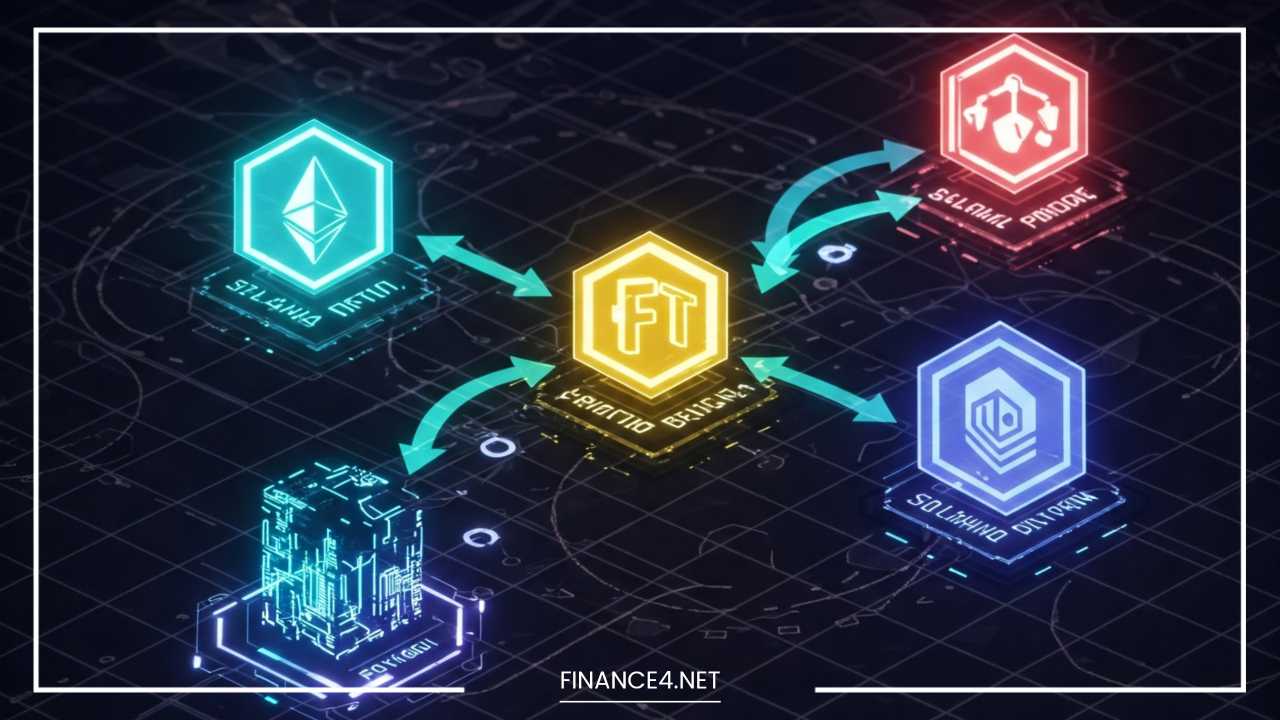
The future is multi-chain. We will see platforms that allow a user on an Ethereum Layer 2 to trade derivatives on NFTs that exist on Solana, Bitcoin (Ordinals), or Avalanche. Built-in oracles will act as the data glue between these ecosystems, providing a unified price for a collection regardless of where the individual assets are held.
Institutional Adoption and Market Making
As the infrastructure stabilizes, institutional market makers will enter the space. These firms provide the deep liquidity necessary for large-scale hedging. They will rely on the transparency and speed of built-in oracles to manage their risk, leading to a much more stable and professional market environment.
Integration with Traditional Finance (TradFi)
Eventually, we may see NFT derivatives integrated into traditional brokerage accounts, allowing diversified investors to gain exposure to the “Digital Culture” asset class alongside stocks and bonds.
Final Thoughts
The “Wild West” era of NFTs, characterized by pure speculation and illiquid holdings, is giving way to a more structured and efficient financial ecosystem. The development of NFT derivative trading represents a critical milestone in this journey. By moving away from the physical constraints of individual token transfers and toward a synthetic, data-driven trading model, the market can finally achieve the capital efficiency it needs to scale.
The linchpin of this entire system is the built-in oracle. By integrating pricing logic directly into the protocol’s architecture, developers can mitigate manipulation, reduce latency, and provide the trustless data necessary for high-stakes financial instruments. While challenges regarding volatility and oracle security remain, the fusion of derivatives and specialized data feeds is undeniably the path toward a more liquid, transparent, and accessible digital asset economy.
As these tools evolve, they will do more than just change how we trade digital art; they will provide the financial foundation for the entire metaverse, allowing every digital asset—from virtual real estate to gaming skins—to be accurately priced and efficiently traded in a global, 24/7 market.