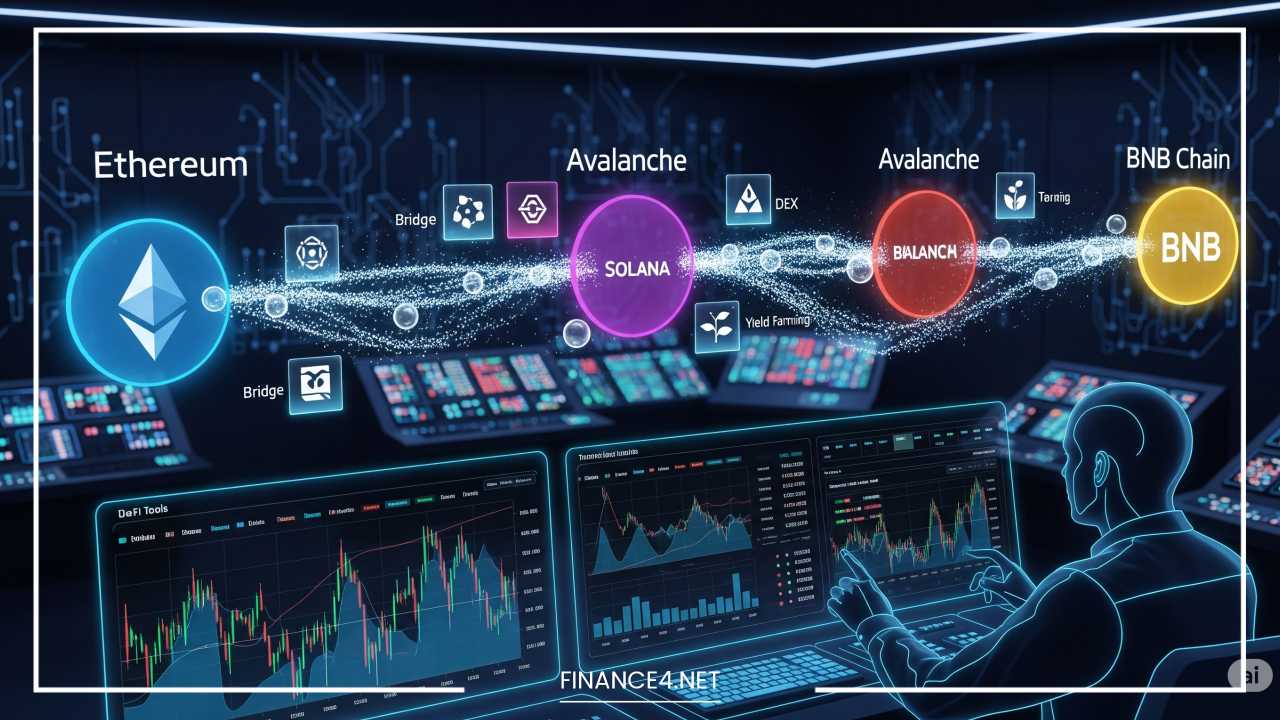
Top Cross-Chain DeFi Aggregators
 by
by 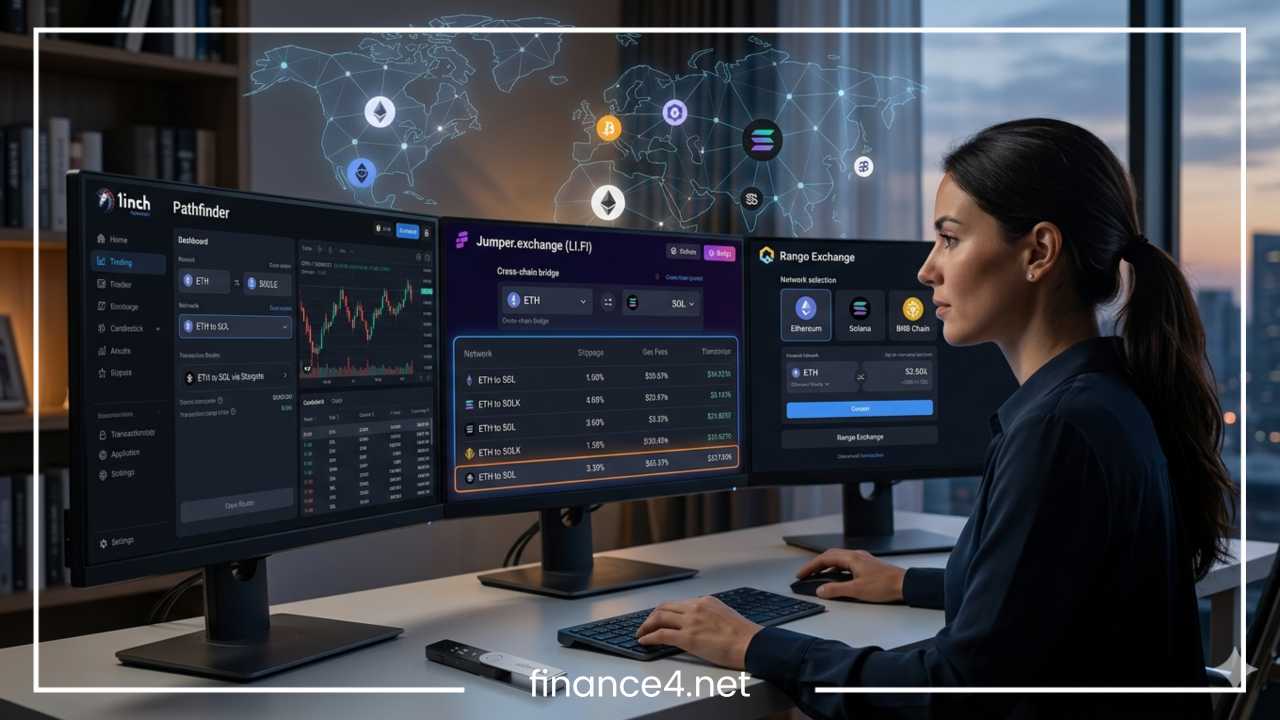
Top Cross-Chain DeFi Aggregators: Best Platforms Compared
The decentralized finance (DeFi) ecosystem has evolved from a single-chain landscape dominated by Ethereum into a vibrant, multi-chain universe. While this expansion has fostered innovation and lowered entry barriers, it has also created a significant problem: liquidity fragmentation. Assets, trading volume, and yield opportunities are now scattered across dozens of independent blockchains, such as Solana, BNB Chain, Polygon, and various Layer 2 scaling solutions.
For the end user, navigating this landscape is increasingly complex. Moving value from one network to another often requires manual bridging, multiple transactions, and the constant monitoring of gas fees and slippage across different platforms. This is where cross-chain DeFi aggregators become essential. These platforms act as a unified interface, connecting disparate liquidity pools and bridging protocols to provide a seamless experience for swapping, lending, and yield farming across the entire blockchain spectrum.
By unifying these services, cross-chain aggregators solve the fragmentation problem. They allow users to access the best prices, reduce operational complexity, and optimize for time and gas efficiency. As the industry moves toward a more interconnected future, these aggregators are transitioning from luxury tools to fundamental infrastructure for the global financial system.
What Are Cross-Chain DeFi Aggregators?
At their core, cross-chain DeFi aggregators are sophisticated software layers that sit on top of decentralized exchanges (DEXs) and cross-chain bridges. Their primary function is to search through hundreds of liquidity sources across multiple blockchains to find the most efficient path for a user’s transaction.
How Aggregators Work
The “magic” of an aggregator lies in its routing algorithms. When a user wants to swap Token A on Chain X for Token B on Chain Y, the aggregator doesn’t just look at one bridge. It analyzes a variety of paths simultaneously. This might involve swapping Token A for a stablecoin on the source chain, bridging that stablecoin to the destination chain via the cheapest or fastest bridge available, and then swapping that stablecoin for Token B on a local DEX.
By sourcing liquidity from both DEXs and bridges, these platforms ensure that users aren’t reliant on a single provider’s depth. If one bridge is experiencing high latency or one DEX has high slippage, the aggregator automatically reroutes the transaction through a more favorable alternative.
Types of Aggregation
There are generally three primary categories of aggregation within this niche:
-
DEX Aggregation: Focused on finding the best price for a swap within a single chain or across multiple chains by splitting orders across different liquidity pools.
-
Bridge Aggregation: Focused on the movement of assets. These platforms compare different bridging protocols (like Stargate, Across, or Celer) to find the one with the lowest fees and highest security.
-
Yield Aggregation: These platforms look for the best interest rates or staking rewards across various lending protocols and liquidity pools, allowing users to move capital to where it earns the most.
Key Infrastructure
The functionality of these aggregators relies on several critical technical components. Smart contracts handle the execution of trades and the movement of funds without a central intermediary. Oracles provide real-time price feeds to ensure the aggregator is working with accurate market data. Finally, cross-chain messaging protocols, such as LayerZero or Wormhole, facilitate the communication between different blockchains, allowing a contract on one chain to “talk” to a contract on another.
Why Cross-Chain Aggregators Are Important
The importance of cross-chain aggregators cannot be overstated in a world where “user experience” is the biggest hurdle to mainstream crypto adoption.
Solving Manual Complexity
Before the rise of aggregators, a user wanting to move from Ethereum to Solana had to find a reputable bridge, wrap their assets, wait for confirmations, and then find a new DEX on the destination chain. Each step required a separate transaction and a separate fee. Aggregators condense this entire journey into a single click. This “one-click” experience is vital for retaining users who might otherwise be intimidated by the technical hurdles of DeFi.
Price and Capital Efficiency
In a fragmented market, prices for the same asset can vary significantly between chains. Cross-chain aggregators enable a form of “passive arbitrage,” where the user is automatically given the best possible rate across the entire ecosystem. Furthermore, they improve capital efficiency. Instead of leaving funds idle on a chain with low opportunities, users can easily migrate their capital to where the highest demand or yield exists.
Institutional and Retail Appeal
For retail users, the benefit is simplicity and cost-saving. For institutional players, the benefit is liquidity depth. Large trades can cause massive slippage on a single DEX; however, an aggregator can split a multi-million dollar order across ten different chains and fifty different liquidity pools, significantly reducing the market impact of the trade.
Key Features to Evaluate
When choosing a cross-chain aggregator, it is important to look beyond just the user interface. High-quality platforms are defined by their underlying technical capabilities and the breadth of their integrations.
Supported Chains and Liquidity Depth
The value of an aggregator is directly proportional to its reach. An aggregator that only supports three chains is far less useful than one that supports thirty. However, chain support is only half the battle; the platform must also have deep “liquidity sourcing.” This means it should be integrated with the major DEXs on every chain it supports to ensure that even large trades don’t suffer from excessive slippage.
Routing Efficiency and Speed
A good aggregator should be fast. The crypto market moves quickly, and a delay in finding a route can result in a failed transaction or a worse price. Advanced aggregators use “Smart Order Routing” (SOR), which calculates thousands of potential paths in milliseconds.
Security Measures
Security is the most critical feature. Since cross-chain movement involves bridges—which have historically been targets for exploits—the aggregator must be transparent about which bridges it uses and how it vets them. Many top-tier aggregators now include “security filters,” allowing users to opt out of using bridges that have not been audited or have a history of issues.
Fees and Slippage Optimization
Users should evaluate whether the aggregator adds an additional “protocol fee” on top of the standard gas and bridge fees. Additionally, features like slippage protection and MEV (Maximal Extractable Value) protection are vital. MEV protection prevents front-running bots from “sandwiching” a user’s trade and stealing a portion of the value.
Top Cross-Chain DeFi Aggregators
The market for aggregators is competitive, with several major players offering unique value propositions. Below are the most prominent platforms currently shaping the cross-chain landscape.
1inch
Originally known as a pioneer in DEX aggregation on Ethereum, 1inch has expanded aggressively into the cross-chain space. It utilizes its proprietary Pathfinder algorithm to find the best trading paths across a multitude of chains.
-
Strengths: 1inch is known for its incredible liquidity depth and highly optimized routing. It often provides the absolute best prices for swaps due to its ability to split a single trade across dozens of different liquidity sources.
-
Weaknesses: The interface, while powerful, can be slightly overwhelming for absolute beginners who are not familiar with terms like “partial fills” or “gas tokens.”
-
Best Use Case: High-volume traders and power users who prioritize getting the best price above all else.
LI.FI
LI.FI is not just a consumer-facing platform but also a powerful infrastructure provider. It acts as a “meta-aggregator,” combining both DEX aggregators and bridge aggregators into a single API and SDK.
-
Strengths: Its greatest strength is its developer-centric approach. Many other DeFi apps actually use LI.FI under the hood to power their own cross-chain features. For end users, its “Jumper.exchange” interface is one of the most intuitive in the industry.
-
Weaknesses: Because it sits on top of many other layers, the complexity of its smart contract interactions can sometimes lead to slightly higher gas costs in specific scenarios.
-
Best Use Case: Developers looking to integrate cross-chain functionality and users who want a simple, bridge-focused interface.
Rango Exchange
Rango Exchange is a true “multi-chain” powerhouse. While some aggregators focus mainly on EVM-compatible chains (like Ethereum and Polygon), Rango bridges the gap between EVM, Cosmos, Solana, and even Bitcoin.
-
Strengths: Its ability to handle non-EVM chains makes it a go-to for users who want to move assets between ecosystems that don’t usually talk to each other (e.g., swapping ATOM for SOL).
-
Weaknesses: The complexity of supporting so many different wallet types and chain architectures can occasionally lead to a slower user experience compared to EVM-only platforms.
-
Best Use Case: Diversified investors who hold assets across many different blockchain ecosystems.
Socket (Bungee)
Socket is an interoperability protocol that powers Bungee, one of the most popular bridging aggregators. Socket focuses on the “transfer” layer, making it easy to move funds between chains quickly.
-
Strengths: Bungee’s “Refuel” feature is a standout, allowing users to send a small amount of native gas tokens to a destination chain so they aren’t “stranded” without gas when they arrive.
-
Weaknesses: It is more focused on the bridge side than the “complex swap” side, though it is expanding its DEX integration features.
-
Best Use Case: Users who frequently move between Layer 2s and need a fast, reliable way to manage their gas tokens across chains.
ParaSwap
ParaSwap is a major competitor to 1inch, offering a highly efficient DEX aggregation service that has expanded into cross-chain swaps.
-
Strengths: ParaSwap is highly regarded for its API performance and its “ParaSwapPool,” which provides private liquidity to help users avoid slippage on large orders. Its integration with hardware wallets like Ledger is also top-notch.
-
Weaknesses: Its cross-chain reach, while growing, has historically been slightly more focused on the major EVM chains compared to some “universal” aggregators.
-
Best Use Case: Professional traders and users who prioritize security and hardware wallet integration.
Matcha
Matcha, powered by the 0x protocol, is often cited as having the best user interface in the DeFi world. It aims to make decentralized trading as easy as using a centralized exchange like Coinbase.
-
Strengths: The UX is clean, simple, and devoid of the “technobabble” found on other platforms. It uses the 0x API to aggregate liquidity, ensuring competitive pricing.
-
Weaknesses: It may lack some of the granular “advanced” settings that power users look for when trying to squeeze every cent out of a trade.
-
Best Use Case: Beginners and retail users who want a beautiful, easy-to-use platform for cross-chain swaps.
OpenOcean
OpenOcean is unique because it bridges the gap between DeFi and CeFi (Centralized Finance). It aggregates liquidity from both decentralized exchanges and major centralized exchanges.
-
Strengths: By tapping into CEX liquidity, OpenOcean can sometimes offer prices that are impossible to find on-chain alone. It supports a massive range of chains and has a very comprehensive dashboard.
-
Weaknesses: The CeFi integration often requires a different level of trust or account management compared to purely “permissionless” DeFi aggregators.
-
Best Use Case: Users who want to compare on-chain prices with off-chain prices in a single window.
Comparison Table
| Platform | Best For | Chains Supported | Key Unique Feature |
| 1inch | Price Optimization | Extensive (EVM) | Pathfinder Routing Engine |
| LI.FI | Developers / Simplicity | 20+ (EVM + others) | Bridge + DEX Meta-aggregation |
| Rango | Ecosystem Variety | EVM, Cosmos, Solana, BTC | Cross-ecosystem routing |
| Socket | Fast Bridging | Major L1s and L2s | “Refuel” gas feature |
| ParaSwap | API / Professional | Major EVM chains | Private Liquidity Pools |
| Matcha | User Experience | Major EVM chains | Clean, minimalist interface |
| OpenOcean | CeFi + DeFi | 20+ chains | Centralized liquidity access |
Risks and Challenges
While cross-chain aggregators provide immense value, they are not without risks. Users must be aware of the trade-offs involved in using these complex layers of technology.
Smart Contract and Bridge Vulnerabilities
The most significant risk is the “security of the weakest link.” When you use an aggregator to bridge funds, your assets are passing through the smart contracts of the aggregator and the smart contracts of the bridge. Bridges have historically been the most targeted infrastructure in crypto, with billions lost to hacks. If a bridge integrated by an aggregator is exploited, the user’s funds could be at risk during the transition.
Slippage and Failed Transactions
In a cross-chain swap, there is a delay between the transaction being sent on the source chain and being executed on the destination chain. During this time, the price of the tokens can change. If the price moves too much (beyond the “slippage tolerance”), the transaction may fail. This can leave the user with “wrapped” or “intermediate” tokens on a chain they didn’t intend to stay on, requiring manual intervention to fix.
Complexity and “The Black Box” Problem
For many users, aggregators act as a “black box.” They see a single button, but behind the scenes, five different contracts are interacting. This complexity makes it harder to audit what went wrong if a transaction gets stuck. Users should always check the “route details” to see exactly which bridges and DEXs are being used.
Future of Cross-Chain Aggregation
The future of this sector is moving toward even greater abstraction. We are entering an era where the underlying blockchain becomes “invisible” to the user.
Rise of Intent-Based Trading
The next evolution is “intents.” Instead of a user saying “I want to swap X for Y using Bridge Z,” the user simply states their intent: “I want 100 USDC on Solana for the lowest possible cost.” Sophisticated “solvers” then compete to fulfill this intent in the most efficient way possible. This shifts the complexity from the user to a professional market of competitive fillers.
Modular Blockchains and Account Abstraction
As blockchains become more modular (separating execution from data availability), the need for cross-chain movement will explode. Simultaneously, “Account Abstraction” will allow users to pay for gas on any chain using any token, or even have the aggregator subsidize the gas entirely. This will make cross-chain DeFi feel as seamless as moving money between folders on a computer.
AI-Driven Routing
Artificial intelligence is beginning to play a role in predicting liquidity trends and gas spikes. Future aggregators may use AI to suggest the “best time” to bridge or to predict which path will be the fastest based on historical network congestion data.
Final Thoughts
Cross-chain DeFi aggregators are the “connective tissue” of the decentralized financial world. By solving the liquidity fragmentation problem, they have transformed a fragmented and difficult-to-navigate landscape into a more unified and efficient ecosystem. Whether you are a retail user looking for a simple swap, a developer building a multi-chain app, or a professional trader seeking the best possible price, these platforms are indispensable tools.
However, as with all things in DeFi, simplicity should not be mistaken for a lack of risk. Users should continue to practice due diligence, understand the bridges they are using, and stay informed about the evolving security standards of the industry. As the technology matures, the “cross-chain” part of DeFi will eventually disappear into the background, leaving only a fast, global, and permissionless financial system accessible to everyone.
Frequently Asked Questions
Are cross-chain aggregators safe to use?
Generally, top-tier aggregators are safe and have undergone multiple audits. However, they rely on external bridges. If an underlying bridge is hacked, the aggregator cannot protect the funds currently in that bridge. Always use aggregators that allow you to select highly-rated, reputable bridges.
What is the cheapest way to swap tokens across chains?
Using a bridge aggregator like LI.FI (Jumper) or Bungee is usually the cheapest method because these platforms compare the fees of every available bridge in real-time. Prices change based on network congestion and liquidity, so checking an aggregator is always better than using a single bridge.
Do I need to hold the native gas token of the destination chain?
Traditionally, yes. However, many aggregators now offer “Gas Refuel” or “Gasless” features that allow you to swap for native gas as part of your transaction, or pay for the entire transaction using the token you are swapping (e.g., paying for Polygon gas using your Ethereum-based USDC).