Best Aggregator for NFT Trading
 by
by 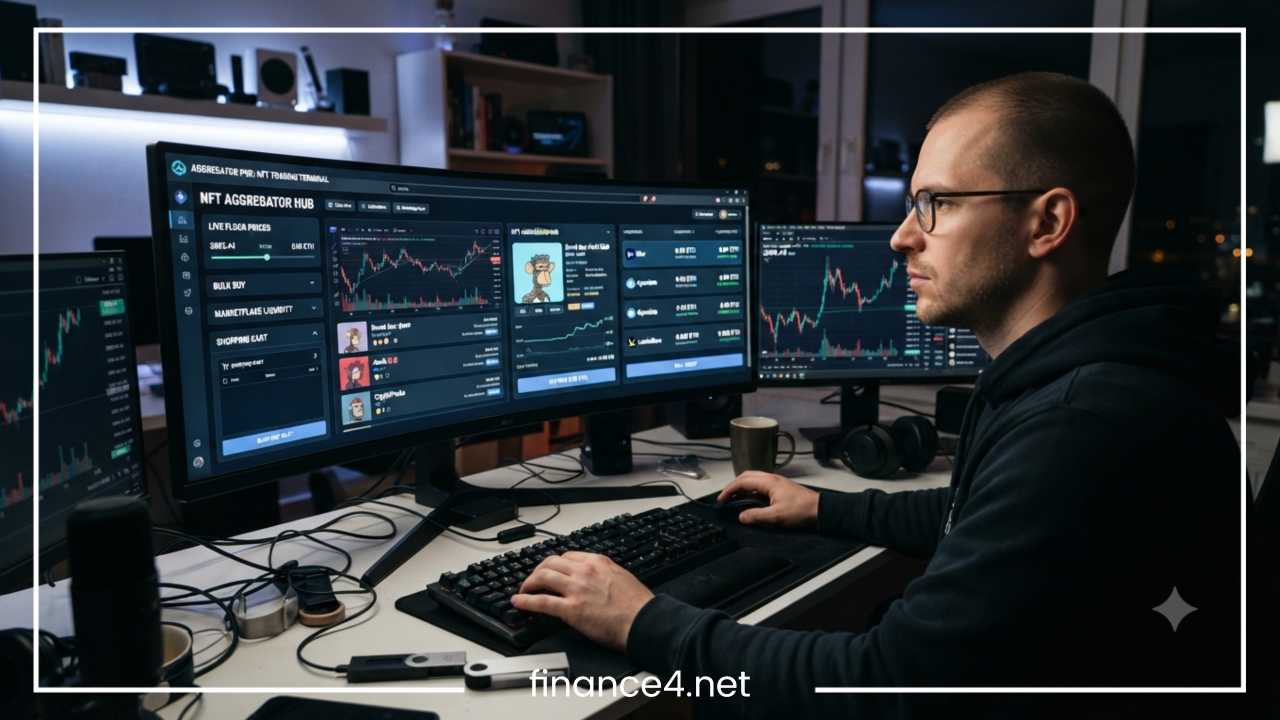
Best Aggregator for NFT Trading: Compare Prices & Buy NFTs Fast
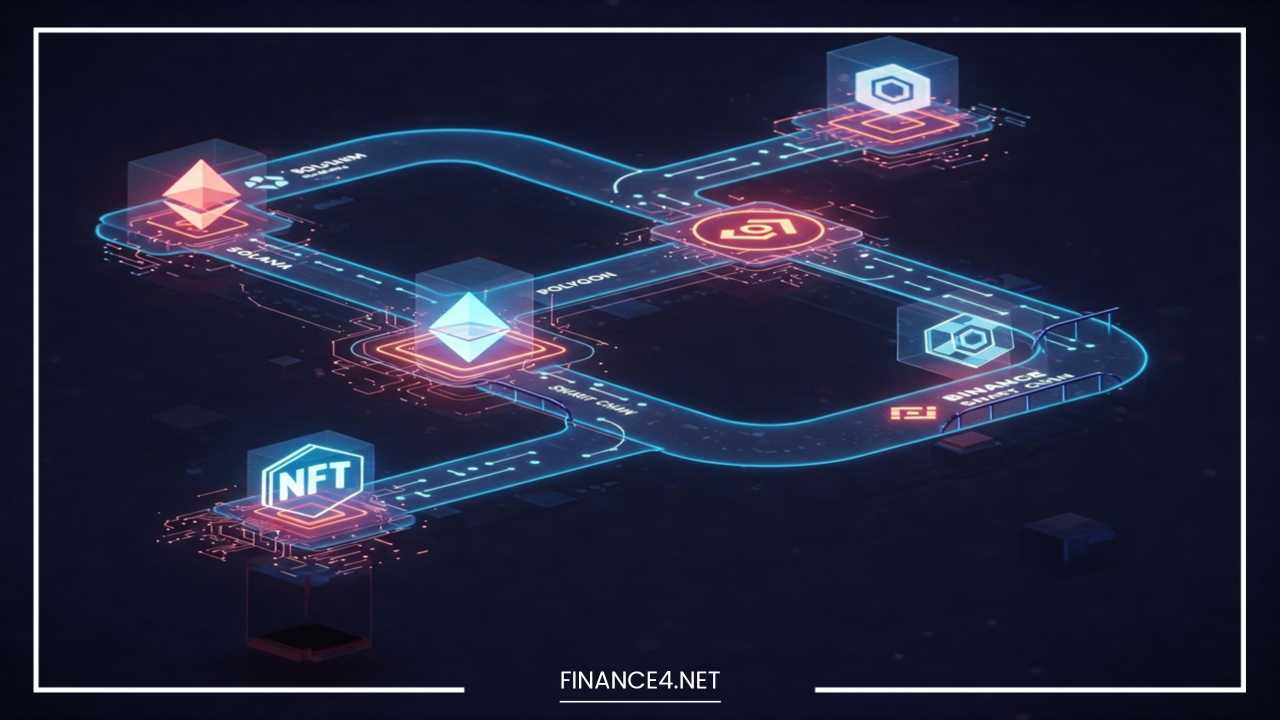
The non-fungible token ecosystem has evolved from a niche corner of the blockchain world into a multi-billion-dollar digital asset market. In the early days of digital collectibles, enthusiasts traded digital art, virtual real estate, and gaming assets across a small handful of isolated platforms. However, as the ecosystem expanded, dozens of distinct blockchains and hundreds of dedicated marketplaces emerged. This fragmentation created a significant challenge for collectors and professional traders alike: liquidity became deeply divided, price discrepancies grew widespread, and the task of finding the best available deal on a specific digital collectible turned into a time-consuming, inefficient process.
To resolve these market inefficiencies, specialized platforms known as non-fungible token aggregators were introduced. These advanced trading tools completely changed how collectors interact with digital assets by consolidating decentralized order books from multiple independent platforms into a single, unified interface. Instead of manually opening numerous browser tabs to compare floor prices across competing venues, digital asset traders can now leverage aggregation protocols to scan the entire blockchain ecosystem simultaneously.
Whether you are a casual collector looking to purchase a single profile picture asset or a high-volume professional trader execution sophisticated bulk-buying strategies, utilizing an aggregation engine has become standard practice. These specialized hubs optimize transaction execution speed, minimize gas consumption, offer superior price discovery mechanisms, and provide institutional-grade analytical tools. This comprehensive guide explores how these powerful routing networks function, reviews the premier options available in the decentralized space, and provides the strategic framework necessary to choose the absolute best aggregation platform for your trading goals.
What Is an NFT Trading Aggregator?
A non-fungible token trading aggregator is a centralized or decentralized dashboard that compiles listing data, historical pricing, metadata, and liquidity pools from various independent digital asset marketplaces into one comprehensive control center. Essentially, it functions exactly like mainstream travel aggregation sites that search hundreds of airlines and hotel databases simultaneously to show consumers the absolute cheapest rates and most efficient routes. In the Web3 domain, an aggregation protocol serves as a powerful search and execution layer positioned directly above individual primary and secondary marketplaces.
To fully understand the value proposition of a dedicated aggregation network, it is important to analyze how it differs fundamentally from a traditional digital asset marketplace. A conventional platform operates its own isolated smart contracts and maintains an internal database where creators and sellers directly list their digital assets. If a seller lists an item exclusively on a specific venue, that item is only visible and purchasable by users who visit that specific website.
Conversely, an aggregation platform does not rely solely on its own isolated liquidity pool or native listings. Instead, it utilizes custom indexers and application programming interfaces to continuously pull live structural data from every major underlying market. When a seller lists a token on any connected marketplace, the aggregator automatically detects the listing, updates its global interface in real time, and enables any user on the aggregator dashboard to purchase that token immediately.
The core technology powering these systems allows a trader to execute a single, unified transaction that interacts with several completely different smart contracts simultaneously. For example, if you wish to purchase five distinct digital collectibles from the same collection, and the lowest-priced listings are scattered across three separate marketplaces, a standard approach would require you to navigate to each site, connect your digital wallet, sign three distinct approval messages, and pay separate blockchain execution fees for every single purchase. An aggregator completely eliminates this friction by combining all five items into a single virtual shopping cart, routing the purchasing commands through an optimized smart contract, and executing the entire multi-market acquisition in one single blockchain transaction.
For buyers, this architecture ensures absolute price discovery, as they are guaranteed to see the lowest available listing regardless of where it was originally posted. For sellers, aggregation networks drastically increase asset exposure and market depth, ensuring that their listings are visible to a massive, global audience of active buyers without requiring manual cross-posting across multiple distinct platforms.
How NFT Aggregators Work
The internal mechanics of a non-fungible token aggregation platform rely on a highly sophisticated infrastructure designed to process vast amounts of on-chain and off-chain data at lightning-fast speeds. The process begins with advanced data indexing systems and application programming interfaces. These indexers constantly listen to blockchain event logs, tracking state changes across dozens of marketplace smart contracts simultaneously. Every time a digital asset is listed, delisted, sold, or modified on any supported platform, the aggregator updates its internal index within milliseconds to ensure traders are looking at entirely accurate, real-time information.
Once the data is indexed and presented to the user, the platform relies heavily on smart contract routing engines to facilitate asset acquisitions. When a user selects multiple digital collectibles from different underlying sources and clicks the purchase button, the aggregator passes the order details to a specialized routing contract. This contract is programmatically engineered to break down the user’s single inbound payment, distribute the precise amounts of cryptocurrency required to satisfy each individual marketplace contract, claim the corresponding digital assets, and safely transfer those newly acquired assets back into the buyer’s non-custodial wallet.
Multi-market order execution and cross-market price comparison happen automatically behind the scenes. The aggregation algorithm evaluates every available listing for a requested collection, filtering out stale orders and sorting the remaining inventory purely by total acquisition cost. This total cost calculation includes not only the base price set by the seller but also any protocol fees or creator royalties imposed by the underlying marketplace. By assessing these variables instantly, the platform consistently exposes the true, uninflated floor price of any given digital item.
Another highly critical engineering feat achieved by premier aggregation platforms is advanced gas optimization. Interacting directly with multiple individual marketplace smart contracts can be incredibly expensive in terms of network transaction fees, particularly during periods of intense blockchain congestion. Aggregation protocols utilize customized smart contracts written with highly efficient code designed to batch multiple transactions together. By executing multiple orders within a single smart contract wrapper, the protocol minimizes the total computational overhead required on the underlying blockchain network. This specialized batch purchasing functionality allows traders to buy dozens of items at once while saving massive amounts of network transaction fees compared to executing those purchases individually.
Finally, seamless wallet integration forms the frontend foundation of the entire aggregator workflow. These platforms are designed to connect effortlessly with all leading browser extensions, hardware wallets, and mobile web3 wallets. This deep integration allows the platform to safely request cryptographic signatures for transactions, manage multi-token approvals, and display accurate portfolio balances without ever taking custody of the user’s private keys or funds.
The simple workflow of utilizing an aggregation engine can be summarized in five clear chronological phases:
-
Connect your non-custodial digital wallet to the aggregation interface.
-
Search for your desired digital asset collection or specific token ID.
-
The aggregator instantly scans all connected marketplaces across the blockchain.
-
The system automatically identifies the absolute cheapest verified listing available.
-
You execute a single batch transaction to finalize the purchase securely.
Why NFT Traders Use Aggregators
Active digital asset traders utilize aggregation networks because these specialized platforms deliver distinct competitive advantages that are simply impossible to achieve when relying on a single, isolated marketplace. The most obvious benefit is immediate access to better prices. Because the platform scans the entire decentralized landscape, it completely eliminates the risk of an investor accidentally overpaying for an asset simply because they failed to check a competing marketplace. Price discrepancies are incredibly common in the digital art and collectibles space, and an aggregator acts as an automated safety net that guarantees you always capture the optimal rate.
Faster discovery is another vital factor for professional market participants. In the highly volatile world of digital asset trading, timing is absolutely everything. When a highly anticipated project begins to experience rapid upward price momentum, finding and purchasing undervalued listings before other market participants can mean the difference between substantial profitability and missed opportunities. Aggregation engines refresh their listings at rapid speeds, allowing traders to spot newly posted undervalued items the exact moment they hit the blockchain.
Managing a diverse portfolio across multiple open-market websites becomes incredibly tedious without a unified interface. Aggregators streamline the entire user experience by providing a single, consolidated dashboard where traders can track market movements, analyze historical volume trends, view comprehensive order books, and manage their existing inventory without ever shifting between different websites or platforms. This central command center drastically reduces manual searching, allowing collectors to reclaim valuable time that would otherwise be spent cross-referencing disparate web platforms.
For high-volume traders, collection flippers, and institutional participants, batch buying capabilities and lower gas costs represent significant financial incentives. The ability to “sweep the floor”—a term used to describe purchasing a massive volume of the lowest-priced items in a specific collection simultaneously—is fundamentally built into the architecture of modern aggregators. Executing a sweep across multiple marketplaces simultaneously through a single gas-optimized transaction saves traders thousands of dollars in network fees over the course of an average trading year.
Furthermore, these platforms greatly enhance rare asset discovery. Advanced filter modules allow collectors to search across all global marketplaces simultaneously for highly specific visual traits, aesthetic properties, or rarity tiers. Rather than hunting through individual platforms hoping to find a uniquely discounted rare item, users can set precise parameters on an aggregator to immediately surface the single cheapest venue hosting that specific asset type. This integrated approach to portfolio management and asset acquisition transforms a highly fragmented decentralized ecosystem into an elegant, hyper-efficient digital trading environment.
Features to Look for in the Best NFT Aggregator
As the demand for aggregated trading solutions has intensified, many different platforms have introduced their own proprietary aggregation interfaces. However, not all platforms are engineered equally. To ensure you are utilizing a system that maximizes your trading efficiency and capital preservation, it is essential to evaluate candidate platforms across several core technical features.
Marketplace Coverage
The absolute foundation of an effective aggregation engine is the depth and breadth of its underlying marketplace coverage. A platform is only as useful as the data sources it integrates. The best platforms maintain robust connections with every major high-volume venue, alongside smaller, niche, or community-governed marketplaces. If an aggregator fails to index a rising platform, it cannot provide true price discovery, which defeats the core purpose of using an aggregation tool in the first place.
Multi-Chain Support
The modern digital collectible ecosystem spans multiple independent blockchain networks, each possessing its own unique community, scaling properties, and project collections. A premier aggregation network must offer robust multi-chain capabilities, allowing users to seamlessly transition between different networks from within a single cohesive dashboard. Comprehensive support across diverse layer-one and layer-two systems is critical for a well-rounded trading strategy.
Fast Search
A sluggish interface is completely unacceptable when attempting to navigate fast-moving digital asset markets. The platform’s search functionality must feature hyper-optimized indexing speeds capable of parsing millions of independent data points, metadata schemas, and token identifiers instantaneously. Users should be able to type in any project name, trait parameter, or contract address and receive accurate, filtered results in fractions of a second.
Real-Time Listings
Market data that is even a few minutes old can lead to highly frustrating user experiences, such as attempted purchases of items that have already been sold on the primary venue—a common issue known as ghost listings. The best aggregation tools leverage high-performance web sockets and direct node connections to ensure that their frontend interface reflects live, on-chain listing modifications the absolute millisecond they occur.
Lowest Price Detection
An exceptional aggregator must possess highly precise algorithmic calculations to reveal the exact mathematical lowest price for any listed item. This calculation must account for all variable underlying fees, dynamic protocol parameters, and enforced creator royalties. The platform should clearly display a breakdown of these costs so that traders can verify they are truly getting the most capital-efficient deal available across the open web.
Gas Optimization
Because blockchain transaction fees fluctuate heavily based on network activity, the efficiency of an aggregator’s underlying routing smart contracts is of paramount importance. Leading platforms consistently audit and refactor their execution code to ensure that multi-contract transactions consume the absolute minimum amount of gas possible. Even a minor percentage reduction in gas consumption per trade can compound into immense savings over a high-volume trading career.
Batch Purchasing
The inclusion of an intuitive, reliable virtual shopping cart system is mandatory for modern digital asset trading. The platform must allow users to freely select multiple tokens from completely different source platforms, pool them together into a single master checkout screen, and finalize the complete purchase in a single block execution. The batch purchasing feature should also incorporate robust slippage protection to automatically handle instances where an individual token within the batch becomes unavailable during processing.
Wallet Compatibility
To ensure a highly accessible and secure trading experience, the platform must maintain native compatibility with an extensive roster of digital wallet solutions. This includes standard browser extension wallets, advanced developer wallets, institutional custody configurations, and mobile-focused connection protocols. Seamless integration guarantees that users can sign transactions safely and securely regardless of their preferred self-custody infrastructure.
Analytics
Professional trading strategies rely completely on hard, quantifiable data. High-tier aggregators go far beyond simple price listings by embedding institutional-grade analytics panels directly into their collection views. Traders require immediate visibility into historical candlestick price charts, live volume bars, historical floor price depth, detailed walls of listing supplies, and real-time transaction feeds to make well-informed, objective market decisions.
Portfolio Tracking
An aggregator should serve as a comprehensive home base for an investor’s entire inventory. This requires built-in portfolio tracking modules that scan a user’s connected wallet addresses to calculate total net worth across collections, monitor unrealized profits and losses, track historical purchase bases, and display comprehensive records of past trading performance across all supported blockchain networks.
Security
Interacting with web3 smart contracts carries inherent risks, making security an absolute top priority when selecting an aggregation venue. The platform’s routing contracts must be thoroughly, independently audited by reputable cybersecurity firms, with the complete audit documentation publically accessible. Furthermore, the platform must feature robust internal security filters that automatically flag malicious collections, unverified copycat projects, and known phishing smart contracts.
Mobile Usability
Digital asset markets operate twenty-four hours a day, seven days a week, and critical market movements frequently occur when traders are away from their desktop computers. Therefore, an aggregator must feature an impeccably designed mobile responsive website or dedicated application. The mobile interface must retain all the core analytical capabilities, speedy searching, and batch purchasing functionalities found on the desktop version.
Best NFT Trading Aggregators
Magic Eden
Magic Eden has established itself as one of the absolute premier multi-chain digital asset hubs in the entire Web3 ecosystem. Originally launched as a dominant primary marketplace on the Solana network, the platform underwent a massive architectural transformation to become a powerful multi-chain aggregator that connects deep liquidity pools across several major layer-one and layer-two blockchains. Magic Eden offers a highly polished, user-friendly interface that masterfully balances simplicity for retail collectors with advanced functionality for professional market participants. Its dedicated launchpad and robust secondary market routing make it an incredibly compelling destination for comprehensive digital asset trading.
-
Supported Chains: Solana, Bitcoin Ordinals, Ethereum, Polygon, and Base.
-
Key Features: Advanced cross-chain asset discovery, integrated digital wallet ecosystem, comprehensive collection launchpad, highly efficient batch sweeping tools, and trait-based offer systems.
-
Pros: Exceptionally deep liquidity across multiple networks, industry-leading interface for trading Bitcoin Ordinals, fast loading times, and a highly active community base.
-
Cons: Imposes a standard marketplace transaction fee on native listings, and creator royalty enforcement can vary depending on specific network guidelines.
-
Best For: Multi-chain collectors and traders who want a unified hub for navigating Solana, Ethereum, and Bitcoin digital assets simultaneously.
Blur
Blur completely disrupted the digital collectible trading landscape upon its arrival by specifically targeting high-volume, professional day traders. Operating fundamentally as both a zero-fee marketplace and a hyper-fast aggregation engine, Blur engineered a minimalist, data-dense terminal design optimized for maximum speed and raw analytical efficiency. The platform completely eliminated traditional visual storefronts in favor of real-time price feeds, depth charts, and instantaneous sweeping mechanics. Blur incentivizes massive institutional-grade liquidity through its native token reward ecosystem, making it the highest-volume aggregation platform for blue-chip assets on the Ethereum network.
-
Supported Chains: Ethereum and Blast.
-
Key Features: Zero percent marketplace trading fees, instantaneous price feed updates, advanced trait-based collection bidding, real-time portfolio profit and loss tracking, and native non-fungible token lending protocols.
-
Pros: Blazing fast execution speeds, deep liquidity pools for high-value collections, completely free to use at the protocol level, and powerful gamified reward mechanics.
-
Cons: The interface can be highly overwhelming for beginners, lacks broad multi-chain support outside of the Ethereum ecosystem, and features a heavily data-dense presentation.
-
Best For: Professional day traders, high-volume flippers, and whales executing complex collection-wide bidding and sweeping strategies on Ethereum.
OpenSea Pro
OpenSea Pro represents the specialized, institutional-grade evolution of the world’s most widely recognized digital asset marketplace. Originally entering the aggregation space through the strategic acquisition of the historic aggregation protocol Gem, OpenSea completely overhauled the infrastructure to launch a highly competitive, separate professional platform. OpenSea Pro aggregates listing data and order books from over a hundred distinct marketplaces across the decentralized web. It combines this massive data pool with OpenSea’s unparalleled internal inventory, offering traders real-time analytics, automated gas routing optimization, and highly advanced inventory management controls.
-
Supported Chains: Ethereum, Polygon, Solana, Arbitrum, Optimism, Base, and Avalanche.
-
Key Features: Massive aggregation across a hundred individual platforms, highly optimized gas routing smart contracts, instant rarity tier filtering, live user activity feeds, and bulk inventory listing management tools.
-
Pros: Unrivaled depth of marketplace aggregation coverage, highly reliable backend architecture backed by an industry leader, and very competitive protocol fee structures.
-
Cons: Can experience slightly slower UI updates during periods of extreme unexpected network traffic compared to pure standalone terminals.
-
Best For: Active traders who require maximum marketplace coverage and robust portfolio analytics across a wide variety of Layer 2 networks.
Tensor
Tensor has earned a reputation as the fastest, most technologically advanced trading terminal and aggregator explicitly built for the Solana blockchain network. Mirroring the professional, data-driven architecture that Blur popularized on Ethereum, Tensor provides Solana market participants with real-time financial charts, candlestick tracking, historical depth of market walls, and lightning-fast execution tools. Tensor operates an automated market maker protocol alongside its core aggregation engine, enabling users to not only buy and sell individual digital items but also instantly provide liquidity to collections to earn yield.
-
Supported Chains: Solana.
-
Key Features: Pro and Lite interface toggle views, integrated automated market maker liquidity pools, real-time collection floor price charting, and high-performance collection sweeping functionality.
-
Pros: Exceptionally fast performance on the Solana network, incredibly low transaction execution costs, and deeply integrated professional trading tools.
-
Cons: Completely restricted to the Solana blockchain ecosystem, making it unsuitable for cross-chain collectors.
-
Best For: Dedicated Solana power users and professional traders who demand real-time data feeds and instantaneous execution speeds on a high-performance network.
Rarible
Rarible operates as a highly versatile, community-centric multi-chain marketplace and aggregation protocol. Focusing heavily on decentralization and creator empowerment, Rarible’s aggregation engine compiles listings from a vast array of EVM-compatible networks. The platform stands out by offering robust open-source developer tools and an innovative “marketplace-as-a-service” architecture, allowing independent creators to easily build their own customized, aggregated storefronts powered entirely by Rarible’s underlying routing protocol and decentralized order book technology.
-
Supported Chains: Ethereum, Polygon, Arbitrum, Optimism, Base, and BNB Chain.
-
Key Features: Open-source protocol architecture, cross-chain order aggregation, native governance token integration, and decentralized marketplace infrastructure toolkits for creators.
-
Pros: Deep commitment to community governance, excellent multi-chain support for Layer 2 scaling networks, and highly flexible creator royalty configuration options.
-
Cons: Lower overall trading volumes for premier high-value collections compared to dominant professional terminals.
-
Best For: Community-oriented collectors, independent digital artists, and developers who want a highly decentralized framework for cross-chain asset discovery.
NFT Aggregator vs NFT Marketplace
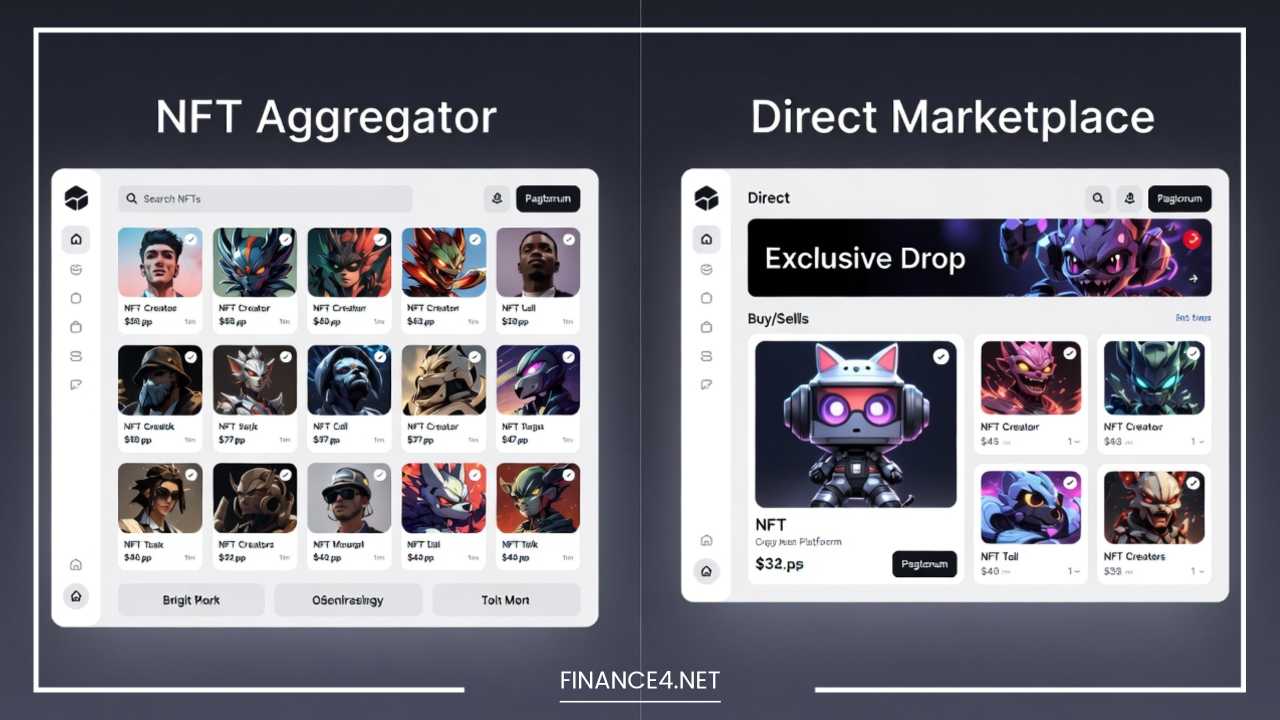
Understanding the structural differences between an aggregator and a marketplace is vital for optimizing your trading workflow. The following table provides a direct architectural comparison between these two platform models:
| NFT Aggregator | NFT Marketplace |
| Searches dozens of independent marketplaces simultaneously | Displays internally hosted and native listings only |
| Provides absolute, global price discovery across the web | Inventory is completely limited to internal platform sellers |
| Enables high-speed multi-item batch buying across platforms | Purchases are restricted to single items per transaction execution |
| Delivers comprehensive cross-market fee and royalty comparison | No external price or fee comparison tools are provided |
| Operates as a single, unified interface for multiple venues | Requires users to manage multiple independent web platforms |
| Utilizes heavily gas-optimized smart contract routing wrappers | Standard contract executions can result in higher network gas fees |
Benefits of Using an NFT Aggregator
Integrating an aggregation protocol into your standard digital asset operations yields immediate, tangible advantages that enhance both your overall profitability and security stance. First and foremost, utilizing an aggregator saves a tremendous amount of time. Instead of spending hours jumping between separate websites, analyzing floor depth across disparate platforms, and manually verifying token details, a trader can access a single consolidated control panel. This centralization collapses a highly fragmented workflow into a highly organized, efficient process, allowing collectors to evaluate entire blockchain ecosystems at a single glance.
In addition to massive time savings, aggregators save traders significant amounts of capital. By continuously tracking and exposing every single active listing across the entire internet, these platforms shield buyers from purchasing overpriced assets. If an identical token is listed on two separate marketplaces for different amounts, the aggregator will instantly surface the lower option, guaranteeing maximum capital efficiency. Furthermore, the advanced gas-burning optimization embedded within aggregator routing contracts directly translates to lower network execution fees, keeping more cryptocurrency inside the user’s wallet.
Enhanced market liquidity represents another monumental benefit. By compiling separate, isolated order books into a single master pool, aggregators drastically reduce slippage and market fragmentation. This combined depth is incredibly critical when an investor wishes to buy or sell a substantial quantity of tokens from a single collection. Instead of causing massive, artificial price disruptions on an individual platform due to thin liquidity, the aggregator cleanly distributes the trading volume across multiple independent protocols, absorbing the market impact smoothly.
Finally, these platforms grant immediate access to a much broader spectrum of unique digital collections and professional trading tools. Users gain exposure to niche localized marketplaces that they might not have even known existed, expanding their investment horizons. The inclusion of institutional-grade data tracking, real-time candlestick charts, floor wall visualization, and historical volume metrics empowers retail collectors to operate with the same high level of rigorous analytical clarity as professional financial institutions.
Potential Risks of NFT Aggregators
While the technological benefits of using an aggregator are undeniable, navigating these advanced routing protocols also exposes market participants to specific operational risks that require careful mitigation. One of the most prevalent concerns is the presence of fake collections and malicious copycat projects. Because aggregators automatically index massive quantities of decentralized data across the entire open internet, sophisticated scammers frequently deploy fraudulent smart contracts designed to visually mimic high-value, authentic collections. If an aggregator’s internal verification filters fail to instantly catch these copycats, an unwary trader might accidentally purchase a completely worthless counterfeit token thinking they found a highly discounted authentic asset.
Smart contract risk represents another inherent vulnerability within any Web3 application. Aggregation platforms rely on highly complex, multi-layered custom routing contracts to execute transactions across multiple external marketplaces simultaneously. Even if the platform’s contracts have undergone rigorous independent security audits, the extreme complexity of compounding multiple external smart contract interactions introduces potential vectors for unexpected exploits, reentrancy vulnerabilities, or code failures that could theoretically jeopardize user funds during execution.
Phishing attacks and wallet security failures also pose constant threats. Due to the high financial volume flowing through premier aggregation portals, malicious actors frequently create highly convincing fraudulent clone websites and distributed phishing links. If a user inadvertently connects their non-custodial digital wallet to a malicious clone site and signs a compromised transaction request, drainer scripts can instantly clear out their entire digital asset inventory. Furthermore, aggregators occasionally display scam listings that contain hidden malicious code within the token’s metadata, which can trigger wallet vulnerabilities if interacted with improperly.
Lastly, traders must contend with the realities of blockchain congestion and failed transactions. During periods of extreme, high-intensity market volatility—such as a highly anticipated collection mint or massive market-wide selloff—underlying blockchain networks can experience immense traffic spikes. If the gas price parameters calculated by the aggregator become outdated during the seconds it takes to process a multi-market order, individual components of a batch purchase can fail. This results in partial order completions where the user still incurs expensive, non-refundable gas fees from the blockchain network without successfully acquiring all their desired digital assets.
To stay completely safe while utilizing aggregation platforms, always follow these core security practices:
-
Double-check the exact website domain name and bookmark authentic trading portals.
-
Always verify the underlying smart contract address of a collection against official project channels before executing a purchase.
-
Utilize a dedicated hardware wallet for holding high-value digital assets, and never keep your entire inventory in a hot browser extension wallet.
-
Thoroughly review the exact transaction breakdown and token approval requests within your wallet prompt before signing any cryptographic messages.
-
Use separate, specialized web wallets for daily trading activities, keeping your long-term storage completely isolated from active protocol connections.
NFT Aggregators for Different Blockchains
Ethereum
The Ethereum network remains the foundational epicenter for high-value digital collectibles and prestigious blue-chip art projects. Due to the substantial network transaction fees historically associated with base-layer Ethereum interactions, utilizing an advanced aggregation protocol on this chain is absolutely vital for cost mitigation. Platforms like Blur and OpenSea Pro dominate this landscape, offering highly sophisticated smart contract routing wrappers that drastically reduce total gas consumption. These platforms allow traders to efficiently navigate Ethereum’s deep, highly fragmented secondary markets, providing the necessary institutional-grade tools to manage multi-thousand-dollar asset positions with absolute precision.
Solana
The Solana blockchain has experienced an absolute explosion in digital asset trading volume due to its underlying high-speed infrastructure and incredibly low transaction execution costs. Because transactions on Solana cost mere fractions of a penny, the trading environment moves at a blistering pace compared to traditional layer-one networks. Tensor and Magic Eden are the undisputed leaders in this ecosystem. These aggregators are engineered specifically to process ultra-fast price updates, allowing traders to execute lightning-fast token snipes and high-volume collection sweeps within milliseconds of an asset hitting the blockchain.
Polygon
Polygon operates as a prominent layer-two scaling framework designed to provide fast, cost-effective EVM-compatible transactions. It has become a highly popular home for massive global mainstream brands, gaming ecosystems, and high-volume digital rewards. Aggregation platforms such as OpenSea Pro and Rarible offer extensive support for Polygon assets, allowing collectors to browse hundreds of thousands of low-cost digital items without encountering aggressive gas barriers. The aggregated data feeds on Polygon make it incredibly simple to track gaming asset economies and large-scale consumer loyalty collections from a single, unified dashboard.
Base
Base, a rapid layer-two network incubated by Coinbase and secured by Ethereum, has quickly risen to become a major hub for decentralized finance and digital culture. Its deep integration with mainstream exchange user bases has triggered a significant influx of new creators and active collectors. High-performance aggregators including OpenSea Pro, Magic Eden, and Rarible have rapidly deployed their infrastructure onto Base. This allows users to capture the absolute lowest floor prices across a fast-growing matrix of localized decentralized marketplaces while enjoying near-instantaneous transaction finality and highly optimized fees.
BNB Chain
BNB Chain provides a highly robust, scalable smart contract environment featuring a massive global user base and deeply liquid decentralized exchange ecosystems. The digital collectible market on BNB Chain features a unique blend of Web3 gaming items, virtual metaverse real estate, and community-driven profile picture collections. Multi-chain aggregation frameworks like Rarible provide essential cross-market listing aggregation here, enabling global investors to easily compare prices across various independent BNB Chain marketplaces and discover undervalued gaming assets effortlessly.
Avalanche
Avalanche is celebrated for its unique multi-subnet architecture, processing transactions with rapid sub-second finality while maintaining robust decentralization. The digital asset ecosystem on Avalanche features highly specialized fine art platforms, independent gaming subnets, and unique real-world asset tokenization initiatives. Aggregators like OpenSea Pro allow collectors to seamlessly track Avalanche digital assets alongside their other multi-chain holdings, eliminating the need to use isolated, network-specific wallet connections to participate in Avalanche’s digital art economy.
How to Choose the Right NFT Aggregator
Selecting the absolute best aggregation platform for your specific operational needs requires a thorough self-assessment of your trading style, financial goals, and technological requirements. The first factor to critically evaluate is your overall experience level. If you are a casual collector or a complete beginner to the Web3 ecosystem, jumping directly into a highly complex, data-heavy terminal interface like Blur or Tensor can be incredibly intimidating and may lead to costly execution mistakes. Newcomers should prioritize platforms like Magic Eden or OpenSea Pro’s simplified views, which offer highly intuitive, user-friendly visual layouts that look and feel like standard e-commerce websites while still providing the core financial benefits of background aggregation.
The specific blockchain networks you intend to trade on also dictate your platform choice. If your investment strategy revolves entirely around high-speed, low-cost Solana profile pictures, then utilizing an Ethereum-centric aggregator is completely useless. You must select a platform that natively specializes in your chosen ecosystem, matching the unique speed and wallet requirements of that specific blockchain. Conversely, if you maintain a highly diversified portfolio spread across Ethereum, Bitcoin Ordinals, and various Layer 2 networks, you should prioritize a comprehensive multi-chain aggregator that prevents you from needing to jump between different standalone software tools.
Your overall trading frequency and individual portfolio size represent additional defining variables. High-volume day traders and professional flippers who execute dozens of transactions per week require zero-fee structures, lightning-fast data refreshes, and advanced programmatic bidding features above all else. For these market participants, saving a fraction of a percent on protocol fees or experiencing a millisecond advantage in data loading speeds directly impacts their bottom-line profitability. On the other hand, long-term investors who buy a digital asset to hold for several months place a much higher premium on comprehensive security tracking, verified collection filters, robust portfolio history modules, and clear mobile device usability.
Finally, consider your specific analytical needs and the platform’s security reputation. If your trading strategy relies heavily on technical analysis, chart patterns, and real-time listing walls, you must choose a terminal-style aggregator that embeds these advanced data streams directly into its core interface. Always cross-reference your candidate platform’s history of contract security, looking closely at past independent audit reports and checking community forums to ensure the protocol has a clean record of protecting user data and funds.
Tips for Buying NFTs Through an Aggregator
To maximize your success and protect your capital when trading digital assets via an aggregation engine, it is highly beneficial to implement a structured, disciplined execution methodology.
-
Verify Collections Manually: Never rely solely on an aggregator’s automated search results. Always look for the platform’s official verification badge, check the total historical trading volume, and cross-reference the exact smart contract address against the project’s official website or Discord channel to guarantee you are not purchasing a clever counterfeit listing.
-
Analyze Floor Price Depth: Before finalizing a purchase, take a close look at the collection’s floor depth chart. An aggregator will show you the absolute cheapest item, but reviewing the depth chart allows you to see how many items are listed close to that price. If the floor is incredibly thin, a small influx of buyers can rapidly drive the collection’s valuation higher.
-
Compare Network and Protocol Fees: Always review the final transaction breakdown on the checkout screen. Ensure you understand exactly how much money is being allocated to the base asset cost, the aggregator’s protocol fee, the underlying marketplace’s fee, and the creator’s royalties. This transparency allows you to optimize your capital deployment.
-
Avoid Emotional FOMO: Fast-moving aggregator data feeds can easily trigger emotional trading decisions, commonly known as the fear of missing out. When you see listing notifications flashing rapidly, take a deep breath and stick strictly to your predefined budget and investment thesis rather than market-buying assets during an artificial hype cycle.
-
Monitor Live Network Gas Fees: Keep a close eye on a live blockchain gas tracker while trading, especially on the Ethereum network. Executing a batch purchase when the network is heavily congested can add significant overhead costs to your transaction. If your trade is not highly time-sensitive, waiting for a period of lower network traffic can save you substantial amounts of money.
-
Review Detailed Transaction Routing: Before confirming a cryptographic signature in your connected wallet, carefully read the execution details. Ensure the wallet prompt matches the exact contract address of the aggregator’s audited routing wrapper and clearly displays the correct number of assets being transferred.
-
Incorporate Hardware Wallet Security: For any digital asset that holds substantial financial value or represents a long-term core investment position, always route your aggregator purchases directly into a secure, cold-storage hardware wallet. Never leave high-value assets stored in an unencrypted hot wallet that remains constantly connected to web browsers.
Future of NFT Aggregators
The technological landscape powering digital asset aggregation is poised for immense evolution as the broader Web3 ecosystem matures and becomes more interconnected. One of the most highly anticipated advancements is the deep integration of artificial intelligence and machine learning models directly into aggregator interfaces. Future platforms will likely leverage AI algorithms to provide highly personalized asset recommendations, predict short-term floor price movements based on historical volume patterns, automatically detect unusual whale accumulation behaviors, and instantly surface undervalued listings across the global web based on complex aesthetic and rarity metrics.
Cross-chain trading architecture is also undergoing a massive paradigm shift. Current systems often require users to hold the specific native cryptocurrency of the underlying blockchain network to complete a purchase. The future of aggregation lies in completely seamless, chain-abstracted execution. Advanced cross-chain messaging protocols and liquidity bridges will soon enable a trader holding only Ethereum in their digital wallet to visit an aggregator and instantly purchase a Solana digital collectible or a Bitcoin Ordinal in a single, unified transaction execution. The underlying routing engine will automatically swap the tokens, cross the bridge, and deliver the asset back to the user without them ever realizing they interacted with multiple completely distinct blockchains.
We are also seeing early signs of deep integration between aggregation engines and the broader decentralized finance landscape. The line separating digital collectibles from traditional financial assets is blurring rapidly. Future aggregators will increasingly feature built-in non-fungible token fractionalization tools, peer-to-peer and peer-to-pool lending protocols, automated rental mechanics, and sophisticated yield-generation modules. This financialization will allow investors to instantly collateralize their digital asset portfolios to borrow stablecoins or hedge their market exposure directly from within their preferred aggregator dashboard.
Finally, the institutional-grade scaling of the digital asset market will drive the development of highly specialized enterprise trading systems. As major global luxury brands, real estate corporations, and entertainment conglomerates transition their intellectual properties onto the blockchain, the demand for high-throughput, legally compliant trading portals will expand significantly. Aggregators will adapt by embedding robust institutional features, including advanced multi-signature security configurations, comprehensive automated tax compliance export reporting, corporate governance modules, and permissioned sub-networks designed specifically for enterprise-level asset management.
Final Thoughts
Non-fungible token trading aggregators have transitioned from an optional power-user luxury into an absolutely mandatory piece of infrastructure for anyone navigating the modern decentralized asset landscape. By elegantly solving the massive challenges associated with market fragmentation, divided liquidity pools, and obscured price discovery, these powerful routing networks have completely democratized access to the global digital collectable economy. They transform a chaotic, inefficient ecosystem of competing marketplaces into a highly streamlined, capital-efficient, and hyper-transparent trading environment.
When selecting the ideal aggregation venue to serve as your personal market command center, remember to rigorously prioritize the features that align directly with your unique operational requirements. Whether you place the highest value on broad multi-chain coverage, lightning-fast execution speeds, zero-fee structures, or comprehensive institutional-grade portfolio analytics, there is a specialized platform engineered to satisfy your goals.
However, as you harness the immense speed and financial efficiency provided by these cutting-edge aggregation engines, never lose sight of foundational Web3 security protocols. Always stay vigilant against sophisticated copycat projects, verify collection smart contracts manually, maintain strict control over your cryptographic signatures, and safeguard your high-value assets within trusted hardware wallet environments. By masterfully combining the advanced analytical power of premier aggregation platforms with an uncompromising, disciplined approach to personal operational security, you can confidently navigate the fast-moving digital asset markets, capture the absolute best available prices, and scale your web3 portfolio with maximum efficiency.
Frequently Asked Questions
What is the best NFT aggregator for Ethereum trading?
The best NFT aggregator for Ethereum trading depends entirely on your trading style. For high-volume professional traders, Blur is widely considered the top choice due to its zero protocol fees, rapid data refreshes, and advanced sweeping tools. For retail collectors who want a balance between deep analytics and a user-friendly interface, OpenSea Pro serves as an exceptional alternative, aggregating listings from over a hundred distinct marketplaces.
Which is the best NFT aggregator for Solana collections?
Tensor is currently the leading professional NFT aggregator built explicitly for the Solana blockchain, offering real-time candlestick charts, floor price depth walls, and instant liquidity provision. Magic Eden also operates as a premier multi-chain aggregator on Solana, making it highly popular for users who want to transition smoothly between Solana, Bitcoin, and Ethereum digital assets.
How do NFT aggregators work behind the scenes?
NFT aggregators function by using custom indexers and APIs to continuously pull live listing data, pricing, and metadata from multiple independent marketplaces. When a buyer executes a purchase, the aggregator routes the command through a single, gas-optimized smart contract wrapper. This contract automatically distributes the required cryptocurrency to the source platforms, claims the digital assets, and delivers them to the buyer’s wallet in a single blockchain transaction.
NFT aggregator vs marketplace: what are the main differences?
The core difference between an NFT aggregator and a marketplace lies in inventory and interface control. A traditional marketplace only hosts and displays its own internal listings. An NFT aggregator, conversely, scans and compiles listings from dozens of external marketplaces simultaneously, offering superior price discovery, deeper liquidity pools, and the ability to execute multi-item batch purchases across different venues at the same time.
What is the safest NFT aggregator to use for high-value assets?
The safest NFT aggregator is one that utilizes thoroughly audited, open-source smart contracts and features robust internal verification filters, such as OpenSea Pro or Magic Eden. To guarantee maximum safety when trading high-value assets, always verify collection contract addresses manually, cross-reference domain names to avoid phishing sites, and sign transactions using a secure hardware wallet.
Which is the cheapest NFT trading platform for gas savings?
Blur and Tensor are among the cheapest NFT trading platforms because they impose zero platform trading fees for native listings. Furthermore, their underlying routing smart contracts are heavily optimized to batch multiple transaction commands together, which significantly reduces the total network gas consumption compared to buying items individually on standard marketplaces.
Where is the best platform to compare NFT prices across different chains?
Magic Eden serves as one of the best multi-chain platforms to compare NFT prices across distinct networks like Ethereum, Solana, Bitcoin, and Polygon. It unifies disparate order books into a single dashboard, allowing cross-chain collectors to track global floor price movements and evaluate market trends without constantly switching networks.
Can I buy NFTs from multiple marketplaces in a single transaction?
Yes, using a multi-chain NFT aggregator allows you to select multiple digital items hosted on completely separate underlying marketplaces, add them to a single virtual shopping cart, and buy them all at once. The aggregator’s batch purchasing functionality handles the multi-contract routing automatically behind the scenes to save you time and network fees.