Top Cross-Chain DEX for Altcoins
 by
by 
Top Cross-Chain DEX for Altcoins: Leading Multi-Chain Platforms
The evolution of decentralized finance (DeFi) has fundamentally altered how global participants interact with digital assets. At its inception, DeFi was largely synonymous with the Ethereum network, where the majority of liquidity, developers, and innovative protocols resided. However, as the industry matured, the limitations of a single-chain world—primarily high transaction costs and network congestion—led to the birth of a vibrant multi-chain ecosystem. Today, liquidity is fragmented across a dozen or more major Layer 1 and Layer 2 blockchains, including Solana, BNB Chain, Avalanche, Arbitrum, Base, and Optimism.
While this expansion has fostered innovation, it has created a significant hurdle for altcoin traders: liquidity fragmentation. An altcoin might have deep liquidity on one chain but be virtually untradeable on another. For years, the only solution to this problem was to move assets back to a centralized exchange (CEX) or navigate complex, high-risk bridges.
The rise of the cross-chain decentralized exchange (DEX) represents the solution to this fragmentation. By allowing users to trade assets directly from their non-custodial wallets across disparate blockchains, these platforms are unifying the DeFi landscape. This article provides a comprehensive exploration of the top cross-chain DEX platforms, the technology that powers them, and how they provide the essential infrastructure for the next generation of altcoin trading.
What Is a Cross-Chain DEX?
To understand the value of a cross-chain DEX, one must first distinguish it from a traditional, single-chain DEX. A standard DEX, such as the original iterations of Uniswap or PancakeSwap, operates exclusively on one blockchain. If you hold an asset on Ethereum and wish to trade it for an asset native to the BNB Chain, a single-chain DEX cannot facilitate that trade directly.
A cross-chain DEX is a decentralized trading venue that enables the exchange of tokens between two different blockchain environments. This process happens without a central intermediary, maintaining the core DeFi principles of self-custody and transparency.
The Evolution of Trading Borders
In the early days of crypto, the “silo” problem was absolute. If you owned Bitcoin, you could not use it in an Ethereum-based lending protocol without trust-based wrapping services. Cross-chain DEXs have dismantled these silos. They act as the “internet of value,” allowing information and assets to flow between previously incompatible ledgers.
Key Idea: Trading Assets without a CEX
The primary appeal of a cross-chain DEX is the removal of the middleman. In a centralized exchange, you must deposit your altcoins into their wallet, execute the trade on their internal database, and then withdraw. With a cross-chain DEX, the trade happens “on-chain.” You maintain control of your private keys throughout the entire duration of the swap, which is the ultimate safeguard against exchange insolvencies.
The Mechanics: How Cross-Chain DEXs Work
The mechanical complexity of a cross-chain swap is significantly higher than a local swap on a single chain. When a user initiates a cross-chain trade, the protocol must manage several moving parts simultaneously to ensure the transaction is secure and cost-effective.
Liquidity Aggregation Across Chains
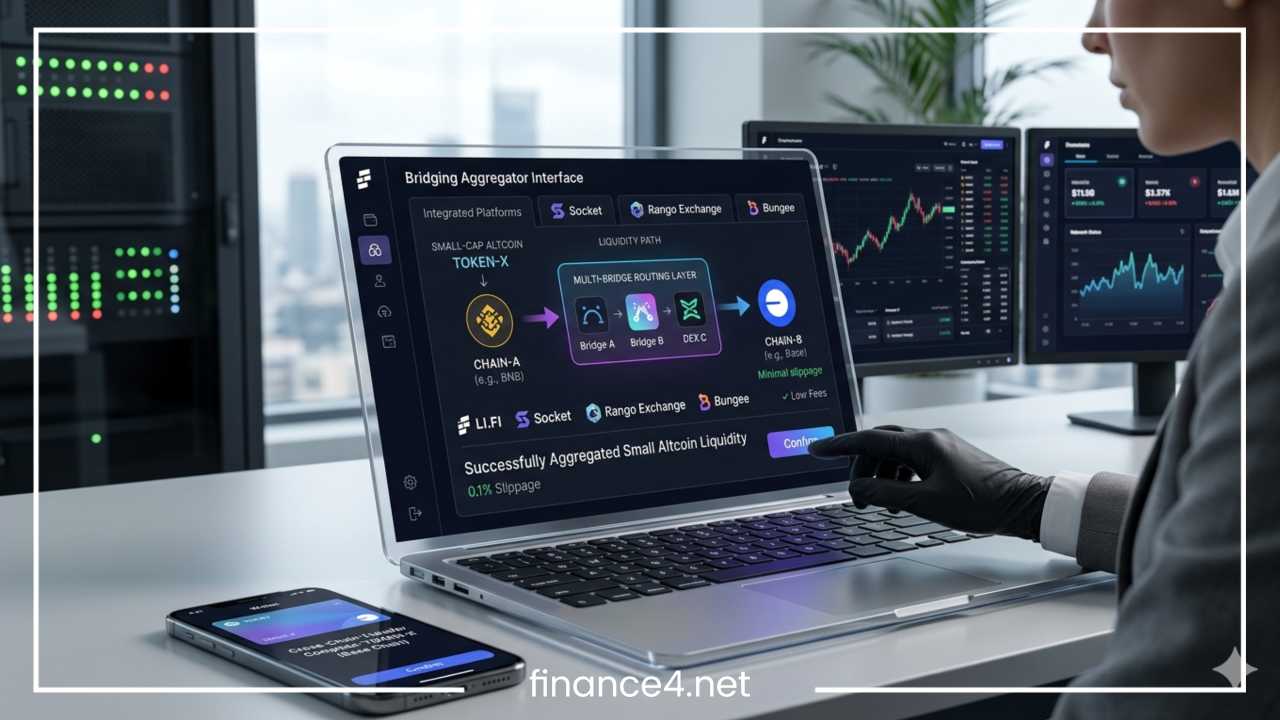
The most effective cross-chain DEXs act as aggregators. Instead of relying solely on their own internal liquidity pools, they scan multiple DEXs across various chains to find the path of least resistance and best pricing. If a user wants to trade an obscure altcoin on Avalanche for another on Polygon, the DEX might route the trade through several intermediary pools to find the necessary depth.
Cross-Chain Messaging Protocols
For a DEX to know that a user has locked funds on Chain A so it can release funds on Chain B, there must be a communication layer. Protocols provide the messaging infrastructure that allows smart contracts on different chains to “talk” to one another. This messaging is the backbone of the modern multi-chain experience, enabling the seamless transfer of state and value.
Routing Systems and Price Discovery
The routing engine is the brain of the cross-chain DEX. It calculates the total cost of a trade, which includes:
-
The Swap Fee: Paid to the liquidity providers.
-
The Bridge Fee: Paid to the protocol moving the asset.
-
Gas Fees: Paid to the miners or validators of both the source and destination chains.
Because gas prices fluctuate wildly, a sophisticated router will determine if it is cheaper to route through a stablecoin intermediary (like USDC) or a native gas token (like ETH or SOL).
Core Technologies Powering the Multi-Chain Future
Several technological frameworks allow these platforms to function across borders that were previously impassable.
Bridges and Vaults
Bridges are the most common infrastructure. They typically operate on a “lock-and-mint” or “burn-and-redeem” model. When you move an altcoin from Ethereum to Solana, the bridge locks your original token in a smart contract on Ethereum and issues a representative token on Solana. While effective, bridges have historically been a point of central failure and a frequent target for exploits.
Atomic Swaps
Atomic swaps use Hash Time-Locked Contracts (HTLCs) to ensure that a trade either happens in its entirety or not at all. It allows two parties to exchange different cryptocurrencies without needing a third party or a bridge. If one party fails to fulfill their end of the bargain within a specific timeframe, the funds are automatically returned to the original owners. While highly secure, atomic swaps can be slow and are limited by the requirement of finding a direct counterparty.
Intent-Based Routing
This is an advanced concept that is currently revolutionizing the space. Instead of the user specifying the exact technical route, they express an “intent” (e.g., “I want to give 1000 MATIC and receive at least 0.5 ETH”). Solvers or market makers then compete to fulfill this intent. The winner of the competition handles the complex bridging, gas management, and slippage calculations in the background.
Key Features of a Good Cross-Chain DEX
Not all platforms are created equal. When evaluating a cross-chain DEX for altcoin trading, several criteria determine whether a platform is a professional-grade tool or a risky experiment.
Supported Chains and Ecosystems
The primary value of a cross-chain DEX is its reach. A platform that only supports Ethereum and its Layer 2s is less useful than one that bridges the gap between EVM (Ethereum Virtual Machine) chains and non-EVM chains like Solana, Cosmos, or Bitcoin. The more “islands” a DEX can connect, the more valuable it becomes to the altcoin trader.
Liquidity Depth and Slippage
For altcoin traders, slippage is the ultimate profit killer. Slippage occurs when there isn’t enough liquidity to fulfill an order at the current market price, forcing the trade to execute at a worse price. A good DEX must have access to deep liquidity pools to ensure that large orders do not move the market price significantly. Aggregators often have an advantage here because they can tap into the collective liquidity of the entire DeFi ecosystem.
Security and Audits
Because cross-chain trading involves multiple smart contracts and bridging protocols, the surface area for attacks is much larger than in traditional trading. A reputable cross-chain DEX must have multiple third-party audits and a proven track record of handling high volume without security breaches.
Top Cross-Chain DEX Platforms for Altcoins
The following platforms represent the current leaders in the cross-chain space, each utilizing a different architectural approach to solve the problem of multi-chain liquidity.
THORChain: The Leader in Native Swaps
THORChain is perhaps the most unique protocol in this list because it does not use wrapped tokens or bridges in the traditional sense. It facilitates the swap of native assets—such as native BTC to native ETH—by utilizing a network of anonymous nodes that secure vaults on various blockchains.
-
Strengths: High security, no bridge risk, and support for native Bitcoin. It allows for “true” decentralization where no one entity controls the assets.
-
Weaknesses: It can be more expensive for small trades due to the complexity of native chain confirmations and the fees required to incentivize node operators.
-
Best Use Case: High-value trades of major assets and primary altcoins where native ownership is a priority and bridge risk must be zero.
SushiSwap (SushiXSwap): Multi-Chain Expansion
Originally a fork of Uniswap, SushiSwap has evolved into a multi-chain powerhouse. Through its “SushiXSwap” feature, it utilizes the Stargate protocol to enable cross-chain swaps across a vast array of EVM-compatible networks.
-
Strengths: Massive brand recognition, presence on over 30 chains, and a simple, familiar interface that most DeFi users already know how to navigate.
-
Weaknesses: It is primarily limited to EVM chains, meaning it cannot swap directly to non-EVM ecosystems like Solana or Bitcoin without additional third-party tools.
-
Best Use Case: General altcoin trading across Ethereum Layer 2s (Arbitrum, Polygon, Base) and sidechains.
1inch Network: The Gold Standard of Aggregation
1inch is the premier DEX aggregator. Its Pathfinder algorithm doesn’t just look at one chain; it looks at the entire multi-chain landscape to find the most efficient trade route, often splitting a single trade across multiple pools to minimize slippage.
-
Strengths: Best possible pricing for users, deep liquidity, and advanced features like limit orders and “Fusion” swaps which protect against MEV (front-running) bots.
-
Weaknesses: The interface is feature-rich, which can be overwhelming for absolute beginners who just want a simple “buy” button.
-
Best Use Case: Large-scale altcoin trading where every fraction of a percentage in price optimization matters.
Stargate Finance: The Liquidity Transport Layer
Built on the LayerZero messaging protocol, Stargate Finance is a fully composable liquidity transport protocol. It allows users to transfer native assets cross-chain while accessing the protocol’s unified liquidity pools.
-
Strengths: It offers “Instant Guaranteed Finality,” meaning a trade cannot fail once it is initiated on the source chain. It also provides deep liquidity for stablecoins and blue-chip altcoins.
-
Weaknesses: It currently supports a more curated selection of tokens compared to pure aggregators that list thousands of low-cap altcoins.
-
Best Use Case: Securely moving large amounts of capital or stablecoins between major chains with zero slippage.
PancakeSwap: From BNB Chain to Everywhere
What started as a BNB Chain exclusive has rapidly expanded. PancakeSwap now supports Ethereum, Aptos, Polygon zkEVM, and several other chains, bringing its massive user base into the cross-chain era.
-
Strengths: Very low fees, high speed, and a gamified user experience that includes lotteries and NFT integration.
-
Weaknesses: While expanding, its deepest liquidity still resides primarily on the BNB Chain.
-
Best Use Case: Small-to-medium trades for retail users who want a fast, low-cost experience.
Rango Exchange and Rubic: The All-in-One Aggregators
Rango and Rubic are often called “aggregators of aggregators.” They don’t just connect to DEXs; they connect to other aggregators, bridges, and cross-chain providers to ensure they can find a path for literally any token.
-
Strengths: Unrivaled token and chain support. They can route a swap from an obscure token on Solana to a new altcoin on Avalanche in a single transaction.
-
Weaknesses: Because they use multiple third-party protocols, the total fee can be higher, and there are more layers of smart contract risk.
-
Best Use Case: Finding and trading “moonshot” altcoins that have not yet reached major liquidity hubs.
DEX vs. Aggregators vs. Bridges: Clarifying the Confusion
The terms “DEX,” “Aggregator,” and “Bridge” are often used interchangeably in marketing, but they serve distinct roles in the DeFi stack.
The Bridge: The Logistics Provider
A bridge is purely an infrastructure layer. Its job is to move an asset from Point A to Point B. It does not facilitate a trade; it simply changes the location of the asset. Think of a bridge as the shipping company (like FedEx) of the crypto world.
The DEX: The Marketplace
A DEX is a trading venue. It relies on liquidity pools to allow users to swap Asset X for Asset Y. A “cross-chain DEX” is a DEX that has built-in bridging capabilities. Think of this as a local store that also has a shipping department.
The Aggregator: The Travel Agent
An aggregator is a search engine for liquidity. It does not own the liquidity pools; instead, it plugs into every available DEX and bridge to find the best route. Think of an aggregator like a travel booking site that finds you the cheapest flights across multiple airlines and connects you with the right transportation to the airport.
Benefits of Cross-Chain Trading for Altcoins
For the individual investor or trader, the shift toward cross-chain DEXs offers several transformative advantages that were previously only available to institutional players.
Access to Global Liquidity
In the past, an altcoin might have been “dead” on its native chain while thriving on a new Layer 2. Cross-chain DEXs allow traders to access the total global liquidity of a token, regardless of which chain that liquidity resides on. This leads to more stable markets and better price discovery.
Lower Slippage and Better Pricing
By routing through multiple chains, a DEX can often find a cheaper path for a trade than would be available on a single chain. This is especially true for altcoins that are paired with different base assets (like ETH on one chain and USDC on another). The protocol can identify where the most efficient “on-ramp” and “off-ramp” exist at any given second.
Early Access to New Tokens
The most profitable altcoin opportunities often appear on new, niche blockchains before they hit centralized exchanges. Cross-chain DEXs allow traders to jump into these ecosystems early. You no longer have to wait for a Tier-1 exchange listing to buy a promising project; you can swap for it the moment its liquidity pool is live on its native chain.
Risks and Limitations
Despite the innovation, cross-chain trading is not without significant risks. The complexity of these protocols means there are more things that can go wrong.
Bridge Vulnerabilities and Hacks
Bridges remain the “weakest link” in the DeFi chain. Since bridges often hold vast amounts of collateral in a single smart contract, they are a primary target for hackers. If a cross-chain DEX relies on a bridge that is exploited, users providing liquidity to those pools can lose their funds entirely.
Smart Contract Vulnerabilities
Every layer added to a trade—the DEX, the aggregator, the bridge, and the messaging protocol—introduces a new smart contract that could have a bug. The “cumulative risk” of a cross-chain swap is mathematically higher than that of a simple single-chain swap.
Price Fragmentation and Latency
Because blockchains operate at different speeds (e.g., Ethereum is slower than Solana), the price of an altcoin can change during the time it takes for a cross-chain message to be confirmed. This can lead to “failed” swaps or the user receiving fewer tokens than expected if the slippage tolerance is set too low.
Impermanent Loss for Liquidity Providers
Those who provide the liquidity that powers these DEXs face the risk of impermanent loss. This occurs when the price of the deposited assets changes significantly compared to when they were deposited, potentially resulting in less value than if the user had simply held the assets in their wallet.
The Future of Cross-Chain DEXs
The long-term goal of the DeFi industry is “chain abstraction.” In this future, the user experience will be simplified to the point where the underlying blockchain becomes irrelevant.
Chain Abstraction Layers
We are moving toward a model where a user doesn’t need to manually switch networks in their wallet or hold native gas tokens (like BNB or AVAX) to make a trade. The cross-chain DEX of the future will automatically handle gas payments and network routing. The user will simply hold a balance and trade for any asset they want, with the complexity hidden behind a clean interface.
Unified Liquidity Networks
New protocols are emerging that aim to create a single, unified liquidity pool that can be accessed from any chain simultaneously. This would eliminate the need for “wrapped” tokens entirely and reduce the fragmentation that currently plagues the altcoin market. This “omni-chain” liquidity will make trading as seamless as it is on a centralized exchange, but with all the security of DeFi.
Institutional DeFi Adoption
As regulatory frameworks become clearer, institutional players—such as hedge funds and asset managers—are looking at cross-chain DeFi as a way to manage large portfolios across different asset classes. This influx of professional capital will bring massive amounts of new liquidity into the space, making cross-chain DEXs more stable and efficient for everyone.
Final Thoughts
The rise of cross-chain DEXs marks a turning point for the cryptocurrency market. By breaking down the walls between isolated blockchains, these platforms are creating a truly global and permissionless financial system. For altcoin traders, the ability to move fluidly between ecosystems is no longer a luxury—it is a necessity for survival and profitability in a multi-chain world.
Whether you prioritize the native security of THORChain, the massive reach of SushiSwap, or the price optimization of 1inch, the tools available today are more powerful than ever. As the technology continues to mature and chain abstraction becomes the norm, the distinction between “chains” will fade. What will remain is a unified landscape where any asset can be traded for another, anytime and anywhere, without ever giving up control of your funds.
When choosing a platform, always prioritize security, check for recent audits, and start with smaller amounts to test the routing and fees. The multi-chain future is bright, but it requires a cautious and informed approach to navigate successfully. By leveraging the top cross-chain DEXs discussed in this guide, traders can position themselves at the forefront of the decentralized revolution, capturing opportunities across the entire breadth of the digital asset world.